Affect and Judgment

IMG_2480For anyone out there interested in issues of intentionality, rationality, and, yes, affect (remember that?), a must read is Linda Zerilli’s recent piece ‘The Turn to Affect and the Problem of Judgment’, in New Literary History (it is part of a collection of pieces on the relations between feminism and ordinary language philosophy, including other contributions by Alice Crary, Toril Moi and Sandra Laugier). Zerilli is one my very favourite thinkers, and I am looking forward to her forthcoming book A Democratic Theory of Judgment.

Zerilli’s locates the outbreak of affect theory in a longer tradition of seeking to avoid excessively intellectualist images of action, including Gilbert Ryle and a broad phenomenological tradition. The really significant contribution of her essay is, I think, to zoom-in on and clarify how the sort of critique of affect theory developed by Ruth Leys and others requires a clearer elaboration of the notion of intentionality. Her essay is also important for explicitly connecting this reconstruction of intentionality to the on-going debate sparked by the disagreement between Hubert Dreyfus and John McDowell about the interpretation of ‘nonconceptual’ and ‘conceptual’ dimensions of action. This is a much more interesting philosophical terrain upon which to engage in the issues at stake in considering questions of action, embodiment, intentionality, and rationality, compared to the rather enclosed worlds of what has become canonized as ‘Continental Philosophy’. There is an interesting subtext to that debate, which revolves around the ways in which spatial metaphors are mobilized by both sides, by Dreyfus with his talk of upper floors and lower floors, and in McDowell’s reconfiguration of ideas of inside and outside and extension and reach to reconfigure mind-body relations.

Zerilli develops a criticism of the ways in which affect theory holds fast to a strong separation of the conceptual and nonconceptual, thought and action, cognition and affect, which is most clearly evident in the recourse to layer-cake images of the priority of the latter over the former (I’ve argued here before that what is involved in the flight from the registers of subjectivity to assertions of the prepersonsal is a more or less acknowledged claim to monopolize a kind of 3rd person perspective on other people’s actions. It’s a move in which this style of theory displays it’s own defining lack of affect, one might say, that is, it’s lack of capacity to relate to a situation in a sensitive and appropriate way).

Zerilli grants that affect theory addresses important issues in both philosophy and politics, but points out that the particular framing of these issues in this field of work leaves in place some of the most significant problems of more traditional intellectualist ways of proceeding. Her own elaboration of the way in which intentionality depends upon feeling, rather than being ruined by it, is developed by reference to Cavell and Wittgenstein, along the lines of the account of reflective judgment that she has also discussed via Arendt before.

Anyway, I’m not really doing Zerilli’s essay justice, it’s a very rich discussion that deserves reading and re-reading.


Changing imperatives of urban thought in South Africa

IMG_3313I have been meaning to congratulate Sophie Oldfield, of Geography at the University of Cape Town and the African Centre for Cities, who has been awarded British Academy Newton Advanced Fellowship. The fellowship involves a collaboration between UK and non-UK universities, in this case between Sophie at UCT and me at Exeter. The project, South African Urban Imperatives Past, Present and Future: Theory Building with Knowledge Beyond the University, has various strands, with an over-arching focus on  exploring the changing notions of commitment and engagement in urban scholarship in South African over the last 40 years or so. It’s very much a development of Sophie’s challenging research work on the difficult politics of engagement between academy and activism. I’m really looking forward to working together with Sophie on the various aspects of this project over the next couple of years.

Here is the abstract for the overall project:

“The Fellowship starts from the premise that urban scholarship has been central to defining the strategic possibilities of political change and socio-economic development in South Africa for 40 years, either side of the transition from apartheid to democracy. The Fellowship focuses on the distinctive imperatives of engagement that shape South African urban scholarship. These include practices of activism, consultancy, forms of co-production, and more conventional forms of academic expertise and critique. The Fellowship will focus on the reorientation of urban social science in post-apartheid South Africa, in light of changing societal imperatives of development, reconciliation, and transformation. In so doing, it will draw into view the ways in which academic knowledge articulates diverse forms of non-academic knowledge that express diverse interests and needs.”

Marketing practices and public action

segmentNick Mahony and I have a new paper published in Policy and Politics, on their ‘fast track’ page, entitled Marketing practices and the reconfiguration of public action. The paper draws on a project for the NCCPE and ESRC that Nick and I worked on a while back when were both at the OU, on the use of segmentation methods in the public sector, charities, and campaign sectors. This paper seeks to open up some interpretative space for exploring what is going on when marketing practices get used in non-commercial sectors, without presuming in advance that what is going on is something to be called ‘neoliberalism’. It is a light-touch elaboration of some ideas about problematization developed in different ways in my piece on that topic at nonsite.org as well as a forthcoming Article Forum on ‘security’ in Dialogues in Human Geography.

Here is the abstract of the Policy and Politics piece:

“Market segmentation methodologies are increasingly used in public policy, arts and culture management and third sector campaigning. Rather than presume that this is an index of creeping neoliberalisation, we track the shared and contested understandings of the public benefits of using segmentation methods. Segmentation methods are used to generate stable images of individual and group attitudes and motivations, and these images are used to inform strategies that seek to either change these dispositions or to mobilise them in new directions. Different segments of the population are identified as bearing particular responsibilities for public action on different issues.”

Foucault and Problematization: new paper in nonsite.org

UntitledShameless self-promotion time again: I have a paper out in the latest issue of the online humanities journal, nonsite.org. The issue as a whole is on the theme of Situation. My paper is entitled On Problematization: Elaborations on a theme in “late Foucault”. It’s an experiment in seeing how much mileage along the path of developing useable social science concepts you can get out of a few passing remarks from a master-thinker . Here is the abstract:

“The notion of problematization has recently been identified as a key to interpreting the arc of Michel Foucault’s work. In the social sciences as well as in the humanities, problematization is often invoked to support a method of critical debunking. I argue that a more nuanced reading of elaborations of this notion by Foucault and others points to an alternative interpretation. This alternative turns on appreciating that problematizations are best thought of as creative responses to uncertain situations, an idea presented by Foucault in an account of the plural rationalities of ethical action. It is argued that to fully realize the potential of the idea of problematization, some of the founding assumptions and manoeuvres of critical social analysis need to be interrupted. The notion lends itself to an understanding of the inherent problematicity of all action, and therefore to a more modest understanding of the tasks of social inquiry.”

Urban Refugees: New book in Routledge Research in Place, Space and Politics Series

urI’m delighted that the first book in the Routledge Research in Place, Space and Politics Series has just been published – Urban Refugees: Challenges in Protection, Services and Policy, edited by Koichi Koizumi and Gerhard Hoffstaedter. Congratulations to the editors and all the contributors.

As Series Editor, I’ll also take this opportunity to remind anyone out there with a book idea, a half-finished book manuscript, or an edited collection in mind, to consider the series as a possible outlet – further details here. Do let me know if you have any questions about the series. Forthcoming titles in the Series include books that address a range of issues including ‘the commons’, migration and radical autonomy, and popular geopolitics; and beyond that, books addressing the politics of theatre, psychological governance, political street art, and the politics of architecture.

Space, Politics and Aesthetics: New book by Mustafa Dikeç

9780748685974I took part in a ‘conversation’ on the theme of Spaces of Democracy yesterday at UCL, organised by Liza Griffin and others, one of a series of events co-organised by the Bartlett School and the OU’s OpenSpace research centre. The other participants were Erik Swyngedouw and Mustafa Dikeç. I gave a potted version of the argument of the book I’m meant to be writing, in response to the question ‘Does democracy need the city?‘.

Mustafa has a new book hot off the presses, Space, Politics and Aesthetics, about thinking spatially about politics alongside Arendt, Nancy, and Ranciere. There is already one review available here.

(How) Should we Read Heidegger?

Scan 130690059-3Just noticed this in Geografica Helvetica (via a tweet from Juliet Fall about this journal being open access now) – a ‘debate’ emerging, perhaps, about the implications for geographical thought of the latest revelations in Heidegger’s ‘black notebooks‘, published last year (not very flattering revelations, which is of course saying something). Benedikt Korf raises the question of whether there isn’t something irredeemably tainted, poisonous, about Heidegger’s thought. Ulf Strohmayer takes up the challenge thus laid down, arguing that the best way to respond is to delve even deeper into Heidegger’s thought – a not uncommon response to the sorts of questions Benedikt raises. Somewhere between the two pieces, the question of the degree to which the fascination with/of Heidegger depends upon all the biographical stuff (Nazi, adulterer, prude, anti-semite, etc) is passed over.

Of course, it might always be possible to go along in geography without worrying about Heidegger’s thought at all, one way or the other.

Urban thought and its problems

IMG_3222Here is the full version of a paper presented last week at the Annual Meeting of the Association of American Geographers, in Chicago, entitled ‘Problematizations: situating contemporary urban thought‘. It’s the first effort to say out loud something about different strands of work I have been doing as part of my Leverhulme-funded project on ‘the urbanization of responsibility‘. It’s very much a work in progress.

Geography and the Priority of Injustice

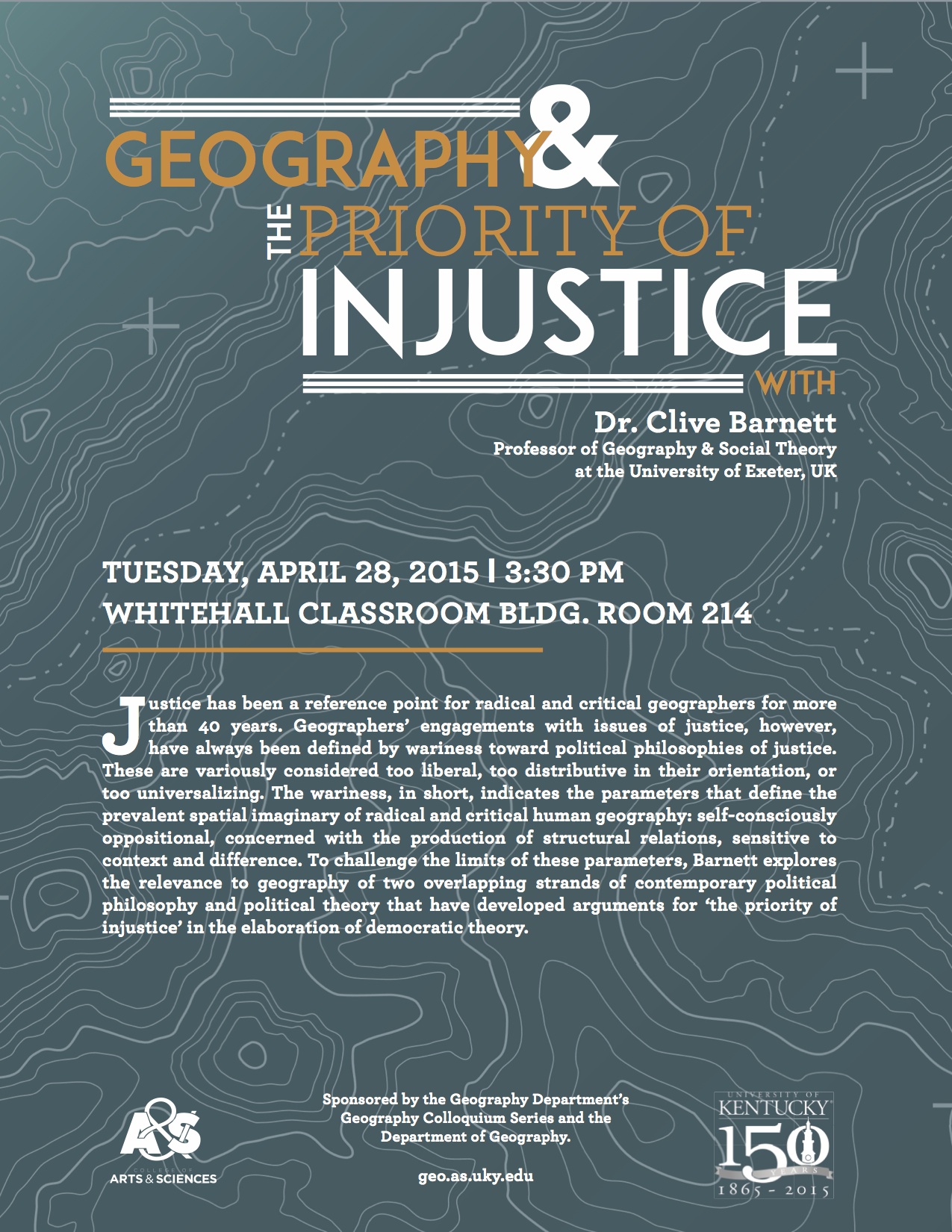
Geo & Injustice_REVNext week I’m attending the Annual Meeting of the Association of American Geographers, in Chicago – organising a couple of sessions on Cases, Spaces and Situations, as well as giving a paper on problematization and urban theory. I’m then going on to visit the Geography Department at the University of Kentucky, in Lexington. I’m giving a talk there on the theme of ‘the priority of injustice‘, and the relevance of recent work on this theme to how the central normative concept of radical and critical human geography is approached. This is the first time I will have talked to the central argument of my book, still in progress, and tentatively entitled Democracy and the Geographies of Justice. I’m looking forward to the challenge of having to say out loud and in public what it’s meant to be about.

What are the humanities good for?

SMAGThere is, apparently, a ‘war against the humanities‘ going on in British higher education, according to a piece in The Observer this weekend. The piece cites as its primary evidence for this ‘war’ the perspectives of scholars from the humanities, of course, lamenting the effects of changes to funding regimes but also the culture of management in British Universities on the proper pursuit of scholarship.

I always worry when ‘the humanities’ is used as a catch-all to encompass the social sciences as well as more ‘arts’-type fields. It is true, of course, that both arts and social sciences disciplines have suffered from the same funding changes since 2010, but I’m not quite sure that the standard ‘whither the humanities?’ style of criticism of higher education policy over this period necessarily sheds much light on what is really going on, or on how best to evaluate it. The piece in The Observer shares various features of a broader genre of criticism of higher education transformation in the name of ‘the humanities’:

First, as already noted, it conflates a range of different disciplines, but presents next to no insight from anyone who looks or sounds like a social scientist. No doubt we could argue about whether the social sciences counts as ‘humanities’ or not, but in this sort of piece, it turns out that ‘the humanities’ really means literary and arts-based fields and forms of analysis. Therein lay the values most under threat from funding changes and top-down management styles and impact agendas. Amongst other things, one effect of this elision of social science is a tendency to present ‘the sciences’ as the more or less unwitting bad guys in the story. Two cultures, all over again, one of which is always a bit too uncultured.

Second, the lament about the squeezing of ‘humanities’ is often enough made in the name of the values of criticism and critique, but I do wonder whether we should really look for our models of these practices from ‘the humanities’ anymore? To be fair, there is a ‘social science’ version of the same lament. John Holmwood, for example, has written in much the same vein recently about the apparent marginalisation of the critical voice of social sciences in British public debate. Holmwood worries that social science is being shaped too pragmatically, in such a way as to displace attention to social structures. I dare say that an appeal to the value of social science as lying in access to knowledge of structures and possibilities of change bears some structural similarity to the form of discerning insight that ‘the humanities’ are meant to have. In both cases, ‘critique’ is the magical practice that is best able to articulate with public worlds by maintaining a certain sort of distance from them.

The genre is remarkably resilient, it seems, even resurgent. Unhappily, it turns on quite conventional oppositions between (bad) instrumental knowledge and (good) critical knowledge. Somewhere in between, the scope for thinking about different versions of instrumentality gets lost, and the critical voice gets snared in its own contradictions, being forced to disavow various public entanglements (the impact agenda, most obviously, or treating students as adults, rather more implicitly), in the name of a weakly expressed ideal of the worldly force of ‘really useless knowledge’.

There is much to lament about the state of British higher education. And there is, of course, a ‘campaign for social science‘, which has recently managed to produce a deeply embarrassing representation of the value of social science that might well confirm all one’s suspicions about the selling-out of social scientists to ‘neoliberal agendas’ (we are in ‘the business of people‘, apparently). Social science is, of course, a divided field, as Holmwood implies. So too, one might suspect, are ‘the humanities’. The resilience of the ‘two cultures’ genre has been evident since 2010, at least, when arguments in the defence of the ‘public university’ took off in response to Coalition policy changes. It was evident, for example, in the controversy around the AHRC’s alignment with ‘the big society’ agenda (remember that?). That episode illustrated the division within the humanities I just mentioned, rather than an impure imposition of pernicious instrumentalism from the outside. It turns out, of course, that the humanities are really good at being instrumentally useful, at knowing how to ‘sell-out’; not least, humanities fields have been at the forefront of legitimizing the impact agenda both in principle and in practice (as evidenced by evaluations of impact submissions and indicators in the 2014 REF exercise).

The ‘two cultures’ genre is always a trap, not least in the current conjuncture when the defence of ‘the value of the humanities’ is made alongside sweeping references to neoliberalization of higher education. Like it or not, the restructuring of higher education in Britain, and elsewhere, is explicitly made in the name of public values like accountability and social mobility; as a result, the defence of ‘the humanities’ always already suffers from a populist deficit when articulated from within the confines of the two cultures genre, however refined that has become in the hands of Stefan Collini or Martha Nussbaum. ‘Neoliberalism’ is, of course, a social science concept, but not a very good one, especially in this context, because in its most sophisticated varieties, it doesn’t allow you to recognise that contemporary political-economic processes involve the reconfiguration of the means and ends of public life, rather than just a straightforward diminution of public life (here represented by ‘the humanities’) in the face of privatisation, individualism, and competition.

Herein lies the real problem with the elision of social science into a precious view of ‘the humanities’ as the repository of irreducibly qualitative values: the defence of the humanities is generally made via a simplistic conceptual vocabulary of ‘the market’, ‘the state’, ‘bureaucracy’, and other hoary old figures of the forces of philistinism. There is a critique, certainly, to be made of trends in higher education in the UK, but it probably requires better social science, better social theory, than the prevalent defence of ‘the humanities’ seems able or willing to muster. It would require, amongst other things, giving up on the idea that critique is a special preserve of ‘the humanities’, or indeed that it requires discerning access to structural analysis.