
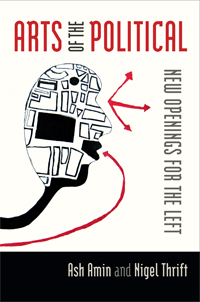
 My review of Ash Amin and Nigel Thrift’s Arts of the Political: New Openings for the Left has just been published on Antipode’s online Book Review page. There is also a (shorter) review of the same book by Fred Inglis in the Times Higher. And the Mobilizing Ideas blog had a post about it a while ago too, in case you missed it (and are interested in these things).
Tag Archives: Geography
Critical spatial theory: my thoughts
 I was conferencing last week, at the annual meeting of the Association of American Geographers in LA. I was involved in two sessions, the first a panel discussion, organised by Scott Rodgers and Rosie Cox, on the uses of social media by academics, including reflections on how blogging, tweeting, and Facebooking can be used to carve out some new spaces of communication with academic and non-academic audiences. The second was on the theme of ‘defining the contours of a new 21st century critical urban theory’, a series of paper sessions organised by Chris Baker and Justin Beaumont. I presented a paper to the title of Where is the action? in which I tried to articulate some of the problems, as I see them, with prevalent approaches to critical urban theory, and critical spatial theory more broadly, and to say too something about some alternatives ways of proceeding. My paper was an attempt to articulate the whole arc of an argument that links, in my head at least, a series of pieces on urban theory, democracy, on ‘ethics’, on ‘class’, and other themes which I have written over the last two or three years (and have therefore already trailed on this blog), as well as some thinking done while developing an online Masters CPD course on critical spatial theory. So, the paper is rather allusive, shall we say.
Anyway, in the spirit of the first of these sessions, I thought I may as well post up the paper I presented in the second session – it will also be linked on the Things to Read page. This is the written paper which I spoke to at the conference – it has no references, although I imagine it as full of invisible hypertext links to other things I have written and to lots of things other people have written. I guess I’m thinking that since I said this all out loud at the conference, there is no good reason not to share these thoughts with the anonymous audience that may or may not be out there reading this blog – and to share it in much the same spirit as one does a ‘live’ conference performance, as a work in progress, awaiting further elaboration, and open to comments and questions….
We’re Number One?
 Simon Batterbury has added a comment on the short post about the ESRC’s International Benchmarking Review of Human Geography, which found that human geography in the UK ‘ranks first in the world’. I don’t get a lot of comments on this blog (I can’t imagine why, I find myself to be a very engaging blogger), so this is an opportunity that does not come along too often to keep a conversation going. Or to just have the final word, depending on how things develop. Here are some thoughts of mine on Simon’s thoughts – I have no specific desire to defend the claim of the Review, but it is interesting to think about how one might proceed to think ‘critically’, as they say, about this sort of exercise:
– The first thing to say is that this isn’t actually UK geography’s own judgement of itself – it was the judgment of an international panel of scholars (some of whom seem to have quite well developed skills in analysing colonial remainders in contemporary life), undertaken at the behest of the ESRC.
– Simon repeats the canard about British geography being all a bit too theoretical. That’s right, British geography departments are chock full of people writing complex exegeses of Marx and Spinoza. I suspect that if you looked closely, you’d find that even the most obvious targets of this sort of complaint turn out to be rather more practically oriented than is acknowledged (by adherents as well as doubters): take non-representational theory and/or affect theory, for example, the most self-consciously ‘theoretical’ field which almost everybody (including me) loves to get wound up by, but which seems to be able to inform plenty of interesting research on ‘applied’ topics such as health and well-being, educational attainment, or the design of built environments; even when it isn’t being all ‘relevant’ like that, this is a field that shares a broader disciplinary hang-up on methodology – if you want to know how to do something empirical with affect theory, then you read geographers writing about this range of work, not sociologists or literary theorists.
– Simon’s suggestion that the ‘public sociology’ agenda needs to be extended to geography seems to get things the wrong way around – it is difficult to imagine another discipline that is not more invested in various fields of application than geography, including, as I have just suggested all that woolly ‘cultural geography’. Debates about public sociology seem to be a case of that particular discipline trying to catch up with other disciplines that have, as it were, always already sold-out.
– I’m not entirely sure that environmental studies, development studies, political ecology, or planning are ‘fringe’ fields in human geography, in the UK or anywhere else – they seem to make up a large chunk of what has been taught and researched in any department I have ever been in as a student or lecturer.
– I’m not sure why one would think of a department like Reading (where I worked in the 1990s) or the LSE as being anomalies for being a bit ‘applied’ – again, this is a fairly standard feature of geography departments all over the UK.
– My last thought goes back to the precise ‘authorship’, shall we say, of this particular report – it’s one of a set of reviews of social science disciplines undertaken by the ESRC, the primary public funder of social science in the UK. These reviews need to be read, one might have thought, as strategic initiatives – they tend to identify weak areas in each discipline, marked for further support or enhanced training (not enough macroeconomics in economics, hilariously!); not enough quant in sociology, that sort of thing. They are moments in ongoing games over the disbursement of public monies, in which the institutional interests at stake are not exhausted by Universities or academic disciplines. They also tend to emphasise various strengths, and they are ‘co-productions’, between the ESRC and other research councils with disciplinary bodies, like the BSA or RGS – pumping-up strong areas is a way of making moves in competitive games for further government funding, amongst other things. Such evaluations also, no doubt, enable defenders of often fragile departments to make stronger cases for further support and investment in their programmes in their own institutions – that might well be where the real significance of ‘Human Geography is Number 1’ lies, whether or not that was intended. I suppose my point is just that ‘critical’ analysis of these sorts of exercises might well benefit from a bit more social science imagination, recognising how organised fields of institutional practice tend to work.
– No other discipline subjected to one of these reviews has been found to be ‘No.1’ in the way human geography was. One can imagine how that might invite a view that this judgement is a kind of back-handed compliment that implicates a whole international field. On the other hand, it is interesting to pause and consider how valuable it might be that human geography isn’t self-evidently dominated by the scholarly infrastructures of the USA – not least, because it might tell us something about the peculiar strengths of human geography in North America and elsewhere too.
– There is of course a well-established tradition of ex-patriot British geographers now located in the US bemoaning how British geography is not all it should or could be (I’m not counting Simon here, since I think one is allowed to rant in blog posts, and he’s not in the US I don’t think). I have in mind pieces more or less regularly published in proper grown-up academic journals. It is impossible to imagine a similar discourse emanating, say, from American sociology or American political science. There are complex reasons for this, no doubt, including biographical trajectories, but also to do with just how mainstream ‘critical’ approaches are to international human geography agendas. Or, to put it another way, UK human geography’s elevated international status is not straightforwardly a function of the qualities of UK human geography on its own, and I mean that in the best possible way.
Geography matters!
At Social Science Bites, Doreen Massey explains why.
Geographies of radical democracy
 For anyone interested in this sort of thing, I have a new paper, co-written with Gary Bridge, just published on-line in the Annals of the Association of American Geographers, which addresses how best to theorise about the relationship between democracy and geography. It develops the idea of agonistic pragmatism, and the notion of transactional space, and explores how the idea of ‘all affected interests’ may, or may not, provide the grounds for rethinking this relationship. It’s an attempt to expand a little the range of reference points, in geography and related fields, for discussions of ‘radical democracy’. You can access a pre-publication draft of the paper here, and the abstract is below:
“There is significant interest in democracy in contemporary human geography. Theoretically, this interest has been most strongly influenced by poststructuralist theories of radical democracy and associated ontologies of relational spatiality. These emphasize a priori understandings of the spaces of democratic politics, ones that focus on marginal spaces and the destabilization of established patterns. This article develops an alternative account of the spaces of democratic politics that seeks to move beyond the stylized contrast of poststructuralist agonism and liberal consensualism. This alternative draws into focus the spatial dimensions of philosophical pragmatism and the relevance of this tradition for thinking about the geographies of democracy. In particular, the geographical relevance of pragmatism lies in the distinctive inflection of the all-affected principle and of the rationalities of problem solving. Drawing on John Dewey’s work, a conceptualization of transactional space is developed to reconfigure understandings of the agonistics of participation as well as the experimental institutionalization of democratic will. The difference that a pragmatist approach makes to understandings of the geographies of democracy is explored in relation to transnational and urban politics.”
New Book: ATLAS: Geography, Architecture and Change in an Interdependent World
 A new book, an edited collected, has just been published by Black Dog Publishing – ATLAS: Geography, Architecture and Change in an Interdependent World. It’s edited by Renata Tyszczuk at Sheffield and three of my OU colleagues, Melissa Butcher, Nigel Clark and Joe Smith. This is part of a long-standing and on-going set of collaborations between OU Geography, Architecture at Sheffield, and the New Economics Foundation, as well as others. There is an associated web-site which archives further materials from these projects, and there is a launch event in London on March 13th, New Maps for an Island Planet.
The book is, apart from anything else, very lovely to look at (I have the least visually imaginative essay, all text, no pictures). Here’s the blurb:
Atlas: Geography, Architecture and Change in an Interdependent World helps readers find their way through the practical and ethical challenges presented by globalisation and global environmental change. Atlas: Geography, Architecture and Change in an Interdependent World combines recent thinking on human geography and architecture on global environmental change issues, setting out to develop a reinterpretation of cartography and a reframing of sustainability. The aim is to find a “re-drawing of the earth” and the “making of new maps”. With a focus on the growth and remaking of cities it offers an innovative mix of essays and shorter texts, original artworks and distinctive re-mappings. The Atlas arises out of a unique collaboration between scholars and practitioners from architecture and human geography.
Geography Matters!
 A shout-out for Geography Matters, the Facebook page looked after by my colleague Melissa Butcher, designed as “a site for promoting geography research and teaching”, not only, it should be said, the research and teaching of geography at the OU. It’s more like a ‘hub’ for things of interest, geography-wise. The place to go if you’re looking for geography-friends.
Amongst other things, you will find a link there to the website of another of my colleagues, Joe Smith, introducing 10 short films on climate change.
Ray Pahl
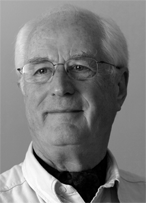 I haven’t seen a full obituary for Ray Pahl yet, who died earlier this month. Pahl had an interesting status in geography, I think – as the one who got away, but then who lots of people ended up following. He wrote the ‘sociological models’ essay in Chorley and Haggett’s classic Models in Geography, the source text for geography’s ‘quantitative revolution’ in the 1960s, and moved from geography as an undergraduate to sociology – pioneering qualitative methods in the social sciences. It took a while for geographers to catch up.
Once upon a time, for a few months, I tried to do PhD research modelled on the sort of detailed qualitative work on family dynamics that he and his wife Jan Pahl both excelled in – but I simply didn’t have the social skills to pull this off. I took refuge in ‘theory’, and the ‘archive’.
Pahl wrote a lenghty review of Mike Savage’s recent account of post-war sociology/social science in The Sociological Review, published earlier this year, in which he partly situates himself in relation to the growth of social science in the UK as theorised by Savage.
 Pop Theory