Local Politics VIII: School Daze

There has been plenty of news coverage recently about the progress of education reform in England, partly coinciding with teachers’ unions conferences threatening action in response to various policies introduced by Tory education secretary, Michael Gove. Not least, of course, the move to systematically transform the structure of public schooling via the Academies Act of 2010, through which schools have been bribed and/or bullied into converting to Academy status. The not-so-stealthy stealthy transformation of the governance of schooling is based on sheer theoretical and ideological prejudice, and is busily realising one of the longest standing aims of right-wing politics in UK, which is the removal of schooling from Local Authority jurisdiction.  

One aspect of the reporting of this process has been the repeated line about how Gove’s project has not attracted the same sort of attention, or opposition, as changes to the NHS. There might be many reasons for this, but one aspect of it might be to do with the ways in which different public services, through the very ‘materiality’ of the services involved, constitute the subjects of public services in very different ways – a theme of the work of my OU colleagues John Clarke and Janet Newman, for example. I wonder if school education, as a public service, doesn’t constitute it’s publics in very different ways from health services?

One of the lesser reported features of the Academy-led transformation of schools is the conversion of primary schools – only 5% of primaries currently have or are seeking Academy status, but that is likely to increase. The school our eldest child goes to, since last Autumn, is one of these Academy primaries. In Swindon, as elsewhere, you apply for a place in local authority schools about 9 months before your child is due to start. So we applied back in January 2011, for a place one of three local authority run primary schools. The closest one, the preferred one, is about 500 yards outside the back gate, is a resolutely middle-class school in a middle-class area, not great Ofsted report last time round. In between applying and being informed of the successful outcome, sometime this time last year, around Easter, the school actually decided, however these things work, to apply for Academy status, in tandem with (and thereby bolstering) the Academy application of the secondary school which is in the next road over from ours, the one-time Grammar school for Swindon. We only found this out sometime in the summer, when we began to attend the induction meetings for parents of new starters. I remember being told in a conversation with one of the Governors that this application did, indeed, amount to accepting a bribe, since the offer on the table at that point from the Government was that schools which applied would get lots more money, which would not be on offer if they delayed. As of 1st August, the school has been an Academy. It’s not clear, yet, what difference this makes – it hasn’t changed its admissions policies, for example, the most obvious change that the Academy policy now allows. But it’s early days.  

So, we find ourselves enrolled into a new form of public schooling, without being consulted, right in the middle of being involved in the process of, nominally at least, exercising a bit of school ‘choice’.

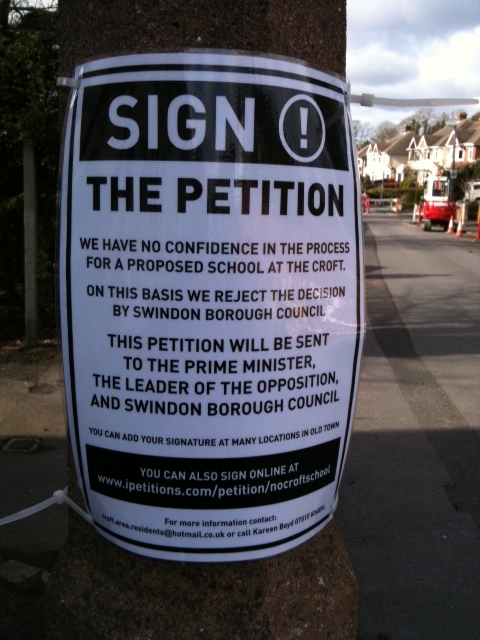
Meanwhile… the decision by the local council, Tory-led, to build another primary Academy not so far from where we live in the Old Town part of Swindon (the ‘old town’ bit refers to what Swindon was before the railway arrived, down the hill, in what became ‘new town), has become the focus of very intense local opposition.

The opposition to this decision has been led by residents of the immediate area around the site of the new school – located next to a local authority sports centre, opposite our local SureStart centre, on local council land. The campaign against the school focussed on issues of procedure around planning decisions, and took a while to catch the attention of local news or politicians. But it has now become a staple item in the Adver, and the local Labour party also caught on too. Despite letters and petitions opposing the new school, it received the go ahead before Xmas, and work has started on the site.

As a news story, however, the new school continues to generate news – it’s due to open in September 2012, so is likely to remain a news item until then, at least. On March 24th, the only news item in the Adver of any significance which was not related to Swindon Town’s day-out at Wembley the next day (oops…) was about the continuing opposition to the new school by local residents. One of the leading figures in the campaign is now challenging the leader of the Tory council in the upcoming elections.

The thing is… the central issue in the debate about the school, beyond the procedural issues involved in the decision, have revolved around the concerns of residents that the new school will create traffic gridlock and reduce green space. This is, then, a very local campaign, focussed on the concerns of people living in the immediate vicinity of the new school. These are not to be dismissed lightly – what has kept the campaign has going, and made it more than a merely local story, is the fact that it is another example of a pattern of cavalier decisions by the Tory council that appear to circumvent democratic norms, such as they are at local government level. But the fact that the new school is an Academy school, and as such is part of the wider Gove-revolution, this has not been much commented upon. This isn’t the issue, in this case of local politics.

The company setting up the new school, which also runs other schools in town already, is also the same company that runs the private nursery which we send our other child to – very good, very nice people (when we only had the one child, pre-school, she went to the Council-run nursery down the hill, also very good, very nice). Our decisions about school and nursery ‘choice’ have been based primarily, I think, on issues of convenience, constrained of course by a fairly limited set of options to actually choose from – nothing unusual there (although, surprise surprise, higher income level groups benefit more from proximity effects in school choice than others).  It turns out, of course, that the sorts of information that parents are meant to use to inform their choices on such matters might well be close to ‘meaningless‘ – according to academic research at least.  

The point of all this is to try to clarify something about how the constituencies of a public service like schooling are constituted. Our relationship to this issue is inevitably partial, mediated by our children; a while back, I knew very little about these things. The relationship of those opposed to the school is somewhat different, although it might overlap in some cases, but is primarily shaped by a very local ‘community of affected interest’, as they say. In neither case are the long-term, structural changes involved in transforming the governance and funding of primary schools, much less secondary schools, with all the attendant issues about inequality and social mobility, a felt concern of those people most immediately affected by these decisions to build new schools, or to convert the status of existing ones. Those changes are, literally, rather abstract, not only for those parents swept along by them like us, but also it seems for those involved in the real politics around school building in this area. In certain respects, education seems to me to constitute its public subjects very differently than do those public services associated with health care, for example – at once more partial, more selective, more inflexible, and more choosy than the subjects of health care, perhaps?
Space and Politics podcasts: Doreen Massey on Soundings

Via the Geography Matters facebook page, here is the link to the first of a series of discussions with Doreen Massey, one of a series of podcasts produced and hosted by the OpenSpace Research Centre at the OU.

Agency and experience: nonsite.org Issue 5

The new issue of nonsite.org contains essays by Ruth Leys, Michael Fried and Robert Pippin, amongst other things, and focusses on “the relation between our agency–our actions, or emotions, our character–and our experience–of the world, of ourselves, of each other.” It also ‘reprints’ Todd Cronan’s review of affect theory.

Where can I find real democracy?

Simon Critchley has a short piece in The Guardian today, on the lessons and future of the Occupy movement and the Arab Spring. It argues that these events show us that ‘true politics’ involves two things – ‘a demand that flows from the perception of injustice’; and ‘a location where that demand is articulated’. There is, he concludes, therefore ‘no poitics without location’.

I’m interested in this sort of argument, and its appeal to these contemporary events, because they resonate with some of my own intellectual predispositions, yet I find something troubling about them (I’ve been trying to express some of the worries while e-chatting recently with Mark Purcell at Paths to the Possible about some of these things). I like the idea that politics, of the sort we like at least, democratic-y politics of a more or less radical sort, arises from a ‘felt sense of injustice’ as Honneth puts it somewhere, and have been trying to write about this idea and how it might be used to think about the relationships between democracy, place and space. So I keep writing papers which have titles like ‘locating democracy’, but the point of them is that actually (democractic) politics doesn’t have a location at all, it’s dispersed across different spaces; it might not even have a proper relation to any specific spatial figure of whatever sort.

Critchley’s piece is just one example of a range of academic commentaries which tend to repeat fairly uncritically the self-representation of activists about the political forms of Occupy, Indignados, and other movements – that these really are the emobodiment of a genuine re-birth of direct, consensual democracy stripped of the parasitical intrusions of representative politics. That’s what ‘real democracy’ turns out to mean.

I think it should be possible to affirm one’s solidarity with these movements without necessarily reiterating these claims without question. It should be possible to analyse the rhetoric and practice of anti-representation in these movements – ‘no parties, no banners’ – as a phenomenon worthy of investigation, not just present such claims as a matter of fact. Jodi Dean and Jason Jones have a really interesting piece on the question of how to think representation in relation to OWS, and it’s one of the few things of it’s sort that I can think of (it’s part of a special edition on the topic of ‘in defence of representation’). I’ve just started reading Pierre Rosanvallon’s Democratic Legitimacy, and it seems to me, for example, that these movements might fit quite well into his genealogy of the emergence of new modes of democratic legtimacy based on values of proximity and presence – my point being that what is required is an analytic imagination that can recognise the emergence of new forms without simply reproducing simplistic dualisms between direct and representative democracy which, while politically effective perhaps, don’t have much interpretative purchase if you think about it for a moment.

Back to Critchley; his piece starts out with a standard narrative device, we’ve all done it: power, as the ability to get things done, has become spatially divorced from politics, the means of getting things done (a globalization cliché he draws from Bauman). Well, maybe, maybe not, but even if this were the case, it would seem to require some thought about how poloitics can be re-spatialised to match the scaling up of power – an argument made by various traditions of thought, including plenty of geographers, and a staple of David Held-style cosmopolitanism. This is easier said than done in theory and practice no doubt, and the diagnosis might just be flawed anyway. But what I’m not sure about is whether Critchley’s conclusion from his starting point follows at all – that the divorce means we need to think about ‘true politics’ in terms of the figure of location. Something seems to get to go astray in the reasoning that starts by saying that power and politics have become too distant from one another and end up by saying that the most effective response is to take a stand in one place (after all, the most interesting aspect of these movements might well be not their ‘occupation’ strategies per se, but the movement of the strategies – that’s why they are called movements).

The attachment to location seems to have something to do with Critchley’s chosen view of contemporary protest movements as embodying values of directness, horizontality, assembly – it’s just one example I think of more general intellectual ‘moment’ in which the idea of true politics and real democracy has become associated with an image of the spaces of politics and democracy as real, physical places of co-presence and gathering together.

If one goes back to Critchley’s point about demands and injustice, then the figure of location seems, again, not to be quite adequate. If demands need to be articulated, then I’m not sure they need a location at all – a specific point, a localisation in space and time. They are, after all, articulated – a demand has a spatiality that is open to connection, combination, joining up. Not one of punctual presence or location. The space of demands generated by injustice is strung out, not gathered together.

Which doesn’t mean that ‘real spaces’ aren’t important. I just think it might be better to think of these spaces of demonstration as enacting a demonstrative force that is better thought of in terms, say, of the idea of spaces of address developed by Kurt Ivesen‘s work on public space. Or of locations as starting places, temporary stopping points. Which might well be move akin to the political geography of ‘occupying’. Even then, though, there might be pause for thought – Crtitchley ends with a call to move on and apply the force of this ‘true politics’ to the London Olympics, a recommendation which might well suggest a form of politics reduced to the purely tactical, tracking the eventalization of the world wrought by spectacular capital with events of its own. So much for getting things done.

And one final thought – Critchley is one of my favourite thinkers, his book on ethics and deconstruction was a fundamental influence on my thinking as a graduate student. It’s one place, though not the first (that was an essay by Nancy Fraser) where I remember learning about the importance of Claude Lefort to a whole strand of French thought that at that time was still being rudely called postmodern. I just wonder, remembering those things I learnt from reading Critchley back then, whether an analysis of true politics and real democracy that rests on the idea that power and politics have become divorced hasn’t lapsed into a certain sort of romantic amnesia about which it should really know better. Conceptually, normatively, the idea that power and politics should be married together, as it were, might be only rather ambivalently ‘democratic’, at best. Which isn’t to say that they should be separated, it’s just that what matters is the quality of the relationship. And conceptualising that relationship, its optimum shape, needs better analysis than can be provided by claims about the importance of location or the form of ‘true politics’.

The ends of aesthetics

In a spirit of anti-Franzen, here are a couple of things I learned about from Facebook and Twitter this weekend, while attending swimming lessons (not my own). Picked up from Paul Harrison on Facebook, a link to a new online journal Singularum, focussing on the relationship between aesthetics and pedagogy (teaching as a theatre of cruelty, perhaps?). 

And from Twitter, here is a podcast with Spivak talking about a new book/collection, An Aesthetic Education in the Era of Globalization – worrying about whether the tools of an aesthetic education (i.e. literary reading) are still useful in relation to challenges of speed, distance, digitalization, and other ‘globalizing’ things.

Never having had a proper aesthetic education, nor having ever really aspired to be a medium for one, as I grow old I find it increasingly peculiar just how much Theory is still attached to faintly reactionary models of what the task of education should be.

Locating transnational advocacy networks: new paper on HIV and AIDS governance

I have a new paper published, online at least, which is always nice –Locating the global governance of HIV and AIDS: exploring the geographies of transnational advocacy networks. It’s in Health and Place, as part of a forthcoming set of papers on global-local relationships in responses to HIV and AIDS. The paper is co-authored with Colin Marx and Abbey Halcli, and is the result of a long process of research (a bit of qualitative, and some numbers), grant writing (shortlisted once, unfunded alpha second-time round), paper drafting, chatting, re-writing, and so on. So, as well as being fun and challenging to work with Abbey and Colin, it also feels like we’ve now got some reward for our efforts.

When we started on this project, I didn’t have children.

The argument of the paper is that cities are important locations for types of politics that aren’t necessarily best thought of as ‘urban politics’, which may or may not be an interesting thing to say. That might depend on who you are saying it to. Here is the abstract:

Over the last two decades, HIV and AIDS have been framed as a “global problem”. In the process, transnational advocacy networks have emerged as important actors, and particular places are recognised as key nodes in global HIV and AIDS governance. Using the example of London, UK, this paper examines how these networks are involved in local articulations of global governance and reveals that ‘global’ processes are inflected by the locations through which networks are routed. The example suggests the need for further analysis of the geographies through which HIV and AIDS is reconfiguring power relations at a variety of spatial scales.

Cultural studies interviews

I’ve only just come across this resource, a series of podcast interviews by Toby Miller of various cultural studies scholars – latest ones includes George Yudice, Janet Wasko, and Dan Schiller; the full list is here.

Social theory: the real thing

Over at the ever excellent Understanding Society blog, John Levi Martin has a post responding to Daniel Little’s earlier post on his recent book The Explanation of Social Action. It’s a pretty good summary of the argument of the whole book, a critique of versions of social science that privilege what he calls ‘third person’ accounts of explanation and causality.

Meanwhile, newly published is Real Social Science, edited by Bent Flyvbjerg, Todd Landman and Sanford Schram, a fuller statement of what they have dubbed ‘phronetic social science’, first outlined in Flyvbjerg’s Making Social Science Matter.

This is the sort of social theory I have been enjoying reading recently, at least when I get the occasional chance to read such things – I have tried, ever so briefly, to give an account of why I think it is fun and interesting in the pieces I have been writing, nominally on ‘ethics’, for Progress in Human Geography over the last couple of years – the last one of these, might be out sometime, and gestures at a fantasy of inventing a whole new programme for investigating ‘geographies of worth’. There is something old-fashioned about this work, in a way, at least if you inhabit the academic habitus I do. This morning I read an insightful review of John McCumber’s new book on continental philosophy, which I almost bought on Saturday but didn’t in the end. It looks interesting, and tells a story centred on issues of time and temporality, which I think I might quite like. The review includes a remark towards the end about how an alternative narrative to the one McCumber (apparently) constructs might focus on how various approaches have addressed “the different ways in which an interpreting human agent tried to understand her world”. I suppose I think that still remains an interesting problem (particularly if you disregard silly catcalls about ‘humanism’) and it’s also what draws together various strands of philosophy beyond the ever renewing canon of contemporary ‘Continental’ with interesting social theory worrying away about ‘normative’ stuff.