
 I gave a talk last week at the Martin School at the University of Oxford, on the findings of a research project ethical consumption – part of a series this Autumn on Certification and Sustainability. We have a book coming out from the project any time now, in time for Xmas, so this was a bit like a promotional gig. They filmed my performance, and have now posted it on their website. I have never actually watched myself talk before; it’s very odd. I seem to wave my hands around a lot, not sure to what purpose. It’s better in audio only.
Category Archives: Social Science
Does size matter? Beyond ‘neoliberalism’
 I attended a day-long seminar this week honouring the work of my colleague at the OU, Janet Newman. One theme of the day was how to understand the new political context in the UK, one of impending public expenditure cuts, lots of talk of ‘The Big Society’, and the coalition stoking ‘blame the poor’ rhetoric to justify fundamental restructuring of welfare regimes. What struck me over the course of the day was how the task of grasping this new political ‘conjuncture’ remains horribly constrained by the inherited academic conceptualisation of ‘neoliberalism’ that has held such sway over the last decade amongst critically-inclined, lefty social scientists [and critical theories of neoliberalism and neoliberalization are very much a product of the 2000s, something which itself seems worth reflecting on – as simple descriptive term, ‘neoliberalism’ has been around a long time, and we all know what it means – but the formalization of grand explanatory theories around this name seems a much more recent phenomenon].
Amongst those who pioneered the development of theories of ‘hegemonic neoliberalism’, the new situation post-2008 has already been dubbed ‘postneoliberalism’. This is hilarious in its own way, but it is in line with a longer tradition in this neo-Gramscian strand of thought of always ensuring that any awkward real-world facts are rapidly taken to confirm the basic understanding of neoliberalization as involving a straightforward shift from ‘state’ to ‘market’. My favourite example of this theoretical sleight of hand is the conceptual distinction between roll-back and roll-out neoliberalism, as a way of suggesting that even when states were being expanded into new areas and government expenditure was growing, this was all still an expression of logics to reduce the state and expand markets – I have discussed the ways in which strand of theory retreats from serious social theory in an essay on publics and markets published earlier this year. Postneoliberalism as a term seems to acknowledge that something might have changed in modes of economic governance over the last couple of years, but that ‘post’ ensures that the basic understanding of neoliberalization in the 1980s, 1990s, and 2000s remain intact. Perhaps we should just describe what we are about to experience in the UK as ‘roll-back-again neoliberalism’.
One notable thing about these Marxist accounts of neoliberalization is the way in which they hold to the same zero-sum understanding of the relationship between markets and states that one can find in classic right-wing, conservative and monetarist thinking. Aditya Chakrabortty noticed in The Guardian this week how George Osborne’s account of the deficit crisis revolves around the rhetoric of public sector borrowing ‘crowding out‘ private sector activity, in a direct echo of high monetarist theories of the 1970s and 1980s. But what is noticeable about debates which revolve around the size of the state, shrinking public spending, or the Big-ness or not of Society is precisely how they all revolve around the idea that it is the size of the state relative to markets and ‘civil society’ that most matters. But as Raymond Plant observes in his new book on The Neo-liberal State (Oxford University Press, 2010), if it makes sense to talk of a neo-liberal political philosophy then not only should this be seen as first and foremost a theory of the state [one which privileges a particular account of the rule of law], not a theory of markets as preferable to the state, but in this strand of thought [in which Oakeshott is as important as Hayek, and Friedmann hardly figures], it is not the size of the state that really matters. It is the character of the state, specifically with regard to the attitude to pursuing putative common goals, that matters most.
The point of all this is to suggest that in large part, the politics of deficit reduction, public sector austerity, and welfore reform under politically conservative regimes, now as in the 1980s, in so far as it does indeed revolve around understandings of the optimal size of the state, is probably not best seen as a simple projection of a single coherent ‘neo-liberal’ programme of the sort imagined by Marxist theorists. Of course those same theorists would acknowledge all this under the sign of ‘contradiction’, but this is really just a cover for the intellectual blinkers which enable any and all counter-evidence to be subsumed into a morally coherent but empirically immunized narrative of neoliberal ‘hegemony’.
One cost of the hegemony of these theories of neoliberal hegemony amongst leftist academics is an inability to think seriously about what markets might be good for, two decades after the flourishing of debates about ‘market socialism’. Of course, there is plenty of interesting work, mainly from economic sociologists, which provides much more pluralist accounts of the intellectual agendas often subsumed beneath the term neoliberalism – Marion Fourcade‘s work on professional economics, for example; or Viviana Zelizer’s challenge to the anti-market moralism of Polanyi, which is so important to critical theories of neoliberalism (see Phillipe Steiner in Theory and Society, (2009) Volume 38, Number 1, pp, 97-110). But this work does not, of itself, challenge the chilling effect that Marxist accounts of neoliberalism have, certainly in the academic fields I have been circulating in over the last decade, which continue to press any and all signs of pluralism and multiplicity into a singular narrative of complicity or selling-out.
What is most surprising about the continuing credulity extended to these critical theories of neoliberalism and neoliberalization is these approaches actually display such a limited view of ‘politics’. Of course, these theories stake their primary claim on understanding neoliberalism as a political process, and also on uncovering this fact as itself a political gesture in itself. But this really just means that for these theories, ‘the state’ acts directly to secure the interests of Capital – either through policy and governance initiatives, in neo-Gramscian versions, or as purveyor of ‘ideology’ in David Harvey’s version. These theories of neoliberalism, which as I say flourished in the 2000s, are pale echoes of the analysis of ‘Thatcherism’ developed by Stuart Hall amidst debates of the 1980s – this account was just one part of an extended attempt to grasp political change as embedded in broader socio-cultural as well as economic transformations. It was Michael Foot who once argued that the real author of the ‘neoliberal’ transformations wrought on the British economy and British society in the 1980s was not Thatcher, Hayek, or Friedman, but Enoch Powell (Foot’s good friend), principled defender of sound money and fiscal prudence as well as populist race-baiter. Powell hardly features in the narratives of neoliberalization developed by Marxist and Foucauldian theorists, and not the least reason for this is that these approaches have little feel for the contingencies of political process: they either present policy-centric visions of the unfolding of neoliberal logics, or stress the contingent outcomes of technological devices and assemblages. Neither has any feel for the broad sense of social change one finds, for example, in Rick Perlstein’s Nixonland, Jefferson Cowie’s Stayin’ Alive, or Andy Beckett’s When the Lights Went Out. These aren’t ‘theory’ books of course, but in reconstructing the turbulent crossings of conservative, radical, individualistic, anti-authoritarian cultural politics in the 1970s, they succeed in unsettling critical narratives of neoliberalization. At the very least, they suggest the need to think more seriously about the possibility of popular neoliberalism, with all the unsettling implications this notion has.
Theories of neoliberalism have, indeed, had a chilling effect on critical social theory over the last decade, ensuring that attempts to acknowledge the determinate effects of other processes in shaping political outcomes and possibilities is always swamped within a discourse of complicity and hegemony. Notions of ‘postneoliberalism’ are just the latest efforts to maintain this grip by seeming to acknowledge change while putting beyond criticism previous formulations of neoliberalism and neoliberalization. Perhaps it’s time to recognise that one reason it is so difficult to think about the politics of the current conjuncture is precisely because this style of thinking, which continues to serve as the horizon for these efforts, has never been able to think seriously about politics in anything other than highly scholastic terms: as an effect of policy, an expression of intellectual programmes, or as a process of ideology.
The politics of behaviour change
 Another plug, this time for a Theme Issue of the journal Environment and Planning A, on the topic of Ethical Foodscapes. I was asked to write a short commentary on the papers in this collection, and ended up using this an excuse to try to say something coherent about ‘the politics of behaviour change’ – the papers in the collection all engage, in different ways, with ongoing attempts to influence individual patterns of consumption by fiddling with the backgrounds of food practices. This is just one field in which the issue of how and whether to influence people’s conduct to achieve various ‘public goods’ has become central to contemporary politics and governance. There is a great research project investigating this phenomenon, based at Aberystwyth, on the time-spaces of soft paternalism. Behaviour change is all over the place these days – in climate change debates, in obesity agendas, amongst the Research Councils who fund science and social science in the UK – it’s all the rage in policy circles, not just in government but also amongst think-tankers and NGOs. The House of Lords Select Committee has just announced an inquiry into how ideas about behaviour change are working in government. What I find most interesting about all this is the challenge this seems to present to styles of ‘critical’ social science analysis – Elizabeth Shove has an interesting reflection on this issue, also in Environment and Planning A earlier this year, which focusses on how ‘attitude-behaviour-change’ models of governance tend to marginalise insights of social theory. It is interesting, certainly, to track the ways in which certain scientific and social scientific fields are being ‘sourced’ for authoritative models of how to intervene to bring about social change – the most obvious example being the selective use of neuroscience, along with the popularisation of behavioural economics by Thaler and Sunstein’s Nudge. There is a cross-over here between academic research fields and popular discourse too; think of Malcolm Gladwell’s books, the success of Freakonomics, or my favourite, Simon Kuper and Stefan Szymanski’s Soccernomics – a book which uses simple statistical analysis to develop some interesting explanations and make some entertaining predictions about how success in national and international football is determined (interestingly, this book was published in the UK under the title Why England Lose: And other curious phenomena explained – the difference in the title between the UK and US version is indicative of the current popularity of this style of popular social science beyond any particular specialised interest).
There is an easy default position that this style of thinking about influencing people is inherently sinister, since it explicitly seeks to get at people through less-than-fully-rational means – by either designing change into infrastructures, or by deploying affective styles of communication. This seems to circumvent a basic principle of persuading people of the reasons to change through rational argument. Behaviour change initiatives are all about ‘manipulating’ the contexts in which people exercise choice and discretion. They seem to be designed to confirm the model of ‘governmentality’ developed by Michel Foucault, of a mode of power which works by shaping the contexts of individuals’ conduct without directly intervening in that conduct. Of course, the question that Foucault doesn’t necessarily help us with is how to know when it is a problem that your conduct is being configured, ‘nudged’, in certain ways, and when it isn’t. There is a tendency of course to read Foucault as a theorist of social control, but I think the proliferation of behaviour change initiatives is one occasion to re-visit the ‘politics’ of using Foucault. The anthropologist James Ferguson has recently argued that there is a real political stake at play in seemingly arcane differences between conceptualisations of neoliberalism as a hegemonic project of class-power, informed by Marxist theorists such as David Harvey, and neoliberalization as a contingent assemblage of varied ‘arts of government’, informed by governmentality theory, in the work of Aihwa Ong for example. One reason not to reconcile these approaches – not to think that Foucault provides a nice micro-analysis of the ‘how’ of neoliberalism, while Marxism still holds the secrets to explaining the real interests driving the ‘why’ (an argument made by Bob Jessop) – is because the governmentality approach draws into view the ‘critical’ imperative to think through the possibilities of alternative ‘arts of government’. Quite a lot of sexy theory these days doesn’t like to do this, preferring stylized images of contestation and disruption. This is why the default reading of behaviour change, as a sinister way of controlling people’s actions in the interests of more neoliberalism, more consumerism, more responsibilization, doesn’t seem convincing to me – it seems to close down the more difficult form of analysis which would ask about the possibility of using devices and discourses of ‘behaviour change’ for different purposes, or in more democratically accountable fashion.
Rethinking the Public
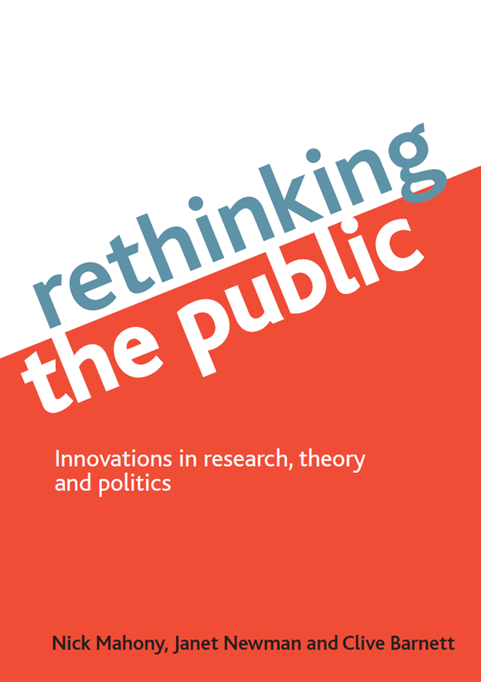
Just a plug for a newly published collection of essays I helped edit with Nick Mahony and Janet Newman, Rethinking the Public, which explores different dimensions of contemporary processes of public formation, with case studies ranging from contemporary UK policy debates to colonial India, modern Brazil, and current ‘global’ activism. The chapters are written by bright new things, PhD students or recently completed PhD’s, and cover a range of fields in which questions of who or what constitutes a public are at stake – policy studies, media theory, urban studies and human geography, development studies, political theory, sociology.
Details of how to obtain a copy can be found at the Policy Press website: http://www.policypress.co.uk/display.asp?k=9781847424167
The book develops out of an ESRC-funded research project on the theme of Emergent Publics, which has informed ongoing research initiatives amongst a group of scholars more or less loosely affiliated to the OU’s Public Research Programme in the Centre for Citizenship, Identities and Governance: http://www.open.ac.uk/ccig/
 Pop Theory