New book by David Harvey: Rebel Cities

Between trying to take a day off and teaching overload (at the same time), I have been speed-reading David Harvey’s new book, Rebel Cities: from the right to the city to the urban revolution, bought on a day out in Bath. I know, this is the sort of book you are meant to buy at Booksmarks or somewhere like that, but Bath is the closest place to where I live with decent book shops (Oxford doesn’t count, because it doesn’t actually have great bookshops, apart from Blackwell’s, and the OUP bookshop, both of which are more like academic libraries where you can buy the books, if you see what I mean).

The book is a collection of mainly recent pieces on urban politics, including a long essay on The Right to the City from New Left Review; the long, written-out-in-neat story of the ongoing urbanization of capital that underwrites the financial meltdown of 2007/8 which Harvey’s viral RSA animation lecture covered; and a set of pieces at the end reflecting on recent events such as the Occupy movement, London riots in 2011, and more interestingly, urban politics in Latin America.

It has some familiar limits, shall we say – an aversion to rights-talk when thought of as anything more than a convenient strategic fiction, and a simplistic contrast between ‘individual rights’ (not to be trusted), and ‘collective’ rights (more of these, please). And a tendency to defer the most pressing problems of political analysis to the field of concrete struggle (the word ‘democracy’ doesn’t feature in the index of this new book, which I thought was telling, until I noticed that the index only lists proper names of people and places and movements, which is a shame).

The two most interesting pieces in this new book are in the middle. A neglected essay, from more than a decade ago, analyses cultural commodities from the perspective of the Marxist conceptualization of monopoly rent. I think there is a lot of mileage to be had from this sort of approach, or at least I used to, when I thought more about these things (I think Nicholas Garnham had a similar line once), though it inevitably runs aground on the limits of an account of commodities that still invests heavily in the manly notion of value being derived from living labour in the production process (come in, Carolyn Steedman).

The other piece, perhaps the most interesting in fact, is on the concept of the urban commons. It’s a critical engagement with a notion that has become quite central to certain strands of contemporary left theory and politics, as both a ‘slogan’ and ‘ideal’ we might say. Philosophically, the commons has emerged as a kind of ontological security blanket for the revival of discussions of communism, a sort of immanent presence that just needs to be recognised and embraced – it is a weirdly post-political idea. Harvey suggests that the commons is always likely to be a construct of struggle and conflict, an effect of one form or another of exclusion or enclosure – he proposes the notion of ‘commoning’ as a practice to be analysed and encouraged. He also points out the degree to which the anarcho-inflection of this concept in contemporary thought systematically evades problems related to variations of ‘scale’ (a criticism which could be read, if one wished, as a surrogate for a much broader evasion of the problem of democracy in this style of leftist political romanticism). Harvey is rather sheepish in his suggestion that a little bit of hierarchy might be OK, although this is really just another way of saying that democracy is an art of governing, amongst other things.

Harvey makes use of the ‘conventional’ thinking of Elinor Ostrom in his discussion of the contradictions surrounding issues of commons, which is also refreshing, and another departure from the constrictions of the hegemonic account of this idea that draw on Hardt and Negri and others (he does not, however, go very far down the line of thinking about institutional analysis and institutional design that this reference point might open up). And there remains something rigid about Harvey’s understanding of ‘public’ attributes – public goods and public space are understood as gifts dragged out of ‘the state’ by class and other struggles, a sort of grudging background that might be actively, creatively appropriated by practices of genuine commoning (what Harvey describes as commoning in this respect looks a lot like authentic public action as described by Arendt, which is only to suggest that it might also suffer from some of the same problems as that description, not least a hint of an image of pure action freed of instrumental concerns).

[The baby’s just been sick, I have to pause].

In this account of commoning as the appropriation of already constructed background environments, Harvey’s critical reconstruction of the notion of the commons ends up, then, looking quite ‘conventional’ itself, although not necessarily in a bad way – whisper it, but there is a minor theme in Harvey’s work I think, behind the rhetoric of revolution, that sees left politics primarily in terms of seeking after more just, more equitable distribution of surplus in the here and now (and there’s no reason that this need not encompass more just relations of surplus production). The rhetoric of unified revolutionary transformation is in abundance in this book, certainly, but it is not really supported by an analysis of politics, culture and economics that has so relentlessly, over many years now, demonstrated the dynamics of fracturing, differentiation and contradiction that inhabit any and all forms of human action (the idea of revolutionary transformation might, it seems to me, if you’ve read enough of David Harvey as a geographer, be deeply antithetical to a geographical imagination). The ambivalent nostalgia for social democratic settlements, for failed Swedish promises of surplus transfer from capital to labour and the like, are testament to a radical politics of redistribution that seems unable to speak its own name – it’s present in Harvey’s book about the New Imperialism, and goes all the way back to Social Justice and the City. This minor key is that of a Polanyian radicalism, not a Marxist one.

The ends of aesthetics

In a spirit of anti-Franzen, here are a couple of things I learned about from Facebook and Twitter this weekend, while attending swimming lessons (not my own). Picked up from Paul Harrison on Facebook, a link to a new online journal Singularum, focussing on the relationship between aesthetics and pedagogy (teaching as a theatre of cruelty, perhaps?). 

And from Twitter, here is a podcast with Spivak talking about a new book/collection, An Aesthetic Education in the Era of Globalization – worrying about whether the tools of an aesthetic education (i.e. literary reading) are still useful in relation to challenges of speed, distance, digitalization, and other ‘globalizing’ things.

Never having had a proper aesthetic education, nor having ever really aspired to be a medium for one, as I grow old I find it increasingly peculiar just how much Theory is still attached to faintly reactionary models of what the task of education should be.

The Femicide Machine: new book by Sergio González Rodríguez

I have just read a little book, an essay really, by the Mexican writer Sergio González Rodríguez, The Femicide Machine. He is one of a number of writers and journalists who have campaigned for justice for the hundreds of women murdered in Ciudad Juárez over the last two decades, or more. This is a subject that the geographer Melissa Wright has written extensively about, for example. Rodríguez’s book does not provide a load of background to this phenomenon – others, like Charles Bowden and Diana Washington Valdez do that – but it does provide a lite-touch theoretical contextualisation of what at first appears to be an almost incomprehensible level of misogynistic violence, and in particular, of the almost systematic failure of Mexican authorities to address the murders effectively. The language is Deleuzian, providing a sense in which ‘the femicide machine’ thrives in the spaces opened up by the concatenation between ‘the war machine’ (Mexico’s enrollment in ‘the war on drugs’) and ‘the criminal machine’, all in the context of the longer history of maquiladora-based industrial and urban development in northern Mexico (I think he might miss a theoretical trick by not connecting ‘assembly’-based manufacturing with ‘assemblages’, but that might not be the main point of the book). This is the ‘trasnlineal’ space of the US/Mexico ‘transborder’ zone, a space which  Rodríguez characterises by quoting Cormac McCarthy’s line that it is here that ‘the probability of the actual is absolute’.

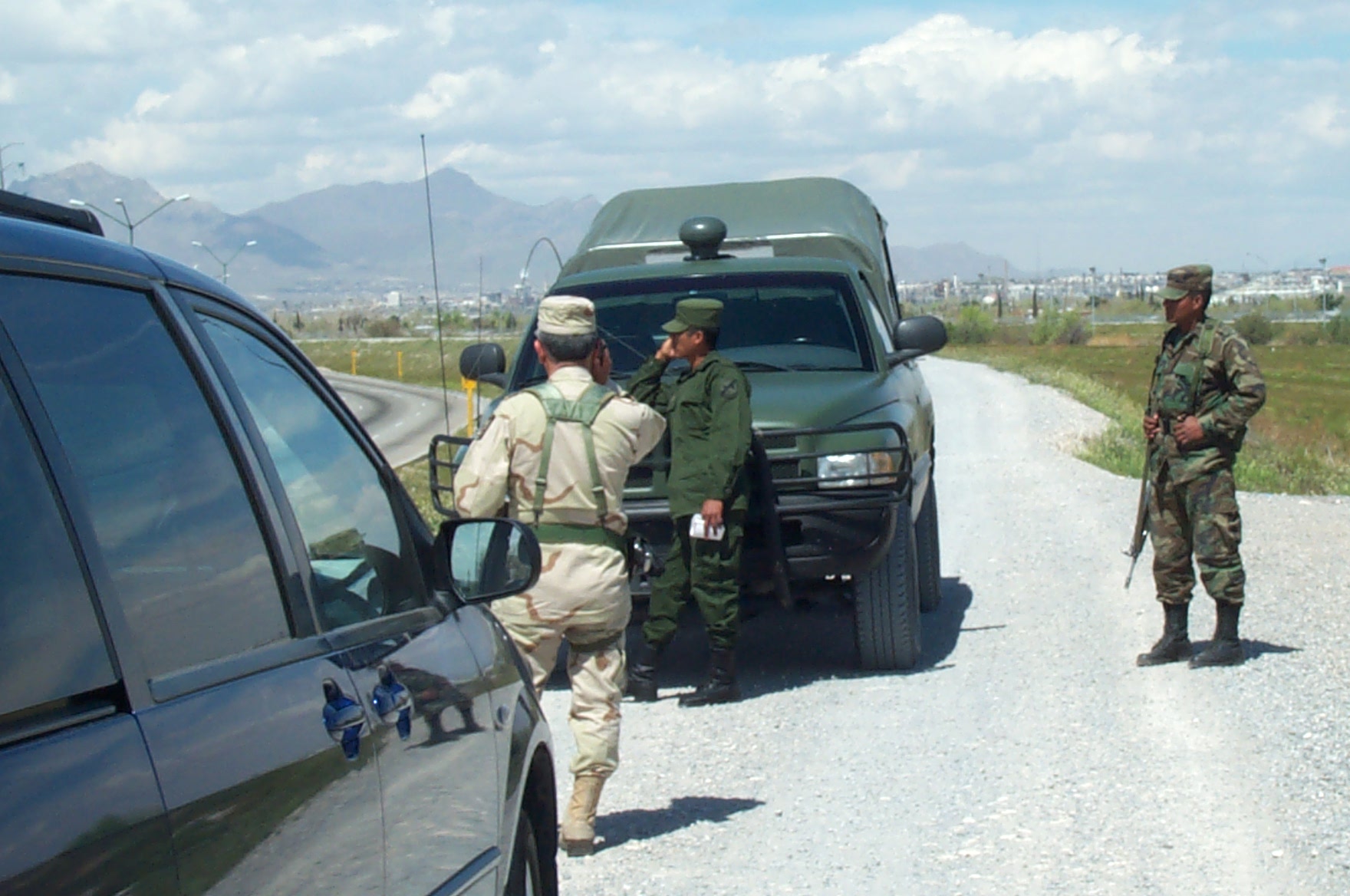
I’m interested in this issue because 7 years ago now (7 years? Where did they go?), I was involved with some filming for an OU course which used the campaigns against femicide in Juárez as a case study for teaching students about the geographies of global responsibility. This was actually before things got really bad, since 2006, with the ratcheting up of militarised anti-drug trafficking on both sides of the border. It was at the time that Amnesty, the UN, Eve Ensler, and others were actively making the Juárez murders into an international issue – this is the issue that we focussed on (along with other issues, such as control of water along the border, the movements of people over the border, and work in the maquiladora – it’s not too late to sign up for the course). It was both a fascinating experience, and at times a very uncomfortable one, not least interviewing women involved in the femicide campaigns; and being detained by the Mexican army, for wandering across the Rio Grande (there was no water in it at the time; technically, we were trying to get into the USA, the U.S. Border Patrol just told us to go back, the Army weren’t pleased).

Actually, I think the most important part of Rodríguez’s book is not the analysis, interesting as it is, so much as the Epilogue, titled ‘Instructions for Taking Textual Photographs’. This consists of a ‘photographic mise-en-scene’ in which he narrates, in the first person voice of one mother, the circumstances surrounding the abduction, murder, and (non-)investigation of her daughter. The narrative here reaffirms the line of the preceding chapters, about how the perpetrators are known and hide in plain sight. This is followed by 20 pages of ‘photographs’; only, there are no photographs – just the captions, a line or a few sentences each, re-iterating the ‘scenes’ from the first person narrative, including ‘photos’ incriminating the perpetrators. It’s an interesting device with which to raise the question about the politics of representation of femicide and it’s victims, certainly. But by presenting the ‘photos’ (which presumably are both real and imagined, judging from their listed content) in this way, he is making the same point about the degree to which the real mystery here is not ‘who did it’ but why so little has been done to address the murders and the demands of victims’ families. The captions indicate the ‘truth’ of the case, the absence of the photos stand as a kind of accusation about a culture of institutionalised impunity – the book is, after all, a manifesto, an intervention.

Either that, or Semiotext(e) just can’t afford to reproduce photos in their books.

New Book: ATLAS: Geography, Architecture and Change in an Interdependent World

A new book, an edited collected, has just been published by Black Dog Publishing – ATLAS: Geography, Architecture and Change in an Interdependent World. It’s edited by Renata Tyszczuk at Sheffield and three of my OU colleagues, Melissa Butcher, Nigel Clark and Joe Smith. This is part of a long-standing and on-going set of collaborations between OU Geography, Architecture at Sheffield, and the New Economics Foundation, as well as others. There is an associated web-site which archives further materials from these projects, and there is a launch event in London on March 13th, New Maps for an Island Planet.

The book is, apart from anything else, very lovely to look at (I have the least visually imaginative essay, all text, no pictures). Here’s the blurb:

Atlas: Geography, Architecture and Change in an Interdependent World helps readers find their way through the practical and ethical challenges presented by globalisation and global environmental change. Atlas: Geography, Architecture and Change in an Interdependent World combines recent thinking on human geography and architecture on global environmental change issues, setting out to develop a reinterpretation of cartography and a reframing of sustainability. The aim is to find a “re-drawing of the earth” and the “making of new maps”. With a focus on the growth and remaking of cities it offers an innovative mix of essays and shorter texts, original artworks and distinctive re-mappings. The Atlas arises out of a unique collaboration between scholars and practitioners from architecture and human geography.

Coetzee on cricket

From Africa is a Country, an interesting discussion of a recent essay by J. M. Coetzee on cricket when he was growing up in South Africa, in a collection of essays entitled Australia: Story of a Cricket Country edited by Christian Ryan. Ryan is the author a very wonderful book about Kim Hughes, famous now mostly for crying which is unfair, Golden Boy, a book which unpicks the sometimes absurd machismo behind a particular moment of modern cricket transformation.

New(ish) book by Hein Marais

Via the excellent Books LIVE, home of South African related literary/publishing news, I have just noticed a link to the Introduction to the new book by Hein Marais, South Africa Pushed to the Limit, actually published last year, I’ve only just found out, a bit out of this world these days, it’s a sequel of sorts to his 1998 book South Africa: Limits to Change. Here too is an interview with him talking about the book from last year at Think Africa Press.

What did happen to Peter Pumpkinhead?

My three favourite books on the Kennedy assassination:

William Manchester’s The Death of a President.  Utterly compelling, minute-by-minute account, I read this in one sitting at a cricket ground in Eastbourne in the summer of 1985. It may or may not be good history, in fact it’s really part of what the event became subsequently as history, but it’s a great read.

Don DeLillo’s Libra. The book the film of which didn’t get made because of Oliver Stone, apparently, according to some stories, which is a shame. One of the few novels I’ve ever read more than once (actually, the only other one is Less than Zero). Has something in it for everyone, conspiracists and Warrenistas (I just made those terms up).

Vincent Bugliosi’s Reclaiming History. The book for grown-ups.

If I had the time, I would try to make a case for why reading lots about this is actually quite significant philosophically – conspiracy theories raise interesting epistemological issues you know. But I don’t have the time. And it would be a bit embarrassing to do so. If you don’t have time to read those books today, then you might always listen to The Wedding Present’s Kennedy, The Human League’s Seconds, or The Fall’s Oswald Defence Lawyer (there are other relevant pop songs, I’m sure, but between them, these three just about cover it all). Or try to find a recording of Lenny Bruce’s shtick on Jackie Kennedy ‘hauling ass’.

Local Politics VI: Where is the University of Christminster?

Bodleian Library, Keypoint, Swindon (Brian Robert Marshall) / CC BY-SA 2.0

Part of the history of civic boosterism in Swindon is a long and largely unsuccessful story of attempts to establish a University presence in the town – in the last decade, schemes involving both UWE and Bath have fallen through; Oxford Brookes has a small presence, and BPP has a pilot scheme with a local FE college to roll-out low cost degree programmes (in Law). The efforts to establish a University go back to the 1940s at least – it’s why the Borough Council own a big old stately home just off Junction 16 of the M4, with a great kids play area, an annual firework display, but no University. And these efforts continue – Swindon will be bidding for a University Technical College any time soon.

I have previously expounded on the frustrations of living in a town which is so poorly served by book shops. This has something to do with the absence of a higher education presence in the town, no doubt. But actually, Swindon does have a huge book store, opened a year ago. The only problem is, it’s a book store, not a bookstore – a Book Storage Facility, to be precise. And not just any old Book Storage Facility.

Should a University ever arrive, it will open in a town that is host to more than 8 million books deposited in the Bodleian’s shiny new warehouse, located just off the A420, round the corner from Honda. The Book Storage Facility is Oxford University’s solution to the fact that the Bodleian’s collection grows by about 170,000 volumes a year, and they had run out of space in Oxford to house them all.  It was opened a year ago, and the books have been transferred over the last year. It is home to mostly ‘low demand’ books – the one’s no one ever borrows.

The ‘BSF’ has been described as a ‘tin shed’, but it continues in a line of high quality industrial architecture in the town – it is that kind of town.

Local politicians got very excited when it was announced that the University 30 miles up the road was going to store it’s unwanted books here. This is actually quite sad – there was a rather fanciful suggestion that the new Central Library would be able to hook up with the Bodleian collection. Not happened. Perhaps the Borough Council should just appropriate the BSF, declare it to be the public property of the people of Swindon, and set up its own University on the back of one of the world’s best collections of scholarly materials. Call it the University of Christminster. It could work.

I actually find this all a bit cruel – they close the Borders a few weeks after we move here, then open a huge warehouse full of books down the road, which you cannot actually access. I used to take an annual visit to the Bookbarn in Somerset, south of Bristol on the way to Wells – a place where old books go to die, I think of it as. Two agricultural warehouses full of musty old books, I very rarely bought anything – these really are the books no one wants to read anymore (you could, though, buy the entire collection of Enoch Powell’s speeches from the 1960s and 1970s, if you were looking for an archive for a PhD thesis). My daughter cried the one time I took her there (what do you do on the days when you have to look after a toddler?). It was probably the smell. But at least you get to go in this warehouse full of books, to wonder round, sit down for a coffee.

Never mind. I console myself with the thought that as I drive up and down the A420, to and from Milton Keynes, some of those white vans might be transporting rare manuscripts to eager scholars waiting in the Radcliffe Camera or the Map Room. Who knows, one of them might even be transporting that rarest of rare ‘low demand’ items – one of my books.

New blog on urbanism and democracy

Just noticed a new blog by Mark Purcell, Path to the Possible, on issues of urbanism, politics, democracy. Mark is author of Recapturing Democracy, one of the few books I can think of in geography/urban studies that engages in detail with democratic theory. I was on the ‘author-meets-critics’ panel for this book at the Annual Meeting of the AAG in Boston in 2008, the only time I have done one of these. I remember thinking how weird it must be to have to sit through other people picking holes in one’s work in such detail. I now have to sit through one of these on a book of my own in a month or so, so what goes around comes around I guess.