
 I have been to the cinema three times this week, the first time I have done that since I was an undergraduate, and used to go almost every night at 11 to the now defunct Arts Cinema in Cambridge. Movie-going has been something to do this week while waiting for a baby to arrive. We both went to see The Little Fokkers, on a Monday afternoon, and were the only people in the cinema. It was like having a private screening. Terrible film though. Then it was Eat, Pray, Love, which was better, best of the three, but still not very good. Full of cliches about other countries. Best thing about this film was going to the 11am show, the Seniors Club performance. £3 for the film plus a cup of tea and a biscuit. It was more than half full. It reminded me of the PhD research of Berry Cochrane at the OU, who did go-alongs with OAPs to the cinema to investigate what sort of practice movie-going is, and how the practice shapes what ‘film’ is. Finally, I went with my four year-old daughter to see the new Disney animation, Tangled, a version of the Rapunzel story. This was not that great either – too many weak songs. Not As good as The Princess and the Frog by a long shot. We had to go to see the 3D version, but my daughter took the glasses off after a couple of minutes, saying that ‘they bring everyting too close’, and that this made her jump. Which pretty much sums up what 3D film technology seems to be for.
Choreographed pop
 I had a night out last night, on my own though – my thirty-nine week pregnant partner stayed at home for some reason. I went to see the UK premiere of the new David Byrne concert film, Ride Rise and Roar [I should keep this blog from becoming excessively focussed on him shouldn’t I]. When I say I went to the premiere, this is sort of true – last night was the premiere of the film, somewhere in London, but the film was simulcast in other cinemas round the country. This exciting event attracted a total of 8 people to the Swindon screening – me, and seven other people; I was the youngest. Oh well, that tells you something about Swindon I suppose. There was supposed to be a live simulcast Q&A session with Byrne afterwards, but rather inevitably the cinema in Swindon couldn’t connect up properly. Oh well, I left happy. The film is great – it is about the choreographing of the performance, as well as a film of the show itself. It made me realise how unusual it is to see any movement on stage for standard ‘rock’ music or ‘indie’ music – for guitar based pop, that is. Take That, or Girls Aloud, that sort of pop music is always animated, which is part of what differentiates it as a distinctive genre. Concert movies are also rather static – any movement comes from lighting, camera positions, editing, and so on. Nobody dances in The Last Waltz. So it was fascinating, and toe-tap inducing, to see old Talking Heads songs and new Byrne/Eno songs literally put into motion.
After affect(s): Ruth Leys on affect theory
 I’m not sure if this is the best way to keep up with exciting theory debates, but I spent an evening this week in a ‘car supermarket’, trying not to fall into a salesman’s traps while also working out whether or not I liked driving an automatic rather than a manual transmission – what do you do with your ‘spare’ foot? In between all this, I stumbled across this announcement of a forthcoming lecture at Duke by Ruth Leys, promising a critique of affect (the things you can do with an iPhone). I will not be in North Carolina next week, but this looks really interesting, and long overdue. The post mentions a forthcoming paper in Critical Inquiry later this year, and Leys mentions in a recent interview that she is writing a book on the relationships between scientific understandings of affects and the affect turn in cultural theory. The interview, from last year, provides a taster of what Leys argument looks like – what is most interesting about this is that she is providing a genealogical analysis of the coherence between the anti-intentionalism of certain fields of psychology and neuroscience and a broad range of ‘affect theory’ in cultural studies and beyond. I was first turned on to Leys work on this stuff by Felicity Callard, who studied with her as a graduate student, and who is also working on the use of scientific authority in the affective turn amongst social scientists and in the humanities. In the interview, Leys explains that “The question that interests me is why so many cultural theorists – geographers, political theorists, new media theorists, and others – are so fascinated by the idea of affect and are so drawn to the work on the affects by certain neuroscientists”. Of course, part of the answer is that the science provides authority for strongly ‘political’ readings of particular models of action, embodiment, habit, and practice. One thing she talks about in the interview is the degree to which ‘strong’ theories of the autonomy of affect tend to be resolutely dualistic, adopting quite old fashioned styles of materialism in setting embodiment off from the mind, affect from cognition. I think she is dead right – this is a clear feature of debates in human geography about non-representational theory, emotions, and affect, in which remarkably simplistic understandings of intentionality, meaning, or rationality circulate.
I have wondered for a while, and tried to articulate in writing, what is the academic pay-off of constructing non-cognitive dimensions of action or practice in the strongly anti-intentionalist ways as one finds in Deleuzian inflected theory – what is gained by the effacement of intention and meaning from the scene of action, and from the re-distribution of knowing rationality almost entirely onto the figure of the expert-theorist? Leys’ argument, which emerges from earlier work about broader shifts from discourses of guilt to discourses of shame in the study of trauma, pinpoints the way in which claims of scientific authority underwrite a motivated reconfiguration of what counts as political: “The whole point of the general turn to affect among recent cultural critics is to shift attention from the level of political debate or ideology to the level of the person’s subliminal or sub-personal material-affective responses, where, it is held, political influences do their real work”. And she goes on, this authorises “a relative indifference to the role of ideas and beliefs in politics in favour of an ‘ontological’ concern with people’s corporeal-affective experiences of the political images and representations that surround them” (of course, in geography and perhaps some media studies, what is most interesting about this sort of work is precisely that it focuses on a much broader array of affective ‘environments’). This ontologization of affect allows for a dark narrative of bad affects – in which people get manipulated for all sorts of sinister ends; and a nice story about good affects, which is meant to be the positive political inflection of affect theory – although this often turns out to be a rather standard ‘proof’ that subjectivities are much more malleable than we think, and can be best transformed by being exposed to some form of aesthetic disruption or other.
All a bit troubling, once you notice that ‘knowing’ has been entirely evacuated from the field of everyday action inhabited by ordinary people, and is now a capacity reserved entirely for those able to handle what are properly thought of as esoteric (in a Straussian sense) theories of affect. In certain respects, and despite the loud rhetoric of political radicalism that accompanies so much affect theory, this style of cultural theory of ‘the political’ might actually be a symptom of a deeply ingrained, scholastic cynicism about the political virtues of ordinary people.
Leys’ genealogy of the science of affect theory is an important resource for thinking through the politics of the ‘political’ invocation’ of affect in cultural theory and social science. Like the Dreyfus/McDowell debate, it is an example of some proper thinking about the forms of reasoning, demonstration, and indeed evidence that lay behind claims of expertise and authority which often work, certainly in geography, to have a chilling effect on serious thought. One thing her work suggests is that the ‘ontological’ commitments of what is now orthodox affect theory in the social sciences and humanities are, indeed, strongly theoretical – the reference to the authority of cutting-edge life sciences might be much more contentious than it appears (and shouldn’t we know this anyway). Or maybe we should just call those commitments ‘metaphysical’, in the bad sense.
Universities and their public purposes
 Nigel Thrift, sometime geographer and all round theorist, who is now Vice-Chancellor at Warwick, has a short note on The Chronicle of Higher Education blogsite WorldWise note on the complexity of the tensions shaping Higher Education today. Apart from the slightly sneering dismissal of ‘critique’ as a posture to adopt in relation to current changes to University financing in the UK context, this is a rather succinct summary of the complex relations into which ‘The University’ is woven. It is also a useful reminder of the degree to which the transformations triggered by post-election decisions in the UK are part of rather longer, more broadly shared processes of reconfiguration in global higher education. One thing that Thrift’s list of tensions brings out is how they all revolve around the basic tension of being (at least in part) publicly funded institutions which are expected to or aspire to deliver a complex and contrdictory range of public ‘goods’ – world class research, economically useful teaching and learning, social mobility, relevant solutions to all sorts of worldly problems. Rather than there being a single model of ‘the public’ to which Universities are expected to be responsive and accountable, Thrift’s list of tensions indicates the diverse range of public purposes and constituencies which have a stake in the future of higher education. Anyway, Thrift promises future posts focussing in more detail on these different tensions, which should be interesting to follow.
Geography without scruples
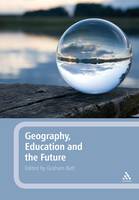 Here is a new book of conceptually sophisticated, research-informed essays about the place of geography education in schools in the UK. It is the product of the geography Education Research Collective (GEReCO), a group of scholars working on researching geography and education issues. I am not part of this group, I should say, but was invited to write a short commentary on some of the essays. Geography’s place in the school curriculum is constantly changing, it seems – sometimes bemoaned for being marginalised, although now suddenly defined as a ‘traditional’ academic subject as part of Michael Gove’s re-definition of standards around the so-called ‘English bac’. There is a vibrant on-line community of geography teachers and education researchers engaging in these issues – amongst others, I like the blog developed by John Morgan and David Lambert, Impolite Geography.
Favourite Thinkers III: David Byrne
 I accidently bought David Byrne’s concept album about Imelda Marcus just before Christmas, while out trying to buy gifts for other people. It’s called Here Lies Love, and is co-produced with Fatboy Slim. It’s full of suprisingly good dance songs, with guest lyrics by all sorts of mostly female singers, including favourites such as Kate Pierson and Róisín Murphy. I also read Byrne’s book about cycling and cities in the summer, while on holiday, which is kind of a blog-book, and was actually one of the things that sparked the idea of trying to write a blog myself. Between them, these two ‘works’ have reminded me of just how much I like David Byrne as a ‘thinker’, and just how important his style of ‘thinking’ might have been in shaping, or confirming, some of my own intellectual inclinations. Talking Heads was the first pop music that I discovered as ‘my own’, in the sense that up to that point (about 1983) I was entirely dependent on listening to things already in the house (my mother’s Neil Diamond record, who I still harbour a soft spot for; my dad’s Johnny Cash album, ditto: David Bowie’s Changes, which both of my sisters’ had copies of, as surely did all sisters who were teenagers in the 1970s; I was less inclined to the Billy Joel, Rush, or Black Sabbath). One of my sisters did in fact send me Talking Heads’ 1983 album, Speaking in Tongues, but alongside albums by Oingo Boingo and X, and without quite knowing what she was doing I think. Talking Heads were my route away from mid-1980s rockism defined by Dire Straits, Pink Floyd, and Marillion, towards a ‘I wear black on the outside because black is how I feel on the inside’ world of the Jesus and Mary Chain, That Petrol Emotion, the Cocteau Twins, Pixies, and Throwing Muses.
Anyway, where was I? Talking Heads songs always had this great geographical sensibility, I think – they are about ordinary experiences of places, of living in cities, of travelling, of meeting new people, of being out of place. They are also about the absurdism of these ordinary experiences, of course. I haven’t really followed Byrne avidly since the end of Talking Heads, although the Bicycle Diaries is just one example of how this geographical imagination has continued to flourish in his work since then – it is part of a serious engagement with issues of contemporary urbanism he is involved in. I do sometimes tune in to his radio station – he posts a monthly play list on his website, of more or less coherently themed songs – sometimes this contains things I am already familiar with, sometimes it opens up new musical avenues to explore, or not.
I’m not sure if pop songs are meant to count as intellectual influences – and I suppose Byrne is one of those people of whom it could be claimed that they are not really ‘pop’, since his work from Talking Heads and on has always been more or less ‘arty’. On the other hand, I remember once having a conversation with a cultural geographer interested in geography and music, who was quite disdainful of my response of ‘Talking Heads’ to his question about whether there was any popular music that was ‘geographical’ (this was a drunken conversation late at night at a party). On his understanding, ‘popular music’ really meant some sort of quasi-organic, placed-based more-or-less-folk music that evaded commercialization. Oh well. I still think that Byrne is ‘pop’, not least in having a sense of wonder for the potentials of commercialised public culture. But I’m not sure I either can or should seek to intellectualise about the sort of pop culture he produces, or why it matters to me.
What is ‘public’ about the Public University?
 I was visiting UCL yesterday, where students are involved in an occupation as part of the ongoing campaign against the Coalition’s pernicious policy of higher education funding (we don’t have one at the OU, cos there aren’t any students at Walton Hall). These occupations are interesting not least because they are seeking to directly shame the VCs of individual institutions, who as a collective group have proved horribly supine in their response to the government’s decision to allow an increase in fees AND to slash public funding in support of teaching of all but a select ‘strategic’ subjects. The last few weeks have exposed clear divisions within the University sector, with representatives of the Russel Group and other research intensive institutions quietly accepting proposed changes as inevitable, while the most forceful criticisms of these proposals, and defence of the public value of higher education beyond the personal benefit derived by individual students, have been made by articulate VCs from institutions such as the University of Central Lancashire and Canterbury Christ Church. This division is so clear that it has generated a debate about whether the Universities UK, the umbrella representative body for the whole sector, has lost its legitimacy as an effective representative by adopting such an accommodating tone – you can track the tensions in recent articles and letters in the Times Higher.
All of this will come to a head this week when the Commons gets to vote on the tuition fees proposals. But one of the more important aspects of this campaign is the way that it has very quickly exposed fault lines around the terms in which the politics of newly austere public sphere is going to be fought out: on the one side, a set of arguments which invoke particular images of ‘fairness’ and focus all the attention on the idea of higher education as a system distributing benefits upon differentially advantaged individuals (on this criterion, of course, there are aspects of the current proposals that are easily commended – the OU has loudly celebrated the equalization of treatment of part-time students as potential high education debtors); on the other side, an argument about the public good of higher education residing in various collectively bestowed, and collectively enjoyed benefits which are more than the aggregate of all these personal benefits. The best thing I have read on this issue is Stefan Collini’s critique of the perfect-market idiocy that informs the Browne Review (whose membership is indicative of a shift in the ‘public’ quality of these sorts of reviews). Collini points out that the headline coverage of the Browne Review, and the protests and campaigns since too, has been on the issue of fees increases; and he elaborates on how there is a much more fundamental aspect of the Review, which is its proposed (and largely accepted by the Coalition) ‘dismantling of the public character of higher education’, which he describes as ‘breathtaking’ in its scale. The emphasis of Collini’s analysis on defending the public quality of higher education in a broad sense has quickly found expression in a newly established Campaign for the Public University. In a letter published in The Times earlier this week, the broader issue is clearly stated: “The issues at stake for the future of higher education are not only to do with the proposed increase in student tuition fees. We believe that the public university is essential both for cultivating democratic public life and creating the means for individuals to find fulfilment in creative and intellectual pursuits.” The letter also refers to the results of rather extensive research survey undertaken by Ipsos MORI on behalf of HEFCE and also published last week, which, to cut a long story short, showed rather widespread support amongst the public for government investment in higher education and a broad appreciation of the varied benefits (economic and non-economic, individual and collective) of higher education. The OU currently has a research centre, CHERI, which also focusses on exploring and promoting the public dimensions of higher education, engaging in empirical research but contributing to conceptualizations of the place of higher education in reconfiguring the public sphere – partly through links with CHERI, some of us hosted Craig Calhoun at the OU earlier this year, whose talk about the changing public status of Universities now seems even more pertinent than it did back in March – you can see the lecture here.
The only thing that worries me about the tone of debate at the moment around these issues is the danger that certain aspects of a rather tired Two Cultures debate are already being reproduced, so that ‘the public’ benefits worth defending from the more extensive marketization of higher education end up being represented in terms of the apparently non-instrumental value ascribed to ‘the humanities’. I think that path threatens to undermine much more expansive, inclusive understandings of the public qualities of higher education, by just reproducing some hoary old (class-bound) stereotypes about ‘really useless knowledge’ being the embodiment of the public value of University life. I think the challenge is to acknowledge and defend a pluralist range of ‘uses’ and ‘instrumentalities’ that higher education helps to sustain.
Globalizing Responsibility
 A new book, Globalizing Responsibility: the political rationalities of ethical consumption, co-written by myself and three colleagues – Paul Cloke, Nick Clarke and Alice Malpass – has just been published. It comes out of an ESRC/AHRC funded project on Governing the subjects and space of ethical consumption that we all worked on together, and which formally ended back in 2006. But these things take time to come to full fruition (we have another book in the pipeline).
The book sets out to analyse various ethical consumption practices from a political perspective. By this, I mean it tries to understand them as forms of political mobilisation, campaigning, lobbying, and so on – not in the sense of evaluating them from a pre-established position of what counts as politics or what makes politics more or less progressive – but in terms of trying to understand how these sorts of activities are indicative of changes in the way politics gets done now. It is based primarily on case studies undertaken in and around Bristol in the mid-2000s, especially focussing on fair trade campaigns of different sorts, and tries to make sense of the local dynamics of global solidarity politics. Theoretically, the book works through various approaches to understanding this sort of activity, including accounts of neoliberalization, governmentality theory, theories of practice, social movement theory, and theories of consumerism.
We have a couple of nice endorsements on the back cover, one from the geographer Peter Jackson at Sheffield: “Based on original research and innovative thinking, this profound and insightful book challenges conventional thinking about ‘ethical consumption’. Approaching the subject as a distinctive form of political mobilisation, Globalizing Responsibility shows how our everyday consumption practices are related to wider narratives of social justice and collective responsibility”; and one from Rob Harrison of Ethical Consumer Magazine: “‘By viewing ethical consumption patterns as a political phenomenon, the authors deliver a far deeper understanding of this growing movement than a whole raft of marketing and business literature which has gone before.”
So if anyone is still stuck for gifts to put under the tree this festive season, this comes just in the nick of time.
It all comes together in Frankfurt
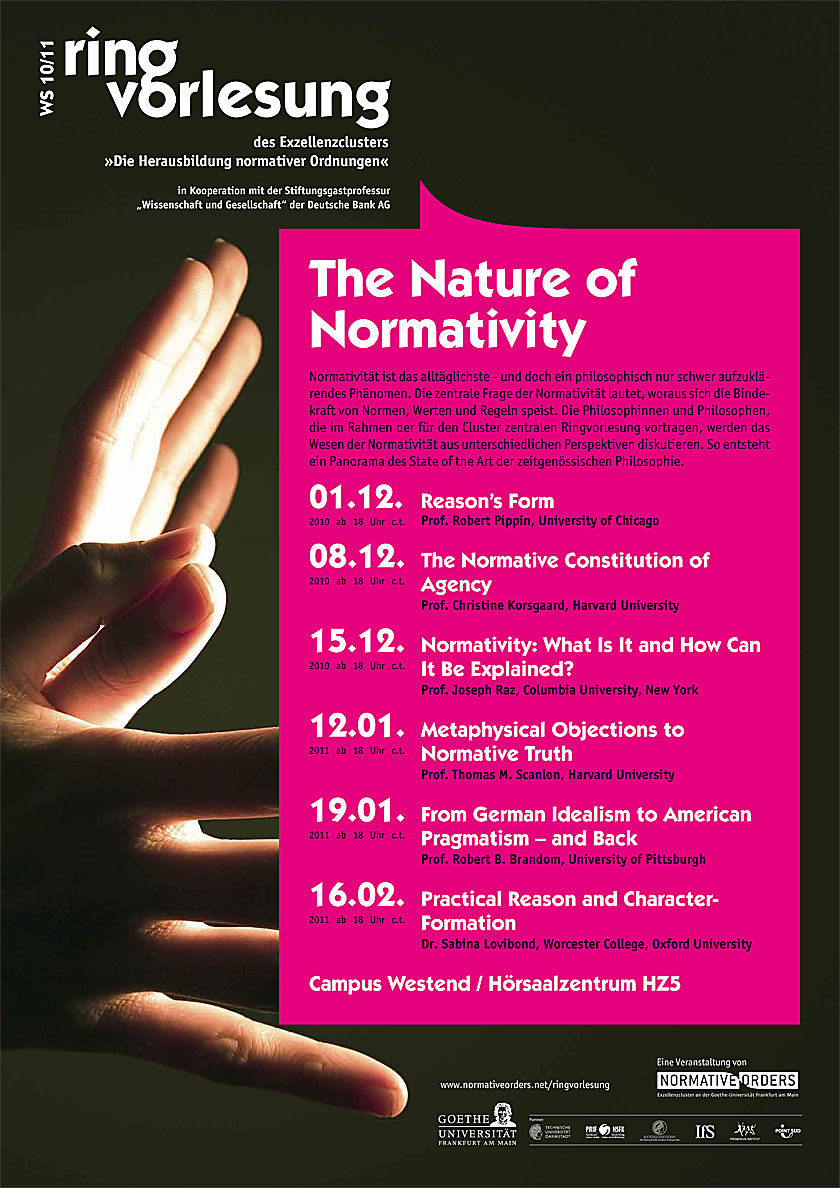 Ooh, this looks interesting – in a parallel universe, I’d like to be in Frankfurt for the next couple of weeks to attend this set of lectures on Normativity. This is one of my favourite topics these days, and I have been trying to write about the ideas of this set of thinkers, and failing to find a way to do so which seems to fit with conventions in critical human geography. There is a resistance to certain styles of reasoning in this world, which is often covered over by appeals to what does and doesn’t count as ‘political’, which seems to make this strand of philosophy oddly beyond the pale. Maybe because this stuff is just really difficult, in a way that a canon of French dudes, inflected by Heidegger, might not be, despite appearances? Or that it is difficult in a serious way?
Being on the receiving end: Making sense of Fatherhood
 Just in time for Christmas, a new book out on becoming a father, Making Sense of Fatherhood, by sociologist Tina Miller at Oxford Brookes, who has previously written about experiences of becoming a mother. My reason for mentioning this is personal, because I am in it. I was one of Tina’s research subjects, back in 2006 and 2007, which involved being interviewed before and after the birth of our first child. The publication of the book is timely, since we are now expecting our second just after Christmas, so it gives me an opportunity to remember what life felt like last time.
I haven’t read the book yet, so I don’t know whether I ended up being a useful [anonymised] informant, nor what Tina has made of all the dad-talk in general. But I enjoyed the experience of being in her project, both for personal and ‘professional’ reasons. Personally, it was fun to have the opportunity to talk about what was going on way back then, and ‘Tina’ became a kind of imaginary friend in my head, who I would silently talk to as I wondered the streets of Bishopston pushing a pram for what seemed like hours on end. Professionally, it was interesting to be on the other side, as it were, to have a glimpse of the ordinariness of how lots of empirical social science gets done. I didn’t really think of it this way at the time, but it was pointed out to me the other day that my participation in Tina’s project sort of counted as ‘volunteering’. So now I am intrigued to discover if there is any work out there on how dependent social science research is on the willingness of people to be interviewed, counted, surveyed, and so on.
So, I might have more thoughts on being a research subject once I have read the book; and I’m going to look into the ‘research volunteering’ thing a little bit more too. In between all the busy, engaged parenting, obviously.
 Pop Theory