Whatever happened to social theory?

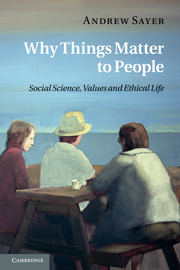
 I’ve just been reading the new book by Andrew Sayer, Why Things Matter to People. It is a full-scale elaboration of the importance for critical social science of what Sayer calls ‘lay normativity’ – people’s evaluative orientation, or relation of concern to the world around them. Sayer thinks this aspect of life is systematically downplayed or misrepresented in lots of social theory. I think he is probably right about that. The notion of lay normativity was used in Sayer’s previous book, The Moral Significance of Class, and the project on ethical consumption that I have been working on, for it seems like ages, made use of what we at least understood this term to be getting at – the importance of giving credence to the evaluations of their own practices that people provide in social science encounters, not least as being able to tell us something interesting about how practices work. Here is the publisher’s blurb for Sayer’s new book:

“Andrew Sayer undertakes a fundamental critique of social science’s difficulties in acknowledging that people’s relation to the world is one of concern. As sentient beings, capable of flourishing and suffering, and particularly vulnerable to how others treat us, our view of the world is substantially evaluative. Yet modernist ways of thinking encourage the common but extraordinary belief that values are beyond reason, and merely subjective or matters of convention, with little or nothing to do with the kind of beings people are, the quality of their social relations, their material circumstances or well-being. The author shows how social theory and philosophy need to change to reflect the complexity of everyday ethical concerns and the importance people attach to dignity. He argues for a robustly critical social science that explains and evaluates social life from the standpoint of human flourishing.”

It will be interesting to see what sort of traction, if any, Sayer’s book gets in critical human geography. Once upon a time, when I was little, Sayer was one of the big names of Theory in geography, in the 1980s heyday of critical realism. Apart from forays every so often to call for more robust normative reflection in the discipline (most recently in Antipode), Sayer is much less of a presence now. He wrote an excellent book in the mid ’90s, Radical Political Economy: A Critique, which I remember Marxist colleagues being apoplectic about because it took seriously non-‘dialectical’ styles of social thought and made productive use of Adam Smith and Hayek.The style of theory that Sayer performs, with its close attention to argumentation, is rather uncommon in geography now. I’m not necessarily sold on all of Sayer’s arguments – I think, for example, that he might find more support for his broad thesis about human vulnerability and ethics in thinkers such as Levinas or Derrida, or for the importance of everyday attachments to things that matter in styles of cultural theory concerned with thinking about the ordinary, such as Lauren Berlant’s work; these are not traditions Sayer has much patience with. Genre blindness? But I think his diagnosis of the limits of current styles of critical thinking has a lot going for it – critical thinking does find it really difficult to give credence to ordinary dispositions as having value in and of themselves beyond their function in systems of discipline, as effects of subjectification, or as indices of unconscious dynamics, or at best residues of untapped resistance or invention.

I happen to think that Sayer over-eggs the normativity-is-important cake by insisting on making the argument with reference to ethical theories – there is a less explicitly ‘moral’ strand of philosophy concerned with rationality, reason, embodiment, and values that might inform the sort of reconstruction of social science Sayer recommends. I have been trying to write about these same issues in a rather more tentative fashion, for a series of ‘reports’ on ‘Geography and Ethics’ due to be published any time soon. The first deals with some recent accounts of justice; the second with some of the philosophy mentioned above, focussing on notions of practical reason [Sayer has lots of interesting things to say on this topic]; the third is still to be written, and will focus on the kind of social theories of value, normativity and justification that Sayer, amongst others, has been developing.

Did I really say that?

I have been meaning to say something about Tina Miller’s book Making Sense of Fatherhood, about the experience of being a first time dad, but I have been too busy being a second time dad, although I did read it before Baby 2 was born. I really enjoyed it, not least for reminding me of episodes and feelings I had forgotten about; it also provided the occasion for an odd parlour game at Christmas, in which friends/partners tried to guess which of the anonymous interview subjects was me. The thing that was most interesting about reading a book in which you are one of the research subjects is, of course, being confronted with your own words inflected by the social scientist. Reading a short chunk of your own words inevitably generates a desire to clarify, elaborate, or revise – at no point did I find myself thinking that Tina had misrepresented me at all, but it made me realise something obvious – a very long extract of me talking at length doesn’t count as evidence, whereas a short extract of me talking along the same lines as other men saying similar things does. I was forced to think quite hard about what you can and cannot say about the things people say to you in interviews on a research project I was working on during the same period I was being interviewed by Tina, and we ended up going for a modest interpretative strategy in which one assumes that people are able to reflect coherently on their own practices, and that this sort of talk provides some insight into their own evaluative practices. Tina does something similar with the stories that me and other dads told her, so I do not have any complaints. But reading her book has reminded me of the inevitability of a disjuncture between the concerns animating those who provide elicited talk, and the purposes for which this talk is being solicited by the social scientist. Which might be obvious. And I don’t think this is quite as ethically problematic as might be supposed – the other thing that reading my own words, some of them at least, written back at me made me think is that participants in research projects like this might be best thought of as gifting their words to the researcher, in a sense, providing them with raw material upon which to do analysis and interpretation. Which does raise some questions of what is owed back in return for this sort of gift – I think, at a minimum, some commitment to not thinking of your research subjects as moral fools, hypocrites, or dupes (the basic models for a lot of critical social science, after all).

Assembling all affected interests: making midwifery visible

Here is a new campaign, Save Midwifery, using Facebook and Twitter to gather together and articulate disparate experiences of midwifery care, as part of broader mobilisations around maternity services, and beyond that around the future of public services. An interesting example of using these forms of media to give voice to highly dispersed, personal experiences and to mobilise them as part of a coherent politics of representation.

Monitor Group, Libya, and the intellectuals

Via the wonderfully named neon tommy blog at USC, some further context about the involvement of various intellectuals with Libya in the mid 2000s. This post includes a link to a fuller analysis in Mother Jones. The consultancy group at the centre of this story, Monitor, has now acknowledged ‘mistakes’ in helping to develop these relationships as part of a sustained campaign to re-brand Libya’s image in the West. Monitor are also implicated in the controversy around Said Gaddafi’s PhD – they helped with the data collection.

LSE Director resigns

Howard Davies, Director of the LSE, has resigned over the acceptance of money by the LSE from the Gadaffi regime, and a formal inquiry into the whole affair has been announced. Davies’ resignation letter is clear that he has fallen on his sword because he accepts responsibility for the reputational damage done over the last week or so – not for entering into the arrangements per se.

Consumption, ethical and anti-

A couple of new books on ethical consumption and/or anti-consumerism, for those interested in that sort of thing (I’m professionally obliged to be): Ethical Consumption: A Critical Introduction, edited by Tania Lewis and Emily Potter; and Excess: Anti-Consumerism in the West, by Kim Humphrey.

Where angels fear to tread: Badiou, Zizek, and les événements

The concept of ‘event’ has become a hot topic in certain strains of cultural and political theory, inflected by the thought of Derrida, Deleuze, Badiou, and others. It’s meant to be a figure for the surprising, unforeseen, ruptural, and, perhaps, the relation of the ‘exciting’ to the more routine, entrained, predictable. It’s also become, in some usages, a smart way of keeping alive a messianic fantasy of political revolution.

It’s been fun, given all the talk of ‘the event’ in theory-land, to see so many of the leading figures of ‘Continental Philosophy’ expound on the political events sweeping North Africa and the Middle East these last two months. Because what is notable is how many of these commentaries manage to find exactly what they want to find in Tunisia, or Egypt, or Libya – even if it’s confirmation of the pure contingency of ‘the event’.

So Alain Badiou has found confirmation of his own version of communism, replete with Orientalist flourishes about ‘Eastern winds’; Hardt and Negri had a nice piece in The Guardian, in which these events were all about the multitude, leaderless movements, and horizonality; Peter Hallward is one amongst a number who are inscribing these events into broader narratives of a revolt against neoliberalism. From a somewhat different position within contemporary Franco-philosophical scene, Andre Glucksmann is less sanguine.

Zizek’s interpretation of the uprising in Egypt is my favourite: “The uprising was universal: it was immediately possible for all of us around the world to identify with it, to recognise what it was about, without any need for cultural analysis of the features of Egyptian society. In contrast to Iran’s Khomeni revolution (where leftists had to smuggle their message into the predominantly Islamist frame), here the frame is clearly that of a universal secular call for freedom and justice, so that the Muslim Brotherhood had to adopt the language of secular demands.” This is a brilliantly self-aggrandizing assertion, one that underwrites the arrogation of interpretative authority to a cadre of bombastic universalists who don’t have to worry about what they do and don’t know about other places!

The projection on these worldly events of current theoretical perspectives has been a feature of lots of the commentary over the last month or so. It’s perhaps most obvious in the ongoing debate about the role of new media like Twitter in triggering and spreading political rebellion – where debate has oscillated between those who over-state the importance of new media, and those who dismiss this aspect. Jay Rosen has already analysed the rhetorical positions in these debates, which might be read as one moment in broader contemporary cultural debates about social technologies, wonderfully dissected by Adam Gopnik in The New Yorker last week.

Amongst all this reflection, the best commentary I have found has been on the SSRC website, which contra Zizek, has provided lots of well-informed discussion by people who know about the region, including voices actively involved in these struggles (Noel McAfee at Gone Public has also provided useful links to regional voices). A couple of things stand out from these discussions – one is a more careful understanding of the secular qualities of these movements, discussed by Seyla Benhabib and John Boy for example; and the other is the importance of nationalist registers to these movements against authoritarian regimes. In both respects, the know-nothing universalism of Badiou or Zizek is revealed as somewhat limited in its analytical purchase. The best way to learn from these events, the welcome challenge presented in the commentaries by Badiou and Hardt & Negri, is to listen to people who know what they are talking about. That’s always a good way learning something you didn’t already think you knew.

‘Big-thinking theoretical brains can be the most treacherous’: Gitlin on Giddens and Libya

Todd Gitlin has a blog post on ‘the perils of public intellectualizing‘, taking as his case Anthony Giddens and his foray into Libyan affairs in the mid-2000s. Gitlin includes a link to two pieces from 2006 and 2007, which provide further context to the gobbet posted on Progressive Geographies the other day. Robert Putnam also has a piece, not quite a mea culpa, on his encounter with Gaddafi, which echoes Barber‘s sobering evaluation of the prospects for democracy in Libya.