 Oh look, my book!
Surprise packages
Oh look, my book!

Oh look, my book!
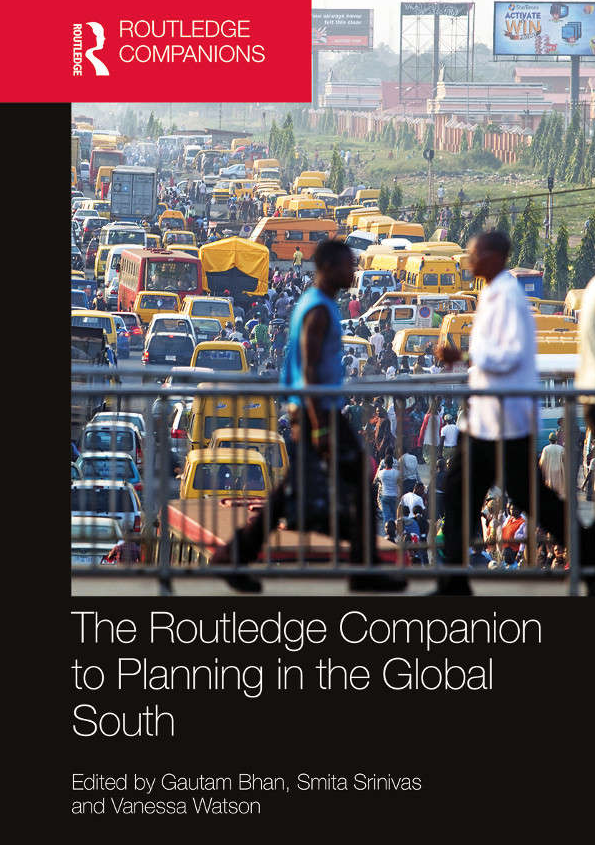 The Companion to Planning in the Global South, edited by Gautam Bhan, Smita Srinivas, and Vanessa Watson, is newly published by Routledge, and available for libraries to order (the cost is otherwise quite steep, although there is a lower cost edition for South Asia due to be published shortly). The collection is another contribution to ongoing debates about ‘southern urbanism’ and related topics, as the blurb makes clear:
“The Routledge Companion to Planning in the Global South offers an edited collection on planning in parts of the world which, more often than not, are unrecognised or unmarked in mainstream planning texts. In doing so, its intention is not to fill a ‘gap’ that leaves this ‘mainstream’ unquestioned but to re-theorise planning from a deep understanding of ‘place’ as well as a commitment to recognise the diverse modes of practice that come within it.
The chapters thus take the form not of generalised, ‘universal’ analyses and prescriptions, but instead are critical and located reflections in thinking about how to plan, act and intervene in highly complex city, regional and national contexts. Chapter authors in this Companion are not all planners, or are planners of very different kinds, and this diversity ensures a rich variety of insights, primarily based on cases, to emphasise the complexity of the world in which planning is expected to happen.”
Sue Parnell and I have a chapter in the collection, reflecting on the significance of SDG 11 (the ‘urban SDG’) and the so-called ‘new urban agenda’, extending the argument of our earlier piece on these issues. You can get the Introduction to the whole collection here.
 My paper on Geography and the Priority of Injustice is now available online at the Annals of the Association of American Geographers. The paper seeks to explain why the argument of my forthcoming book, The Priority of Injustice (available from all good booksellers anytime now, including Target), matters for geographers, and geographical thinking about the city in particular (it is part of a special issue of the journal on the theme of Social Justice and the City).
You can get a free online copy of the paper if you click here (this is free for the first 50 clicks – I guess after that you have to ask me for a copy). Here is the abstract:
“This article considers the challenges that follow from giving conceptual priority to injustice in the analysis of political life. Human geography, urban studies, and related fields of spatial theory meet this challenge halfway, insofar as expressions of injustice through social movement mobilizations are given primacy over philosophical elaborations of justice. The privileging of practice over theory, however, reproduces a structure of thought in which justice continues to be understood as an egalitarian ideal against which injustice shows up as an absence or deviation. The practical primacy accorded to expressed claims of injustice inadvertently displaces a model of authoritative, monological reasoning about the meaning of justice from ideal theory onto explanatory accounts and ontologies of space. Basic assumptions about how spatial theory matters to questions of justice are disclosed by tracing the recurrent disavowal of “liberalism” in debates on social justice and the city, the just city, and spatial justice. Thinking about claims of injustice in a double sense—as involving demands on others that require vindication—calls into question the value of inherited ideals of the political significance of the “the city,” by drawing attention to the enactment of distributed public spaces of claims-making, reasoning, and accountable action.”
Do please circulate the Call for Papers below for a session at the Annual Meeting of the AAG next April, in New Orlean, on the theme of Alternative Urbanisms to anyone who might be interested:
Call for Papers
Annual Meeting of the Association of American Geographers,
New Orleans, 10th-14th April, 2018.
ALTERNATIVE URBANISMS
Organizers: Clive Barnett and Jon Cinnamon (University of Exeter)
Cities are increasingly characterized as important sites of political, economic, cultural and environmental transformation, yet the proliferating attention to ‘the urban’ from policymakers threatens a narrowing of the boundaries of urban imaginaries around certain favored models. This session thus seeks to bring together papers that address one or more aspects of a growing contemporary concern with developing ‘alternative urbanisms’ in theory, policy and practice (e.g. Derickson 2015, Buckley and Strauss 2016, Parnell and Robinson 2012). We conceive of ‘alternative urbanisms’ along three dimensions. Firstly, alternative urbanisms might describe a focus on counter-hegemonic forms of urban living and practice that are alternative in relation to mainstream models and trends. Secondly, it can refer to a focus on how urban spaces are configured as experimental fields for the development of new practices in response to imperatives to restructure and reconfigure economic, social and technological infrastructures. Thirdly, alternative urbanisms might refer to a concern to broaden the scope of intellectual reference points through which urban practices can be conceptualised and investigated methodologically. Across these dimensions, it is agreed that more effort is needed to extend the canon of contemporary urban studies, urban and regional science, planning, and human geography to include insights from the humanities, natural sciences, or engineering, and also to draw on empirical and theoretical resources from beyond the Global North.
We welcome theoretical and empirical papers that push up against the boundaries of urban thought, policy and practice – papers that aim to critique the urban mainstream as well identify new possibilities for understanding and acting on urban challenges. The following is a sample of questions germane to this session, although we welcome papers on all topics that fit the broad scope.
Please send an abstract of no more than 250 words by 13th October to: Clive Barnett (c.barnett@exeter.ac.uk) and Jon Cinnamon (j.cinnamon@exeter.ac.uk).
References
Barnett, C. and Bridge, G. (2016) The situations of urban inquiry: thinking problematically about the city. International Journal of Urban and Regional Research 40, 1186-1204.
Buckley, M. & Strauss, K. (2016) With, against and beyond Lefebvre: Planetary urbanization and epistemic plurality. Environment and Planning D: Society and Space, 34, 617-636.
Derickson, K. D. (2015) Urban geography I: Locating urban theory in the ‘urban age’. Progress in Human Geography, 39, 647-657.
Parnell, S. & Robinson, J. (2012) (Re)theorizing Cities from the Global South: Looking Beyond Neoliberalism. Urban Geography, 33, 593-617.

 Here are details of a Forum on the theme of Resilience and Design, edited by Rob Cowley, in the journal Resilience. As well as an introduction by Rob, it consists of four short essays on ‘urbany’ themes, mainly, by myself, Tania Katzschner, Nathaniel Tkacz, and Filip De Boeck. Here is the list of contents:
Resilience and design: an introduction, Robert Cowley
Planning as design in the Wicked City, Clive Barnett
Design, responsibility and ‘Staying with the Trouble’: rethinking urban conservation in Cape Town, Tania Katzschner
In a world of data signals, resilience is subsumed into a design paradigm, Nathaniel Tkacz
‘The Hole of the World’: designing possibility through topography in Congo’s urban settings, Filip de Boeck
And here is the abstract for the whole collection:
“This forum aims to encourage theorists of resilience to engage more closely with different aspects of design theory and practice. The introduction outlines a series of largely unacknowledged parallels between resilience and design, relating to the valorisation of processes over states, the loss of faith in ‘planning’, the ambivalent status of boundaries and interfaces, and open-ended political possibilities. Four short reflections then follow on various design-related topics: the significance of the ‘wicked problem’ in contemporary urban planning and design, and the urbanisation of responsibility; design’s potential to repoliticise and engender new forms of responsibility; the significance of the digital interface; and the condition of everyday life in the ‘unplanned’ post-colonial city. Readers are invited to build on or refute the explicit and implicit links made between resilience and design in the various forum contributions.”
I have a bunch of free e-copies of the Forum, so let me know if you’d like one!
My review of Territories of Poverty: Rethinking North and South, edited by Ananya Roy and Emma Shaw Crane, is available online at Space and Polity – it’s a really good collection, informative, challenging, and innovative in its weaving of different perspectives and different generations into a whole.
 So, here is the back-cover blurb for The Priority of Injustice, from the new Winter catalogue from the University of Georgia Press. The book is not published yet, I am sitting here with the proofs at my feet, waiting for an index to be delivered before sending it all back to the publisher one last time (no-one else might read this book, but it seems to be all I’ve been reading for the last two years).
“This original and ambitious work looks anew at a series of intellectual debates about the meaning of democracy. Clive Barnett engages with key thinkers in various traditions of democratic theory and demonstrates the importance of a geographical imagination in interpreting contemporary political change.
Debates about radical democracy, Barnett argues, have become trapped around a set of oppositions between deliberative and agonistic theories—contrasting thinkers who promote the possibility of rational agreement and those who seek to unmask the role of power or violence or difference in shaping human affairs. While these debates are often framed in terms of consensus versus contestation, Barnett unpacks the assumptions about space and time that underlie different understandings of the sources of political conflict and shows how these differences reflect deeper philosophical commitments to theories of creative action or revived ontologies of “the political.” Rather than developing ideal theories of democracy or models of proper politics, he argues that attention should turn toward the practices of claims-making through which political movements express experiences of injustice and make demands for recognition, redress, and repair. By rethinking the spatial grammar of discussions of public space, democratic inclusion, and globalization, Barnett develops a conceptual framework for analyzing the crucial roles played by geographical processes in generating and processing contentious politics.”
 After 8 years, the imminent departure from Swindon by the end of the summer now looms on the horizon. This blog has been very much shaped by the experience of living in this non-University town, while living in a very Respectable Street.
Swindon, of course, has a certain sort of reputation as ‘a dump’, which is not quite fair, and even if it is, given the representative significance of Swindon in the history of British society, it’s no more of a dump than the rest of the country. Aroundaboutz, of course, in the surrounding countryside populated by plenty of Generals and Majors, there are all sorts of attractions, if you like White Horses and stones circles and if you can survive on a Farmboy’s Wages. And it’s not too far away from the Towers of London, if you fancy a day trip. But that’s still underselling Swindon itself, which has quite a few treasures all of its own. It’s a good place to visit if you like railway museums, odd art deco treasures, or want to trace the origins of the NHS. In the time I have lived here, one can trace the diminution of the public realm under the pressure of austerity, felt in the absence of Sure Start centres, libraries, bus services, and nurseries that were the elements of our daily life when I first moved here. But actually, a life here isn’t just the privatised experience of a New Town Animal in a Furnished Cage. There are things worth getting out and about for. You could even spend half a day on a self-made Diana Dors walking tour, culminating perhaps at Swindon’s very own answer to the Statue of Liberty.
So should you ever find yourself stuck here and in need of entertainment, or indeed if you find yourself Making Plans to pass close by, here is my personal guide to the best 10 things that public life in Swindon offers to you:
1). Top of the list is the Swindon Museum and Art Gallery. A quite extraordinary place, mainly for the art collection (not to the mention the crocodile or the Mummy).
2). Town Gardens. A place for kids to play, the site of the best annual(ish) South Asian festival I’ve ever been to, and a place where sometimes, if you look carefully, you can catch a glimpse of the Mayor of Simpleton wandering around.
3). No public sphere is possible, as old uncle Habermas reminds us, without a thriving commercial life to sustain it. The Swindon Designer Outlet shopping centre might not sound much, but even if you don’t like shopping, go there – it’s in the remaining part of the Great Western railways works, so it’s like walking through a portal into the historical geography of the town.
4). And, still with Habermas, you need coffee shops too – visit Baila, a little slice of cosmopolitanism in Old Town. At nighttime, it might well be true that Life Begins at the Hop, but it should end here, in a Crowded Room full of discerning gin drinkers. By day, it’s a haven for home-workers happy to listen to acid jazz and not-so-obvious Motown.
5). Los Gatos, or just ‘the Spanish’, a small slice of authentic British ex-pat Tapas in Wiltshire, this was the ONLY nice place when I moved here, but now it is like a trusted old friend you know will always be there when other things disappoint. Great coffee.
6). The Arts Centre. Swindon has a proper, big theatre, The Wyvern, which is also worth a visit (especially for Jon Richardson’s ‘returning home’ gigs), but the Arts Centre is another little hidden gem, a place to see Am-Dram performances of The Crucible or watch Mark Thomas or see foreign films or listen to Thea Gilmore.
7). Swindon is a very sporty town, with a disappointing football team embedded in the community in all sorts of commendable ways, Speedway, and best of all, Ice Hockey. Go Wildcats! It’s just like Canada.
8). There are various things to do at Coate Water park, but the best one is to take a ride on the miniature railway – because it’s Swindon, so you have to find a way of riding on a steam train.
9). The Old Town Railway Path. Yes, yes, I know, it turns out that almost everything on the list is related to railways, but if you need a walk, this is great – this is another bit of historical geography, a disused railway cutting that overlooks the ‘The Front Garden’ between Swindon and the M4, now the site of a major new housing development, and gives you a view in the distance of the Science Museum‘s large-object store at Wroughton, and if you like Rock, you can even see some exposed Upper Jurassic geological formations (apparently). Certainly a place to get your Senses Working Overtime.
10). Oh, and then there is the musical heritage – you don’t even have to come here to experience any of this, but all of it makes so much more sense if you’ve lived here. This is Pop.
How said to hear, via Derek Gregory at Geographical Imaginations, of the death of John Davey, long-time editor of a whole series of agenda-setting books, texts, and series in Geography going back more than four decades. I first met John when I was a graduate student, when he could sometimes be found immersed in intense rivalry with David Harvey over the Bar Billiards table in the Bookbinders Arms in Jericho. I remember learning from John just how peculiar, tenuous, but also central commercial publishing was to the growth of new academic fields. Twenty years or so ago, I sent him a proposal for an edited collection on the links between media theory, spatial theory, and theories of democracy – he suggested that it would be better if I wrote it myself, which was a tremendously important confidence booster for me at the time, so I did, coaxed along by him. He had moved to Edinburgh University Press at this stage, where he cultivated for a short time a remarkably strong Geography list, including titles by Harvey, David Smith and Marcus Doel. Another figure from a pivotal geographical generation who is done too soon.
 Pop Theory