Music to Write Books To

UntitledI participated in an ESRC-sponsored seminar last week on the theme of the politics and economies of attention, which was interesting and fruitful in all sorts of ways. Lots of the work on this topic turns around a distinction between ‘good’ forms of attention, which is focussed and contemplative and “deep”, and ‘bad’ forms of attention, which is fleeting, distracted. A certain sort of reading of a certain sort of text is the model against which other forms of attention are often judged in a great deal of high theorizing on this topic.

Trying to find something interesting to say about this topic made me aware of how the ways in which I work, both in relation to reading and writing, do not quite conform to the expected model of scholarly attention. I read with the TV on, and write while listening to music or the radio, and not serious Radio 3-type music either (it’s generally a matter of choosing between Taylor’s 1989 and Ryan’s 1989). This way of working may or may not be reflected in the depth of understanding of ideas and thinkers displayed in the things that I write. I actually find it rather odd to write, in particular, in silence. I am still in recovery from having finished a book manuscript, and found myself today, while sitting in a hairdressers, not having my hair done, constructing a list of songs that, more or less tangentially, capture something of the experience of writing the sort of book I have been trying to write for the last year and a half:

  1. I Just Don’t Understand – Spoon
  2. Jacques Derrida – Scritti Politti
  3. Acid Tongue – Jenny Lewis
  4. Distractions – Bobby Darin
  5. Why Theory – Gang of Four
  6. Unputdownable – Róisín Murphy
  7. Waking Up – Elastica
  8. We Love You – Psychedelic Furs
  9. Drink in My Hand – Eric Church
  10. Gone Daddy Gone – Violent Femmes

I’ve got a lot of songs but they’re all in my head

IMG_1983I have come to the end of my ‘research retreat‘ in Vancouver, and have succeeded in reducing the first sprawling draft of +200k words to a more manageable size, ready for a final edit and submission in a month or so. In the process, some themes have been reduced or sidelined, some theorists have disappeared (no Poulantzas after all), and some issues crystallised for me.

Vancouver is a good place to immerse oneself in one task, away from other cares and concerns. It’s sunny (well, they have a drought on). And it has plenty of the ‘architecture’ of Thought, those spaces that make up the distributed office: public spaces of various sorts, coffee shops and public libraries in which to write and think (and plenty of free wi-fi), loads of bookshops (my favourite is Lucky’s), as if it was the 1990s (a lot of Vancouver seems to be like the 1990s), and a decent bus service to ferry you from one place to the other as you punctuate the day’s work. In no particular order, these are the places upon which my routine settled: Cuppa Joy Coffee (great for 6.30am starts); Professor and Pigeon (the only place that wasn’t a Starbucks to do Flat Whites); Melriches Coffee House (good for the evenings); MBA House in Wesbrook Village (good to be surrounded by other studious people); Koerner Library at UBC (a proper university library, it has the books you think it won’t have but turns out that it does); and the bar at Cardero’s on Coal Harbour (good for talking about the history and philosophy of geography, amongst other things).

I should say that I am surprised by just how much Neil Young is played in Vancouver’s coffee shops, bars and restaurants. You know you are in Canada when….

So back to the real world now, to a rainy bank holiday weekend in Swindon, kids back to school next week, start of term on the horizon, and a book to finish – back to Baila.

Bookfair!

bookfairIt’s all happening this month in Swindon, including the first Radical Bookfair, presented by the Swindon TUC.

Local Politics: A University for Swindon?

stDespite now being the home to one of the largest collections of scholarly books in the world, Swindon remains very much not-a-University town – there has been a long-standing civic ambition which goes back at least to the 1940s to get one. Recent years have seen initiatives to snag some bit of an expanding existing University, such as Bath, but these have come to naught. It does, though, now have a BPP University College, so that’s good. In a way. Maybe. Maybe not.

Swindon claims, not proudly, that it is the only major urban area in England and Wales without a University, or the biggest one, or some variation on this (though I think Milton Keynes might also qualify for this distinction, depending on what it is that this sort of claim is getting at – it’s about relatively low levels of participation in higher education in these places). Even Cirencester up the road is now set to be a proper University town.

Allan Cochrane and others at the OU have been researching the place of Universities in their localities and regions, looking at the changing rationales of economic growth and public engagement shaping this relationship. Swindon is interesting because here the story isn’t how established institutions now seek to engage with the places of which they are a part, but how and why local actors think it’s a good idea to have a local University in the first place. Via Twitter, I came across the latest round of discussions on this issue of the Borough Council earlier this month, including a consultancy report, A University for Swindon, which provides a profile of the current participation in HE of people living in Swindon. The report is shaped by the aim of establishing levels of potential demand for Higher Education in the town and round-abouts (ha!).

The report, and the wider strategizing over the last couple of years, indicates some of the assumptions about the potential benefits of having a higher education presence (of any sort, we’re not fussy), assumptions shared broadly across the political spectrum (as I think I have mentioned before, Swindon’s civic boosterism has a long history of attracting academic scrutiny of one sort of another, from Michael Harloe in the ’60s through to the 1980s localities debates. Phil Pinch even dubbed Swindon an archetypal ‘ordinary place’ twenty years or so ago. Trust me, it’s certainly a lot more ordinary than Johannesburg or Rio de Janeiro).

Anyway, the current strategy is an incremental one. A University Technical College (UCT) is set to open in 2014, with Oxford Brookes as its University sponsor and a locally-based ‘international high-tech’ company as its business sponsor. It will specialize in providing in engineering courses for 14-19 year olds. This is meant to be the first step towards realizing the dream of a University for the town, a dream which is seen as central to local economic development and growth, and which is strongly  supported by Influence, the organization representing the business community in Swindon.

The report commissioned by the Council has some interesting stuff in it. For a start, Swindon has relatively low rates of participation in HE, and they are not improving. This, in fact, is central to the strategy for attracting or building an HE presence locally. There is an assumption that the skills base is central to future economic development, and that a University is one way of dealing with the supply side challenges facing the town. It turns out, and this is what first attracted my attention, that 15% of Swindonians in higher education study with the Open University, which is above the national average. The report takes this as proof of ‘latent demand’ for a local University, along with the fact that a third of all Swindonians enrolled in HE are at UWE in Bristol, Bath Spa, Oxford Brookes, or the University of Gloucester – all about an hours drive away, but none technically ‘local’ according to the way these things are officially defined. But the report is careful to point out that levels of participation in HE are not straightforwardly linked to the presence or absence of a local University: “The availability of local HE provision is just one factor influencing learning patterns, other factors include levels of attainment prior to 19; deprivation and aspirations.” Swindon does not score well at all in those other factors, which is the real story behind the report.

Region

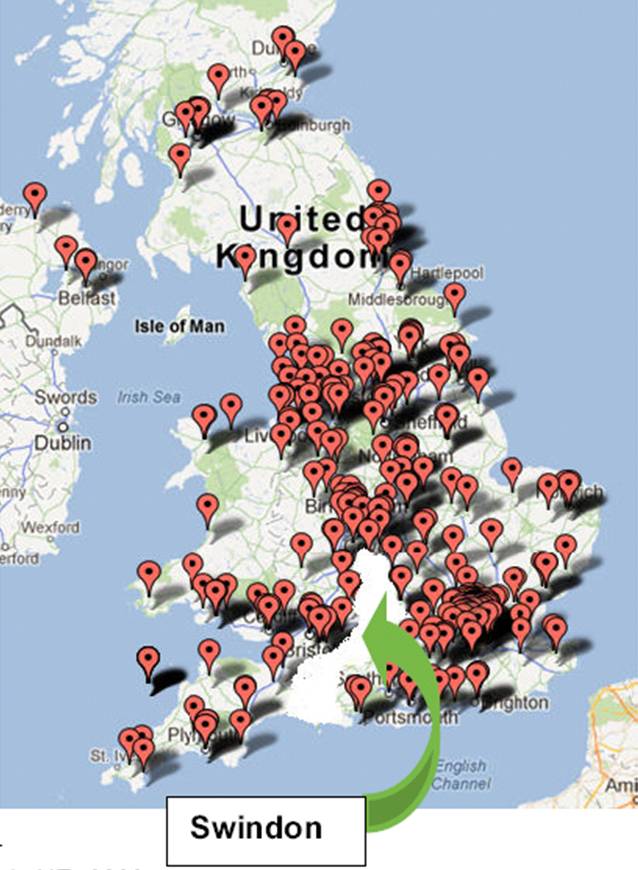
So there are interesting geographies revealed by this report – geographies of absence, and geographies of ambition, and imagined geographies too. In one section, for example, it is noted that “The impetus for a university stems in part from the knowledge that Swindon is one of the few major settlements in the country without an HE institution”. Then, with the help of a rather busy map, it is claimed that “Swindon lies in a swathe of country without a university which stretches from Stratford on Avon in the north to Weymouth in the south. Whilst this research has focused on demand from Swindon; this gap underlines the point that any new university would also be likely to attract students from nearby Wiltshire and Gloucestershire.” I’m not sure this ‘swathe’ actually adds up to a real region – it’s basically anywhere West of the M40 if you swing round Oxford on the A34, east of the M5 as long as you don’t stop at Bristol, Gloucester, or Cheltenham, and a large part of this empty swathe south of the M4 consists of Salisbury Plain. And I rather doubt whether rates of HE participation in Wiltshire towns like Marlborough or Salisbury will be significantly affected by any new University of Swindon (Swindon is in Wiltshire, but not necessarily of Wiltshire). And of course that statistic about the level of enrolment with the OU might not be best read as an index of the absence of alternatives either – but as further indication of the fact that local levels of HE participation are only tangentially related to local provision.

But keep your eye on Swindon – the future of non-elite higher education, shaped by assumptions about skills, the knowledge economy, and business partnerships might be slowly revealed here. Meanwhile, I have the sense of the town having all the component parts of a proper University without quite having composed them properly into one: loads of potential students, as well as already having all the books and even all the research money. What could be easier?

Local Culture II: ‘Mum, it wasn’t Drogba’

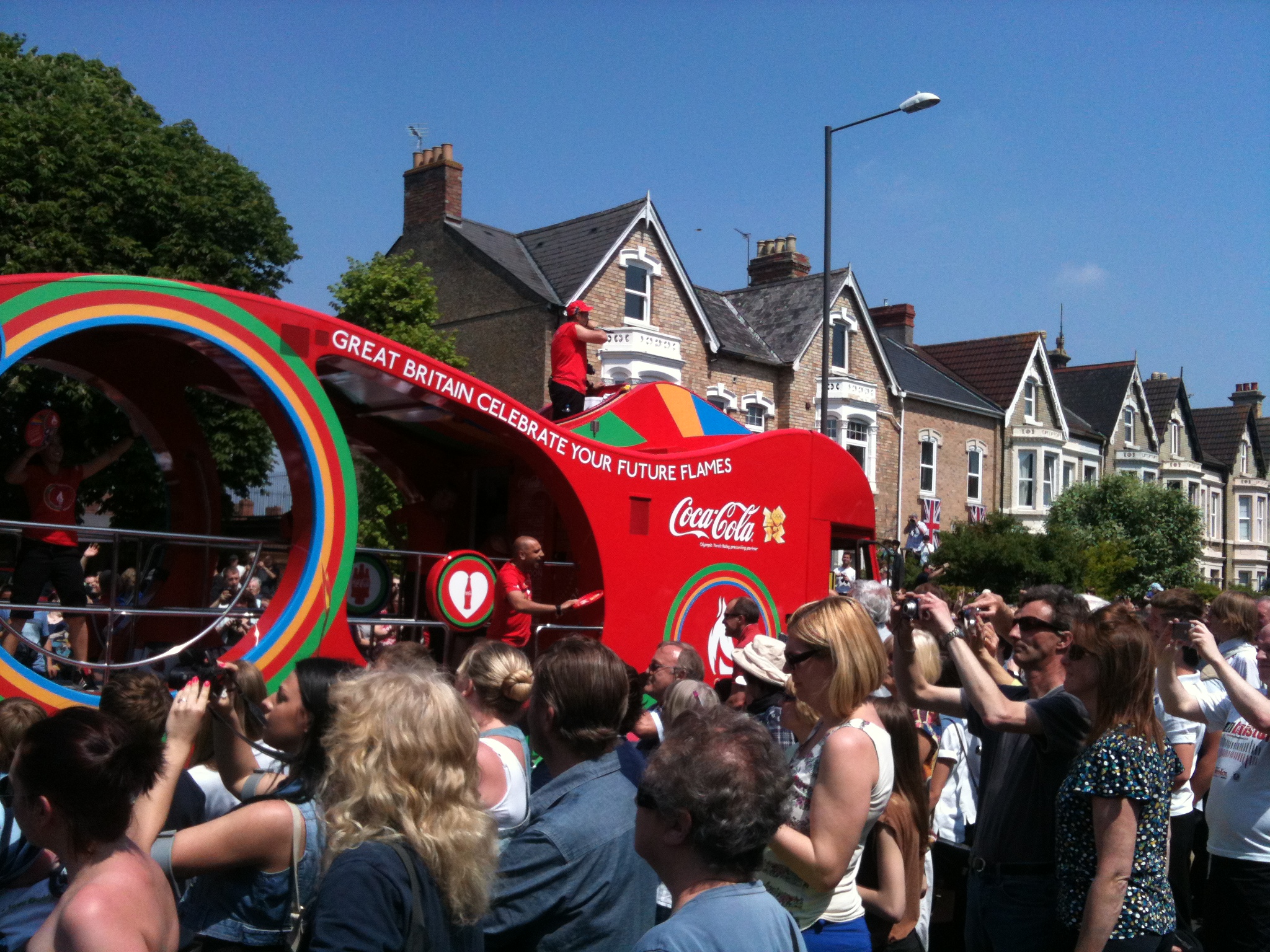
I’m not sure that I should admit this publicly, but I’ve just been to watch the Olympic Torch go past – right down the bottom of our road, en route from Bristol to Gloucester, which is a route that maps onto a whole trajectory of my life at the moment.

Last time I participated in a form of organised spontaneity on this scale was in 1997, when we accidentally stumbled into the middle of the Queen’s return to Buckingham Palace the day before Diana’s funeral. Today seemed altogether much healthier.

Anyway, the buzz is all about Didier Drogba carrying it through town – where else would he want to make his first important public appearance since Saturday, after all? Hey, Swindon Town could afford him now, they should snap him up while he’s here.  

Listened to a bit of the Torch’s progress live on radio this morning, a fantastic example of how radio can now conjure really parochial public spheres into existence: listening to the Torch go through Wroughton; or to county cricket live from Taunton? Dilemmas, dilemmas.  

Obviously, I have engaged in all of this for cultural studies purposes only.

Local Politics VIII: School Daze

There has been plenty of news coverage recently about the progress of education reform in England, partly coinciding with teachers’ unions conferences threatening action in response to various policies introduced by Tory education secretary, Michael Gove. Not least, of course, the move to systematically transform the structure of public schooling via the Academies Act of 2010, through which schools have been bribed and/or bullied into converting to Academy status. The not-so-stealthy stealthy transformation of the governance of schooling is based on sheer theoretical and ideological prejudice, and is busily realising one of the longest standing aims of right-wing politics in UK, which is the removal of schooling from Local Authority jurisdiction.  

One aspect of the reporting of this process has been the repeated line about how Gove’s project has not attracted the same sort of attention, or opposition, as changes to the NHS. There might be many reasons for this, but one aspect of it might be to do with the ways in which different public services, through the very ‘materiality’ of the services involved, constitute the subjects of public services in very different ways – a theme of the work of my OU colleagues John Clarke and Janet Newman, for example. I wonder if school education, as a public service, doesn’t constitute it’s publics in very different ways from health services?

One of the lesser reported features of the Academy-led transformation of schools is the conversion of primary schools – only 5% of primaries currently have or are seeking Academy status, but that is likely to increase. The school our eldest child goes to, since last Autumn, is one of these Academy primaries. In Swindon, as elsewhere, you apply for a place in local authority schools about 9 months before your child is due to start. So we applied back in January 2011, for a place one of three local authority run primary schools. The closest one, the preferred one, is about 500 yards outside the back gate, is a resolutely middle-class school in a middle-class area, not great Ofsted report last time round. In between applying and being informed of the successful outcome, sometime this time last year, around Easter, the school actually decided, however these things work, to apply for Academy status, in tandem with (and thereby bolstering) the Academy application of the secondary school which is in the next road over from ours, the one-time Grammar school for Swindon. We only found this out sometime in the summer, when we began to attend the induction meetings for parents of new starters. I remember being told in a conversation with one of the Governors that this application did, indeed, amount to accepting a bribe, since the offer on the table at that point from the Government was that schools which applied would get lots more money, which would not be on offer if they delayed. As of 1st August, the school has been an Academy. It’s not clear, yet, what difference this makes – it hasn’t changed its admissions policies, for example, the most obvious change that the Academy policy now allows. But it’s early days.  

So, we find ourselves enrolled into a new form of public schooling, without being consulted, right in the middle of being involved in the process of, nominally at least, exercising a bit of school ‘choice’.

Meanwhile… the decision by the local council, Tory-led, to build another primary Academy not so far from where we live in the Old Town part of Swindon (the ‘old town’ bit refers to what Swindon was before the railway arrived, down the hill, in what became ‘new town), has become the focus of very intense local opposition.

The opposition to this decision has been led by residents of the immediate area around the site of the new school – located next to a local authority sports centre, opposite our local SureStart centre, on local council land. The campaign against the school focussed on issues of procedure around planning decisions, and took a while to catch the attention of local news or politicians. But it has now become a staple item in the Adver, and the local Labour party also caught on too. Despite letters and petitions opposing the new school, it received the go ahead before Xmas, and work has started on the site.

As a news story, however, the new school continues to generate news – it’s due to open in September 2012, so is likely to remain a news item until then, at least. On March 24th, the only news item in the Adver of any significance which was not related to Swindon Town’s day-out at Wembley the next day (oops…) was about the continuing opposition to the new school by local residents. One of the leading figures in the campaign is now challenging the leader of the Tory council in the upcoming elections.

The thing is… the central issue in the debate about the school, beyond the procedural issues involved in the decision, have revolved around the concerns of residents that the new school will create traffic gridlock and reduce green space. This is, then, a very local campaign, focussed on the concerns of people living in the immediate vicinity of the new school. These are not to be dismissed lightly – what has kept the campaign has going, and made it more than a merely local story, is the fact that it is another example of a pattern of cavalier decisions by the Tory council that appear to circumvent democratic norms, such as they are at local government level. But the fact that the new school is an Academy school, and as such is part of the wider Gove-revolution, this has not been much commented upon. This isn’t the issue, in this case of local politics.

The company setting up the new school, which also runs other schools in town already, is also the same company that runs the private nursery which we send our other child to – very good, very nice people (when we only had the one child, pre-school, she went to the Council-run nursery down the hill, also very good, very nice). Our decisions about school and nursery ‘choice’ have been based primarily, I think, on issues of convenience, constrained of course by a fairly limited set of options to actually choose from – nothing unusual there (although, surprise surprise, higher income level groups benefit more from proximity effects in school choice than others).  It turns out, of course, that the sorts of information that parents are meant to use to inform their choices on such matters might well be close to ‘meaningless‘ – according to academic research at least.  

The point of all this is to try to clarify something about how the constituencies of a public service like schooling are constituted. Our relationship to this issue is inevitably partial, mediated by our children; a while back, I knew very little about these things. The relationship of those opposed to the school is somewhat different, although it might overlap in some cases, but is primarily shaped by a very local ‘community of affected interest’, as they say. In neither case are the long-term, structural changes involved in transforming the governance and funding of primary schools, much less secondary schools, with all the attendant issues about inequality and social mobility, a felt concern of those people most immediately affected by these decisions to build new schools, or to convert the status of existing ones. Those changes are, literally, rather abstract, not only for those parents swept along by them like us, but also it seems for those involved in the real politics around school building in this area. In certain respects, education seems to me to constitute its public subjects very differently than do those public services associated with health care, for example – at once more partial, more selective, more inflexible, and more choosy than the subjects of health care, perhaps?

Local Politics VII: Coming soon to a place near you

Swindon is suddenly at the centre of a concerted right-wing attack on trade union rights in the public sector. The Tory-led council intends to put into practice the changes demanded by a concerted campaign orchestrated by the Taxpayer’s Alliance, and the newly formed Trade Union Reform Campaign, to attack ‘facility time’, on the grounds that this is a ‘scandalous’ subsidy by taxpayer’s of union activity. The TUC provides a corrective to the claims behind the campaign, and a nation-wide campaign to oppose these moves is quickly being galvanised, apparently.

And they say nothing ever happens here – just remember, they got rid of speed cameras first in Swindon, well before the idea caught on at national government level. What happens in Swindon…

Local Culture I: Life in a Museum

Should anyone out there be stuck for something to do in Swindon in the next couple of months, you might try a newly opened exhibition at the Swindon Museum and Art GalleryBack to Black… and White is the product of a project that involved local schoolkids, working in a dialogue with an archive of photos of the town from the 1940s to 1970s. The details and background to the project are here.

I have to say that it was a complete accident that I found out about this. The Museum is just down the road from where we live, and it has recently come in handy as a place to spend half an hour with a 5-year-old and an almost-1 year old. But today I managed to drag the 37 year-old (oops) in, rather reluctantly. The Museum is in fact a terrible space – no lift, in a nineteenth-century house with multiple floors, which is no good for the pram-connected. You have to get the little one out and carry her – and she’s getting heavier by the day.

But, anyway, I didn’t know this ’til we (me and the two non-reluctant ones) wandered in just before Xmas, but it turns out that the Museum houses what is meant to be one of the best collections of twentieth-century British art outside of London. Who knew? It actually consists of one piece by just about anyone you might have heard of – a Lowry here, a Freud over there, an important Ben Nicholson, apparently. Another aspect of the town’s weird legacy of mid-century civic mindedness.

The art collection and the town’s public art (statues of Diana Dors, that sort of thing) have been the focus of projects by the local public-ish-private-ish booster organisation, Forward Swindon, to make more of these cultural assets – as I said, an effort that has to address the fact that the museum and art gallery is actually such a rubbish space.

The art gallery is not very big – the size of about three squash courts, so you don’t get to see the whole collection all at once. And this new exhibition is the first time I’ve seen them showing a range of the photos that they apparently hold – a few are pasted on the walls. The Council’s full collection is on Flickr. I’m not sure why old photos of Swindon are as fascinating as they are to me – I didn’t grow up here (lucky escape). I think it might be because Swindon is quite small, so that many photos of the town are of places vaguely familiar, already. It’s also that the historical geography of the place is quite transparent, ‘cos it’s not very old, so you can see ‘layers of investment’ quite easily as you walk/drive/ride (I have a new bike!) around. Whatever it is, it’s another worrying sign of a growing attachment I seem to be developing, at least to the idea of Swindon.

Neoliberalism after governmentality

A good crisis is usually bad news for rigorous thinking, and so it seems as the term ‘neoliberalism’ ossifies into a catch-all popular phrase to describe all the things that right-minded lefties don’t like and blame for current troubles. Oh well. I suspect the systematic mis-representation of the past 40 years or so of politics, policy and economics which the ‘critical conventional wisdom’ on neoliberalism sustains (in both Marxoid and Foucault-inflected variants) is a hindrance to the development of creative alternative visions of democracy and economic life. The ‘critical conventional wisdom’ line is from a new book by Stephen Collier, Post-Soviet Social: Neoliberalism, Social Modernity, Biopolitics. Collier is an anthropologist, and has developed a similar line of critical thinking about ‘neoliberalism’ and the use of Foucault to that of James Ferguson – Collier has an excellent 2009 paper in Theory, Culture and Society on the need to move beyond analyses of governmentality that just extend old-style models of ‘power’ (on a related note, Michael Warner’s recent piece on the past and future of queer theory is another reminder of the degree to which political readings of Foucault tend to rush over the problems of thinking about normativity, towards simpler ideas of the power of ‘norms’; or, to put it another way, conventional accounts of governmenality and neoliberalism are remarkably ‘straight’ in the ways in which they think about subjectivity, power, and the like).

The book is a detailed empirical analysis of the restructuring of ordinary spatial infrastructures in Russia over the last two decades, but one which seeks to challenge a series of settled understandings about The Washington Consensus, neoliberalization, and the like. It’s very ‘geographical’, partly in its focus on urban and regional scale issues, but it also has a much more interesting line on how to think about the geographies of ‘neoliberal technologies’ than the standard diffusionist line peddled by many geographers. There are various notable features of Collier’s analysis:

– it looks at ordinary practices of governance, how they arise as problems in specific situations, rather than tracking circulations of policy discourse;

– related to this, he focuses (at last, someone has, one might think), on a set of ‘neoliberal’ thinkers beyond Hayek, Friedman, etc – in this case, James Buchanan and George Stigler; theorists of government, law, regulation, the state, institutions, not ‘markets’; as I have suggested here before, the insistence on thinking of ‘neoliberalism’ as a theory of markets-against-the-state is factually wrong and analytically short-sighted;

– he insists on thinking of neoliberalism as a precise range of ideas and practices, in line with the quite restrictive sense that Foucault deployed in his 1978-79 lectures on biopolitics, and resists the ‘hegemonic’ interpretation which insists that everywhere neoliberalism turns up it must and does become the dominant dynamic (i.e. neoliberalism might not be the most important thing that has been going on, always, and everywhere, once one stops calling all sorts of things ‘neoliberal’);

– and he develops the intriguing thoughts of Foucault on socialist governmentality, focussing ‘methodologically’ on thinking about socialist biopolitics from back in the 1920s, and in terms of the analysis of ‘problematizations’ rather than coherent systems of ‘governmentality’.

The thinking that Collier, Ferguson and others are doing about these issues strikes me as really important – it’s not just ’empirical’, but cuts to the heart of some prevalent ways of doing theory which have arisen around topics such as neoliberalism, concepts such as governmentality and biopolitics, and imperatives for academics to be ‘critical’.

Demonstrative Theory

Current events ‘out there’, in the streets no less, have been an occasion for the rehearsal of various theoretical standpoints on the meaning of democracy and the status of politics. Some writers have presented recent politicizations of public space as models of a purity of political action consisting of the expressive presence of bodies in space, as confirming both that this is all that is left politically and that this is what is most proper to left politics (a shout-out here for my old friend Andrew Merrifield, who provides a most eloquent variant on this theme in the latest New Left Review). I’m in no position to evaluate or assess the contours of these movements (there is no Occupy Swindon movement, nor do I expect there one to be anytime soon), but there is something about this sort of interpretation that doesn’t quite ring true for me.

There are some interesting blog discussions sparked by a piece at Critical Inquiry’s new blog site on Occupy Theory. What this piece raised for me was the question of how far one thinks of theory as essentially an interpretative device, used to give meaning to an event or events; or how far one thinks of theory as a hypothesis generating machine, something that raises questions about an event. There is a new site at Possible Futures that does some of this latter sort of theory work, including essays by Saskia Sassen and Craig Calhoun (newly announced as the next Director of the LSE – what a great appointment). Calhoun’s piece, for example, raises some interesting questions about how policing of protest has changed time. At TomDispatch, Rebecca Solnit has a piece about the Occupy movement in the US connects with longer traditions of civil society and non-violence movements, and this reminded me of arguments about the idea of the US in particular as a ‘movement society’ – there are interesting generational effects at work behind these protest movements which deserve more attention.

The fascination with the occupation of real space also surely needs to be put in the context of how this form of ‘presencing’ reverberates through other spaces, including mediated ones (it was all kicked-off by Adbusters, remember), but also through time, and above, there is the vexed question of how this moment of protest (not just the Occupy example, but also the return of street protest in Egypt) interacts with the sequencing of electoral cycles. Given the likely geographical dynamics of the 2012 US Presidential election, for example, it is interesting to speculate on how far the populist sentiments expressed by the Occupy movement will be articulated in the coming year, and by which side. Sidney Tarrow had an interesting little piece in Foreign Policy a month or so ago, on OWS as a ‘we are here’ movement akin to the women’s movement, the point being about the long-term effects of this ‘event’. Tarrow and Doug McAdam also have an interesting piece on the relationship between social movement scholarship and electoral studies, from 2010, but which is rather prescient in light of recent events in the USA – one of their points is that analysis of movements tends to be overly movement-centric, and underplays the role of electoral politics in generating and orienting non-electoral, non-party mobilisations, campaigns and protests: this point appears to be well supported by the resurgence of protest in Egypt these last few days, as Mariz Tadros argues at the IDS blog, in which the relationship between street mobilizations and elections is central.