What Do Universities Know?

Yesterday saw the launch of the GW4 Vision, the statement of ambition of the GW4 Alliance of four ‘research intensive’ Universities in what is referred to as the “Great West”, Bath, Bristol, Cardiff and Exeter. GW4 is modelled after other regional higher education consortiums in the UK (the first of these was the N8), and together they represent a paradigm for the coordinated effort to do ‘impact’ of a certain sort. GW4 is nominally a research-focussed initiative, although in practice it is driven primarily by the discourse of “research and innovation”, which is something else entirely. GW4’s vision is oriented around a reference to the ‘region’ of the “Great West” – in one sense this is entirely made-up, but perhaps more interestingly, one might think of this type of research and innovation strategy as one step in the active process of trying to make-up this region, if you see what I mean.

The GW4 vision identifies key areas of research excellence with the potential to drive “innovation”, including sectors of advanced engineering and manufacturing, data sciences and medical sciences. It’s an interesting test case of a rapidly consolidating policy consensus about how higher education institutions can drive urban and regional economic growth, in a context in which national government’s belated discovery of the need for an “Industrial Strategy” translates into an agenda for reconfiguring the purposes of science funding. This is reflected in the rapid emergence of the discourse of ‘challenge-led’ research, which sounds like an uncontroversial, even virtuous idea. You can see this reflected in the GW4 strategy – you don’t have to look too hard to notice that the challenges that it seeks to address are all copied straight from unmediated government-directed funding priorities, rather than from scientific or intellectual agendas – so it is that research is reoriented around Global challenges (as in the Global Challenges Research Fund), Industrial challenges (as in BEIS’s Industrial Strategy), and the Productivity challenge.

Outside of those niche fields specifically concerned with higher education policy, the full ramifications of this reconfiguration of research funding systems have generated remarkably little controversy – not only ‘out there’ in the real world, but even amongst most academics. Initiatives such as the GCRF and the formation of UKRI effectively mean the end of the long-cherished, perhaps idealized, Haldane Principle, according to which decisions about what government sourced research funds should be spent on should not be made by politicians but by scientists. The way in which that principle is now enshrined in legislation – according to which decisions about which individual projects to fund are still determined by independent peer review – is a wonderfully Orwellian piece of double-think – it confirms the abandonment of the structural core that makes the principle of any value in the first place. In a broader institutional context in which securing external grant funding is now a key, if not the main, criteria for professional advancement for many University researchers, one might think that the burgeoning field of challenge-led funding initiatives might constitute a serious infringement of both scientific integrity and academic freedom. But it has been effectively sold as meaning more money for researchers, and that tends to have a chilling effect on any serious dissent. This re-orientation of the public purposes of research funding not only attracts much less attention than the sorts of issues of access and affordability associated with news stories about Oxbridge admissions and tuition fees, but in no small part those controversies tend to draw on and support the underlying logic of these research-facing initiatives – it is often the status of Universities as institutions in receipt of large amounts of public funding directed at research, increasingly justified in relation to claims about driving economic innovation, that is leveraged against them when it comes to accusations of lack of inclusivity in matters of student recruitment.

A set of somewhat taken-for-granted geographical assumptions underwrite not only the GW4 initiative but this whole field of regional economic policy. According to GW4, for example, Universities “anchor” regional economies and have the potential to “drive-up productivity and wealth creation”. Assumptions about the links between science, innovation, and regional development now form the “spontaneous philosophy” of a whole sector of higher education external strategising. On the face of it, this actually looks like a breathtakingly naïve viewpoint, according to which the solutions to all sorts of pressing social and economic and environmental ills just require the application of appropriately complex scientific knowledge. Because that’s an idea that has worked well in the past, isn’t it? This rosy vision of the dynamic role of Universities as drivers of a virtuous circle of discovery, innovation, skills development, productivity and economic growth seems to require not knowing a lot about the causal processes underlying the structural problems of, for example, regional space economics in the UK; or not knowing a lot about the politics of economic policy making and implementation, much less about the politics of policy failure; and not acknowledging the full range of ways in which  Universities are always already parts of their localities and regions in ways which might well acerbate the problem those places face. In short, these sorts of research and innovation strategies seem to depend on the systematic elision of a large amount of the social science knowledge produced by significant parts of the institutions in whose names they speak (there is, it should be said, plenty of anti-social science of certain sorts informing these initiatives; and there is no problem finding space for the humanities in these initiatives either, since they are after all fields of expertise in the arts of selling out).

It would be easy enough to fall back on a conventional form of negative criticism at this point, as if all that social science can bring to the table is a certain sort of grumpy knowingness that would ruin any dinner party. My point, though, is that there are a series of social science arguments about how industrial development, business development, or labour markets actually work locally and regionally that, if they factored in, might provide for a more holistic, shall we say, account of how Universities sit in their places. There are at least aspects to this point worth considering in relation to a document such as the GW4 Vision statement. Two of these are related to the question of what type of economic growth Universities help to drive, and the third is to do with the coherence of the assumptions lying behind the vision of Universities as anchors of regional economies and therefore drivers of not only regional but national economic transformation:

1). Universities are, of course, machines for reproducing social inequality – the only question worth asking is whether the forms of inequality produced by higher education systems are justified or not (perhaps they can be if they are found to be to “the greatest benefit of the least advantaged members of society”, as someone once put it). This is not only a matter of student recruitment, but also includes broader questions about Universities as employers (or out-sourcers). This first point, one might suppose, already complicates the vision of the University as intentional agents of positive socio-economic benefits.

2). Following on from this first point, Universities in the UK certainly, and elsewhere too, are more or less proactive agents of a series of processes related to skewed property markets and financialization of urban space, including gentrification associated with expansions of University employment of academic and non-academic professionals, the ‘studentification’ of housing markets and retail spaces, and investments in green field science park initiatives and the like. This range of phenomena are no less significant means through which Universities help to shape patterns of economic growth in their localities than explicit efforts at doing knowledge-exchange and commercialisation of research, and their benefits are less than obviously fair.

3). Finally, there is a more reflexive dimension to this,  related to the ways in which very specific social science concepts are actively invoked to shape higher education research and innovations – concepts like “clusters”, for example, or “catalysts” which are sourced from particular disciplinary fields, or theoretical speculations such as “smart specialization“, the idea that underwrote the UK government’s Science and Innovation audits, one of which directly informs the GW4 vision of Universities as drivers of all sorts of innovative solutions to all sorts of challenges. These types of ideas are not merely descriptive ones, they are normative propositions, which just means it might be wise to slow down and think through possible unintended consequences of acting upon as if they were innocent.

GW4 might be a great case study, as it develops and unfolds, of the process of imaginative region-making. It’s an example of how increasingly Universities, either individually or in partnership as in the case of GW4, tend to adopt management styles based on singular, corporate-like visions of shared mission that everyone is meant to identify with, despite the fact that higher educations institutions (HEIs) are self-evidently and ever increasingly complex and internally variegated institutions juggling various and not necessarily consistent public functions. To adopt the terms of the research on publicness that I have been involved in with various colleagues, one might think of public purposes of HEIs in terms of the subjects of higher education (individual beneficiaries such as students, local communities, stakeholders such as non-student audiences, ‘parents’, and collective interests such as the national economy, employers and business); the mediums of public benefit of higher education (research, teaching, training, community engagement activities); and the objects, or the pubic goods, delivered by HEIs (skilled workforce, a knowledge economy, citizenship, lifelong learning, widening participation, public culture). Even this simple differentiation indicates the multiple and competing ways in which HEIs sit in their localities and regions and reach beyond them, as well as the variegated nature of the “impacts” associated with this multiplicity. This whole field – the role of HEIs in regional development – remains somewhat under-researched and poorly understood. Wouldn’t it be an innovative research project to investigate how and why Universities have impact, not just asserting that they should do it and pretending to measure it when they do. Investigating the impacts Universities have rather than the impacts they imagine themselves to be able to intentionally bring about would involve treating Universities as organisations just like all those others subjected to scrutiny by normal social science investigation.

In the context of the broader agenda towards thinking of HEIs as integral to the ways in which cities and regions act as drivers of economic, social and environmental change, there are at least two key research challenges that the elision of social science in current models of University-led research and innovation strategy keeps from coming fully into view. First, an initiative like the GW4 vision conforms to a wider tendency for economic growth strategies to run separately from social policy fields addressing issues of poverty, inequality, skills, as well as policy issues relating to sustainability (apart from when these are seen as technical or behavioural issues) and democratic accountability. Wouldn’t it be nice to imagine a University strategy for research and innovation geared towards inclusive growth? A strategy, perhaps, which imagined ways of addressing issues which are often taken to be obstacles (e.g. entrenched poverty, low skills, fragmented infrastructure) as routes to sustainable and inclusive economic growth strategies (e.g. through for example public sector procurement policies and social value initiatives, living wage campaigns, as well as skills policy, or sustainable regional innovation). Second, strategies like the GW4 vision and the broader shift to challenge-led funding are informed by a strong rhetoric of interdisciplinarity (again, who could possible gainsay that?). But the fields of research on cities and innovation or smart cities and regions that implicitly underwrite claims about HEIs and regional innovation – fields like environmental studies, information sciences, health sciences, regional science – are often associated with design-based, behavioural, technocratic, or engineering solutions to varied urban challenges. The happy rhetoric of interdisciplinarity in the world of research funding policy is another example of a seemingly wilful elision of social science knowledge, in this case knowledge about the difficulties of doing interdisciplinary work in ways that do not reproduce asymmetries of status and influence to harmful effect.  In those new fields of urban and regional ‘science’, certainly, the lack of shared vocabularies to bring competing epistemologies and methodologies into critical engagement with one another means that political, practical and ethical issues are not currently fully addressed in many debates about city-region futures. The ascendancy of new urban epistemologies that favour technocratic approaches to societal challenges raises pressing questions about the relationships between practices of expertise, civic participation, institutional accountability, and substantive economic and social outcomes. Again, there is plenty of scope here for creative, innovative research projects, if only someone was smart enough to fund them.


New Book: The Priority of Injustice

Newly published, The Priority of Injustice: Locating Democracy in Critical Theory. You can read more about the book here.

My book is available from most booksellers. If your local store doesn’t have a copy in stock, please ask them to special order it for you. If you don’t have a preferred local store here are a few other ways to buy a copy.

To find an independent bookseller in your area, visit these sites:

UK: https://www.booksellers.org.uk/Home

North America: http://www.indiebound.org/

Shop at these online booksellers:

Book Depository

Amazon

Barnes & Noble

Powell’s City of Books

Exclusive Books

Buy a copy direct from the University of Georgia Press by visiting my book’s page on the website and clicking the buy link:

http://www.ugapress.org/index.php/books/index/priority_of_injustice


Author-Meets-More-or-Less-Friendlies: The Priority of Injustice at AAG 2018

I’m delighted to announce that the very wonderful Michael Samers has arranged an Author Meets Critics session on The Priority of Injustice, my new book (did I mention that?) at the annual meeting of the Association of American Geographers in New Orleans in April. It’s a great panel, with Joshua Barkan (U. of Georgia), Jennifer Fluri (U. of Colorado, Boulder), Leila Harris (UBC), and Kirsi Kallio (University of Tampere) all commenting on the book. The session is sponsored by AAG’s Political Geography Specialty Group and Ethics, Justice, and Human Rights Specialty Group. There’s a nice symmetry about the prospect of discussing the book in New Orleans – the last time the conference was there, in 2003, I presented a paper on theories of radical democracy that was my first post-Culture and Democracy effort at articulating the limits of broadly post-structuralist approaches to that topic, an effort that led eventually to the shape of The Priority of Injustice (yes, I’m a slow thinker).

Here’s the pitch for the session, a somewhat revised version of the cover blurb for the book itself:

“In The Priority of Injustice, Clive Barnett challenges conventional ways of thinking about the spaces of democratic politics. In geography and related disciplines, debates about democracy have become trapped around a set of oppositions between deliberative and agonistic theories, in which the promotion of participatory experiments runs alongside widespread protestations about the post-political tendencies of contemporary events. Interrupting the broadly shared romanticization of spaces of assembly, public protest, and the street in these debates, Barnett unpacks the philosophical assumptions about space and time that underlie competing understandings of the sources of political conflict. Rather than developing ideal theories of democracy or ontological accounts of proper politics, he proposes an ordinary style of analysis that focuses on how experiences of injustice and demands for recognition, redress, and repair are articulated and processed across various spaces.

This Author-Meets-Critics panel brings Barnett into conversation with interlocutors with expertise in areas including environmental politics, feminist geographies, legal geography and political geography. Panellists will include Joshua Barkan, Jennifer Fluri, Leila Harris, and Kirsi Pauliina Kallio. Clive Barnett will respond to the critics and take questions from the audience.”

The Priority of Injustice

So, finally, the book that I have been writing, on and off, for the last four years, The Priority of Injustice, has been published.  It arrived earlier this week – a rather hectic week, which has oddly meant I have been too busy to experience the strange sense of anti-climax that often accompanies the arrival of the finished form of something that you have been making for so long.

This is, in one sense, my Exeter book – the first thing I did in my very first week here, four years ago, was write the proposal and send it off to prospective publishers, It’s also, though, my Swindon book, a book which attempts to articulate an approach to theorising in an ordinary spirit which has been published just a few weeks after moving away from that very ordinary town where I have lived while writing it.

It’s a beautiful object, with a great cover image, by Helen Burgess (I bought one of her pictures once, in one of those open-house art trail events that you get in places like Bishopston in Bristol, so that’s why I knew of her work; it turns out she is part of a geography-friendly network of artists). And I am honoured and humbled to have the book published in University Georgia Press’s very excellent Geographies of Justice and Social Transformation series.

I’m now faced with the challenge of promoting the book. I’m quite fond of the Coetzee-esque principle that books should have to make their own way in the world without the help of the author; on the other hand, I have some sense of responsibility towards the argument made in the book, a responsibility to help project it into the world. I’ve already realised that it’s not the sort of book that lends itself to an easy press release – ‘THEORY COULD BE THEORISED DIFFERENTLY’, SAYS THEORY-BOY doesn’t really work as a headline, does it?.

The book doesn’t even have any empirical case studies in it, upon which to hang a more popular pitch. It doesn’t really have much more than passing references to some real-world examples. In this respect, I might have broken one of the cardinal rules of writing in GeographyLand. But the book is about the different forms of theoreticism that one finds in contemporary political thought, where that refers to the ways in which  appeal to preconstructed examples is used to confirm ready-made philosophical perspectives. So, as a matter of principle, I couldn’t very well reproduce that same gesture myself.

I realise that this might sound defensive, although in this respect I’m in good company. Kant, in the Preface to The Critique of Pure Reason, starts by apologising for not having any examples or illustrations, which he knows would have helped the reader along (if you live and work among geographers, his discussion is actually very funny – it indicates that Kant really was a proper geographer, haunted by the same anxieties about ‘real world examples’ that we have drummed into us all the time!). I am going to resist the temptation to lay claim to his defence that “many a book would have been clearer if it had not made such an effort to be clear”. I am inclined instead to appeal to another grand Theory Master, Talcott Parsons (great name) – Parsons, in his 1968 Introduction to a new edition of The Structure of Social Action, also responds to the accusation that his work was all theory and no empirics – his book, he asserted, was “an empirical study in the analysis of social thought”, which treats the writings of various thinkers as “documents” that “present problems of understanding and interpretation”. Had I read that before I finished my own book, I would have used it, but I didn’t, but I am certainly going to use it a lot from now on. It’s pretty much exactly how I conceive what I am doing in The Priority of Injustice. This is not, mind, merely a matter of exegesis – it’s more like something described by Yi-Fu Tuan, in another preface (I do read past the first few pages of some books), to his Dominance and Affection. He describes his book as an essay, a preliminary undertaking that imaginatively lays out ideas, as a first step towards the focus on specific problems and their analysis. I see my book as doing a bit of what both Parsons and Tuan recommend, with only touch of the apologetic anxiety expressed by Kant.

I should have a go, shouldn’t I, at saying out loud what this very long book is actually about, what it actually argues (it does have a fantastic index!). There is a promotional jacket blurb, which does a quite good job of doing that, but let me try to give a little more substance.

The first thing to say is that this an argumentative book – it’s an argument for a certain way of thinking and theorising, and against certain other ways. The ways of thinking that I argue against can be variously characterised, for sure, but I have come to think of them a constituting a fairly coherent discourse, shall we say, that defines being in the true of avowedly ‘poststructuralist’ critical thought. That name might not quite capture the field, exactly, but what I have in mind is an intellectual world defined by two core features: a recurrent fixation on the dynamics of subjectification; and a tendency towards what I have called ontological trumping, expressed most clearly in the convergence of critical spatial theory with assertive ontologies of the political. Take those two features, splice them together, and you have entered into the unreflexive common sense of what it means to perform critique in contemporary TheoryLand.

The Priority of Injustice is, primarily, a book about democratic theory, which isn’t just any old body of theory, but it’s also a book about the vocation of critical theory more broadly. It’s also in part a book in which I try to pay homage to the thinkers who have really influenced my own intellectual trajectory: thinkers including Stanley Cavell and Judith Shklar, Iris Marion Young and Amartya Sen, Linda Zerilli and Stuart Hall, Albert Hirschman and Partha Chatterjee, Nancy Fraser and Hannah Pitkin, Axel Honneth and Bernard Williams, Phillip Pettit and Cora Diamond. As well as old uncle Habermas, of course. Somewhere in that list there is, I think, the outlines of an account of the rapprochement between post-analytical political philosophy and critical theory of a big C and big T, post-Frankfurt School style (that might be the subject of the next book). It’s in the relationship between those two traditions that I situate my own vision of the tasks of doing critical analysis in a democratic spirit.

The book has three parts, and certainly in my head, these three parts hang together perfectly in a narrative sequence (but hey, you can dip and dip out too, I’m sure – nobody actually reads academic books from front to back, do they?).

In the first part (Democracy and Critique) – which I can’t help but think of as the equivalent of the ‘methods’ section – Chapter 1 (An Awareness of Politics) distinguishes between  different styles of radical democratic theory, arguing that it is not disputes about the meaning of democracy that are crucial so much as different understandings of the meaning of meaning. I argue that the rise to prominence of ontological trumping in political thought is associated with an attachment to the ‘etymological gesture’ in accounting for the meaning of key terms of democratic dispute (and I also suggest that Roland Barthes has much the most interesting thing to say about democracy as any twentieth-century French thinker). In the next chapter (Criteria for Democratic Inquiry), I try to articulate, for the first time in my own writing, why I love Stanley Cavell, outlining a view of how the meaning of democracy can be best approached as a problem by roving across discussions of exemplary thinking in Arendt and Derrida, ‘the ordinary’ and the projection of new meanings in Cavell and others, ‘essentially contested concepts’, and analogies of lake-formation, and the ideas of ‘the enactment of democracy’ and democracy as an ‘ethnographically emergent’ phenomenon. This is all as a preliminary to the discussion in Part 3 of the book (Phenomenologies of Injustice) about attending to the force of assertive claims against injustice.

Before getting to that bit, though, the book has a big middle section (Rationalities of the Political), consisting of three chapters in which I try to redeem something of value from what has become the deadeningly simple analysis of ‘the political’, the post-political, and (de-)politicization. In draft, this section was very long, 100,000 words or so, and it was largely negative in tone, but then I remembered the reason why I cut a very similar section from a previous book I wrote – because it seemed a waste of an opportunity to write so much about something that you didn’t actually feel was of much value. So I try to reconstruct the kernel of what is interesting about the tradition of predominantly Francophile discussions of the theme of ‘the political’ (a large part of the answer to what is most interesting about that theme is… the American strand of debates about the eclipse of ‘the political’). I argue (in The Ontological Need) that the splitting of politics into 2 parts (politics and the political, etc – a trick that is mind-blowing the first time you come across it, but quickly loses its allure) – needs to be saved from the prevalent ontological reading in which it has now been entombed. Discussions of the political, certainly in GeographyLand and related fields as well as in a great deal of political theory – qualify as metaphysical in the sense used by Cora Diamond: they impose requirements on what and how phenomenon should appear and how they should be apprehended in order for them to qualify as properly political. It is, really, a bizarre style of analysis, but one which is really good for reproducing certain sorts of spatialized romanticism. Along the way, I attempt to parse different vocabularies of antagonism in political thought (in The Scandal of Consent and The Significance of Conflict), suggesting that it a good idea NOT to ontologize conflict, struggle, and contestation.

I proffer instead a view of ‘the political’ theme that recovers the phenomenological inflection of this concept as it shows up in the often rather pessimistic viewpoints of Claude Lefort, Sheldon Wolin and Pierre Rosanvallon, with a backward nod to Merleau-Ponty’s Machiavellian account of political life. Finding the interesting aspect of discussions of ‘the political’ in the emphasis on the experiential (which is emphatically not the same as super-structuralist analyses of ‘distributions of the sensible’) allows me to seamlessly link the three chapters of this section of the book to the discussion in the final part of the book.

In the final three chapters, I follow a hint by Axel Honneth and seek to reconstruct a lineage of radical democratic thought that develops not by reference to ever more refined ontologies of disruption and becoming, but by reference to the analysis of the rationalities of action. The final part of the book, the assertive part, has three steps, chapter by chapter: first, (in Claims of the Affected) I reconstruct how the theme of all affected interests has been revived in the geographical turn of certain strands of political thought, and add my own inflection (with due acknowledgement to Robert Dahl), suggesting that this idea needs to be thought of as a heuristic device rather than a prescriptive rule. That argument is then connected (in Subjects of Domination) to a consideration of how theories of democratic justice have come to pivot on the value of non-domination (partly but not only with reference to Phillip Pettit), and how this in turn implies a particular understanding of the grammar of justice claims, best articulated by the wonderful work of Iris Marion Young, my guiding light in all things democratic. The final chapter (The Sense of Injustice) then works through the implications of the argument about affectedness, non-domination and claims-making more fully, catching sight of and bringing into the open a somewhat under appreciated strand of thought that interrupts debates about how best to theorise justice not by ‘going ontological’ but by reordering the conceptual relationships between the idea of justice and the experience of injustice. That strand of thought is quite thin, it’s very recent, but it includes some heavy hitters – Shklar, Sen, for example, and it meets critical theorists like Honneth coming from another direction, and I seek in this last chapter to express why giving conceptual priority to injustice in the analysis of political life matters to the vocation of critique (the theme of the priority of injustice should not be confused with a more general preference, not least in GeographyLand, for practice over theory – I explain just why it shouldn’t in a new paper in Annals of AAG – and to be clear, that paper is a supplement to the book, it contains a discussion that isn’t in the book at all).

And then the book ends, with a claim – a reminder to me more than anything else – about that earlier point that the whole book is really an essay – a preliminary to further inquiry, a setting of a scene, if not of an agenda. If there is anyone out there who wants to give me loads of money to actually pursue the research programme laid out at the end of the book, do let me know.


Sharing Economies in Times of Crisis: Practices, Politics and Possibilities

I’m having a strange moment in which a whole series of things that I have written at some point, stretching back at least to 2015, but some much more recently, are suddenly published in the same week (yes, yes, I know, like buses, you wait ages for a paper to come out and then….). A really interesting new collection of essays on Sharing Economies in Times of Crisis, edited by Ant Ince and Sarah Marie Hall, arrived in my pigeon-hole today, to which I wrote a short Foreword (in which I riff on some ideas about the meaning of sharing and public life). Here is the blurb for the book (order it for your library):

“The ‘new sharing economy’ is a growing phenomenon across the Global North. It claims to transform relationships of production and consumption in a way that can improve our lives, reduce environmental impacts, and reduce the cost of living. Amidst various economic, environmental, and other crises, this message has strong resonance. Yet, it is not without controversy, and there have been heated debates over negative dimensions for workers and consumers alike. This book stretches far beyond the sharing economy as it is popularly defined, and explores the complex intersections of ‘sharing’ and ‘the economy’, and how a better understanding of these relationships might help us address the multiple crises that confront contemporary societies.”

And here is the full list of contents:

Chapter 1. Introduction: Sharing Economies in Times of Crisis

By Sarah Marie Hall and Anthony Ince

Part 1: Sharing In and Through Crisis

Chapter 2. ‘It feels connected in so many ways’: circulating seeds and sharing garden produce

By Laura Pottinger

Chapter 3. Malleable homes and mutual possessions: caring and sharing in extended family households as a resource for survival

By Chris Gibson, Natascha Klocker, Erin Borger and Sophie-May Kerr

Chapter 4. Reciprocity in Uncertain Times: Negotiating Giving and Receiving Across Time and Place Among Older New Zealanders

By Juliana Mansvelt

Chapter 5. Relationships, reciprocity and care: alcohol, sharing and ‘urban crisis’

By Mark Jayne, Gill Valentine and Sarah L. Holloway

Part 2: Sharing, the Economy and Sharing Economies

Chapter 6. Home for Hire: How the sharing economy commoditises our private sphere

By Paula Bialski

Chapter 7. ‘Hand-me-down’ Childrenswear and the Middle-class Economy of Nearly New Sales

By Emma Waight

Chapter 8. Franchising the disenfranchised? The paradoxical spaces of food banks

By Nicola Livingstone

Chapter 9. Shared Moments of Sociality: Embedded Sharing within Peer-to-Peer Hospitality Platforms

By Katharina Hellwig, Russell Belk and Felicitas Morhart

Part 3: Alternative Sharingscapes

Chapter 10. Swimming against the tide: collaborative housing and practices of sharing

By Lucy Sargisson

Chapter 11. Just Enough to Survive: Economic citizenship in the context of Indigenous land claims

By Nicole Gombay

Chapter 12. Crisis, capitalism, and the anarcho-geographies of community self-help

By Richard White and Colin Williams

Planning in the Global South: new publication

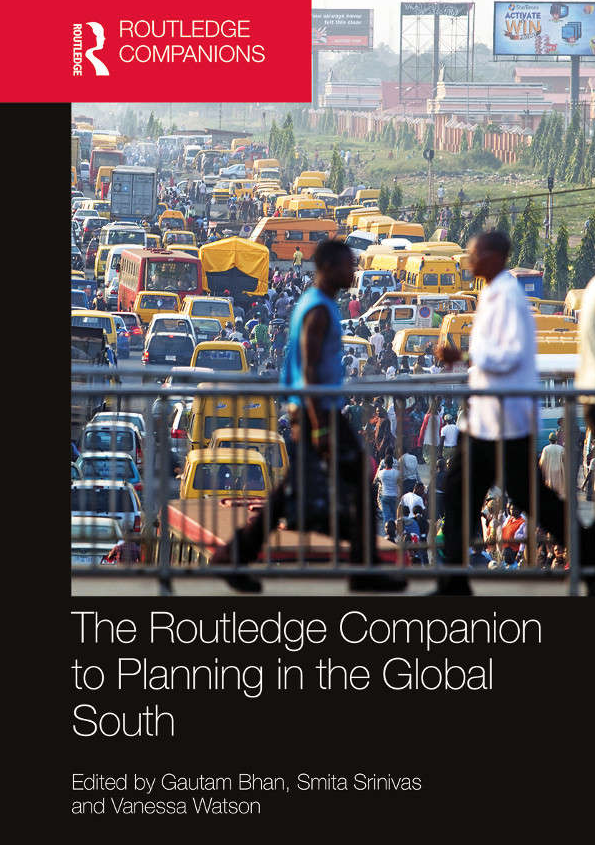
The Companion to Planning in the Global South, edited by Gautam Bhan, Smita Srinivas, and Vanessa Watson, is newly published by Routledge, and available for libraries to order (the cost is otherwise quite steep, although there is a lower cost edition for South Asia due to be published shortly). The collection is another contribution to ongoing debates about ‘southern urbanism’ and related topics, as the blurb makes clear:

“The Routledge Companion to Planning in the Global South offers an edited collection on planning in parts of the world which, more often than not, are unrecognised or unmarked in mainstream planning texts. In doing so, its intention is not to fill a ‘gap’ that leaves this ‘mainstream’ unquestioned but to re-theorise planning from a deep understanding of ‘place’ as well as a commitment to recognise the diverse modes of practice that come within it.

The chapters thus take the form not of generalised, ‘universal’ analyses and prescriptions, but instead are critical and located reflections in thinking about how to plan, act and intervene in highly complex city, regional and national contexts. Chapter authors in this Companion are not all planners, or are planners of very different kinds, and this diversity ensures a rich variety of insights, primarily based on cases, to emphasise the complexity of the world in which planning is expected to happen.”

Sue Parnell and I have a chapter in the collection, reflecting on the significance of SDG 11 (the ‘urban SDG’) and the so-called ‘new urban agenda’, extending the argument of our earlier piece on these issues. You can get the Introduction to the whole collection here.

Geography and the Priority of Injustice

My paper on Geography and the Priority of Injustice is now available online at the Annals of the Association of American Geographers. The paper seeks to explain why the argument of my forthcoming book, The Priority of Injustice (available from all good booksellers anytime now, including Target), matters for geographers, and geographical thinking about the city in particular (it is part of a special issue of the journal on the theme of Social Justice and the City).

You can get a free online copy of the paper if you click here (this is free for the first 50 clicks – I guess after that you have to ask me for a copy). Here is the abstract:

“This article considers the challenges that follow from giving conceptual priority to injustice in the analysis of political life. Human geography, urban studies, and related fields of spatial theory meet this challenge halfway, insofar as expressions of injustice through social movement mobilizations are given primacy over philosophical elaborations of justice. The privileging of practice over theory, however, reproduces a structure of thought in which justice continues to be understood as an egalitarian ideal against which injustice shows up as an absence or deviation. The practical primacy accorded to expressed claims of injustice inadvertently displaces a model of authoritative, monological reasoning about the meaning of justice from ideal theory onto explanatory accounts and ontologies of space. Basic assumptions about how spatial theory matters to questions of justice are disclosed by tracing the recurrent disavowal of “liberalism” in debates on social justice and the city, the just city, and spatial justice. Thinking about claims of injustice in a double sense—as involving demands on others that require vindication—calls into question the value of inherited ideals of the political significance of the “the city,” by drawing attention to the enactment of distributed public spaces of claims-making, reasoning, and accountable action.”

Resilience and Design

Here are details of a Forum on the theme of Resilience and Design, edited by Rob Cowley, in the journal Resilience. As well as an introduction by Rob, it consists of four short essays on ‘urbany’ themes, mainly, by myself, Tania Katzschner, Nathaniel Tkacz, and Filip De Boeck. Here is the list of contents:

Resilience and design: an introduction, Robert Cowley

Planning as design in the Wicked City, Clive Barnett

Design, responsibility and ‘Staying with the Trouble’: rethinking urban conservation in Cape Town, Tania Katzschner

In a world of data signals, resilience is subsumed into a design paradigm, Nathaniel Tkacz

‘The Hole of the World’: designing possibility through topography in Congo’s urban settings, Filip de Boeck

And here is the abstract for the whole collection:

“This forum aims to encourage theorists of resilience to engage more closely with different aspects of design theory and practice. The introduction outlines a series of largely unacknowledged parallels between resilience and design, relating to the valorisation of processes over states, the loss of faith in ‘planning’, the ambivalent status of boundaries and interfaces, and open-ended political possibilities. Four short reflections then follow on various design-related topics: the significance of the ‘wicked problem’ in contemporary urban planning and design, and the urbanisation of responsibility; design’s potential to repoliticise and engender new forms of responsibility; the significance of the digital interface; and the condition of everyday life in the ‘unplanned’ post-colonial city. Readers are invited to build on or refute the explicit and implicit links made between resilience and design in the various forum contributions.”

I have a bunch of free e-copies of the Forum, so let me know if you’d like one!

Review of Territories of Poverty

My review of Territories of Poverty: Rethinking North and South, edited by Ananya Roy and Emma Shaw Crane, is available online at Space and Polity – it’s a really good collection, informative, challenging, and innovative in its weaving of different perspectives and different generations into a whole.

Almost Ready

So, here is the back-cover blurb for The Priority of Injustice, from the new Winter catalogue from the University of Georgia Press. The book is not published yet, I am sitting here with the proofs at my feet, waiting for an index to be delivered before sending it all back to the publisher one last time (no-one else might read this book, but it seems to be all I’ve been reading for the last two years).

This original and ambitious work looks anew at a series of intellectual debates about the meaning of democracy. Clive Barnett engages with key thinkers in various traditions of democratic theory and demonstrates the importance of a geographical imagination in interpreting contemporary political change.

Debates about radical democracy, Barnett argues, have become trapped around a set of oppositions between deliberative and agonistic theories—contrasting thinkers who promote the possibility of rational agreement and those who seek to unmask the role of power or violence or difference in shaping human affairs. While these debates are often framed in terms of consensus versus contestation, Barnett unpacks the assumptions about space and time that underlie different understandings of the sources of political conflict and shows how these differences reflect deeper philosophical commitments to theories of creative action or revived ontologies of “the political.” Rather than developing ideal theories of democracy or models of proper politics, he argues that attention should turn toward the practices of claims-making through which political movements express experiences of injustice and make demands for recognition, redress, and repair. By rethinking the spatial grammar of discussions of public space, democratic inclusion, and globalization, Barnett develops a conceptual framework for analyzing the crucial roles played by geographical processes in generating and processing contentious politics.”