
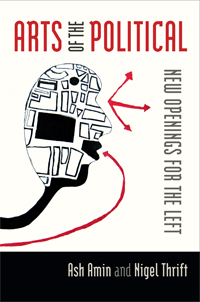
 My review of Ash Amin and Nigel Thrift’s Arts of the Political: New Openings for the Left has just been published on Antipode’s online Book Review page. There is also a (shorter) review of the same book by Fred Inglis in the Times Higher. And the Mobilizing Ideas blog had a post about it a while ago too, in case you missed it (and are interested in these things).
Category Archives: Social Science
Radical Democracy
My previously advertised co-authored paper with Gary Bridge, Geographies of Radical Democracy, is now published for ‘real’, in print, in the latest issue of the Annals of the Association of American Geographers. We have been sent a whole load of off-prints of the article – a long time since I have received any of those, it’s quite quaint really. Let me know if you want one!
Here is the abstract, again:
“There is significant interest in democracy in contemporary human geography. Theoretically, this interest has been most strongly influenced by poststructuralist theories of radical democracy and associated ontologies of relational spatiality. These emphasize a priori understandings of the spaces of democratic politics, ones that focus on marginal spaces and the destabilization of established patterns. This article develops an alternative account of the spaces of democratic politics that seeks to move beyond the stylized contrast of poststructuralist agonism and liberal consensualism. This alternative draws into focus the spatial dimensions of philosophical pragmatism and the relevance of this tradition for thinking about the geographies of democracy. In particular, the geographical relevance of pragmatism lies in the distinctive inflection of the all-affected principle and of the rationalities of problem solving. Drawing on John Dewey’s work, a conceptualization of transactional space is developed to reconfigure understandings of the agonistics of participation as well as the experimental institutionalization of democratic will. The difference that a pragmatist approach makes to understandings of the geographies of democracy is explored in relation to transnational and urban politics.”
My Loss Library
 I mentioned way back now, before Christmas, a book that I picked up when I was in Bloemfontein, The Loss Library and other unfinished stories, a collection by Ivan Vladislavic about “stories I imagined but could not write or started to write but not finish” – stories from which characters wandered off into other stories, or from which episodes escaped to turn up in other novels. Of course, by writing a book about these ‘failures’ and false starts, Vladislavic has managed at least in part to cash-out the original intuitions behind these characters, episodes, and plot-lines, if only at a tangent to his original intentions.
I have been confronted with my own loss library, of sorts, in the last couple of weeks, as I have been going through piles of paper in boxes and draws as I prepare for an office move. I have been doing quite a good job of throwing lots of paper out – unread photocopied journal articles on topics I once imagined I might need to know about for imagined projects which now, at this juncture in life, I am confidently able to say that I will never get around to even starting. And then there are the remnants of projects started but never finished, of half-written papers, of book proposals not picked-up by publishers, of unsuccessful research grant bids.
– There are my first, unsuccessful bids for ESRC funding (on publishing and global culture, on food and media), and failed bids for research in South Africa (on media and understandings of crime and violence, for example).
– There are uncompleted grant proposals (on notions of European identity in city of culture programmes, the trace of a year-long conversation with Denise Meredyth about governmentality and cultural policy.
 – There are unwritten papers, on the ‘sexing’ of communications technologies in First Amendment jurisprudence, an idea developed during a summer spent in the Law School library at Ohio State in 1998; notes and drafts of a paper on the ‘normalization’ of apartheid in academic debates about South African democratization in the mid-1990s, fragments of lunch-time conversations with Kevin Cox that same summer; drafts of a jointly authored paper with Peris Jones on the strange career of BopTV, the television station of the ‘independent’ homeland of Bophuthatswana, which survived until the late 1990s, and which we thought could serve as an interesting entry-point to think about the politics of regionalism after the end of apartheid.
– There are notes of some initial research at the BBC archives at Caversham, in Reading (I didn’t like the idea of travelling too far to an archive), on the role of Lord Reith in the early history of South African broadcasting (Reith travelled to South Africa in 1934, to advise on the setting-up of a broadcasting service which would enhance the development of ‘the Union’ (Reith’s diaries from this trip consist mainly of griping about the quality of the service he experienced on his travels).
None of these projects are completely off the wall, in retrospect: they seem to be examples of me working out ideas about media, South Africa, democracy, cultural policy, Foucault, textual publics, that sort of thing, the sorts of things I did (and sometimes still do) worry about and have worked on through other projects. There does seem to be a strain of my former self trying to find ways of writing in a more sustained way about popular culture, which perhaps I have never quite found the courage to do. Maybe that’s what one should do on a blog?
If piles of paper and files of unfulfilled projects are part of my ‘extended mind’, or the ‘prosthesis’ of my own ‘individuation’ (depending on what theory you favour), then what will happen to me if I throw out these traces of ambition and failure?
Doing Public Things
 Last week I attended a workshop organised by CCIG’s publics research programme and the Creating Publics project (I was only able to attend one day of the three because of an outbreak of chicken-pox at home). The workshop was in part a moment in a collaborative project on Making Publics across time and space between some OU social science researchers and a humanities-based network based at McGill that has been behind the Making Publics project (MAP for short). There is a great set of CBC radio programmes that grew out of that project, covering a wide historical sweep of issues related to public formation.
The discussions at the workshop clarified for me the importance of thinking about the grammar of conceptualizations of publicness. I have tried to write a little about this, in a paper submitted last month and a chapter that I have just got back for proof-reading, so it was on my mind already.
Everyone seems to agree that one should adopt a plural register when approaching public questions – that it is right and proper to talk about publics rather than the public. But I wonder whether it makes much difference if one pluralises the public, rather say than pluralising the public sphere or public space. Speaking of publics in the plural might not make much difference in so far as attention remains focussed on overly substantialised images of publics as more or less sociolgical group-like entities.
The default to thinking in terms of plural publics, thought of as a straightforward synonym for the conceptual issues raised by ideas such as the public sphere or public space, is associated with successive moves which emphasise the ‘constructed’ qualities of publics: publics are made, assembled, performed, or enacted, depending on one’s particular theoretical inclinations. All of these ideas tend to leave in place the strong impression that there is some sort of animating subject doing the making or assembling, and/or that the product of the assembling or enacting is also best thought of as some sort of collective subject. Something has been lost along the way: the sense of publicness as a subjectless process, to paraphrase old uncle Habermas. After all, ‘the public sphere’ might be a quite clunky translation of a concept that was not meant only to name an institutional form, but also, perhaps more importantly, to name a certain sort of action – acting publicly and acting in public understood as a distinctive mode or medium of social organisation (see here and here for a neat summary of the continuing subtlety, shall we say, of Habermas’ account of ‘the public sphere’ and the vicissitudes of its transition, indicating some of the reasons why fixating on publics might not be the advance it is sometimes assumed to be).
This is where the grammar of theories of publicness becomes important:
– If one talks in terms of making, enacting, or assembling publics, then the modalities of action are already presupposed (and the most important thing always seems to be the constructed qualities of publics, with slightly different inflections, as if publics were ever thought of as naturally occurring kinds). This type of formulation makes publicness the subject of a process that is not, strictly speaking, specifically public per se – I think perhaps only performativity has a genealogy that brings it up close to the distinctive problems of public action, in a way that assemblage, or enactment, for example do not quite share – these latter might be too comfortable in their assumptions about the sociality of collective action as distinct from its publicity.
– If, on the other hand, one talks of making things public – making science public, for example – then the emphasis is more squarely on publicness as a type of action. And this is where the fun starts – this action might be about sharing, or exposing, or making transparent or accountable or equally accessible….
My point, I suppose, is that one can either apply certain concepts of action derived from more or less proximate fields to understand the formation of publics; or, one can think a little more about the distinctively public qualities of certain types of action. I think the latter task is probably more difficult. The ‘politics’ of asserting that publics are performed, or enacted, or assembled tends to be relatively predictable and two-dimensional (since publics are made in contingent circumstances, they can be re-made, that sort of thing). The stake in theorising about distinctively public types of action is, I think, less satisfying: it requires thinking about power relations in more than two dimensions, in terms of the reconfiguration of plural public values – of openness, transparency, sharing, accessibility and so on – rather than in terms of dualisms between public and private, universal and particular, natural or contingent, however ‘paradoxical’ those dualisms can be made to appear.
So my mid-year resolution is to try not to talk about publics at all, while trying to be more precise in usage when talking about public spheres, public spaces, and the types of action associated with processes and mediums of publicness.
Neuroscience, politics, and judgment
 The latest issue of Perspectives on Politics has an extensive ‘debate’ section on the relevance of neurobiology to political analysis, centred on a piece from John Hebbing. Respondents include some usual suspects – George Marcus, and William Connolly, for example. My favourite response is from Linda Zerilli, and not only because she quotes me! Zerilli is the author of one of my favourite ever pieces of ‘Theory’, a wonderful ‘Cavellian’ reading of the limits of post-structuralist feminist deconstructions of foundations (it’s re-printed in her book Feminism and the Abyss of Freedom). In her contribution to this debate about neuroscience, she pinpoints the degree to which debates about the relevance of neuro-stuff and affect-stuff revolve around troubled ideas about practices of judgment, a theme of her work more broadly (see here). Zerilli’s argument about neuroscience and affect theory is part of a broader current project developing a democratic theory of judgment.
New book from Roger Cooter: Writing History in the Age of Biomedicine
Picked this up from Somatosphere, a new collection by Roger Cooter with Claudia Stein, Writing History in the Age of Biomedicine.
Dialogues in Human Geography
Re-blogging a re-blog from Progressive Geographies, the latest issue of Dialogues in Human Geography is currently available on open access. Includes a section on academic blogging and public geographies, and also a debate section revolving around an intervention by Kevin Cox on the relations between critical realism and Marxism in and around geography (Blur or Oasis? The Beatles or The Stones? The Beatles and the Stones?).
Contemporary Political Agency: Theory and Practice
 A new edited collection has just been publised, titled Contemporary Political Agency: Theory and Agency, and edited by Bice Maiguascha and Raff Marchetti. I have a chapter in it, Political agency between urban and transnational spaces, where I pretend to know about why assemblage theory and actor-network theory might be interesting, amongst other things. The book arises from a workshop held in Rome in 2009, under the auspices of the GARNET programme, an EU 6th Framework initiative, based at Exeter. In addition to all the intellectual stimulation during the workshop, the occassion was also a crash course in how to do Italian food properly, beyond pizza and pasta sauce from a jar. Here is the blurb for the collection:
“This book explores and critically reflects on the theory and practice of political agency in contemporary global politics. In light of the changing relationship between the state, the market and the society, it seeks to map both theoretically and empirically contemporary forms of global political agency.
This book reflects on the theory and practice of political agency in contemporary global politics. More specifically, it empirically analyses a range of different forms of political agency and explores their significance for understanding and enacting global politics. Reflecting the efforts of scholars from a variety of disciplines from political theory and Sociology to Geography and International Relations, it brings into conversation a wide spectrum of theoretical approaches including Marxism, feminism, post-structuralism and historical institutionalism. The contributors compare a range of forms of political agency; exploring their significance for the theory and practice of global politics; and reflect on the tensions and synergies generated by recent efforts to conceptualise them.
Demonstrating an innovative and interdisciplinary approach Contemporary Political Agency will be of interest to students and scholars of international relations, sociology, political economy and political theory.”
Living with Poverty
Later this week, a news series of documentaries about poverty in the UK starts, a BBC/OU collaboration called Living with Poverty. Links to OU-related resources can be found here, including an interactive tool for exploring (mis-)representations of poverty.
Debating the politics of consumption
 The latest issue of the journal Area has just published a Review Forum on the Globalizing Responsibility book which came out of a research project on the politics of ethical consumption. The Forum arises from a session held at the RGS-IBG conference in 2011, which included critical commentaries on the book by Alex Hughes and Mike Goodman. Both Alex and Mike have written responses to the book for the Forum. They raise various issues at stake in analysing and evaluating the politics of this field, including conceptualisations of the materiality of consumption, postcolonial approaches to consumption, issues of inequality and corporate power, and the role of media and communications practices in the extension of ethical discourses around consumption. We have a response/clarification/defence of the approach pursued in the book, grandly titled Problematising Practices, which, as the name might suggest, elaborates a little on the idea of focussing on ‘problematisation’ as both an object and method of analysis.
 Pop Theory