Externalizing Migration Management: New book in Routledge Research in Place, Space and Politics Series

RZThe latest book in the Routledge Research in Place, Space and Politics series has been published – Externalizing Migration Management: Europe, North America and the spread of ‘remote control’ practices, edited by Ruben Zaiotti. Further details are available here.

Further details on the series, including guidelines for submitting proposals, can be found here and here.

Urban Theory in the New Urban Agenda

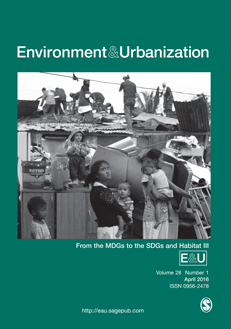
eanduThe latest issue of Environment and Urbanization contains a collection of papers examining different aspects of the emergence of the so-called ‘new urban agenda’ in global development policy, titled From the MDGs to the SDGs and Habitat III. It includes the paper by myself and Sue Parnell, ‘Ideas, implementation and indicators: epistemologies of the post-2015 urban agenda‘ which tracks some of the intellectual influences circulating around these worlds of policy-making and agenda-setting (Sue also has another piece tracing the longer history of global urban development agendas in World Development).

To repeat a previous invitation, if you would like a copy of our paper, do let me know and I will forward it along. Once more, here is the abstract for the paper:

“The success of the campaign for a dedicated urban Sustainable Development Goal (SDG) reflected a consensus on the importance of “cities” in sustainable development. The relevance accorded to cities in the SDGs is twofold, reflected both in the specific place-based content of the Urban Goal and the more general concern with the multiple scales at which the SDGs will be monitored will be institutionalized. Divergent views of the city and urban processes, suppressed within the Urban Goal, are, however, likely to become more explicit as attention shifts to implementation. Acknowledging the different theoretical traditions used to legitimize the new urban agenda is an overdue task. As this agenda develops post-2015, the adequacy of these forms of urban theory will become more contested around, among other concerns, the possibilities and limits of place-based policy, advocacy and activism; and ways of monitoring and evaluating processes of urban transformation along multiple axes of development.”

Durban Nyts

acI find myself in Durban, where it’s hot and sticky in ways that I had forgotten. I am here to take part in the Southern African City Studies conference, which I am really looking forward to. I’m ere too to start (preliminary) work, in earnest, on the project that Sophie Oldfield and I are collaborating exploring the changing imperatives of South African urban thought.

This is my first trip to Durban for 10 years, having spent quite a lot of time here in the early and mid-2000s. In the meantime, we’ve had babies, lost parents, got new jobs, moved house, moved town, and kept the cat alive. So far, after about 7 hours here, it seems very familiar and yet subtly different. Or, in some ways, not so subtly different. This is also the first time I have been to Durban, or eThekwini, it’s rather lovely Zulu name, since the controversial programme of renaming lots of the city’s roads, overseen by the former City Manager and geographer Mike Sutcliffe, in which (some) road-names with Anglo or colonial or apartheid associations were replaced with names honouring heroes and heroines of ‘the struggle’. And it’s not just South Africans who are so honoured – I am staying just around the corner from Amilcar Cabral Road. You turn a corner around here, and there is a reminder – no, literally, a sign – of an important anti-colonial thinker or Pan-African activist. It’s like browsing the spines of a vast bookshelf diffused across the street plan of the city: it could be the basis of a great field-world exercise.

Economies of attention

DSCF2834Back in December, I participated in a seminar on the theme of The Politics and Economics of Attention, organized by Jessia Pykett as part of an ESRC Seminar Series on the theme of Behaviour Change and Psychological Governance. Slides from some of the presentations (including mine, on ‘Economies of attention and the acknowledgment of partiality’), are available on the webpage for the event, where there is also a link to an incisive commentary on the whole set of presentations by Rupert Alcock.  

Bite Size Methodology: Methods of Discovery

“Most teaching on methods assumes that the student will start a research project with a general question, then narrow that to a focussed question, which will dictate the kind of data needed, which will in turn support an analysis designed to answer the focussed question. Nothing could be further from reality. Most research projects – from first-year undergraduate papers to midcareer multiyear, multi-investigator projects – start out as general interests in an area tied up with hazy notions about some possible data, a preference for this or that kind of method, and as often as not a preference for certain kinds of results. Most research projects advance on all of these fronts at once, the data getting better as the question gets more focused, the methods more firmly decided, and the results more precise. At some point – the dissertation-proposal hearing for graduate students, the grant-proposal stage for faculty, the office hour with the supervising faculty member for any serious undergraduate paper – an attempt is made to develop a soup-to-nuts account of the research in the traditional order. Now emerges the familiar format of puzzle leading to literature review leading to formal question, data, and methods. Even then, the soup-to-nuts menu is likely to be for a different meal than the one that ends up in the final paper.”

Andrew Abbott, 2004, Methods of Discovery: Heuristics for the Social Sciences. W.W.Norton.

Urban Theory and the Urban SDG

IMG_3127Sue Parnell and I have a paper, “Ideas, implementation and indicators: epistemologies of the post-2015 urban agenda, forthcoming in Environment and Urbanization, in a special issue dedicated to exploring the significance of the so-called ‘urban SDG’ and the associated ‘new urban agenda’ associated with the Habitat III conference later this year. Our paper explores the intellectual background to the campaign that culminated in the inclusion of the ‘urban’ goal (Goal 11, which commits to making cities “inclusive, safe, resilient, and sustainable”).

If you’d like a journal-ready copy of the piece, let me know. Here is the abstract of our paper:

“The success of the campaign for a dedicated urban Sustainable Development Goal (SDG) reflected a consensus on the importance of “cities” in sustainable development. The relevance accorded to cities in the SDGs is twofold, reflected both in the specific place-based content of the Urban Goal and the more general concern with the multiple scales at which the SDGs will be monitored will be institutionalized. Divergent views of the city and urban processes, suppressed within the Urban Goal, are, however, likely to become more explicit as attention shifts to implementation. Acknowledging the different theoretical traditions used to legitimize the new urban agenda is an overdue task. As this agenda develops post-2015, the adequacy of these forms of urban theory will become more contested around, among other concerns, the possibilities and limits of place-based policy, advocacy and activism; and ways of monitoring and evaluating processes of urban transformation along multiple axes of development.”

Space, Power and the Commons: new book in Place, Space and Politics series

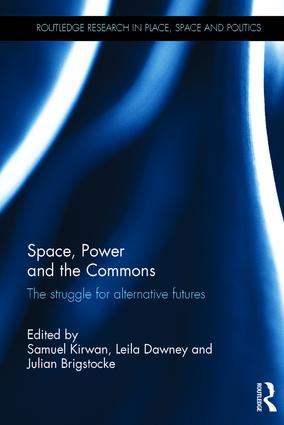
9781138841680The latest book in the Routledge Research in Place, Space and Politics series is now published (technically it is a 2016 book) – Space, Power and the Commons: The struggle for alternative futures is edited by Sam Kirwan, Leila Dawney and Julian Brigstocke, and is associated with the Authority Research Network. It’s an important addition to the literature on the theme of ‘the commons’, not least because it draws together discussions of high theory on this topic (Hardt, Nancy, Ranciere, etc) with empirical analyses of practices of ‘commoning’.

This is the second title to appear in the Place, Space and Politics series, after the collection on Urban Refugees. There are more titles in the pipeline. More details on the series, including guidelines for submitting proposals, can be found here and here.

On the milieu of security: Paper and discussion in Dialogues in Human Geography

IMG_0167I have a piece newly published in Dialogues in Human Geography, grandly titled ‘On the milieu of security: Situating the emergence of new spaces of public action‘. As that may or may not indicate, it is a discussion of different ways in which issues of security are discussed in various fields of critical social science. It is one attempt to think through how ideas of problematization might re-cast the self-image of ‘critique’ in left theory, or at least, to elaborate further on two very different ways of doing things with Foucault (I’m sure there are more than tw0).

The formula for this new-ish journal is that lead articles are published alongside a series of commentaries. My interlocutors were Ben Anderson, Anne-Marie D’Aoust, Matt Hannah, Jess Pykett, William Walters, and, David Murakami Wood. And then there is response (‘The Scandal of Publicity‘) to their comments. It’s an interesting process, and I would have loved to write more in response to the commentaries, partly for clarification inevitably, but also because different people raised all sorts of issues I have lots to say about as well (like concepts of attention).

As with lots of my publications recently, this one was not so much planned as arising out of an invitation to think about a topic I didn’t know I was meant to know about. It dates back to a conference in Ottawa more than three years ago on the theme of Security and its Publics (organised by two of the commentators mentioned above, William and Anne-Marie). Efforts to publish a collection of the papers from the event fell foul of some rather shoddy practices from journal editors (not in geography, I should hasten to add). The turnaround for the piece in Dialogues, from submission to full publication, has been less than a year, which is remarkable considering that it involved not just getting referees for the original submission but also a whole bunch of coherent commentaries too. William and Anne-Marie have also published a piece which addresses some of the issue raised at the event, on the theme of ‘Bringing publics in critical security studies‘.

Here’s the abstract for my lead piece:

“Critical analysis of security presents processes of securitization as sinister threats to public values such as accountability, inclusion and transparency. By questioning some of the theoretical premises of this view of the milieu of security, it is argued that practices of securitization might be understood less as an assertive medium for the constitution of the social field and more as a responsive mode of problematization of the temporalities of concerted public action. The argument proceeds in stages. First, two ways in which publicness is figured in the critique of security are identified and the spatiality of securitization associated with them elaborated. Second, this view of the spatiality of securitization is then linked to two modes of temporality that apparently define the historical novelty of contemporary security practices. It is argued that uncovering the pernicious politics of security depends on identifying putative subject effects sought and achieved by programmes of rule. In contrast to this approach, an alternative inflection of the genealogical perspective on security is identified. This inflection seeks to diagnose problematizations to which security initiatives are a response, suggesting a reorientation of critical attention to investigating the reconfiguration of public life around various temporal registers of uncertainty, adjustment and repair. The article closes by arguing that the specific public values at stake in securitization should be given more credence.”

Going public

cbcoraI am, finally, ever so close to finishing my book, and sending the final manuscript away to the publisher. A couple more weeks of ‘research retreat’ would enable me to complete it, but I am well and truly back in the real world now, so it’s a matter of squeezing book-work in between all sorts of other things. This coming week I have a nice distraction from worrying about not working on the book, as I am attending the Annual Meeting of Finnish Geographers, in Tampere. I am giving a couple of talks, one on ‘Geography and the Priority of Injustice’. Last time I talked to this title, back in April, I only had a very long note-like draft of a book. This time, I have a written-out-in-prose final draft, going through final edits. It’s a real thing, not a pretend thing.

My working title for the book has become The Priority of Injustice, although the ‘geography’ bit is not actually central to the book. The talk is developing into the occasion where I try to say out loud why the grand theme of the priority of injustice might capture some of the difficulties covered over in much of the work in the burgeoning field of geographies of justice. So I’m thinking of the coming week as a final impetus to finishing the monster in the box, so that I might move on to other things.

Affect and Judgment

IMG_2480For anyone out there interested in issues of intentionality, rationality, and, yes, affect (remember that?), a must read is Linda Zerilli’s recent piece ‘The Turn to Affect and the Problem of Judgment’, in New Literary History (it is part of a collection of pieces on the relations between feminism and ordinary language philosophy, including other contributions by Alice Crary, Toril Moi and Sandra Laugier). Zerilli is one my very favourite thinkers, and I am looking forward to her forthcoming book A Democratic Theory of Judgment.

Zerilli’s locates the outbreak of affect theory in a longer tradition of seeking to avoid excessively intellectualist images of action, including Gilbert Ryle and a broad phenomenological tradition. The really significant contribution of her essay is, I think, to zoom-in on and clarify how the sort of critique of affect theory developed by Ruth Leys and others requires a clearer elaboration of the notion of intentionality. Her essay is also important for explicitly connecting this reconstruction of intentionality to the on-going debate sparked by the disagreement between Hubert Dreyfus and John McDowell about the interpretation of ‘nonconceptual’ and ‘conceptual’ dimensions of action. This is a much more interesting philosophical terrain upon which to engage in the issues at stake in considering questions of action, embodiment, intentionality, and rationality, compared to the rather enclosed worlds of what has become canonized as ‘Continental Philosophy’. There is an interesting subtext to that debate, which revolves around the ways in which spatial metaphors are mobilized by both sides, by Dreyfus with his talk of upper floors and lower floors, and in McDowell’s reconfiguration of ideas of inside and outside and extension and reach to reconfigure mind-body relations.

Zerilli develops a criticism of the ways in which affect theory holds fast to a strong separation of the conceptual and nonconceptual, thought and action, cognition and affect, which is most clearly evident in the recourse to layer-cake images of the priority of the latter over the former (I’ve argued here before that what is involved in the flight from the registers of subjectivity to assertions of the prepersonsal is a more or less acknowledged claim to monopolize a kind of 3rd person perspective on other people’s actions. It’s a move in which this style of theory displays it’s own defining lack of affect, one might say, that is, it’s lack of capacity to relate to a situation in a sensitive and appropriate way).

Zerilli grants that affect theory addresses important issues in both philosophy and politics, but points out that the particular framing of these issues in this field of work leaves in place some of the most significant problems of more traditional intellectualist ways of proceeding. Her own elaboration of the way in which intentionality depends upon feeling, rather than being ruined by it, is developed by reference to Cavell and Wittgenstein, along the lines of the account of reflective judgment that she has also discussed via Arendt before.

Anyway, I’m not really doing Zerilli’s essay justice, it’s a very rich discussion that deserves reading and re-reading.