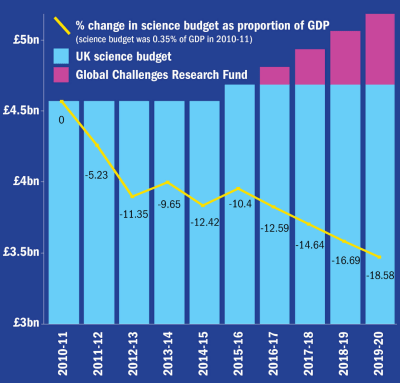
 In UniversityLand in the UK, alongside various worries about the TEF, OfS, and UKRI (try to keep up) generated by the government’s Higher Education white paper, there is also a sudden flurry of notice being taken of the Global Challenges Research Fund (GCRF). This was formally announced before Christmas in George Osborne’s Spending Review. It is now officially launched as “a new Resource funding stream” (see the RCUK’s brief on the GCRF). That’s how it is being presented at University level, by research and funding councils, and in cross-University partnerships. The GCRF is part of the UK science and research budget, so it belongs to the Department of Business, Innovation and Skills (BIS), according to whom “It provides an additional £1.5bn of Resource spend over the next five years to ensure that UK research takes a leading role in addressing the problems faced by developing countries. This fund will harness the expertise of the UK’s research base to pioneer new ways of tackling global challenges such as in strengthening resilience and response to crises; promoting global prosperity; and tackling extreme poverty and helping the world’s most vulnerable.” That all sounds nice, doesn’t it.
Oh, by the way, the key thing to remember is this: “GCRF is protected science spend that is also part of the Government’s pledge to allocate 0.7% of Gross National Income to Official Development Assistance (ODA).”

Maybe I’m just a cynic, but it does seem to me that there are a number of issues around the GCRF that deserve a little more honest acknowledgement before everyone (individual researchers, research teams, departments, whole Universities) rushes-off to re-brand themselves as international development specialists (I’m not one, so I’m not being defensive). The GCRF is a deeply political initiative, in the sense that it involves all sorts of pitfalls and risks and likely unintended consequences that need some thinking through by those being enrolled into the agenda of which it is a part. In fact, the GCRF is ‘political’ in at least three related senses:
- First, the GCRF is quite explicitly a re-direction of government spending on ‘international development’ away from the Department nominally charged with that area, DFID, to BIS, the department that is responsible for science, innovation and research (but which would also really like to not spend much money doing very much at all). It is one part of a dispersion of spending on development and aid across a larger number of departments, while allowing the government to remain committed to the principle spending 0.7% of national income on official development assistance (ODA) (a commitment which is itself, of course, the target of ongoing right-wing campaigning, directed primarily against DFID; this is a rather important context for the re-configuration of aid policy by the current government). The headline story from the November spending review was that the science budget did much better than expected, with a real term protection over the next five year period. But this commitment depends on various things being ‘tucked under’, as they say, including the GCRF – it’s not new money for science at all, it is DFID’s money handed over to BIS. Depending on how you look at it, the GCRF is either a very clever and quite open accounting scam, or it is a rather wonderful example of having your cake and eating it – an austerity shaped cake with ODA-shaped sprinkles on top.
- So, everyone knows all this, but the point is that the GCRF is part of a concerted reconfiguration of the way in which UK government development funding is organised. The reconfiguration is shaped by an approach now enshrined in the new UK Aid Strategy, which seeks to ‘tackle global challenges in the national interest’. This actually means a refocusing of aid policy around concerns with security, crisis, and emergency. Again, none of this is a secret, it’s all quite well-known. Somebody, somewhere is no doubt already writing the critique of this new policy. In terms of the GCRF specifically, a £1.5 billion pot of money dedicated to ‘ODA’-relevant research has the potential to fundamentally reorient the ethos, one might say, of UK scientific research. On the other hand, it also looks like a move to direct more ‘development’-related spending to the UK. GCRF is explicitly premised on the idea that “research directly and primarily relevant to the problems of developing countries may be counted as ODA. The costs may still be counted as ODA if the research is carried out in a developed country.” That’s why everyone is so much more excited about this than they have been by the Newton Fund, which is much more explicitly about the difficult work of building partnerships and capacity with international collaborators (and the GCRF is a lot more money than Newton). Whether and how GCRF will help generate capacity-building elsewhere, rather than the requirement to meet ODA criteria being met by standard ‘impact’ models, is just one dimension of the future politics of the GCRF. On the one hand, then, GCRF redirects ‘development’ money to UK institutions; on the other hand, this money comes with very thick strings attached (apart from everything else, the GCRF is also just one example of a widespread and disturbing move to centralize strategic decision-making about what counts as science that is evident elsewhere in government higher education policy).
- As I say, all of this is publicly known, although it seems to me interesting how little of this context is being acknowledged as the GCRF is rolled-out. There is some growing awareness of what it all might imply. In one interpretation, for example, the GCRF has been identified as ‘hoovering up extra science cash’ for ‘developing world problems’. That’s true in a sense, although as already indicated, the ‘extra cash’ was always already development-related money. No one is actually taking money away from non-ODA-able research funds for the GCRF – it’s that any extra money the science budget is getting, to make it appear as if it is ‘protected in real terms’, is actually coming from DFID’s coffers, without actually being administered by DFID (My point is not that DFID is a model of idealistic efficiency. There is already a rather contested institutional field assessing whether international aid strategy does any good (see the ICAI website). This field is only likely to get a lot more complicated when it’s not primarily focussed on the accountability of DFID). There is a bit of a Duck-Rabbit issue here: rather than thinking of the GCRF as ‘a new funding stream’, it might be better to acknowledge that it effectively obliges a significantly greater proportion of science and research to get engaged with the world of international development issues. This is where the more mundane, but very real politics of the GCRF is going to unfold: no doubt there will be an initial rush to re-badge current research as ODA-compliant (by Universities and funders and government departments), but over the more medium term this all implies either very significant transformations in how research agendas are shaped and delivered, or, an ongoing finessing and revision of ODA criteria to justify, nationally and internationally, the redistribution of money away from traditional fields of development policy. That’s a politics already going on, and it is evidenced by the recurring theme of ‘uncertainty’ and ‘need for clarification’ in the commentaries around the GCRF ever since the November spending review.
It seems likely that an awful of people in British Universities are suddenly going to be learning about the SDGs, scurrying around to find people in their institution who have ever visited Mali or Cambodia, and, I suspect, engaging in more or less unreconstructed paternalistic and patronising ‘development-speak’. It’s best not to be too credulous about the public statements about tackling extreme poverty and helping the most vulnerable – if Universities are going to be drawn much more holistically into the world of international development policy, driven by nice-sounding funding streams, then they are, of course, going to be drawn into a world that is complex, and grubby, and deeply compromised (‘Aid as Imperialism’, anyone?). There is, of course, a very real politics of development assistance already, that lots of people in Universities might hopefully be about to learn a little bit more about.
Be careful what you wish for!

 Here’s a thought, from Hannah Arendt’s 1971 essay ‘Lying in Politics’, to orient one’s analysis and thinking about political excitement in the UK this past week or so (actually the whole essay helps, as does ‘Truth and Politics’ in Between Past and Future, 1968):

 Pop Theory