Intentionality and objectivity: Todd Cronan on Zerilli (and me)

I mentioned yesterday that my contribution to the Syndicate review forum on Linda Zerilli’s book touched upon the similarities and differences between her critique of affect theory and that developed by scholars associated with the ‘nonsite school’ of cultural criticism. In the spirit of dialogue encouraged by the Syndicate platform, Todd Cronan, one of the editors of nonsite.org, has posted a comment engaging with my own comments and Linda’s response, addressing ideas of intentionality, objectivity, interpretation and truth. Zerilli’s book elaborates on a political sense of objectivity indebted to Hannah Arendt, revolving around the theme of the conditions of sharing in a common world with others; Todd’s comment specifies some differences and clearly states the position associated with the nonsite school. The comment is a little hidden, so here it is in full:

“There is much to say here but there is one thing in particular–the question of objectivity–that makes what many of us at nonsite say unrecognizable. So there are several problems with the idea that “intentionality is closely associated with claims to objective truth.” The first is that, for us, intentionality is much more than closely associated with truth, it’s incomprehensible without it, and the second is that although Zerilli may think there’s some connection between truth and objectivity, we don’t; objectivity is not only not closely associated with truth, it’s not associated with truth at all. So on the one hand, there’s no meaning without intentionality and no meaning without truth, which is just to say that both meaning something and understanding something are normative–all interpretations must be either true or false (or some combination of the two). But on the other hand, no interpretations are objectively true or false.”

There’s much more to say around these issues, no doubt, not least, I suspect, some important disciplinary differences across fields of political theory and aesthetic theory. Some of these issues might well be further aired in a forthcoming ‘Tank’ in nonsite considering the significance of Ruth Leys’ recent book The Ascent of Affect. More on that when it appears.


 

The Priority of Injustice: Book Review Forum in Political Geography

Another day, another review forum, this time, on my own book, The Priority of Injustice. This one, in Political Geography, is the first of these forums to see the light of day (the other one is soon to appear in the AAG Book Review). Thanks to Sam Kinsley for coordinating this forum, as well as the ‘author-meets-critics’ conference session from last year out of which these commentaries emerged. And thanks to Jack Layton, Juliet Davis, Jane Wills, David Featherstone and Cristina Temenos, all of whom found things to like in the book and who each articulate in friendly tones the things they found wanting in it. If you have trouble accessing the forum, let me know. My response to the commentaries, ‘The all too human geographies of justice’, is also available here – it focusses on clarifying the sense of ‘structure’ (and by extension, of ‘critique’) and ‘the ordinary’ that are at work in the book.

Putting affect into perspective: further thoughts on Linda Zerilli’s A Democratic Theory of Judgment

Further to my previous post on the Syndicate review forum on Linda Zerilli’s A Democratic Theory of Judgment (also available here), my own comments are now live, as well as a generous response from Linda herself. My own thoughts focus on Zerilli’s critical engagement with the ontological turn to theories of affect in some strands of political theory, and how her own treatment of these issues overlaps with but also differs from the approach articulated by thinkers associated with nonsite.org including Walter Benn Michaels, Todd Cronan, and Ruth Leys.

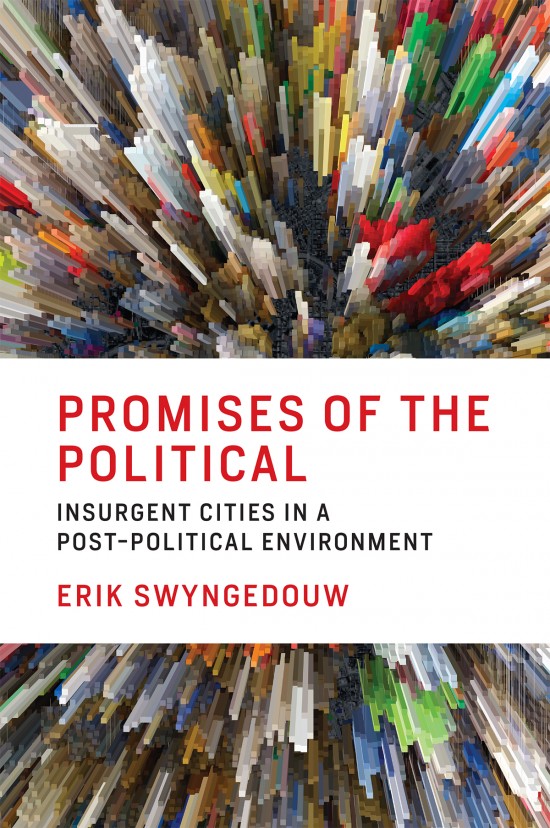
Promises of the Political: Review Symposium on Erik Swyngedouw’s new book

I’ve mentioned that I have recently been writing lots of commentaries on books (other people’s and my own), and the latest of these to find its way out into public is part of a review symposium in Urban Geography on Erik Swyngedouw’s Promises of the Political, put together by Joe Penny. If you don’t have access to the journal, Erik has also posted the symposium on his page at ResearchGate. My own thoughts on Erik’s book appear under the title ‘Mourning politics Final‘.

Review Symposium: Linda Zerilli’s A Democratic Theory of Judgment

I seem to have spent a lot of time in the past year writing pieces for book review forums – pieces about other people’s books, and pieces about things people have written about my book, The Priority of Injustice. The first of these forums to go public, a series of commentaries on Linda Zerilli’s wonderful A Democratic Theory of Judgment, is perhaps the most interesting (and easily accessible), in so far as it takes the dialogic form that book review forums seek to perform in print/text, and extends it through an online medium. Syndicate is described as a ‘living network of scholarship in the humanities’, and their symposium on Zerilli’s book is now live, through to mid-September – the format involves one commentary being published a week, with a response from Linda, and further comments added as and when. My commentary is due to be published next week (it focusses on Zerilli’s contribution to a series of critical debates about ‘affect theory‘).

Social Justice and the City

Now available as a hardback book, the special issue originally published in the Annals of the Association of American Geographers on the theme of Social Justice and the City. As before, my chapter, as it is now, works through the relevance of the arguments made in The Priority of Injustice for fields of geographical research. It might also be one of the only chapters which addresses in any substance the original book of the same title. Not sure what to make of that.

New Book by Matt Hannah: Direction and Socio-Spatial Theory

The latest edition to the Place, Space and Politics monograph series is now available, Matt Hannah’s Direction and Socio-spatial Theory: A Political Economy of Oriented Practicean important contribution to debates in geography and beyond about embodiment, practice, one might even say intentionality (my word not, I think, his).

Details of soon-to-be-published titles in the series, as well as a full list of already published books, are available here.

Who Does Geography Matter For?


The report last week by the Royal Historical Society on Race, Ethnicity and Equality into the discipline of History in UK higher education, as well as some of the attendant press coverage, has reminded me of a train of thought I have been following, in my own head, since the summer. It was prompted by the #ChooseGeography hashtag, which has been a medium for sharing various reasons to affirm why Geography Matters, as they used to say.

The stream of tweets reminded me that I, and a number of other geographers I know, didn’t really choose geography at all. It chose us – it’s proved to be an unexpectedly creative and open space in which to find things out. Perhaps this grammatical difference – between choosing geography and being chosen by it – indicates a significant cleavage within the field more broadly. The active sense of choosing geography is associated with a strongly justificatory rhetoric of why geography matters in more or less useful, practical, even applied, ways. #ChooseGeography does reflect a wider embrace of the idea that Geography is ideally placed to address all sorts of ‘global challenges’ – because geographers are really good at understanding the interactions between local actions and global processes [they really are].

Of course, it’s worth remembering that all those ‘challenges’ that drive current debates about the value of research are externally sourced (remember, the establishment of UKRI means the Haldane principle is effectively dead – by defining it as a principle only relating to decision about individual research proposals) – which does raise the question of what is involved when whole scholarly fields define their own intellectual agendas by so openly embracing the logics of ‘challenge-led’ research (i.e. what the government of the day randomly decides is worthwhile, with no more arms length mediation).

The problem with the ‘really useful knowledge’ version of geography is that it tends to side-line that strand of geographical thought that focuses on how all those ‘challenges’ arise as matters of public concern in the first place [you could call that a ‘critical’ strand, or a ‘genealogical’ strand; or, just ‘science’, in so far as science is about problem-finding, not problem-solving, to borrow a line from Richard Sennett].

So, for example, lots of those ‘global challenges’ are now described as really complex, and therefore requiring integrative, ‘interdisciplinary’ approaches. Climate change is, obviously, the best example – it’s now routinely thought of as a “super wicked problem”. Now, if you take that idea seriously (and you should), then it means that this sort of problem can’t be solved (and certainly not by the application of scientific knowledge, however integrative and expansive it might be). A little bit of intellectual history can be a dangerous thing. Science doesn’t offer solutions. It’s difficult to roll that idea into grand funding bids though, isn’t it.

So, here is my final thought: Just what is the relationship between the idea of geography-as-useful-and-challenge-oriented, on the one hand, and the chronic whiteness of the discipline, in the UK, on the other?

To be more precise, how does the ongoing framing of a field of knowledge – one that seeks to understand the worldliness of the world – as a purveyor of beneficent knowledge which is able to solve other people’s/peoples’ problems (and especially, which is able to solve problems created by other people’s/peoples’ supposed lack of thoughtful action), how does that framing help to reproduce a problematic and unacknowledged paternalism at the heart of the Subject of academic Geography (whether as student, teacher, or researcher)? Just askin’. Seriously.

Anyway, I wonder if the Royal Geographical Society (with the Institute of British Geographers, of course) might consider a similar exercise to the one undertaken by the RHS sometime soon. It would make interesting reading.


Can ‘Research’ Drive ‘Development’?

Some time ago now I wrote a post which raised some questions about how the decision of the UK government to redirect a large slice of ‘development aid’-related funding to the science budget, primarily through the Global Challenges Research Fund (GCRF), might play itself out over the course of time. Well, this question is already a live public one – Eleni Courea at Research Fortnight has a concise account of how both the GCRF and the Newton Fund are currently subject to debate amongst academics, politicians, and NGOs concerning the degree to which the aims of those schemes can be justified. There is a much larger story here, I should say, and perhaps the terms of the debate summarised in this piece might well be challenged. Noel Castree’s comment at the end of this piece – concerning the implied paternalism regarding British expertise that is sometimes associated with these schemes – captures much of what I suspect many people worry about. I should say also that the Newton Fund project that I am involved in aims to address precisely that worry. Basically, a good lesson to remember is that you should never trust people who claim to be able to mobilise ‘science’ in order to ‘solve’ what are too glibly called ‘global’ problems.

Guilty Pleasures

For no good reason at all…

  1. Bad Liar
  2. Dreamer
  3. Life in the Fast Lane
  4. I am I said
  5. Love Machine
  6. Love is an Open Door
  7. Water of Love
  8. Fist City
  9. Salute
  10. Grey Matter

….. but who needs reason anyway?