Regulating nothing?

For anyone interested in such things (and you should be), here is the full 193 page U.S. Supreme Court ruling, including dissents, in National Federation of Independent Business v. Sebelius – upholding the constitutionality of Obamacare, mostly. When is a tax not a tax, when is a penalty a tax, can you regulate people because they are not acting?

Already an interesting subtext to the story is developing, about the twitter-sphere, and CNN, calling the result too early, evidently having only listened to John Roberts for a couple of minutes. High drama, it seems.

Elinor Ostrom 1933-2012

The Monkey Cage has various (un)timely links to comments and appreciations of Elinor Ostrom, whose death was announced yesterday, and Jim Johnson promises to update similar links as they appear. Here is a list of her major publications, reduced to one paragraph summaries; and here is an interview from earlier this year on climate change. The New York Times has an obituary here.

Waldron on political theory

This has been blogged and tweeted already by various people, and is very good: Jeremy Waldron’s inaugural lecture as Chichele Chair of Political Theory at Oxford, on ‘political political theory’.

Neoliberalism: the latest news

Aditya Chakrabortty set off a bit of fuss by complaining recently that non-economist academics (he meant sociologists, poor souls, leave them alone) weren’t doing enough work on ‘the crisis’ – proving, mainly, that all journalists, irrespective of political stripe, have a standard article template which they roll out every so often complaining that academics work on absurd topics, talk only to themselves, and ignore things that really matter (my favourite recent version of this type of piece is a column by Nick Cohen last year, lambasting Judith Butler for being an obscurantist – it took him fully more than a decade to recycle the story about her ‘winning’ a bad writing contest, and then oddly presented this as if it were an ‘objective’ judgement of academic fact. Read the piece, it’s an exemplary case of the broader genre).

Anyway, I’m getting distracted – the Chakrabortty piece/debate made me think, again, of how pervasive the notion of ‘neoliberalism’ has become as the basis of the standard alternative discourse, the exception as it were that appears to prove the wider absence of a critical alternative analysis that he claims to identify.

In so far as this is the case – certainly in academic circles, the vocabulary and wider theoretical understanding shaped by more-or-less Marxist accounts of ‘neoliberalism’ and ‘neoliberalization’ have become widespread – then this seems to me to compound the problem that Chakrabortty discerns – of a lack of thought about the current conjuncture and its alternatives.

A couple of months ago, I posted one or two things about conceptualizations of neoliberalism and governmentality, biopolitics and the like – including a recommendation of a new book by Stephen Collier. Collier has a new piece in the journal Social Anthropology, a contribution to a ‘debate’ set off in the same journal by Loic Wacquant. It’s well worth a look if you are at all interested in finding ways out of the straightjacket of what currently passes as critical orthodoxy in geography, anthropology, urban studies and related fields.

What I like in particular about Collier’s piece is the way in which he identifies a particular tendency in ‘structural’ narratives of neoliberalism to expand the concept to include all sorts of things, once it is found that neoliberalism in a narrow sense (conventionally defined, rightly or wrongly, as a range of state-shrinking and/or market friendly policies) tends to be found alongside other processes and trends – state-sanctioned violence, or securitization, or counterintuitive extension of state provision in certain areas, and so on. He also has a nice critique of the geography variant of this methodological and conceptual trick, which is to affirm that neoliberalism is ‘variegated’, where that means any variation is only ever recognised as movement anchored to a static norm, combined with a convenient line about ‘contradictions’ and a flawed understanding of ‘family resemblances’.

Collier argues instead, briefly, but it’s the argument of his book on post-Soviet biopolitics too, that actually the concept of neoliberalism should be used much more restrictively, and he again appeals here to Foucault’s lectures on biopolitics and neoliberalism (or not) that have attracted so much attention. The basic point comes down to a suggestion that neoliberalism might not be all there is going on in the world, nor even the most important, most determinative thing, all the time, everywhere. And, a little more fundamentally, it’s an argument about the extent to which rather than presuming to know what ‘neoliberalism’ refers to, it might be fun to follow Foucault and keep open a sense of puzzlement about just what sort of ‘power’ a quite specific mutation in economic thought was and is an index of.

Collier’s argument about the expansive tendency of neoliberalism-talk, whereby everything becomes a facet of neoliberalism that ever comes into contact with ‘it’, reminded me of a piece, also just published, by Matt Hannah on Foucault’s ‘German Moment’ (Matt sent me a copy of this paper around the time of those previous posts, I didn’t have time to read or respond back then – I’m doing so now, publicly, sort of, and  I’m not sure if this is rude or not). It’s an interesting piece about the context in which Foucault’s mid-1970s work developed, specifically his engagement with German politics around the time of the Red Army Faction, the German Autumn, etc. It provides really useful background to these debates, including some context to Foucault and Deleuze’s ‘falling out’.

Hannah’s larger point is a claim about the significance of Foucault’s account of neoliberalism which emerged from this ‘German moment’, which included a strong emphasis on extra-legal state violence and securitization, compared to the more narrowly ‘economistic’ account of the 1979 lectures. Others have identified the same shift, but interpreted it differently (to cut a long story short, it all turns on how far one is prepared to think that all forms of state power are reducible to ‘fascism’).

My thought is why this shift should be presented, as Hannah does, as a loss – why does the more narrow account of neoliberalism represent a retreat, rather than, say, a specification. Along with Collier (I like his argument, and not only ‘cos he cites me), it seems to me that the later and narrower focus on the ‘laissez-faire-ing’ of subjects as Mark Driscoll has put it, as a quite precise modality of power, is preferable to the expansive account which would insist on adding in some necessary relation between this modality and, say, securitization – to read the shift as a loss is to close down the question that Foucault seemed to open up in the 1979 lectures by narrowing the focus.

Part of the scandal of the ‘late’ Foucault in his ever-changing incarnations has always been and remains the degree to which he ends up saying much less radical things than he is meant to be saying, given the construction of what ‘Foucault’ is meant to be saying as a central figure of the left-academic canon. What if less is more, when it comes to talking about neoliberalism – what if the term really should be used quite narrowly, and what if doing so might help prise open questions long since closed down – questions that can’t be asked by banging on about hybrid variations, or even articulations, for as long as these formulations maintain a happy consensus about what ‘it’ was and is in the first place.

I’m rambling a bit now – read Collier, he’s more articulate than me.

Roemer, Scanlon, and others remembering G. A. Cohen

Via Crooked Timber, here are some interesting comments and personal reflections on the legacy of G.A. Cohen from a memorial service held in 2010 – Roemer’s remarks are a neat little summary of the approach, and hang-ups, of ‘analytical Marxism’; Scanlon’s end with a really succinct, and quite telling comparison of two perspectives from which to think about justice and injustice, as a way of trying to account for Cohen’s seemingly odd, for a Marxist, insistence on thinking that questions of justice were not primarily about institutions (following Rawls), but about interactions between individuals (following, and critiquing, Nozick).

New book by David Harvey: Rebel Cities

Between trying to take a day off and teaching overload (at the same time), I have been speed-reading David Harvey’s new book, Rebel Cities: from the right to the city to the urban revolution, bought on a day out in Bath. I know, this is the sort of book you are meant to buy at Booksmarks or somewhere like that, but Bath is the closest place to where I live with decent book shops (Oxford doesn’t count, because it doesn’t actually have great bookshops, apart from Blackwell’s, and the OUP bookshop, both of which are more like academic libraries where you can buy the books, if you see what I mean).

The book is a collection of mainly recent pieces on urban politics, including a long essay on The Right to the City from New Left Review; the long, written-out-in-neat story of the ongoing urbanization of capital that underwrites the financial meltdown of 2007/8 which Harvey’s viral RSA animation lecture covered; and a set of pieces at the end reflecting on recent events such as the Occupy movement, London riots in 2011, and more interestingly, urban politics in Latin America.

It has some familiar limits, shall we say – an aversion to rights-talk when thought of as anything more than a convenient strategic fiction, and a simplistic contrast between ‘individual rights’ (not to be trusted), and ‘collective’ rights (more of these, please). And a tendency to defer the most pressing problems of political analysis to the field of concrete struggle (the word ‘democracy’ doesn’t feature in the index of this new book, which I thought was telling, until I noticed that the index only lists proper names of people and places and movements, which is a shame).

The two most interesting pieces in this new book are in the middle. A neglected essay, from more than a decade ago, analyses cultural commodities from the perspective of the Marxist conceptualization of monopoly rent. I think there is a lot of mileage to be had from this sort of approach, or at least I used to, when I thought more about these things (I think Nicholas Garnham had a similar line once), though it inevitably runs aground on the limits of an account of commodities that still invests heavily in the manly notion of value being derived from living labour in the production process (come in, Carolyn Steedman).

The other piece, perhaps the most interesting in fact, is on the concept of the urban commons. It’s a critical engagement with a notion that has become quite central to certain strands of contemporary left theory and politics, as both a ‘slogan’ and ‘ideal’ we might say. Philosophically, the commons has emerged as a kind of ontological security blanket for the revival of discussions of communism, a sort of immanent presence that just needs to be recognised and embraced – it is a weirdly post-political idea. Harvey suggests that the commons is always likely to be a construct of struggle and conflict, an effect of one form or another of exclusion or enclosure – he proposes the notion of ‘commoning’ as a practice to be analysed and encouraged. He also points out the degree to which the anarcho-inflection of this concept in contemporary thought systematically evades problems related to variations of ‘scale’ (a criticism which could be read, if one wished, as a surrogate for a much broader evasion of the problem of democracy in this style of leftist political romanticism). Harvey is rather sheepish in his suggestion that a little bit of hierarchy might be OK, although this is really just another way of saying that democracy is an art of governing, amongst other things.

Harvey makes use of the ‘conventional’ thinking of Elinor Ostrom in his discussion of the contradictions surrounding issues of commons, which is also refreshing, and another departure from the constrictions of the hegemonic account of this idea that draw on Hardt and Negri and others (he does not, however, go very far down the line of thinking about institutional analysis and institutional design that this reference point might open up). And there remains something rigid about Harvey’s understanding of ‘public’ attributes – public goods and public space are understood as gifts dragged out of ‘the state’ by class and other struggles, a sort of grudging background that might be actively, creatively appropriated by practices of genuine commoning (what Harvey describes as commoning in this respect looks a lot like authentic public action as described by Arendt, which is only to suggest that it might also suffer from some of the same problems as that description, not least a hint of an image of pure action freed of instrumental concerns).

[The baby’s just been sick, I have to pause].

In this account of commoning as the appropriation of already constructed background environments, Harvey’s critical reconstruction of the notion of the commons ends up, then, looking quite ‘conventional’ itself, although not necessarily in a bad way – whisper it, but there is a minor theme in Harvey’s work I think, behind the rhetoric of revolution, that sees left politics primarily in terms of seeking after more just, more equitable distribution of surplus in the here and now (and there’s no reason that this need not encompass more just relations of surplus production). The rhetoric of unified revolutionary transformation is in abundance in this book, certainly, but it is not really supported by an analysis of politics, culture and economics that has so relentlessly, over many years now, demonstrated the dynamics of fracturing, differentiation and contradiction that inhabit any and all forms of human action (the idea of revolutionary transformation might, it seems to me, if you’ve read enough of David Harvey as a geographer, be deeply antithetical to a geographical imagination). The ambivalent nostalgia for social democratic settlements, for failed Swedish promises of surplus transfer from capital to labour and the like, are testament to a radical politics of redistribution that seems unable to speak its own name – it’s present in Harvey’s book about the New Imperialism, and goes all the way back to Social Justice and the City. This minor key is that of a Polanyian radicalism, not a Marxist one.

Geographies of radical democracy

For anyone interested in this sort of thing, I have a new paper, co-written with Gary Bridge, just published on-line in the Annals of the Association of American Geographers, which addresses how best to theorise about the relationship between democracy and geography. It develops the idea of agonistic pragmatism, and the notion of transactional space, and explores how the idea of ‘all affected interests’ may, or may not, provide the grounds for rethinking this relationship. It’s an attempt to expand a little the range of reference points, in geography and related fields, for discussions of ‘radical democracy’. You can access a pre-publication draft of the paper here, and the abstract is below:

“There is significant interest in democracy in contemporary human geography. Theoretically, this interest has been most strongly influenced by poststructuralist theories of radical democracy and associated ontologies of relational spatiality. These emphasize a priori understandings of the spaces of democratic politics, ones that focus on marginal spaces and the destabilization of established patterns. This article develops an alternative account of the spaces of democratic politics that seeks to move beyond the stylized contrast of poststructuralist agonism and liberal consensualism. This alternative draws into focus the spatial dimensions of philosophical pragmatism and the relevance of this tradition for thinking about the geographies of democracy. In particular, the geographical relevance of pragmatism lies in the distinctive inflection of the all-affected principle and of the rationalities of problem solving. Drawing on John Dewey’s work, a conceptualization of transactional space is developed to reconfigure understandings of the agonistics of participation as well as the experimental institutionalization of democratic will. The difference that a pragmatist approach makes to understandings of the geographies of democracy is explored in relation to transnational and urban politics.”

Local Politics VIII: School Daze

There has been plenty of news coverage recently about the progress of education reform in England, partly coinciding with teachers’ unions conferences threatening action in response to various policies introduced by Tory education secretary, Michael Gove. Not least, of course, the move to systematically transform the structure of public schooling via the Academies Act of 2010, through which schools have been bribed and/or bullied into converting to Academy status. The not-so-stealthy stealthy transformation of the governance of schooling is based on sheer theoretical and ideological prejudice, and is busily realising one of the longest standing aims of right-wing politics in UK, which is the removal of schooling from Local Authority jurisdiction.  

One aspect of the reporting of this process has been the repeated line about how Gove’s project has not attracted the same sort of attention, or opposition, as changes to the NHS. There might be many reasons for this, but one aspect of it might be to do with the ways in which different public services, through the very ‘materiality’ of the services involved, constitute the subjects of public services in very different ways – a theme of the work of my OU colleagues John Clarke and Janet Newman, for example. I wonder if school education, as a public service, doesn’t constitute it’s publics in very different ways from health services?

One of the lesser reported features of the Academy-led transformation of schools is the conversion of primary schools – only 5% of primaries currently have or are seeking Academy status, but that is likely to increase. The school our eldest child goes to, since last Autumn, is one of these Academy primaries. In Swindon, as elsewhere, you apply for a place in local authority schools about 9 months before your child is due to start. So we applied back in January 2011, for a place one of three local authority run primary schools. The closest one, the preferred one, is about 500 yards outside the back gate, is a resolutely middle-class school in a middle-class area, not great Ofsted report last time round. In between applying and being informed of the successful outcome, sometime this time last year, around Easter, the school actually decided, however these things work, to apply for Academy status, in tandem with (and thereby bolstering) the Academy application of the secondary school which is in the next road over from ours, the one-time Grammar school for Swindon. We only found this out sometime in the summer, when we began to attend the induction meetings for parents of new starters. I remember being told in a conversation with one of the Governors that this application did, indeed, amount to accepting a bribe, since the offer on the table at that point from the Government was that schools which applied would get lots more money, which would not be on offer if they delayed. As of 1st August, the school has been an Academy. It’s not clear, yet, what difference this makes – it hasn’t changed its admissions policies, for example, the most obvious change that the Academy policy now allows. But it’s early days.  

So, we find ourselves enrolled into a new form of public schooling, without being consulted, right in the middle of being involved in the process of, nominally at least, exercising a bit of school ‘choice’.

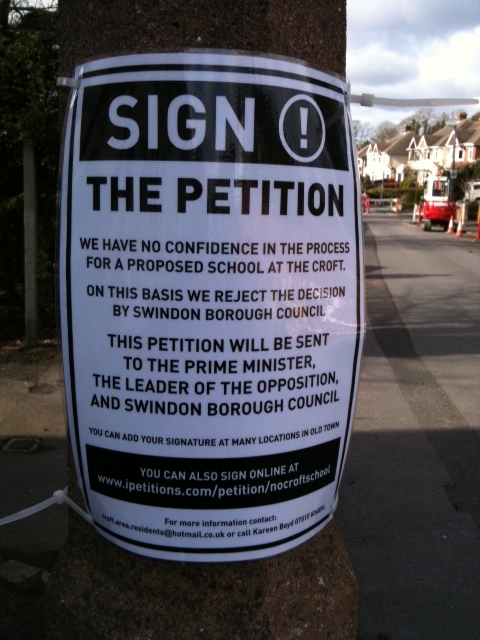
Meanwhile… the decision by the local council, Tory-led, to build another primary Academy not so far from where we live in the Old Town part of Swindon (the ‘old town’ bit refers to what Swindon was before the railway arrived, down the hill, in what became ‘new town), has become the focus of very intense local opposition.

The opposition to this decision has been led by residents of the immediate area around the site of the new school – located next to a local authority sports centre, opposite our local SureStart centre, on local council land. The campaign against the school focussed on issues of procedure around planning decisions, and took a while to catch the attention of local news or politicians. But it has now become a staple item in the Adver, and the local Labour party also caught on too. Despite letters and petitions opposing the new school, it received the go ahead before Xmas, and work has started on the site.

As a news story, however, the new school continues to generate news – it’s due to open in September 2012, so is likely to remain a news item until then, at least. On March 24th, the only news item in the Adver of any significance which was not related to Swindon Town’s day-out at Wembley the next day (oops…) was about the continuing opposition to the new school by local residents. One of the leading figures in the campaign is now challenging the leader of the Tory council in the upcoming elections.

The thing is… the central issue in the debate about the school, beyond the procedural issues involved in the decision, have revolved around the concerns of residents that the new school will create traffic gridlock and reduce green space. This is, then, a very local campaign, focussed on the concerns of people living in the immediate vicinity of the new school. These are not to be dismissed lightly – what has kept the campaign has going, and made it more than a merely local story, is the fact that it is another example of a pattern of cavalier decisions by the Tory council that appear to circumvent democratic norms, such as they are at local government level. But the fact that the new school is an Academy school, and as such is part of the wider Gove-revolution, this has not been much commented upon. This isn’t the issue, in this case of local politics.

The company setting up the new school, which also runs other schools in town already, is also the same company that runs the private nursery which we send our other child to – very good, very nice people (when we only had the one child, pre-school, she went to the Council-run nursery down the hill, also very good, very nice). Our decisions about school and nursery ‘choice’ have been based primarily, I think, on issues of convenience, constrained of course by a fairly limited set of options to actually choose from – nothing unusual there (although, surprise surprise, higher income level groups benefit more from proximity effects in school choice than others).  It turns out, of course, that the sorts of information that parents are meant to use to inform their choices on such matters might well be close to ‘meaningless‘ – according to academic research at least.  

The point of all this is to try to clarify something about how the constituencies of a public service like schooling are constituted. Our relationship to this issue is inevitably partial, mediated by our children; a while back, I knew very little about these things. The relationship of those opposed to the school is somewhat different, although it might overlap in some cases, but is primarily shaped by a very local ‘community of affected interest’, as they say. In neither case are the long-term, structural changes involved in transforming the governance and funding of primary schools, much less secondary schools, with all the attendant issues about inequality and social mobility, a felt concern of those people most immediately affected by these decisions to build new schools, or to convert the status of existing ones. Those changes are, literally, rather abstract, not only for those parents swept along by them like us, but also it seems for those involved in the real politics around school building in this area. In certain respects, education seems to me to constitute its public subjects very differently than do those public services associated with health care, for example – at once more partial, more selective, more inflexible, and more choosy than the subjects of health care, perhaps?

Space and Politics podcasts: Doreen Massey on Soundings

Via the Geography Matters facebook page, here is the link to the first of a series of discussions with Doreen Massey, one of a series of podcasts produced and hosted by the OpenSpace Research Centre at the OU.

Where can I find real democracy?

Simon Critchley has a short piece in The Guardian today, on the lessons and future of the Occupy movement and the Arab Spring. It argues that these events show us that ‘true politics’ involves two things – ‘a demand that flows from the perception of injustice’; and ‘a location where that demand is articulated’. There is, he concludes, therefore ‘no poitics without location’.

I’m interested in this sort of argument, and its appeal to these contemporary events, because they resonate with some of my own intellectual predispositions, yet I find something troubling about them (I’ve been trying to express some of the worries while e-chatting recently with Mark Purcell at Paths to the Possible about some of these things). I like the idea that politics, of the sort we like at least, democratic-y politics of a more or less radical sort, arises from a ‘felt sense of injustice’ as Honneth puts it somewhere, and have been trying to write about this idea and how it might be used to think about the relationships between democracy, place and space. So I keep writing papers which have titles like ‘locating democracy’, but the point of them is that actually (democractic) politics doesn’t have a location at all, it’s dispersed across different spaces; it might not even have a proper relation to any specific spatial figure of whatever sort.

Critchley’s piece is just one example of a range of academic commentaries which tend to repeat fairly uncritically the self-representation of activists about the political forms of Occupy, Indignados, and other movements – that these really are the emobodiment of a genuine re-birth of direct, consensual democracy stripped of the parasitical intrusions of representative politics. That’s what ‘real democracy’ turns out to mean.

I think it should be possible to affirm one’s solidarity with these movements without necessarily reiterating these claims without question. It should be possible to analyse the rhetoric and practice of anti-representation in these movements – ‘no parties, no banners’ – as a phenomenon worthy of investigation, not just present such claims as a matter of fact. Jodi Dean and Jason Jones have a really interesting piece on the question of how to think representation in relation to OWS, and it’s one of the few things of it’s sort that I can think of (it’s part of a special edition on the topic of ‘in defence of representation’). I’ve just started reading Pierre Rosanvallon’s Democratic Legitimacy, and it seems to me, for example, that these movements might fit quite well into his genealogy of the emergence of new modes of democratic legtimacy based on values of proximity and presence – my point being that what is required is an analytic imagination that can recognise the emergence of new forms without simply reproducing simplistic dualisms between direct and representative democracy which, while politically effective perhaps, don’t have much interpretative purchase if you think about it for a moment.

Back to Critchley; his piece starts out with a standard narrative device, we’ve all done it: power, as the ability to get things done, has become spatially divorced from politics, the means of getting things done (a globalization cliché he draws from Bauman). Well, maybe, maybe not, but even if this were the case, it would seem to require some thought about how poloitics can be re-spatialised to match the scaling up of power – an argument made by various traditions of thought, including plenty of geographers, and a staple of David Held-style cosmopolitanism. This is easier said than done in theory and practice no doubt, and the diagnosis might just be flawed anyway. But what I’m not sure about is whether Critchley’s conclusion from his starting point follows at all – that the divorce means we need to think about ‘true politics’ in terms of the figure of location. Something seems to get to go astray in the reasoning that starts by saying that power and politics have become too distant from one another and end up by saying that the most effective response is to take a stand in one place (after all, the most interesting aspect of these movements might well be not their ‘occupation’ strategies per se, but the movement of the strategies – that’s why they are called movements).

The attachment to location seems to have something to do with Critchley’s chosen view of contemporary protest movements as embodying values of directness, horizontality, assembly – it’s just one example I think of more general intellectual ‘moment’ in which the idea of true politics and real democracy has become associated with an image of the spaces of politics and democracy as real, physical places of co-presence and gathering together.

If one goes back to Critchley’s point about demands and injustice, then the figure of location seems, again, not to be quite adequate. If demands need to be articulated, then I’m not sure they need a location at all – a specific point, a localisation in space and time. They are, after all, articulated – a demand has a spatiality that is open to connection, combination, joining up. Not one of punctual presence or location. The space of demands generated by injustice is strung out, not gathered together.

Which doesn’t mean that ‘real spaces’ aren’t important. I just think it might be better to think of these spaces of demonstration as enacting a demonstrative force that is better thought of in terms, say, of the idea of spaces of address developed by Kurt Ivesen‘s work on public space. Or of locations as starting places, temporary stopping points. Which might well be move akin to the political geography of ‘occupying’. Even then, though, there might be pause for thought – Crtitchley ends with a call to move on and apply the force of this ‘true politics’ to the London Olympics, a recommendation which might well suggest a form of politics reduced to the purely tactical, tracking the eventalization of the world wrought by spectacular capital with events of its own. So much for getting things done.

And one final thought – Critchley is one of my favourite thinkers, his book on ethics and deconstruction was a fundamental influence on my thinking as a graduate student. It’s one place, though not the first (that was an essay by Nancy Fraser) where I remember learning about the importance of Claude Lefort to a whole strand of French thought that at that time was still being rudely called postmodern. I just wonder, remembering those things I learnt from reading Critchley back then, whether an analysis of true politics and real democracy that rests on the idea that power and politics have become divorced hasn’t lapsed into a certain sort of romantic amnesia about which it should really know better. Conceptually, normatively, the idea that power and politics should be married together, as it were, might be only rather ambivalently ‘democratic’, at best. Which isn’t to say that they should be separated, it’s just that what matters is the quality of the relationship. And conceptualising that relationship, its optimum shape, needs better analysis than can be provided by claims about the importance of location or the form of ‘true politics’.