
One of the theorists who is all the rage in spatial-theory-land at the moment, subject of a veritable ‘second coming’, is German philosopher Peter Sloterdijk. Society and Space had a special issue on his work a year or so ago, and Stuart Elden has edited a collection of essays on his work which is forthcoming. It’s interesting to watch this process, in particular the finessing of Sloterdijk’s political interventions. Sloterdijk is a professional provocateur, and amongst the various ‘controversies’ he has triggered in the world of German letters revolves around a Ayn Rand-like assault on the welfare state in 2009. I’m a bit slow, so am only now catching up on this, because I’m trying to write something about Honneth. You can read a summary of Sloterdijk’s position in English here in Forbes magazine or here in City Journal, both resolutely proud free-market publications. You can read Axel Honneth’s substantive response to Sloterdijk in translation here. Apart from the obvious politics to this (see the commendation of Sloterdijk by the National Review) there is also a dispute about how to interpret the role of various emotional dynamics in political life – a central theme of Honneth’s reconstruction of critical theory, and a feature of Sloterdijk’s work too since his ‘first coming’, in his analysis of cynicism. Rage makes the world go round for Sloterdijk, whereas disrespect and dignity are key dynamics for Honneth. Might sound similar, but quite different really. I’m not inclined to get too excited about Sloterdijk’s spatial metaphysics, which is what does excite geographers and others who like all things ontological; I actually think the reactionary inflection he gives to an analytics of resentment is helpful in reminding us that simply asserting the importance of ‘the emotional’ or ‘affect’ in life has no necessary political meaning per se – everything depends on how this affirmation is worked through. The Sloterdijk/Honneth to-do is interesting for drawing out the significance of this issue, and also helps to clarify an issue at stake in suggestions that Honneth’s ethics of recognition has some affinities with the work of Rancière – an affinity rooted in a particular sort of commitment to avoid a scholastic disdain for ordinary people (the case is made by Jean-Philippe Deranty).
Category Archives: Philosophy
A non-event?
Fascinating interview with Mehdi Belhaj Kacem, one of the bright new things of French philosophy, on the Tunisian revolution. He’s very rude about Badiou and Zizek’s pronouncements on all this: ‘It’s obvious that Badiou and Zizek, who reacted very late to the first positive event of historical and global scope of the twenty-first century, know absolutely nothing about the situation’.
Interview with Simon Critchley
Via the Naked Punch blog, an interview with Simon Critchley at Vice Magazine.
Where angels fear to tread: Badiou, Zizek, and les événements
 The concept of ‘event’ has become a hot topic in certain strains of cultural and political theory, inflected by the thought of Derrida, Deleuze, Badiou, and others. It’s meant to be a figure for the surprising, unforeseen, ruptural, and, perhaps, the relation of the ‘exciting’ to the more routine, entrained, predictable. It’s also become, in some usages, a smart way of keeping alive a messianic fantasy of political revolution.
It’s been fun, given all the talk of ‘the event’ in theory-land, to see so many of the leading figures of ‘Continental Philosophy’ expound on the political events sweeping North Africa and the Middle East these last two months. Because what is notable is how many of these commentaries manage to find exactly what they want to find in Tunisia, or Egypt, or Libya – even if it’s confirmation of the pure contingency of ‘the event’.
So Alain Badiou has found confirmation of his own version of communism, replete with Orientalist flourishes about ‘Eastern winds’; Hardt and Negri had a nice piece in The Guardian, in which these events were all about the multitude, leaderless movements, and horizonality; Peter Hallward is one amongst a number who are inscribing these events into broader narratives of a revolt against neoliberalism. From a somewhat different position within contemporary Franco-philosophical scene, Andre Glucksmann is less sanguine.
Zizek’s interpretation of the uprising in Egypt is my favourite: “The uprising was universal: it was immediately possible for all of us around the world to identify with it, to recognise what it was about, without any need for cultural analysis of the features of Egyptian society. In contrast to Iran’s Khomeni revolution (where leftists had to smuggle their message into the predominantly Islamist frame), here the frame is clearly that of a universal secular call for freedom and justice, so that the Muslim Brotherhood had to adopt the language of secular demands.” This is a brilliantly self-aggrandizing assertion, one that underwrites the arrogation of interpretative authority to a cadre of bombastic universalists who don’t have to worry about what they do and don’t know about other places!
The projection on these worldly events of current theoretical perspectives has been a feature of lots of the commentary over the last month or so. It’s perhaps most obvious in the ongoing debate about the role of new media like Twitter in triggering and spreading political rebellion – where debate has oscillated between those who over-state the importance of new media, and those who dismiss this aspect. Jay Rosen has already analysed the rhetorical positions in these debates, which might be read as one moment in broader contemporary cultural debates about social technologies, wonderfully dissected by Adam Gopnik in The New Yorker last week.
Amongst all this reflection, the best commentary I have found has been on the SSRC website, which contra Zizek, has provided lots of well-informed discussion by people who know about the region, including voices actively involved in these struggles (Noel McAfee at Gone Public has also provided useful links to regional voices). A couple of things stand out from these discussions – one is a more careful understanding of the secular qualities of these movements, discussed by Seyla Benhabib and John Boy for example; and the other is the importance of nationalist registers to these movements against authoritarian regimes. In both respects, the know-nothing universalism of Badiou or Zizek is revealed as somewhat limited in its analytical purchase. The best way to learn from these events, the welcome challenge presented in the commentaries by Badiou and Hardt & Negri, is to listen to people who know what they are talking about. That’s always a good way learning something you didn’t already think you knew.
Republicanism in Spain: new book by Pettit
 How’s this for public engagement – Philip Pettit‘s theory of republican freedom is a very real force in shaping Spanish government policy, it turns out; and not only that, he has been involved in auditing these policies for their success in achieving these theoretical objectives. For more on the background to this, see A Political Philosophy in Public Life: Civic Republicanism in Zapatero’s Spain, and for a critical consideration, there is this. Would be interesting to know how this is playing now, in the wake of how the finanical crisis is resonating in Spain.
Religion and critique in the public sphere
 From Columbia University Press, The Power of Religion in the Public Sphere, with contributions from Habermas, Judith Butler, Cornel West, and Charles Taylor. The audio of the symposium in 2009 from which the first of these derives is at The Immanent Frame site. Interesting for all sorts of reasons, including Habermas taking on the genealogy of the concept of ‘the political’. A related collection, Politics of Culture and the Spirit of Critique, has a set of dialogues with Butler, Fraser, Honneth, Kymlicka, Benhabib, and others.
Rancière at criticism
Via Continental Philosophy, here is an audio of Jacques Rancière, talking about the relationship of critical theory and contemorary social movements. It’s only 20 minutes long, but it’s a concise little summary of his position, mainly being rude about what he sees as the sellinof out of the emancipatory promise by current critical theorists, though its unclear sometimes exactly who he has in mind. There is a swipe at the ontological flights of fancy of Sloterdijk, and a slightly more sustained reference to Boltanski and Chiapello’s account of the spirits of capitalism.
His basic argument is that various facets of classical critical theory are now deployed in an inverted way, so that the main objects of criticism in analyses of consumerism or commodity culture are now the subjects of these processes, ordinary people themselves. The main object of critique, Rancière suggests, has become the ignorance and culpability of ordinary people.
This rings true for me, I think it is a feature of a great deal of contemporary theory, forced to find some ‘political’ purchase for its culturalist analyses, to end up focussing on how people have been ‘got at’ in one way or another, and to lament their susceptibility (this is also a feature of many ‘moralised’ fields of social science, on climate change and environmental issues, on behaviour change, on global poverty).
Rancière proposes an alternative, quite old fashioned model of critique, derived from Kant – critique as the reflection on and elaboration of the conditions of possibility of emancipatory action. That’s much the same concept of critique you find in ‘third generation’ big-C, big-T Critical Theorists like Nancy Fraser and Axel Honneth.
Rancière’s version of this Kantian model of critique is notable of course because of the emphasis he places on the principle of equality of intelligence or competence, specifically of aesthetic judgement. This is the principle contravened by scholastic disdain for ordinary consumer entertainments and commodity cultures.
Rancière’s point against Boltanski and Chiapello seems, however, to replay an older division between a more sociological take on aesthetic discourse, that emphasises aesthetics as a discourse of distinction and differentiation, and a more populist affirmation of the universality of aesthetic competence (in Anglo cultural studies, see Paul Willis or Tony Bennett might stand for different positions on this). Rancière implies that the identification of two styles of critique of capitalism, a social and an aesthetic one, by Boltanski and Chiapello replays a bourgeois disdain for the aesthetic competencies of working people. I’m not sure this is convincing. The sociological analysis of the differentiating deployment of aesthetic values is normally animated by exactly the sort of universalist, egalitarian commitment that Rancière affirms – it’s perhaps less prone to the philosophical presumptions that his egalitarian account of aesthetics reproduces.
Favourite Thinkers IV: J.M. Coetzee
 I was idly surfing for videos of philosophers giving talks, and find that Robert Pippin, who you can watch ‘live’, has a recent essay in a collection of philosophical reflections on the work of J.M. Coetzee (Pippin is also writing about Westerns, a fun juxtaposition with his work on Hegel, Nietzsche, and the like). Coetzee has become a favourite of English-language philosophy with a Continental bent recently, with writers such as Stephen Mulhall, Stanley Cavell, Cora Diamond and John McDowell all finding resources for philosophical reflection in his work – in particular, it is Coetzee as an ethicist of sorts that seems to attract philosophers’ attention. The idea that Coetzee’s fictions add up to a sustained oeuvre of ethical thought is not a new one – the literary theorist David Atwell was making that argument more than a decade ago – but philosophical interest in Coetzee seems to be a ‘post-Disgrace’ phenomenon, related to the more explicit engagement with issues of animal rights and ethical propriety that Coetzee has been elaborating through the recurrent figure of Elizabeth Costello in a number of works.
The philosophical framing of Coetzee is a new stage in the variable reception history of his writing, which I wrote about way back in the late 1990s – then, you could discern both a geographical difference in how Coetzee was read in South Africa and South Africanist circles, and a generic difference in how he was read by academic theorists and generalist critics. In the late 1980s and 1990s, Coetzee was a favourite novelist for literary theorists, particularly those of a poststructuralist inclination,and especially amongst postcolonial theorists. There was a circular relationship involved here, in so far as Coetzee’s novels are of course highly ‘academic’ in their form and content, so they are kind of ‘always already’ available to be mined for evidence of certain literary theoretical axioms. I wonder if the same circularity isn’t involved in the philosophical interest in his work too? There is something odd about the supreme allegorist, Coetzee, having his novels read as allegories of certain theoretical, philosophical arguments.
I used Coetzee in my PhD back in the early 1990s, as a way of making sense of Spivak’s account of subaltern representation – not least, because at that time, she often invoked Coetzee’s Foe as an exemplar of her thesis. This engagement with Coetzee’s work was an important influence on my own intellectual and academic trajectory – it was a way into debates about South African cultural policy, and I ended up doing research on these issues from 1996 onwards; this was also a way out of a certain kind of dead-end of cultural theorising that 1990s human geography was sending me down. My initial interest was in the fact that Spivak’s invocation of Coetzee in support of her theoretical position was rather de-contextualised, in so far as it was detached from Coetzee’s rather controversial status at that time within debates about anti-apartheid cultural politics. Coetzee had always resisted incorporation into the forms and norms of ‘political’ writing that defined so much South African fiction in the 1980s (One of my most cherished ‘bookshop moments’ is coming across a copy of Upstream, a little magazine published in Cape Town in the ’80s, from 1988, in Ike’s bookshop in Durban. This edition, which cost me 10 Rand, contains an essay by Coetzee called ‘The Novel Today’ in which he tries to articulate the validity of the idea of the novel as an autonomous form not to be reduced to the imperatives of ‘historical’, that is political, expediency). At that time, the early 1990s, though, the settled models of cultural politics in South Africa were coming apart, both through ‘official’ revision in ANC circles and amongst academic writers such as Rob Nixon. Coetzee’s international reputation has grown and grown of course since the end of apartheid, and the end of that particular framing of South African writing – though of course, domestically he remained and remains a controversial figure, being denounced as racist when Disgrace was published (by a very high-ranking ANC politician no less) and then following a more general trend amongst white South Africans of emigrating (though he went to Adelaide, not Perth, or London). The Oxford based literary scholar Peter McDonald, in his book The Literature Police and elsewhere has uncovered the fascinating story of apartheid-era censorship systems in which Coetzee was, personally and as an author of fictions, ambiguously embroiled.
I haven’t worked on or written about Coetzee for more than a decade – as I say, it turned out that he was route away from literary theory and work on textuality (although I think these fields of research remain rather more valuable than they are given credit for in geography these days – a two decade metaphysical odyssey from postmodernism to ‘speculative realism’, affect theory and materialities has managed to pass by the flowering of all sorts of sociologically inflected, ethnographically informed accounts of the institutions and political economies of reading publics, publishing, popular literacy, national cultures, and educational practices, which might cash-out the promise of a materialist imagination rather better than repeated ontological assertions about materiality per se). I still read his books regularly, from a sense of duty and familiarity – they do have a ‘serial’ quality to them in their repetition of certain themes of high literary modernism. I like some of them more than others – Slow Man, his first novel after leaving South Africa, I enjoyed reading, while in South Africa, because it almost had a proper story in it. The multi-perspectival approach of The Diary of a Bad Year was a bit too didactic after a while. But Summertime, the most recent not-quite-autobiographical fiction managed to pull off the ‘where is the author?’ trick while also being funny, touching, and prosaically tragic (I know a South African who did a Masters dissertation on Coetzee’s fiction, Orli Bass, who wrote a letter to him to ask for an interview – she got a lovely, brief note in response, words to the effect that he believed that ‘books deserve to make their own way in the world’ – this is pretty much the theoretical premise that Coetzee’s fiction and his public profile seeks to systematically enact, which is why it proves so difficult to pin him and his work down in standard modes of critical interpretation. In turn, it’s why the fiction can be presented as exercises in ethical practice).
One of the things that seems to get lost in the theoretical-philosophical allegorization of Coetzee’s fictions is the brilliance, I think, of his work as a theorist and critic. He is after all, or was, a professional, academic, theorist. His conceptualization of the dynamics of censorship and offence in Giving Offence is wonderful and compelling; I think his consistent engagement with the problems of authentic expression in contexts saturated with ‘political’ imperatives, through the figure of Erasmus’ fool for example, is a deeply important contribution to thinking about the politics of free expression, ethics, and political responsibility; and one of my favourite pieces by him is an essay on The Misfits, which is as significant as anything written by Coetzee on the ethics and justice of human-animal relations through the figure of Elizabeth Costello I think, and which turns on the observation that a movie full of wonderful actorly performances by Monroe, Gable, Clift, and Wallach revolves around a purely deictic presentation of the suffering and fear and passion of horses. Sometimes, the real theoretical and philosophical force of Coetzee’s writings might be much better registered in these non-fictional genres – the essay or review – than in the fiction; but oddly, these texts don’t provide the same authority as the ‘stories’ which often enough write out the same arguments in fictional form.
It all comes together in Frankfurt
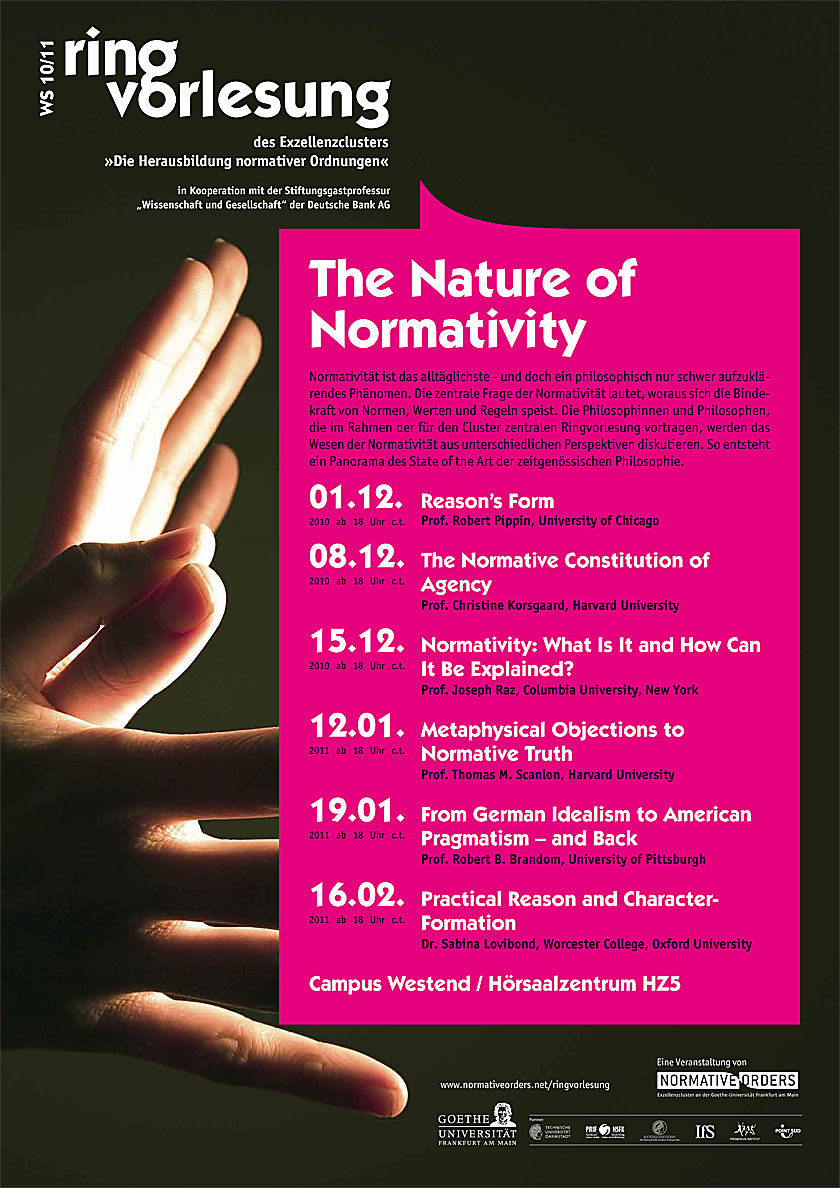 Ooh, this looks interesting – in a parallel universe, I’d like to be in Frankfurt for the next couple of weeks to attend this set of lectures on Normativity. This is one of my favourite topics these days, and I have been trying to write about the ideas of this set of thinkers, and failing to find a way to do so which seems to fit with conventions in critical human geography. There is a resistance to certain styles of reasoning in this world, which is often covered over by appeals to what does and doesn’t count as ‘political’, which seems to make this strand of philosophy oddly beyond the pale. Maybe because this stuff is just really difficult, in a way that a canon of French dudes, inflected by Heidegger, might not be, despite appearances? Or that it is difficult in a serious way?
Favourite Thinkers I: Stanley Cavell
 The American philosopher Stanley Cavell has just published his autobiography, Little Did I Know (Stanford University Press). I haven’t read it yet, it is just out, but I certainly will. I have been trying, and probably failing, to think in a ‘Cavellian’ way for a while, which mainly ends up meaning that I just use the word ‘ordinary’ a lot and in a knowing kind of way. Cavell’s distinction between knowing and acknowledging seems to me to be the basis for a profound re-thinking of the epistemology of criticism in a more modest direction. ‘Critical’ styles of thinking often suffer from what Pierre Bourdieu called, after Cavell’s mentor and philosophical hero J.L. Austin, ‘scholasticism’. Cavell helped me to see how certain styles of critical thinking are chronically scholastic, in the sense that they tend to assume that relations of knowledge are constitutive of all human associations – and that therefore knowing how things really are, how they really work, is always a politically charged tool of de-bunking, de-mystifying, de-stabilising. I have a fantasy book project which would reconstruct critical social theory in a Cavellian register, but that might never see the light of day.
Cavell is notoriously difficult to read (I think reading Cavell might be a bit like what it must be like to read Derrida in French), but he is also a bit of a populist – most obviously in his taste in films, which he has written a great deal about, and which he uses to make philosophical arguments – Cavell’s favourites are 1930s and 1940s Hollywood romantic comedies, films like Bringing Up Baby and The Philadelphia Story. Cavell has an interesting take on the ontology of film, and the screen more generally, though it quite distinct from the sort of ontological account one might find in Deleuze (a film-maker’s film theorist) or Bernard Stiegler – Cavell’s media ontology sets off from the puzzle that we manage to recognise ourselves in the narratives of different genres.
So, I am looking forward to reading his autobiography – not least, because I increasingly find myself drawn to books which are about theory or philosophy, rather than books of theory or philosophy. This is probably age, and lack of time; but I also think there is something important about the way in which current styles of theory and philosophy often attach themselves in important ways to Proper Names, exemplary lives, places, or events – Cavell I suspect will have interesting things to say about the relationships between thought and life for those of us who have led very ordinary lives indeed.
 Pop Theory