
 I have a new paper in Geoforum, just published online, titled Situating injustice in the geographies of democracy. It will be included in a special issue on space, contestation and the political, coming out of a workshop held in Zurich back in 2009, organised and now edited by Dave Featherstone, Benedikt Korf, Joris Van Wezemael. I’m not sure exactly when the whole issue will go live. My paper argues that contestation is rather more important to critical theories of deliberative democracy, broadly defined, than is usually acknowledged, and that it is understood in this work in ways that promise a more modest approach to thinking about the geographies of democratic politics than one finds in approaches that adopt a priori conceptions of what counts as ‘political’. It is one of a series of things I have been writing for the last couple of years on the topic of ‘all affected interests’, exploring how this idea from political science and political theory might be re-interpreted as the basis for thinking about geography and democracy; it’s the first of these pieces to actually get out into the world.
Category Archives: Geography
Urban theory and archaeology
Michael E Smith provides a link in a comment to a paper of his, on the uses of urban theory in archaeological research on ancient cities – his argument is that this work serves as middle-range theory in contrast to grand theory of the sort developed by Latour, or Giddens, or Bourdieu. I like the idea that theories are always best when they are marked by a certain sort of empirical modesty – although it’s interesting that the sorts of social theory that Smith thinks of as ‘grand’ in his field would in geography these days appear to be much more ‘middling’ than the grandly philosophical styles associated with current work on spatial ontologies, affect, events, the post-political, and related themes.
Geography and ethics: justice unbound
 The first of my three ‘progress reports’ on Geography and Ethics is now published in Progress in Human Geography. This first one is dubbed ‘justice unbound‘, and discusses recent literature on justice and injustice in and around geography and related fields – including Sen’s recent book, G.A. Cohen’s leftist riposte to Rawls, Nancy Fraser, and Iris Marion Young . It was written before recent books by Danny Dorling, Ed Soja, Susan Fainstein were published, but these otherwise different works sort of confirm the point I am trying to make in this piece – that it might be worthwhile to think through the idea that injustice is the medium of justice (the line is J.M. Berstein’s), without thinking that this absolves us completely from engaging with normative reflection on what these terms mean. It’s not meant as a warrant for assuming that we all just naturally know injustice when we see it.
Anyway, as I say, this is the first of three of these reports; the second is already done, the final one I’ll do later this year. I have ended up not quite writing about ‘geography and ethics’, not least cos most of what I know about ethics is part of that poststructuralist strain of thought that Jeff Popke had already reviewed rather thoroughly as the previous ‘incumbent’ of this role; partly because it might be more interesting to think about how normative practices are an ordinary aspect of how life hangs together, rather than thinking of ethics as an extra special ‘responsibility’ that requires a special effort to pull off; and partly because I said ‘yes’ when invited because I wanted to write about some overlaps between social theory, political theory, and moral philosophy that I find intriguing for no other reason that they don’t quite show up in geography-land despite being on the edges of conversations which take place there. I think their not showing up has something to do with the degree to which Theory in geography has drifted into such a resolutely ‘metaphysical’ register, in the sense of this term that someone reminded me this week Ian Hunter uses to describe the genealogy of contemporary Theory-land. But that’s another story.
William Cronon on intimidation and academic freedom
Via Anne Mosher on twitter, news of a new blog by historian/geographer Bill Cronon at the University of Wisconisn-Madison, called Scholar as Citizen, which seeks “to reflect on ways that scholarly methods and habits of mind can help us ask better questions and thereby offer constructive approaches for better understanding why current events unfold as they do.” Cronon’s first post earlier this month put recent political events in Wisconsin in the wider historical context of conservative ascendancy in US politics over the last 30 years or so, including a ‘how to’ guide for anyone interested in researching this process of right-wing assertion further. He has a new post discussing the political reaction to this first one, from the state Republican party, who have used freedom of information legislation to request his emails since the start of the year. All sounds very nasty, a clear attempt to intimidate him and seek to chill public criticism. And it does remind me, this week when UK-based academics have been involved in strike action, with all its inconveniences and interruptions, that we should be aware that these sorts of rights for academic and other public sector employees are the target of very explicit political assault in the USA at the moment.
Living Geography
From Alan Parkinson of the Geographical Association at Living Geography, a draft of resources for school teachers to use to teach about and through the earthquake and tsunami in Japan. If I still taught students in real-time, this sort of material would be great even at undergraduate level – the sorts of pedagogy being done in school geography is often rather wonderful.
Whatever happened to social theory?
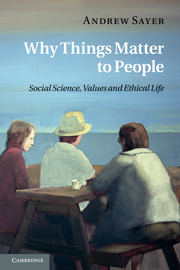 I’ve just been reading the new book by Andrew Sayer, Why Things Matter to People. It is a full-scale elaboration of the importance for critical social science of what Sayer calls ‘lay normativity’ – people’s evaluative orientation, or relation of concern to the world around them. Sayer thinks this aspect of life is systematically downplayed or misrepresented in lots of social theory. I think he is probably right about that. The notion of lay normativity was used in Sayer’s previous book, The Moral Significance of Class, and the project on ethical consumption that I have been working on, for it seems like ages, made use of what we at least understood this term to be getting at – the importance of giving credence to the evaluations of their own practices that people provide in social science encounters, not least as being able to tell us something interesting about how practices work. Here is the publisher’s blurb for Sayer’s new book:
“Andrew Sayer undertakes a fundamental critique of social science’s difficulties in acknowledging that people’s relation to the world is one of concern. As sentient beings, capable of flourishing and suffering, and particularly vulnerable to how others treat us, our view of the world is substantially evaluative. Yet modernist ways of thinking encourage the common but extraordinary belief that values are beyond reason, and merely subjective or matters of convention, with little or nothing to do with the kind of beings people are, the quality of their social relations, their material circumstances or well-being. The author shows how social theory and philosophy need to change to reflect the complexity of everyday ethical concerns and the importance people attach to dignity. He argues for a robustly critical social science that explains and evaluates social life from the standpoint of human flourishing.”
It will be interesting to see what sort of traction, if any, Sayer’s book gets in critical human geography. Once upon a time, when I was little, Sayer was one of the big names of Theory in geography, in the 1980s heyday of critical realism. Apart from forays every so often to call for more robust normative reflection in the discipline (most recently in Antipode), Sayer is much less of a presence now. He wrote an excellent book in the mid ’90s, Radical Political Economy: A Critique, which I remember Marxist colleagues being apoplectic about because it took seriously non-‘dialectical’ styles of social thought and made productive use of Adam Smith and Hayek.The style of theory that Sayer performs, with its close attention to argumentation, is rather uncommon in geography now. I’m not necessarily sold on all of Sayer’s arguments – I think, for example, that he might find more support for his broad thesis about human vulnerability and ethics in thinkers such as Levinas or Derrida, or for the importance of everyday attachments to things that matter in styles of cultural theory concerned with thinking about the ordinary, such as Lauren Berlant’s work; these are not traditions Sayer has much patience with. Genre blindness? But I think his diagnosis of the limits of current styles of critical thinking has a lot going for it – critical thinking does find it really difficult to give credence to ordinary dispositions as having value in and of themselves beyond their function in systems of discipline, as effects of subjectification, or as indices of unconscious dynamics, or at best residues of untapped resistance or invention.
I happen to think that Sayer over-eggs the normativity-is-important cake by insisting on making the argument with reference to ethical theories – there is a less explicitly ‘moral’ strand of philosophy concerned with rationality, reason, embodiment, and values that might inform the sort of reconstruction of social science Sayer recommends. I have been trying to write about these same issues in a rather more tentative fashion, for a series of ‘reports’ on ‘Geography and Ethics’ due to be published any time soon. The first deals with some recent accounts of justice; the second with some of the philosophy mentioned above, focussing on notions of practical reason [Sayer has lots of interesting things to say on this topic]; the third is still to be written, and will focus on the kind of social theories of value, normativity and justification that Sayer, amongst others, has been developing.
Geographies of Labour
 Becoming a parent is one of those occasions when one gets to see a lot of ‘the state’ – engaging with doctors, nurses, hospital administration; becoming a welfare recipient, through signing up for child benefit, or the now defunct child trust fund; visits from health visitors; registering a birth. Of all the professional people we have engaged with in this process, twice now, my heroes are the midwives. ‘We’ have had very different experiences of maternity care, first in Bristol, now in Swindon. In Bristol, with our first child in 2006, we were part of a progressive so-called ‘domino’ system of midwifery care, attached to a midwife-led maternity unit – this system is distinctive because the same midwives provide continuity of care through antenatal, intrapartum and postnatal stages. We were enrolled into this practice through one of our neighbours, at a summer street party actually, when she and one of her colleagues convinced us of the benefits of this approach, compared to the model in which community midwives provide antenatal and postnatal care, while different midwives are responsible for care while in hospital. The Bishopston midwife practice was, in fact, full of properly feminist midwives – Mary Stewart, our neighbour, was both a practicing midwife and a part-time PhD student at UWE at this time, and she is now an academic at Kings College London. I didn’t know this back then, but she is the editor of an important primer on feminist approaches to midwife care. I remember having a conversation with her, after the birth of our first child (she wasn’t actually the attending midwife at the birth), about her use of Judith Butler and qualitative methodologies in her PhD to understand midwives discourses about performing vaginal examinations during labour. The speed-reading I have done in this area, just by tracking Mary’s publications and where they lead, reveals an interesting and unexpectedly close relationship between high-falutin social theory – lots of Foucault in particular – and very practical concerns of how to enact, as they say, feminist principles of empowerment in contexts where midwives are mediating all sorts of imperatives, from surveillance of women, doing things to them, and sharing their experience and expertise with them.
One surprising thing about being part of this midwife practice was that we were quickly converted to the idea of having a home birth, which would previously have seemed like a bizarre thing to do. In the end, our first daughter wasn’t born at home, but the decision to start from a home birth as a first preference was an important aspect in ‘empowering’ and building confidence for my partner around the process of labour and giving birth. This second time round, in Swindon, things have been a little bit different. No domino system, and the Great Western Hospital in Swindon does not yet have a birth centre either (it opens later this year, and my partner couldn’t hold on). While not impossible to have a home birth, it was not in any way encouraged. Before Christmas, just as my partner started maternity leave, there was a rush of national news stories about funding cuts to midwife care and heightened risk to mothers in labour, and about ongoing controversies about the safety of home births. So we found ourselves in a context of renewed debates about medicalization of child-birth, and campaigns to protect maternity services in an age of ideologically-led austerity. But in the end, the birth of our second daughter involved two great midwives at the hospital, in and out in one day, and no sight of a doctor at all. And whereas we had planned to use a birth pool at home first time (I never even got to inflate it in the end), this second time ‘we’ did a have a water birth.
Two children in two different towns, both born in hospital but under different organizational arrangements. There is a large aspect of comparison to the practice of parenting – comparing one’s own conduct to peers and cohort groups, or to parents or sisters; and now, it turns out, comparing the second time to the first time. And then you remember there is something irreducibly singular about each birth, each child, each nappy. So I’m not going to generalize on the basis of our experience, not least because while in Bristol we got the ‘theory’ right, in Swindon we have had as nice, and in some respects even nicer, and as ‘empowering’ an experience despite being in a more classically ‘medicalized’ system. There is, of course, lots of serious social science about the geography of labour (though not really much in Geography), in at least two respects: the different arrangements available in different parts of the country; and at a different scale, but closely related to this, the differences between births planned at home, in midwifery units, or obstetric units. Our former neighbour Mary, since completing her PhD, has been working on a major Department of Health research programme, the Birthplace programme, looking at whether there are significant differences in outcomes for mothers depending on where births are planned. The results of the programme are due to be published later this year.
Geography without scruples
 Here is a new book of conceptually sophisticated, research-informed essays about the place of geography education in schools in the UK. It is the product of the geography Education Research Collective (GEReCO), a group of scholars working on researching geography and education issues. I am not part of this group, I should say, but was invited to write a short commentary on some of the essays. Geography’s place in the school curriculum is constantly changing, it seems – sometimes bemoaned for being marginalised, although now suddenly defined as a ‘traditional’ academic subject as part of Michael Gove’s re-definition of standards around the so-called ‘English bac’. There is a vibrant on-line community of geography teachers and education researchers engaging in these issues – amongst others, I like the blog developed by John Morgan and David Lambert, Impolite Geography.
Globalizing Responsibility
 A new book, Globalizing Responsibility: the political rationalities of ethical consumption, co-written by myself and three colleagues – Paul Cloke, Nick Clarke and Alice Malpass – has just been published. It comes out of an ESRC/AHRC funded project on Governing the subjects and space of ethical consumption that we all worked on together, and which formally ended back in 2006. But these things take time to come to full fruition (we have another book in the pipeline).
The book sets out to analyse various ethical consumption practices from a political perspective. By this, I mean it tries to understand them as forms of political mobilisation, campaigning, lobbying, and so on – not in the sense of evaluating them from a pre-established position of what counts as politics or what makes politics more or less progressive – but in terms of trying to understand how these sorts of activities are indicative of changes in the way politics gets done now. It is based primarily on case studies undertaken in and around Bristol in the mid-2000s, especially focussing on fair trade campaigns of different sorts, and tries to make sense of the local dynamics of global solidarity politics. Theoretically, the book works through various approaches to understanding this sort of activity, including accounts of neoliberalization, governmentality theory, theories of practice, social movement theory, and theories of consumerism.
We have a couple of nice endorsements on the back cover, one from the geographer Peter Jackson at Sheffield: “Based on original research and innovative thinking, this profound and insightful book challenges conventional thinking about ‘ethical consumption’. Approaching the subject as a distinctive form of political mobilisation, Globalizing Responsibility shows how our everyday consumption practices are related to wider narratives of social justice and collective responsibility”; and one from Rob Harrison of Ethical Consumer Magazine: “‘By viewing ethical consumption patterns as a political phenomenon, the authors deliver a far deeper understanding of this growing movement than a whole raft of marketing and business literature which has gone before.”
So if anyone is still stuck for gifts to put under the tree this festive season, this comes just in the nick of time.
The politics of behaviour change
 Another plug, this time for a Theme Issue of the journal Environment and Planning A, on the topic of Ethical Foodscapes. I was asked to write a short commentary on the papers in this collection, and ended up using this an excuse to try to say something coherent about ‘the politics of behaviour change’ – the papers in the collection all engage, in different ways, with ongoing attempts to influence individual patterns of consumption by fiddling with the backgrounds of food practices. This is just one field in which the issue of how and whether to influence people’s conduct to achieve various ‘public goods’ has become central to contemporary politics and governance. There is a great research project investigating this phenomenon, based at Aberystwyth, on the time-spaces of soft paternalism. Behaviour change is all over the place these days – in climate change debates, in obesity agendas, amongst the Research Councils who fund science and social science in the UK – it’s all the rage in policy circles, not just in government but also amongst think-tankers and NGOs. The House of Lords Select Committee has just announced an inquiry into how ideas about behaviour change are working in government. What I find most interesting about all this is the challenge this seems to present to styles of ‘critical’ social science analysis – Elizabeth Shove has an interesting reflection on this issue, also in Environment and Planning A earlier this year, which focusses on how ‘attitude-behaviour-change’ models of governance tend to marginalise insights of social theory. It is interesting, certainly, to track the ways in which certain scientific and social scientific fields are being ‘sourced’ for authoritative models of how to intervene to bring about social change – the most obvious example being the selective use of neuroscience, along with the popularisation of behavioural economics by Thaler and Sunstein’s Nudge. There is a cross-over here between academic research fields and popular discourse too; think of Malcolm Gladwell’s books, the success of Freakonomics, or my favourite, Simon Kuper and Stefan Szymanski’s Soccernomics – a book which uses simple statistical analysis to develop some interesting explanations and make some entertaining predictions about how success in national and international football is determined (interestingly, this book was published in the UK under the title Why England Lose: And other curious phenomena explained – the difference in the title between the UK and US version is indicative of the current popularity of this style of popular social science beyond any particular specialised interest).
There is an easy default position that this style of thinking about influencing people is inherently sinister, since it explicitly seeks to get at people through less-than-fully-rational means – by either designing change into infrastructures, or by deploying affective styles of communication. This seems to circumvent a basic principle of persuading people of the reasons to change through rational argument. Behaviour change initiatives are all about ‘manipulating’ the contexts in which people exercise choice and discretion. They seem to be designed to confirm the model of ‘governmentality’ developed by Michel Foucault, of a mode of power which works by shaping the contexts of individuals’ conduct without directly intervening in that conduct. Of course, the question that Foucault doesn’t necessarily help us with is how to know when it is a problem that your conduct is being configured, ‘nudged’, in certain ways, and when it isn’t. There is a tendency of course to read Foucault as a theorist of social control, but I think the proliferation of behaviour change initiatives is one occasion to re-visit the ‘politics’ of using Foucault. The anthropologist James Ferguson has recently argued that there is a real political stake at play in seemingly arcane differences between conceptualisations of neoliberalism as a hegemonic project of class-power, informed by Marxist theorists such as David Harvey, and neoliberalization as a contingent assemblage of varied ‘arts of government’, informed by governmentality theory, in the work of Aihwa Ong for example. One reason not to reconcile these approaches – not to think that Foucault provides a nice micro-analysis of the ‘how’ of neoliberalism, while Marxism still holds the secrets to explaining the real interests driving the ‘why’ (an argument made by Bob Jessop) – is because the governmentality approach draws into view the ‘critical’ imperative to think through the possibilities of alternative ‘arts of government’. Quite a lot of sexy theory these days doesn’t like to do this, preferring stylized images of contestation and disruption. This is why the default reading of behaviour change, as a sinister way of controlling people’s actions in the interests of more neoliberalism, more consumerism, more responsibilization, doesn’t seem convincing to me – it seems to close down the more difficult form of analysis which would ask about the possibility of using devices and discourses of ‘behaviour change’ for different purposes, or in more democratically accountable fashion.

