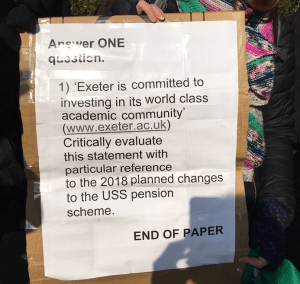
 You can tell that University administration has become dysfunctional when it becomes normal for everyone to refer to senior managers from the VC downwards by their first names. After all, properly functional, responsible bureaucracies are supposed to be anonymous and depersonalised – yet Universities in the UK increasingly organise themselves internally as if the effective operations and achievements of the whole institution can be accounted for by the forms of authority projected through the charisma of their ‘leaders’ (This is a just warped expression of a more basic and much cherished principle of University governance, whereby Vice-Chancellors are selected from ‘the ranks’ as it were, moving from practicing academics to senior management positions). Of course, the relationships that really matter in Universities are those structured by conventions of pastoral care between students and teachers, and by respect between professionals, not those structured by weirdly personified hierarchies of cascading “strategy”. In the UK, the consequences of the topsy-turvy distribution of personal relations of trust and suspicion in cultures of higher education management (see also my previous comments on the systematic distrust towards academic professionalism embedded in the TEF) have been fully realised in the current dispute about the future of the pension system in pre-1992 Universities. And whatever the outcome of the dispute, it seems to me that there at least two certainties upon which one can count about what life is going to be like in the future for people working in this part of the UK higher education sector.
1). Large numbers of academic and non-academic staff working in British Universities now know that senior management have, to varying degrees and with some notable and honourable exceptions, been actively seeking to systematically diminish the pay and conditions of those working in the sector – we know this because we have all been reading about this for at least a couple of weeks now, a bit late perhaps but better late than never (you can read the position of your own institution here, and more generally follow up on this issue by following the commentary by Michael Otsuka). If the UUK position on the future of the USS pension system prevails, then there will be an awful lot of University staff who will find themselves significantly less materially well off and secure in the future. I’m not aware of any plan by any University to think about compensating their staff for the financial losses which will follow from proposed changes to the USS system. Basically, we’re all expected to do the same amount of work (that is, “more and more” of it all) for less money. This is worth saying out loud to underscore the brazen quality of the collective position publicly endorsed by Universities which provoked the current strike action by University staff. Even if the UUK position does not prevail, even if in some unlikely outcome the UCU’s position wins the day (I’m not that optimistic), then what now exists is an open awareness across the sector, amongst everyone working in a University (with a few notable exceptions), that the particular institution they work for was more or less happy to try to force through this sort of restructuring as quietly as possible, without admitting it, and by attempting to ‘naturalise‘ the economics of pensions by way of justification when called out. The sheer mendacity of Universities in allowing the dispute over pensions to get to the current point (leaving aside deeper questions about longer term mismanagement of the pensions system) is not something that will just be erased from memories – it’s now a known fact about institutions that are often enough happy to circulate platitudinous congratulations to their staff when League Table results go well or REF outcomes are positive or NSS scores go up, that they were and are keen to steal money from those same staff members in order to sustain what seem like increasingly thoughtless and unsustainable strategies of institutional growth and ‘global’ competitiveness (the visible, measurable success of which we all suspect directly benefits senior management through ill-considered performance related pay schemes).
2). The irreparable damage to morale and trust that follows from the betrayal revealed by the UUK position and the way it has been meekly supported by individual institutions is only further worsened by the ways in which the more routine forms of higher education administration have been almost automatically applied to the micro-management of the current dispute. This extends from explicitly punitive and provocative efforts to bully staff into giving up on strike action through to more ordinary, often rather clumsy, but I have no doubt widespread efforts such as those at my own institution to require individual academics to provide detailed information about the impact of their strike action on teaching (somehow they never ask that question about impacts on research), as well as explicit efforts to force colleagues to make-up classes not held because of strike action (i.e. to provide teaching after the strike for which salary has been withheld because of being on strike). These sorts of heedless attempts to manage the effects of the strike action extend to the making of blanket promises to students, strongly implying to them that any missed classes will indeed be caught-up by striking academics, a promise which amounts to central University managers seeking to leverage the expectations of students in order to expose often relatively junior staff members to further stress, harassment and pressure. In one respect, this is business as usual, in so far as all of these forms of response reflect what is now an almost taken-for-granted model of top-down micro-control in which University management seeks to monopolise the right to speak in the interests of students in order to impose from above changes to teaching practices that are wholly insensitive to either sound pedagogy or well-established good practice at ‘the chalkface’. In short, if one certainty going forward is that senior University managers will not be able to put their own Humptiness back together again, the other seems to be that they will nonetheless continue for a while yet to operate with the same centralised models of internal micro-management as before, thereby only compounding the effects of demotivation, demoralization and lack of trust that follow from 1). above.
 The predictable outcome of the current dispute, then, is that University senior managements are likely to be widely held in contempt by significant proportions of the staff working for their own institutions, and with complete justification. Again, with some exceptions of differing degrees (and those exceptions just underscore the degree to which the standard line taken by many Universities is an intentional decision to act in a particular manner), a large number of individual Universities and the umbrella organisation UUK have been revealed to be dishonest, out of touch, ill-informed, and manipulative (did I forget to mention incompetent?); and the embedded systems of institutional micro-management that have been rolled-out over the last decade or so have been revealed to be entirely unsuited to the cultivation and maintenance of a spirit of collegiality upon which any University community crucially depends.
Properly speaking, that all amounts to a real live crisis of legitimation – Universities no longer have the means to secure the identification of those over whom they presume to exert authority.
It should be said that this is far from an unambiguous state of affairs. University management in the UK is already suffering from a very serious PR problem thanks to scandals about vice-chancellor pay and expenses. The cultural politics of that issue are far from obviously aligned with the interests being defended by the UCU in its campaign for secure pensions (remember, the same person who thinks that levels of VC pay is a scandal also thinks that academics’ spend half their time on holiday, which is another way of saying we are underworked and overpaid). This dispute, however enlivening and affirming for all of those involved in it, is taking place in a context in which a decadent and decaying Tory government is intent on forcing through a series of ill-considered structural changes to higher education, including revisions to student fee systems, intrusive regulatory regimes (TEF, again), heightened competition by allowing ‘new entrants’, and further compromising the autonomy and integrity of research at the altar of ‘innovation’ and ‘regional growth’ and ‘impact’ and ‘global challenges’. For an entire culture of higher education senior management and leadership to have been so thoroughly delegitimized in the eyes of those who, remember, do all the teaching and deliver all that research excellence, is in this wider context a far from unambiguous process. There is, after all, nothing about ‘crisis’ situations that tends naturally to encourage progressive outcomes. This is a moment for heightened vigilance not only towards the unfolding of this particular dispute but also of the ways in which this dispute might be spun and appropriated by various interested on-lookers.
The ‘crisis’ that the current dispute over pensions represents is, one might suggest, in no small part an effect of a systematic form of hubris shared across a whole stratum of University managers, a stratum which has for more than two decades happily embraced and promoted the idea that Universities can do everything – deliver social mobility, help drive national economic growth and technological innovation and revive productivity, generate cultural diversity and creativity, anchor local and regional dynamism, and various other functions too. Taking on these undeniably public responsibilities has, however, been associated not only with the adoption of particular models of University financing but also with the consolidation of ill-starred systems of centralised and hierarchical management that are, in practice, at odds with the fundamentally pluralistic qualities of the modern University. There is behind all of these issues a series of questions about the opacity and unaccountability of University governance, beyond and above questions about the management of Universities, that too often remain hidden from view – time for the co-operative University, anyone?










 Pop Theory