Almost Famous

jhbThe Sociological Review blog has a series of articles on what it calls Superstar Professors, including commentaries on thinkers such as Zizek, Giddens, and Bauman. There are some interesting thoughts raised in the posts published so far, including reflections on the relationship between MOOCs and academic celebrity, and on the relevance of recent debates in the sociology of ideas (the work of Cimic, Gross, and Baert for example) in accounting for the ‘success’ of certain strands of thought.

There is, though, a rather predictable tone to these pieces, in which the apparent ‘rise’ of ‘star authors’ is taken as a sign of standards of ‘scholarship and intellectual quality’ being undermined by the unfortunate pressures of commerce and the market. It’s actually a recurrent problem of trying to analyse seriously the relationship between ‘thought’ and its conditions, this temptation to fall back on a style of evaluation in which one identifies the instrumental and strategic calculations that shape academic life in an act of disapproving exposure.

I have an amateurish interest in these things, partly related to some current thinking about how to research the living histories of ideas, partly as a more general interest in understanding cultures of theory. Long ago, Murray Low and I wrote a paper in which we tried to conceptualise the relationship between what was then called French Theory and the changing dynamics of academic publishing (in the interim, one might be inclined to extend the analysis to investigating the formation over the last two decades of ‘Continental Philosophy’ as the name for a serious, canonical field of intellectual curiosity, as distinct from a term of abuse). Slightly less long ago, I also did some work on the complex relations between commercial dynamics, public institutions, and cultures of aesthetic evaluation that shaped the formation of a canon of post-colonial African literary writing.

I tend now to think of those projects as part of a wider, long standing interest in understanding the variable formation of public life. One thing I take for granted, on the basis of things learnt from these projects certainly, but it’s also a pretty basic feature of any decent account of the concept of the public sphere, is that the relationship between public life and markets, public life and commercial practices, public life and processes of exchange, is an internal, constitutive, and integral one. Contradictory, no doubt, often tragic in a Habermasian kind of way, but nevertheless, a type of relationship which requires a rather more careful style of analysis than the one provided by simple claims that the standards of intellectual life are menaced by such worldly matters. 


Bite Size Theory

“The presence/absence of mobile phones in one’s fictional worlds is going to be, I suspect, no trivial matter. Because so much of the mechanics of novel writing, past and present, is taken up with making information available to characters or keeping it from them, with getting people together in the same room or holding them apart. If, all of a sudden, everyone has access to more or less everyone else – electronic access, that is – what becomes of all that plotting?”

John Coetzee, in Paul Auster and J.M. Coetzee, 2013, Here and Now: Letters 2008-2011.

Externalizing Migration Management: New book in Routledge Research in Place, Space and Politics Series

RZThe latest book in the Routledge Research in Place, Space and Politics series has been published – Externalizing Migration Management: Europe, North America and the spread of ‘remote control’ practices, edited by Ruben Zaiotti. Further details are available here.

Further details on the series, including guidelines for submitting proposals, can be found here and here.

Music to Write Books To

UntitledI participated in an ESRC-sponsored seminar last week on the theme of the politics and economies of attention, which was interesting and fruitful in all sorts of ways. Lots of the work on this topic turns around a distinction between ‘good’ forms of attention, which is focussed and contemplative and “deep”, and ‘bad’ forms of attention, which is fleeting, distracted. A certain sort of reading of a certain sort of text is the model against which other forms of attention are often judged in a great deal of high theorizing on this topic.

Trying to find something interesting to say about this topic made me aware of how the ways in which I work, both in relation to reading and writing, do not quite conform to the expected model of scholarly attention. I read with the TV on, and write while listening to music or the radio, and not serious Radio 3-type music either (it’s generally a matter of choosing between Taylor’s 1989 and Ryan’s 1989). This way of working may or may not be reflected in the depth of understanding of ideas and thinkers displayed in the things that I write. I actually find it rather odd to write, in particular, in silence. I am still in recovery from having finished a book manuscript, and found myself today, while sitting in a hairdressers, not having my hair done, constructing a list of songs that, more or less tangentially, capture something of the experience of writing the sort of book I have been trying to write for the last year and a half:

  1. I Just Don’t Understand – Spoon
  2. Jacques Derrida – Scritti Politti
  3. Acid Tongue – Jenny Lewis
  4. Distractions – Bobby Darin
  5. Why Theory – Gang of Four
  6. Unputdownable – Róisín Murphy
  7. Waking Up – Elastica
  8. We Love You – Psychedelic Furs
  9. Drink in My Hand – Eric Church
  10. Gone Daddy Gone – Violent Femmes

10 Best Books (I haven’t read) in 2015

IMG_0215I spent much of this year trying to write my own book, which ended up being all-consuming in various ways. I have read plenty of stuff in a “need-to-look-at-this-for-the-book-even-though-it-won’t-make-the-final-cut” kind of way. So it’s been a year of reading instrumentally, if you see what I mean. There are various books I haven’t read but which I want/need to read soon, for fun or for new/deferred research and teaching projects. Amongst others, they include:

  1. Ivan Vladislavic, 101 Detectives.
  2. James McPherson, The War that Forged a Nation: Why the Civil War Still Matters.
  3. Patrick Modiano, The Search Warrant.
  4. Ira Katznelson, Fear Itself: The New Deal and the Origins of Our Time.
  5. Marie Luise Knott, Unlearning with Hannah Arendt.
  6. James Ferguson, Give a Man a Fish: Reflections on the New Politics of Distribution.
  7. Steven Friedman, Race, Class and Power: Harold Wolpe and the Radical Critique of Apartheid.
  8. Lisa Gitelman, Paper Knowledge: Towards a Media History of Documents.
  9. Wolfgang Streeck, Buying Time: The Delayed Crisis of Democratic Capitalism.
  10. Jamie Peck and Nik Theodore, Fast Policy: Experimental Statecraft at the Thresholds of Neoliberalism.

Space, Power and the Commons: new book in Place, Space and Politics series

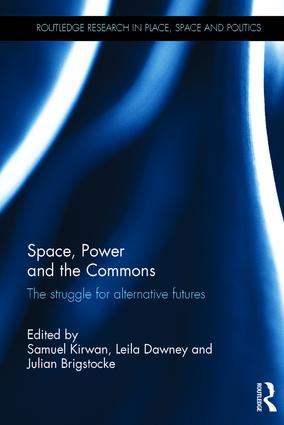
9781138841680The latest book in the Routledge Research in Place, Space and Politics series is now published (technically it is a 2016 book) – Space, Power and the Commons: The struggle for alternative futures is edited by Sam Kirwan, Leila Dawney and Julian Brigstocke, and is associated with the Authority Research Network. It’s an important addition to the literature on the theme of ‘the commons’, not least because it draws together discussions of high theory on this topic (Hardt, Nancy, Ranciere, etc) with empirical analyses of practices of ‘commoning’.

This is the second title to appear in the Place, Space and Politics series, after the collection on Urban Refugees. There are more titles in the pipeline. More details on the series, including guidelines for submitting proposals, can be found here and here.

Going public

cbcoraI am, finally, ever so close to finishing my book, and sending the final manuscript away to the publisher. A couple more weeks of ‘research retreat’ would enable me to complete it, but I am well and truly back in the real world now, so it’s a matter of squeezing book-work in between all sorts of other things. This coming week I have a nice distraction from worrying about not working on the book, as I am attending the Annual Meeting of Finnish Geographers, in Tampere. I am giving a couple of talks, one on ‘Geography and the Priority of Injustice’. Last time I talked to this title, back in April, I only had a very long note-like draft of a book. This time, I have a written-out-in-prose final draft, going through final edits. It’s a real thing, not a pretend thing.

My working title for the book has become The Priority of Injustice, although the ‘geography’ bit is not actually central to the book. The talk is developing into the occasion where I try to say out loud why the grand theme of the priority of injustice might capture some of the difficulties covered over in much of the work in the burgeoning field of geographies of justice. So I’m thinking of the coming week as a final impetus to finishing the monster in the box, so that I might move on to other things.

I’ve got a lot of songs but they’re all in my head

IMG_1983I have come to the end of my ‘research retreat‘ in Vancouver, and have succeeded in reducing the first sprawling draft of +200k words to a more manageable size, ready for a final edit and submission in a month or so. In the process, some themes have been reduced or sidelined, some theorists have disappeared (no Poulantzas after all), and some issues crystallised for me.

Vancouver is a good place to immerse oneself in one task, away from other cares and concerns. It’s sunny (well, they have a drought on). And it has plenty of the ‘architecture’ of Thought, those spaces that make up the distributed office: public spaces of various sorts, coffee shops and public libraries in which to write and think (and plenty of free wi-fi), loads of bookshops (my favourite is Lucky’s), as if it was the 1990s (a lot of Vancouver seems to be like the 1990s), and a decent bus service to ferry you from one place to the other as you punctuate the day’s work. In no particular order, these are the places upon which my routine settled: Cuppa Joy Coffee (great for 6.30am starts); Professor and Pigeon (the only place that wasn’t a Starbucks to do Flat Whites); Melriches Coffee House (good for the evenings); MBA House in Wesbrook Village (good to be surrounded by other studious people); Koerner Library at UBC (a proper university library, it has the books you think it won’t have but turns out that it does); and the bar at Cardero’s on Coal Harbour (good for talking about the history and philosophy of geography, amongst other things).

I should say that I am surprised by just how much Neil Young is played in Vancouver’s coffee shops, bars and restaurants. You know you are in Canada when….

So back to the real world now, to a rainy bank holiday weekend in Swindon, kids back to school next week, start of term on the horizon, and a book to finish – back to Baila.

It’s not the city, it’s the weather we love

2015-07-29 18.34.29I once saw Spalding Gray live, in Atlanta, performing the monologue Monster in a Box, about the tribulations of writing his first novel. It was at a time when I was wondering whether to even start doing a PhD on, never mind finishing it, which took a while. I’ve been reminded of this, and the image of the lumbering physical presence of the tome itself, because I have been hauling an unfinished manuscript of my own around for a few months now. Actually, I have been carrying it around on a USB stick. I am in Vancouver now, for a month’s ‘research retreat’, as I like to think of it. So the first thing I have managed to do is print the whole thing off – all 209,000 words of a first draft, more than twice as long as it’s meant to be. I’ve also been re-thinking the title. That’s progress, right?

I’m now sitting in libraries or coffee shops (not the beach), trying to cut it down and make it cohere and ensure it has lots of narrative continuity (all those things you tell PhD students to do as they approach the finishing line). The young man sitting next to me this morning reading  Poulantzas’s Fascism and Dictatorship provoked one of those “Oh no, I should probably say something about that”-moments that tend to beset you when you are trying to finish something like this (another way in which I feel like I’m trying to complete a PhD all over again, again). Last time I wrote a book all on my own the bits that I cut out of the final version, quite rightly, lived on as subsequently re-worked journal papers, and actually have ended up animating parts of the argument of this new book. So this time I think I might just blog the bits I cut out, so that I can slough off those spare thoughts and move on properly once it’s all done and dusted.

But maybe I’m getting ahead of myself. I’m off to sharpen the pencils.