
 It’s all happening this month in Swindon, including the first Radical Bookfair, presented by the Swindon TUC.
Category Archives: Books
Books, shelfs, & selves
For anyone currently concerned with books and shelves…..
Ash Amin and Nigel Thrift, Arts of the Political: New Openings For the Left, reviewed by Dave Featherstone
Arts of the Political by Ash Amin and Nigel Thrift: Review
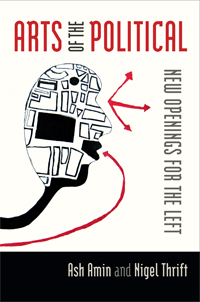 My review of Ash Amin and Nigel Thrift’s Arts of the Political: New Openings for the Left has just been published on Antipode’s online Book Review page. There is also a (shorter) review of the same book by Fred Inglis in the Times Higher. And the Mobilizing Ideas blog had a post about it a while ago too, in case you missed it (and are interested in these things).
Favourite Thinkers VIII: Wasting my life with Jonathan Lethem
 A while ago now, I mentioned a coffee-table book I had been given about the ideal bookshelf. One of the contributors to this was Jonathan Lethem, who I may or may not have known about before. But we’ll come back to that. Lethem’s books also appeared on quite a few of the ideal bookshelves of other contributors to this volume, I seem to remember. I particularly liked Lethem’s thoughts on his choices of favourite books (not one of which I have read). I underlined this:
“The thing about this bookshelf is that each of these books is a vast experience unto itself, while also being both self-contained and superbly useless. Reading any one of them doesn’t get you anywhere particularly meaningful; you haven’t arrived or graduated; you’ve just gone and done something that passed the time. It’s like taking a long walk with a friend who’s got a lot to say. There’s no cumulative purpose to it – it’s just an excellent way to waste your life”.
I’ve ended up spending quite a lot of time in the company of Lethem, more or less accidentally bumping into some of his books over the last couple of months. Over Easter, in Covent Garden, I bought a copy of his collection of essays, The Ecstasy of Influence, under pressure from a 6 year old imploring me to hurry up and choose something. I bought it on the basis of the title, the colourful spine, and the vague recollection of the author’s name, and because it seemed to include essays on things like Otis Redding and Devo. It’s what Lethem calls a ‘bloggish book’ of short reviews, essays, and one or two fiction pieces, ranging from serious subjects like living in New York in the aftermath of 9/11 to a range of pop culture reflections on topics such as discovering The Go-Betweens. The title essay is a little manifesto on the creativity of copying, borrowing, and re-using – first published in Harper’s Magazine, it performs a grand exercise of plagiarism in developing ideas about the gift economy and public commons as the dynamic source of cultural life (the ideas and practice are further developed in Lethem’s Promiscuous Materials, which you can find out about along with other bits and pieces at Lethem’s website.
A week later, I came across a collection of his short stories while on holiday in Devon (the third surprising encounter within 10 minutes while strolling down the main street in Totnes), and then, a couple of days later, still on holiday, found a copy of one of his novels, Motherless Brooklyn, a great ‘crime novel’ of sorts.
 Having spent some time with Lethem while on holiday, I then enjoyed his company again while in LA for a conference at the beginning of April. At The Last Bookstore, I found a copy of The Disappointment Artist, another non-fiction collection, but with a more coherent theme, a series of semi-autobiographical reflections on his attachments to things like comics, or pop music, or the films of John Cassavetes (that’s a great bookstore by the way, playing the soundtrack from Friday Night Lights while I was there, which was lovely). One thing I like about Lethem’s writing is a recurring concern with this issue of attachment, attunement, obsession, and immersion in specific cultural worlds – life as lived through the medium of fandom, being taken over by a series of works of some sort.
When I got back from LA, I then noticed that one of the books that Amazon had been prompting me to buy for a while was a book about the Talking Heads album Fear of Music. This is just one in a series of books on ‘classic’ albums, not the sort of thing I normally read at all (honest). Now though, having spent the previous month acquainting myself with Lethem, I noticed that the author of this little book was none other than the very same Jonathan Lethem. My algorithmic avatar suddenly coincided exactly with my situational self.
 The Fear of Music book is really excellent, if you like the sort of thing that Lethem likes, which it seems that I do, to a certain extent at least. He writes about the record by tacking back and forth between the experience of listening to it in 1979 as a 15 year old and his current, adult self. So, it turns out not just to be a nerdy fan book at all, in so far as it develops a serious account of the relations between one’s old, current, and next self. Writing about this record in the space between ‘the boy in his room’ and ‘the aging fan writing these words’, Lethem brings to light the degree to which avowals of cultural authority, taste, and judgment often turn on the performance of knowingness that is a disavowal of processes of learning and discovery – expressed in the the trick, or is it a temptation, of appearing to always already have known about an artist, or a chain of influences, or a line of significance that, in fact, one once knew nothing about, and which came after one’s initial seizure by a work: “The mind making retrospective sense of the artwork is a liar. Or a lie. Unspooling expertise and arcana, the critic spins a web of knowingness that veils its manufacturer, a spider shy of the light”. This theme of the knowing character of cultural taste is a feature of other essays by Lethem I have read, including ‘Dancing about architecture’, where he writes about the dorky knowingness of being a fan, where being able to spot influences and point out references to other sources is analysed as “a revenge of the seduced”. One way of processing one’s own capture by a song, a band, a novelist, a theorist perhaps, is to place one’s pleasure into a wider context of knowledge and prior disposition – it’s a way of acknowledging the force of the attraction while presenting this as something that still somehow remains under one’s own control.
Most recently, in Liverpool a couple of weekends ago, I came across another of Lethem’s novels, The Fortress of Solitude, again while stealing a minute from one of my children to book browse (or was it sharing a minute?). It’s about growing up in Brooklyn, again, and being a fan, and gentrification, and about not quite knowing what’s going on.
So I feel like Lethem is my new imaginary friend, he seems to share some of the same tastes as me, in films (I like Westerns too), in music, in literary theory, though he is, inevitably, smarter and more clued in than me on all these things and others. He seems like the older brother I never had; or needed. And he has a nice way of articulating the relations between learning, knowing, and pretending that make up whole worlds of intellectual anxiety and authority.
And I also identify with the idea of ‘used bookstore lag’ that Lethem refers to when describing his own pattern of learning and knowing – it resonates strongly with me, suggesting both a sense of discovering ideas late, after their time has passed; but also of discovering ideas unexpectedly, of receiving them as gifts of chance.
New book from Roger Cooter: Writing History in the Age of Biomedicine
Picked this up from Somatosphere, a new collection by Roger Cooter with Claudia Stein, Writing History in the Age of Biomedicine.
J.M. Coetzee Archive Open for Research in Austin, Texas
Contemporary Political Agency: Theory and Practice
 A new edited collection has just been publised, titled Contemporary Political Agency: Theory and Agency, and edited by Bice Maiguascha and Raff Marchetti. I have a chapter in it, Political agency between urban and transnational spaces, where I pretend to know about why assemblage theory and actor-network theory might be interesting, amongst other things. The book arises from a workshop held in Rome in 2009, under the auspices of the GARNET programme, an EU 6th Framework initiative, based at Exeter. In addition to all the intellectual stimulation during the workshop, the occassion was also a crash course in how to do Italian food properly, beyond pizza and pasta sauce from a jar. Here is the blurb for the collection:
“This book explores and critically reflects on the theory and practice of political agency in contemporary global politics. In light of the changing relationship between the state, the market and the society, it seeks to map both theoretically and empirically contemporary forms of global political agency.
This book reflects on the theory and practice of political agency in contemporary global politics. More specifically, it empirically analyses a range of different forms of political agency and explores their significance for understanding and enacting global politics. Reflecting the efforts of scholars from a variety of disciplines from political theory and Sociology to Geography and International Relations, it brings into conversation a wide spectrum of theoretical approaches including Marxism, feminism, post-structuralism and historical institutionalism. The contributors compare a range of forms of political agency; exploring their significance for the theory and practice of global politics; and reflect on the tensions and synergies generated by recent efforts to conceptualise them.
Demonstrating an innovative and interdisciplinary approach Contemporary Political Agency will be of interest to students and scholars of international relations, sociology, political economy and political theory.”
Debating the politics of consumption
 The latest issue of the journal Area has just published a Review Forum on the Globalizing Responsibility book which came out of a research project on the politics of ethical consumption. The Forum arises from a session held at the RGS-IBG conference in 2011, which included critical commentaries on the book by Alex Hughes and Mike Goodman. Both Alex and Mike have written responses to the book for the Forum. They raise various issues at stake in analysing and evaluating the politics of this field, including conceptualisations of the materiality of consumption, postcolonial approaches to consumption, issues of inequality and corporate power, and the role of media and communications practices in the extension of ethical discourses around consumption. We have a response/clarification/defence of the approach pursued in the book, grandly titled Problematising Practices, which, as the name might suggest, elaborates a little on the idea of focussing on ‘problematisation’ as both an object and method of analysis.
On the shelf
Just came across this little essay by Francesca Mari on shelving books….
 Pop Theory