
 Nigel Thrift, sometime geographer and all round theorist, who is now Vice-Chancellor at Warwick, has a short note on The Chronicle of Higher Education blogsite WorldWise note on the complexity of the tensions shaping Higher Education today. Apart from the slightly sneering dismissal of ‘critique’ as a posture to adopt in relation to current changes to University financing in the UK context, this is a rather succinct summary of the complex relations into which ‘The University’ is woven. It is also a useful reminder of the degree to which the transformations triggered by post-election decisions in the UK are part of rather longer, more broadly shared processes of reconfiguration in global higher education. One thing that Thrift’s list of tensions brings out is how they all revolve around the basic tension of being (at least in part) publicly funded institutions which are expected to or aspire to deliver a complex and contrdictory range of public ‘goods’ – world class research, economically useful teaching and learning, social mobility, relevant solutions to all sorts of worldly problems. Rather than there being a single model of ‘the public’ to which Universities are expected to be responsive and accountable, Thrift’s list of tensions indicates the diverse range of public purposes and constituencies which have a stake in the future of higher education. Anyway, Thrift promises future posts focussing in more detail on these different tensions, which should be interesting to follow.
Tag Archives: Publics
Fair is Fair
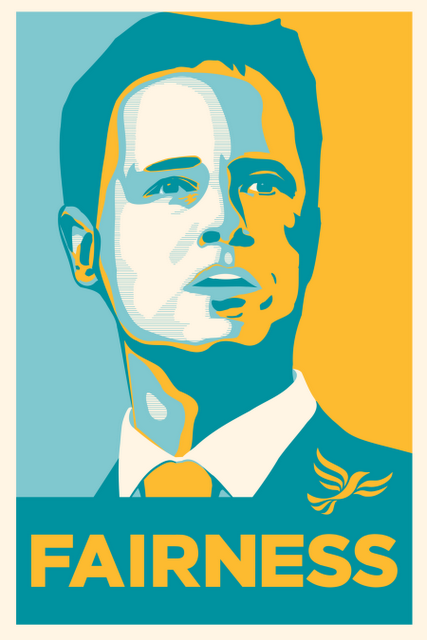 Everybody’s talking about fairness, these days, as my colleague John Clarke observes. It’s been a central and recurring motif in discussions of the end of universal child benefit, the Browne review of higher education funding, and Nick Clegg’s announcement of the Pupil Premium. All this fairness talk is part of general break-out of explicitly normative political discourse in the last 6 months, or at least the surfacing of themes which have been floating around for a while – The Big Society, with it’s Burkean heritage and ‘Red Tory’ sheen of radicalism is just one example; Ian Duncan-Smith’s catholic inflected social justice agenda is another; David Willets’ account of intergenerational justice yet another, the latter two more obviously having policy relevance than Cameron’s more flaky sounding Big Society. A key question here is whether it is wise to think of these discourses as simply ‘cover’ for spending cuts, simply means of legitimating more fundamental decisions.
John worries that fairness is too airy, lacking the incisiveness of a value like equality for example. I’m not so sure. Firstly, I think fairness is a term through which intuitive values of equality and justice is ordinarily expressed – these aren’t opposed terms at all. John Rawls’ egalitarian liberalism revolves around a notion of fairness, for example (a rather opaque account admittedly). But the principle of ‘from each according to ability, to each according to need’ also expresses an egalitarian sense of fairness. I think the intimate relationship between fairness and from abstract notions of equality or justice is worth considering more carefully as the politics of ‘the new politics’ begins to unfold, starting tomorrow with the comprehensive spending review. Last week, The Guardian’s right-wing provocateur Julian Glover managed to concoct a mean-spirited response to the ECHR’s report, How Fair is Britain?. What exercised Glover was precisely the coupling of fairness with equality in this report, leading him to argue that since fairness is a woolly idea, and since it is too easily mistaken as ‘equality’, we should do away with both notions. Glover’s self-serving argument elicited a debate , which underscored again the close relationship between these two different values.
My point is that we might do well to take seriously the different meanings of fairness, and attend to their changing deployment in public culture and in different contexts. But more than this, might usefully think of this break-out of fairness talk not so much as merely ‘legitimating’ economic decision-making, but as a form of justificatory discourse – in the sense that justificatory practices are understood by economic sociologists such as Luc Boltanski, Eve Chiapello, and Laurent Thévenot, as crucial mediums for the coordination of social life. From their perspective, justificatory discourses need to be understood as exerting real constraints on the exercise of unfettered capitalist logics, and as indices of fields of contestation and critique to which selective responses are made. From this sort of perspective, all this fairness talk is notable precisely because it is an index of the terrain of conflict and contestation to which an emerging, half-baked political programme feels itself obliged to respond in the hope of circumventing other modes of critique. Fairness is not meaningless, and certainly not an empty signifier. It has as set of intuitive associations, which the Coalition is doing its best to both make use of and control. David Cameron talks of fairness as ‘giving people what they deserve, and what people deserve depends on how they behave’. This definition ties fairness to a notion of individual responsibility, but it articulates a broader sense of fairness having to do with desert – an idea that is easily inflected in egoistically ‘meritocratic’ ways for sure, but which is also open to re-inscription.
So fairness might be worth taking more seriously than the urge to question all this woolly moralism leads us to think it should, if only because this is one terrain in which ‘the new politics’ is about to be articulated – not just spending cuts, but the coming debate about electoral reform too. It’s not the only one, of course, and there is no good reason to restrict oneself to the terms laid down by those in formal political control of events. In this respect, too, though, it is notable that there are some funny things happening in political discourse just now. For example, the reaction to the announcement of the end of universal child benefit by right-wing columnists in The Daily Mail and The Daily Telegraph is interesting not least because the challenge to the narrowly ‘transactional’ view of fairness expressed by Osborne and Cameron at the Tory conference was presented through a clear statement of a principle of public value – the defence of ‘stay at home mums’ receiving child benefit irrespective of personal or household income levels was made in the name of the principle that engaging in an activity that benefitted the collective life of the community deserved reward and support. This is a gendered, nationalistic, paternalistic vision of public value, no doubt, but a vision of public value it certainly is – it is in marked contrast to the ruling principle behind the Browne review of higher education, for example, which confirms an already evident drift to thinking of the public function of Universities primarily in terms of the efficiency with which they distribute private benefits to those who pass through their doors – a trend tracked by OU colleagues in the Centre for Higher Education Research and Information, and theorised by Craig Calhoun. If the ‘stay at home mum’ logic was applied to higher education, the proposals for University funding would look markedly different. All of which is to suggest that one task for a critical response to ‘the new politics’ of spending cuts, austerity, re-moralisation of the poor, electoral reform, and much else is to carefully track the modes of justification presented for different decisions, for it is here that one will be able to track the genealogies of vulnerability to which this idiosyncratic political project is responding and the opportunities for opposition it is helping to generate in its wake.
Does size matter? Beyond ‘neoliberalism’
 I attended a day-long seminar this week honouring the work of my colleague at the OU, Janet Newman. One theme of the day was how to understand the new political context in the UK, one of impending public expenditure cuts, lots of talk of ‘The Big Society’, and the coalition stoking ‘blame the poor’ rhetoric to justify fundamental restructuring of welfare regimes. What struck me over the course of the day was how the task of grasping this new political ‘conjuncture’ remains horribly constrained by the inherited academic conceptualisation of ‘neoliberalism’ that has held such sway over the last decade amongst critically-inclined, lefty social scientists [and critical theories of neoliberalism and neoliberalization are very much a product of the 2000s, something which itself seems worth reflecting on – as simple descriptive term, ‘neoliberalism’ has been around a long time, and we all know what it means – but the formalization of grand explanatory theories around this name seems a much more recent phenomenon].
Amongst those who pioneered the development of theories of ‘hegemonic neoliberalism’, the new situation post-2008 has already been dubbed ‘postneoliberalism’. This is hilarious in its own way, but it is in line with a longer tradition in this neo-Gramscian strand of thought of always ensuring that any awkward real-world facts are rapidly taken to confirm the basic understanding of neoliberalization as involving a straightforward shift from ‘state’ to ‘market’. My favourite example of this theoretical sleight of hand is the conceptual distinction between roll-back and roll-out neoliberalism, as a way of suggesting that even when states were being expanded into new areas and government expenditure was growing, this was all still an expression of logics to reduce the state and expand markets – I have discussed the ways in which strand of theory retreats from serious social theory in an essay on publics and markets published earlier this year. Postneoliberalism as a term seems to acknowledge that something might have changed in modes of economic governance over the last couple of years, but that ‘post’ ensures that the basic understanding of neoliberalization in the 1980s, 1990s, and 2000s remain intact. Perhaps we should just describe what we are about to experience in the UK as ‘roll-back-again neoliberalism’.
One notable thing about these Marxist accounts of neoliberalization is the way in which they hold to the same zero-sum understanding of the relationship between markets and states that one can find in classic right-wing, conservative and monetarist thinking. Aditya Chakrabortty noticed in The Guardian this week how George Osborne’s account of the deficit crisis revolves around the rhetoric of public sector borrowing ‘crowding out‘ private sector activity, in a direct echo of high monetarist theories of the 1970s and 1980s. But what is noticeable about debates which revolve around the size of the state, shrinking public spending, or the Big-ness or not of Society is precisely how they all revolve around the idea that it is the size of the state relative to markets and ‘civil society’ that most matters. But as Raymond Plant observes in his new book on The Neo-liberal State (Oxford University Press, 2010), if it makes sense to talk of a neo-liberal political philosophy then not only should this be seen as first and foremost a theory of the state [one which privileges a particular account of the rule of law], not a theory of markets as preferable to the state, but in this strand of thought [in which Oakeshott is as important as Hayek, and Friedmann hardly figures], it is not the size of the state that really matters. It is the character of the state, specifically with regard to the attitude to pursuing putative common goals, that matters most.
The point of all this is to suggest that in large part, the politics of deficit reduction, public sector austerity, and welfore reform under politically conservative regimes, now as in the 1980s, in so far as it does indeed revolve around understandings of the optimal size of the state, is probably not best seen as a simple projection of a single coherent ‘neo-liberal’ programme of the sort imagined by Marxist theorists. Of course those same theorists would acknowledge all this under the sign of ‘contradiction’, but this is really just a cover for the intellectual blinkers which enable any and all counter-evidence to be subsumed into a morally coherent but empirically immunized narrative of neoliberal ‘hegemony’.
One cost of the hegemony of these theories of neoliberal hegemony amongst leftist academics is an inability to think seriously about what markets might be good for, two decades after the flourishing of debates about ‘market socialism’. Of course, there is plenty of interesting work, mainly from economic sociologists, which provides much more pluralist accounts of the intellectual agendas often subsumed beneath the term neoliberalism – Marion Fourcade‘s work on professional economics, for example; or Viviana Zelizer’s challenge to the anti-market moralism of Polanyi, which is so important to critical theories of neoliberalism (see Phillipe Steiner in Theory and Society, (2009) Volume 38, Number 1, pp, 97-110). But this work does not, of itself, challenge the chilling effect that Marxist accounts of neoliberalism have, certainly in the academic fields I have been circulating in over the last decade, which continue to press any and all signs of pluralism and multiplicity into a singular narrative of complicity or selling-out.
What is most surprising about the continuing credulity extended to these critical theories of neoliberalism and neoliberalization is these approaches actually display such a limited view of ‘politics’. Of course, these theories stake their primary claim on understanding neoliberalism as a political process, and also on uncovering this fact as itself a political gesture in itself. But this really just means that for these theories, ‘the state’ acts directly to secure the interests of Capital – either through policy and governance initiatives, in neo-Gramscian versions, or as purveyor of ‘ideology’ in David Harvey’s version. These theories of neoliberalism, which as I say flourished in the 2000s, are pale echoes of the analysis of ‘Thatcherism’ developed by Stuart Hall amidst debates of the 1980s – this account was just one part of an extended attempt to grasp political change as embedded in broader socio-cultural as well as economic transformations. It was Michael Foot who once argued that the real author of the ‘neoliberal’ transformations wrought on the British economy and British society in the 1980s was not Thatcher, Hayek, or Friedman, but Enoch Powell (Foot’s good friend), principled defender of sound money and fiscal prudence as well as populist race-baiter. Powell hardly features in the narratives of neoliberalization developed by Marxist and Foucauldian theorists, and not the least reason for this is that these approaches have little feel for the contingencies of political process: they either present policy-centric visions of the unfolding of neoliberal logics, or stress the contingent outcomes of technological devices and assemblages. Neither has any feel for the broad sense of social change one finds, for example, in Rick Perlstein’s Nixonland, Jefferson Cowie’s Stayin’ Alive, or Andy Beckett’s When the Lights Went Out. These aren’t ‘theory’ books of course, but in reconstructing the turbulent crossings of conservative, radical, individualistic, anti-authoritarian cultural politics in the 1970s, they succeed in unsettling critical narratives of neoliberalization. At the very least, they suggest the need to think more seriously about the possibility of popular neoliberalism, with all the unsettling implications this notion has.
Theories of neoliberalism have, indeed, had a chilling effect on critical social theory over the last decade, ensuring that attempts to acknowledge the determinate effects of other processes in shaping political outcomes and possibilities is always swamped within a discourse of complicity and hegemony. Notions of ‘postneoliberalism’ are just the latest efforts to maintain this grip by seeming to acknowledge change while putting beyond criticism previous formulations of neoliberalism and neoliberalization. Perhaps it’s time to recognise that one reason it is so difficult to think about the politics of the current conjuncture is precisely because this style of thinking, which continues to serve as the horizon for these efforts, has never been able to think seriously about politics in anything other than highly scholastic terms: as an effect of policy, an expression of intellectual programmes, or as a process of ideology.
Rethinking the Public
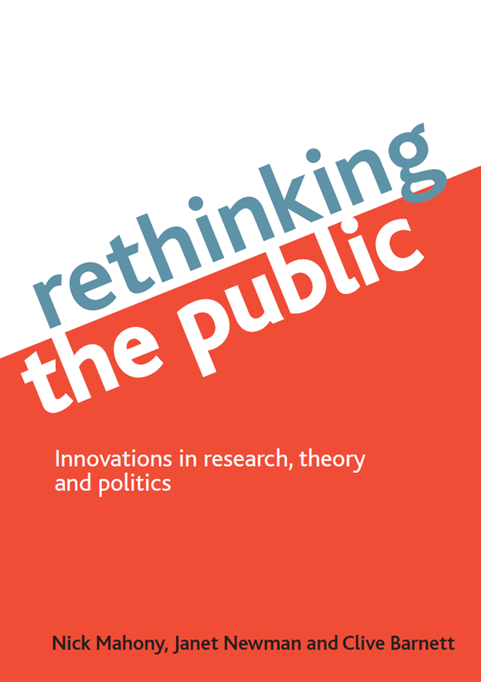
Just a plug for a newly published collection of essays I helped edit with Nick Mahony and Janet Newman, Rethinking the Public, which explores different dimensions of contemporary processes of public formation, with case studies ranging from contemporary UK policy debates to colonial India, modern Brazil, and current ‘global’ activism. The chapters are written by bright new things, PhD students or recently completed PhD’s, and cover a range of fields in which questions of who or what constitutes a public are at stake – policy studies, media theory, urban studies and human geography, development studies, political theory, sociology.
Details of how to obtain a copy can be found at the Policy Press website: http://www.policypress.co.uk/display.asp?k=9781847424167
The book develops out of an ESRC-funded research project on the theme of Emergent Publics, which has informed ongoing research initiatives amongst a group of scholars more or less loosely affiliated to the OU’s Public Research Programme in the Centre for Citizenship, Identities and Governance: http://www.open.ac.uk/ccig/
 Pop Theory