Doing Public Things

DorsLast week I attended a workshop organised by CCIG’s publics research programme and the Creating Publics project (I was only able to attend one day of the three because of an outbreak of chicken-pox at home). The workshop was in part a moment in a collaborative project on Making Publics across time and space between some OU social science researchers and a humanities-based network based at McGill that has been behind the Making Publics project (MAP for short). There is a great set of CBC radio programmes that grew out of that project, covering a wide historical sweep of issues related to public formation.

The discussions at the workshop clarified for me the importance of thinking about the  grammar of conceptualizations of publicness. I have tried to write a little about this, in a paper submitted last month and a chapter that I have just got back for proof-reading, so it was on my mind already.

Everyone seems to agree that one should adopt a plural register when approaching public questions – that it is right and proper to talk about publics rather than the public. But I wonder whether it makes much difference if one pluralises the public, rather say than pluralising the public sphere or public space. Speaking of publics in the plural might not make much difference in so far as attention remains focussed on overly substantialised images of publics as more or less sociolgical group-like entities.

The default to thinking in terms of plural publics, thought of as a straightforward synonym for the conceptual issues raised by ideas such as the public sphere or public space, is associated with successive moves which emphasise the ‘constructed’ qualities of publics: publics are made, assembled, performed, or enacted, depending on one’s particular theoretical inclinations. All of these ideas tend to leave in place the strong impression that there is some sort of animating subject doing the making or assembling, and/or that the product of the assembling or enacting is also best thought of as some sort of collective subject. Something has been lost along the way: the sense of publicness as a subjectless process, to paraphrase old uncle Habermas. After all, ‘the public sphere’ might be a quite clunky translation of a concept that was not meant only to name an institutional form, but also, perhaps more importantly, to name a certain sort of action – acting publicly and acting in public understood as a distinctive  mode or medium of social organisation (see here and here for a neat summary of the continuing subtlety,  shall we say, of Habermas’ account of ‘the public sphere’ and the vicissitudes of its transition, indicating some of the reasons why fixating on publics might not be the advance it is sometimes assumed to be).

This is where the grammar of theories of publicness becomes important:

– If one talks in terms of making, enacting, or assembling publics, then the modalities of action are already presupposed (and the most important thing always seems to be the constructed qualities of publics, with slightly different inflections, as if publics were ever thought of as naturally occurring kinds). This type of formulation makes publicness the subject of a process that is not, strictly speaking, specifically public per se – I think perhaps only performativity has a genealogy that brings it up close to the distinctive problems of public action, in a way that assemblage, or enactment, for example do not quite share – these latter might be too comfortable in their assumptions about the sociality of collective action as distinct from its publicity.

– If, on the other hand, one talks of making things public – making science public, for example – then the emphasis is more squarely on publicness as a type of action. And this is where the fun starts – this action might be about sharing, or exposing, or making transparent or accountable or equally accessible….

My point, I suppose, is that one can either apply certain concepts of action derived from more or less proximate fields to understand the formation of publics; or, one can think a little more about the distinctively public qualities of certain types of action. I think the latter task is probably more difficult. The ‘politics’ of asserting that publics are performed, or enacted, or assembled tends to be relatively predictable and two-dimensional (since publics are made in contingent circumstances, they can be re-made, that sort of thing). The stake in theorising about distinctively public types of action is, I think, less satisfying: it requires thinking about power relations in more than two dimensions, in terms of the reconfiguration of plural public values – of openness, transparency, sharing, accessibility  and so on – rather than in terms of dualisms between public and private, universal and particular, natural or contingent, however ‘paradoxical’ those dualisms can be made to appear.

So my mid-year resolution is to try not to talk about publics at all, while trying to be more precise in usage when talking about public spheres, public spaces, and the types of action associated with processes and mediums of publicness.
New blog on nature and culture

From my colleague Shonil Bhagwat, a new blog on nature-culture issues, starting with posts on invasive species.

Living with Poverty

Later this week, a news series of documentaries about poverty in the UK starts, a BBC/OU collaboration called Living with Poverty. Links to OU-related resources can be found here, including an interactive tool for exploring (mis-)representations of poverty.

Policing the crisis

UntitledDetails here of the new edition of Policing the Crisis, 35 years on from its first publication, with new chapters on its relevance to ‘the current conjuncture’, as the old saying goes.

Change of scenery

UntitledOne way of thinking about the ever-so slightly old fashioned practice of blogging is as a way of producing so many ‘advertisements for myself’. I think this might be perfectly defensible. So, in this spirit, this seems as good a medium as any to let anyone out there who might be interested know that I have accepted a position as Professor of Geography and Social Theory at the University of Exeter, in the Department of Geography, starting later this year.

I have spent a decade at the OU – one half of my grown-up academic career, and I must admit to being a little bit daunted by the idea of returning to the world of face-to-face teaching, seasonal Terms, that sort of thing. I suspect that one might remain ‘ex-OU’ for quite a while after leaving, in various ways. I’m really looking forward to working with the range of great people in Geography at Exeter, and also, maybe, living close to the seaside.

Poverty and Social Exclusion on TV

The first results from the Poverty and Social Exclusion UK 2012 study will be broadcast on ITV at 7.30pm on Thursday, 28 March in a special ‘Tonight’ programme on ‘Breadline Britain’. More details at the project website here – the first report from the project will be published tomorrow on the website too (any DD206 students out there might want to have a look, this is the survey used as the basis of the exercise students have participated in as part of The Uses of Social Science).


Favourite Thinkers VII: Iris Marion Young

Picture 092Noticing, rather belatedly I now realise, that the last book by Iris Marion Young had been published got me reflecting on the different encounters I have had with her work over the years, making me feel old, and slow, but also making me realise that sometimes thinkers act as helpful companions. I have always found, on reading Young, that she had got somewhere I wanted to be well before I arrived there, but I have also found this kind of affirming – she is one of the thinkers who always reassured me that I wasn’t completely on the wrong track. So I have been reconstructing ‘my life with Iris’, which does, oddly, include one occasion when I met her in person.

I think my first encounter was in late 1989 – I was in my first term as a graduate student, and this was the moment of postmodernism in geography: Ed Soja’s Postmodern Geographies had been published earlier that year, shortly before I took my Finals as an undergraduate; the week I started as a graduate student, David Harvey’s much awaited (by me anyway) The Condition of Postmodernity was published (this is the last book I read before getting glasses; actually, I started it without glasses, but was wearing glasses by the time I finished). Shortly after this, I was leant an advance copy of the collection Feminism/Postmodernism, edited by Linda Nicholson (which might just be one of the most influential books, in a more or less unacknowledged way, in geography of the last 25 years or so). This was a revelation – it opened a door into a world where though ‘postmodernism’ was still used as a term, people were talking about more serious things in more serious ways – deconstruction, phenomenology, post-structuralism. I’m not sure that I ever took discussions of ‘postmodernism’ in geography terribly seriously again, all a bit too Rorty-lite as they were, after reading this book, which included essays by Young, Nancy Fraser, Judith Butler, Donna Haraway. I remember around that time reading Young’s ‘Throwing like a girl’ in a reading group that some of us had set up , and remember too that  the argument in it resonated because, well, I’m a boy who never could throw quite well enough – a slightly different subject-position, as we all learnt to say about that time, from the one primarily intended by Young’s analysis of gendered embodiment.

What particularly sticks in my mind as a turning-point, intellectually, for me is coming across a copy of Young’s Justice and the Politics of Difference in a bookshop in 1990. In October to be precise – more or less systematically, I put the date in the front of books when I get them. Around this time, I was trying to start ethnographic research which somehow was meant to keep together various things I was interested in – space, gender, money, urbanism, culture, language, all sorts really. I gave this up, for various reasons, but partly it was because Young’s book impressed upon me the sense that there were a set of theoretical traditions it might be fun to engage with in greater depth than discussions about ‘postmodernism’ seemed to allow. So, alongside Robert Young’s White Mythologies, Justice and the Politics and Difference set me off in the direction of doing a reading-based dissertation all about deconstruction, discourse theory, Foucault, Ricoeur, postcolonialism Said, Spivak. (The two Youngs, Iris and Robert, also strike me now as exemplary figures whose work gets subjected to a certain style of reading in geography – finding someone talking about ‘spatial’ or ‘geographical’ things, but then finding them not quite up to scratch, not materialist enough perhaps, lacking an adequately sophisticated grasp of the wobbliness of spatiality, that sort of thing. Sometimes, most of the time perhaps, there are more interesting things to talk about than space, spatiality, and the like).

Picture 041Over time, I came to work out just how smart Young’s use of Derrida, Levinas, Irigary to re-read notions of public space in more affective registers was – I ended up writing about this in my book, Culture and Democracy (pages 60 to 65 if you’re really interested), but really didn’t have much to say on these issues that Young had not already got to in developing the notion of communicative democracy, in Inclusion and Democracy for example.  I’m not sure whether one should admit it, but sometimes, in a field like mine, ‘critical exegesis’ is shaped primarily by the commitments of the fan. 

Young’s response to David Harvey’s Justice, Nature and the Geography of Difference is also a key reference point for another thought I now take almost for granted. Reading this in Antipode in Columbus, Ohio in the summer of 1998, what I took away was the insistence on thinking of universal notions of justice or rights as, well, discursive, that is, in terms of claims. That is, I think, a much more political understanding of universality than one finds in most other places, but also a more redeemably ‘universal’ notion of universality because of its concern with the to-ing and fro-ing of claim-making.  More generally, it was, for me at least, a precursor to thinking about claims as an important register for thinking about practices of representation or responsibility, or democracy more generally, an idea I have tried to articulate myself, but which other people like my former colleague Mike Saward or John Parkinson have smarter versions of than me.

When I started work at Bristol, in the early 2000s, I tried to teach Young alongside more obvious geographical literature on justice, by Harvey, David Smith and so on – not least, I think by then I was working out that her work did rather different things with a Rawlsian line of thought than you got in geography, where Rawls was either summarily dismissed as ‘liberal’ (an accusation that I have come to think reflects more negatively on the person making it than on the person so accused), or taken as providing a universal model to be applied to empirical situations.

In 2003, during the long Easter weekend in Durban, when most of the country seems to close down completely, I actually met Iris Young, visiting as a guest of Raphael Kadt, then editor of the journal Theoria – a few of us, Di Scott, Jenny Robinson, Murray Low, spent an afternoon in the garden of Gill Hart’s house in Musgrave, drinking wine and eating nibbles. I admit to having been more than a little bit star-struck.

IMG_4846Then in the late summer of 2003, Marion Werner, who had been a Masters student at Bristol that year, left a copy of Dissent in my pigeon-hole, pointing me in the direction of an essay by Young on a social connection model of responsibility in relation to labour solidarity campaigns. This was another ‘Wow’ moment, and I have spent the last decade shamefully ripping-off Young’s model of political responsibility in various research and writing projects. When I started at the OU, later that same year, I did my best to get Young’s account of responsibility adopted as the framework for the course on globalisation that we were making then. Later, in 2004 or 2005 we approached her to do an audio interview for the OU globalisation course, but she was unable to do so, because she was by then already dealing with her illness, from which she died in 2006. Her influence does, though, resonate across that course and various pieces of work by myself and others who engaged with it at that time. Her influence is reflected in the idea that structures that course – globalisation is a process that is realised through demands and responses that different actors make on each other. The responsibility theme also provided an important reference point for the project on ethical consumption that I worked on at this time too – Young’s ideas on the distribution of responsibility across extended fields of action provide the intellectual ballast at the front and end of the book from this project.

Most recently, in writing about justice and responsibility and ethics in geography, I have tried to be more explicit than before about what it is that Young’s work brings to the debates that geographers engage with, or at least draw from. Her concept of political responsibility comes into better focus if you triangulate it, for example, with Cohen’s work on justice and Pogge’s working up of the idea of a global basic structure. I also noticed around the time of writing these pieces that Young, like one or two other thinkers I was reading, made more or less explicit reference to Pettit’s account of republican freedom as non-domination in working up her account of responsibility – one day, if I have time, I’d like to delve deeper into that relationship in the case of Young’s ideas and others. I think, in particular, what is of most value is the theme of shared responsibility that Young develops across all the work on the idea of justice and responsibility over the last decade or so of her life: this is a lot smarter than the standard move of simply asserting that one needs to think in terms of collective responsibility rather than individual responsibility (which kind of closes down problems of effective agency in its knock-down simplicity). By bringing into view differential capacities to act responsibly, it is a resolutely political but not moralising notion of responsibility. And if you can’t find something of ‘geographical’ value in this work, something which does not need simply to be corrected, then you just aren’t trying.

Local Politics: A University for Swindon?

stDespite now being the home to one of the largest collections of scholarly books in the world, Swindon remains very much not-a-University town – there has been a long-standing civic ambition which goes back at least to the 1940s to get one. Recent years have seen initiatives to snag some bit of an expanding existing University, such as Bath, but these have come to naught. It does, though, now have a BPP University College, so that’s good. In a way. Maybe. Maybe not.

Swindon claims, not proudly, that it is the only major urban area in England and Wales without a University, or the biggest one, or some variation on this (though I think Milton Keynes might also qualify for this distinction, depending on what it is that this sort of claim is getting at – it’s about relatively low levels of participation in higher education in these places). Even Cirencester up the road is now set to be a proper University town.

Allan Cochrane and others at the OU have been researching the place of Universities in their localities and regions, looking at the changing rationales of economic growth and public engagement shaping this relationship. Swindon is interesting because here the story isn’t how established institutions now seek to engage with the places of which they are a part, but how and why local actors think it’s a good idea to have a local University in the first place. Via Twitter, I came across the latest round of discussions on this issue of the Borough Council earlier this month, including a consultancy report, A University for Swindon, which provides a profile of the current participation in HE of people living in Swindon. The report is shaped by the aim of establishing levels of potential demand for Higher Education in the town and round-abouts (ha!).

The report, and the wider strategizing over the last couple of years, indicates some of the assumptions about the potential benefits of having a higher education presence (of any sort, we’re not fussy), assumptions shared broadly across the political spectrum (as I think I have mentioned before, Swindon’s civic boosterism has a long history of attracting academic scrutiny of one sort of another, from Michael Harloe in the ’60s through to the 1980s localities debates. Phil Pinch even dubbed Swindon an archetypal ‘ordinary place’ twenty years or so ago. Trust me, it’s certainly a lot more ordinary than Johannesburg or Rio de Janeiro).

Anyway, the current strategy is an incremental one. A University Technical College (UCT) is set to open in 2014, with Oxford Brookes as its University sponsor and a locally-based ‘international high-tech’ company as its business sponsor. It will specialize in providing in engineering courses for 14-19 year olds. This is meant to be the first step towards realizing the dream of a University for the town, a dream which is seen as central to local economic development and growth, and which is strongly  supported by Influence, the organization representing the business community in Swindon.

The report commissioned by the Council has some interesting stuff in it. For a start, Swindon has relatively low rates of participation in HE, and they are not improving. This, in fact, is central to the strategy for attracting or building an HE presence locally. There is an assumption that the skills base is central to future economic development, and that a University is one way of dealing with the supply side challenges facing the town. It turns out, and this is what first attracted my attention, that 15% of Swindonians in higher education study with the Open University, which is above the national average. The report takes this as proof of ‘latent demand’ for a local University, along with the fact that a third of all Swindonians enrolled in HE are at UWE in Bristol, Bath Spa, Oxford Brookes, or the University of Gloucester – all about an hours drive away, but none technically ‘local’ according to the way these things are officially defined. But the report is careful to point out that levels of participation in HE are not straightforwardly linked to the presence or absence of a local University: “The availability of local HE provision is just one factor influencing learning patterns, other factors include levels of attainment prior to 19; deprivation and aspirations.” Swindon does not score well at all in those other factors, which is the real story behind the report.

Region

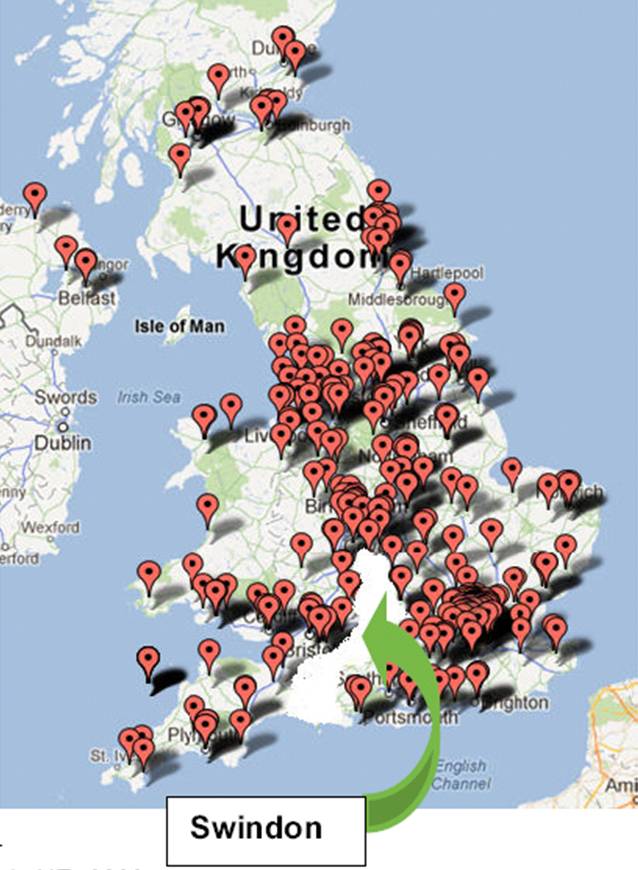
So there are interesting geographies revealed by this report – geographies of absence, and geographies of ambition, and imagined geographies too. In one section, for example, it is noted that “The impetus for a university stems in part from the knowledge that Swindon is one of the few major settlements in the country without an HE institution”. Then, with the help of a rather busy map, it is claimed that “Swindon lies in a swathe of country without a university which stretches from Stratford on Avon in the north to Weymouth in the south. Whilst this research has focused on demand from Swindon; this gap underlines the point that any new university would also be likely to attract students from nearby Wiltshire and Gloucestershire.” I’m not sure this ‘swathe’ actually adds up to a real region – it’s basically anywhere West of the M40 if you swing round Oxford on the A34, east of the M5 as long as you don’t stop at Bristol, Gloucester, or Cheltenham, and a large part of this empty swathe south of the M4 consists of Salisbury Plain. And I rather doubt whether rates of HE participation in Wiltshire towns like Marlborough or Salisbury will be significantly affected by any new University of Swindon (Swindon is in Wiltshire, but not necessarily of Wiltshire). And of course that statistic about the level of enrolment with the OU might not be best read as an index of the absence of alternatives either – but as further indication of the fact that local levels of HE participation are only tangentially related to local provision.

But keep your eye on Swindon – the future of non-elite higher education, shaped by assumptions about skills, the knowledge economy, and business partnerships might be slowly revealed here. Meanwhile, I have the sense of the town having all the component parts of a proper University without quite having composed them properly into one: loads of potential students, as well as already having all the books and even all the research money. What could be easier?

Urban discontents

boatsThere has been a flurry of interest in the theme of ‘planetary urbanization’ recently. Andy Merrifield has an essay on the theme of ‘Whither urban studies’, and there is a longer published version of his argument about the contemporary fate of the old-fashioned sounding ‘urban question’ (and Andrew has a new book coming out on all this too, The Politics of the Encounter). There is a video of the workshop discussion of the same theme at theurbanfix. This post also includes a link to a lecture by Neil Brenner on similar themes, re-posing ‘the urban question’ as ‘the urbanization question’ – and outlining some themes from a paper on planetary urbanisation by Brenner and Christian Schmid in a recent collection, Urban Constellations, edited by Matthew Gandy.

My interest in these interventions arises both from some things I have been trying to work on (teach, mainly), and also because I am meant to give a paper in a session at the 2013 Association of American Geographers meeting in a set of sessions on the future of critical urban theory. Reading and watching these and other things are helping me to clarify what it is I might try to say then.

There are some interesting overlaps in the arguments being made across this range of ‘post-Lefebvrian’ urban theory (I just made that up). There is the gesture of noting and then taking one’s distance from the oft-repeated line about ‘more than half the world’s population’ now living in cities, or at least in some type of urban settlement. It’s no doubt sensible to pause awhile about such stylized facts (although the stats about urban population growth might be better thought of along the lines suggested recently by David Runciman in LRB, as representations that enable certain sorts of political work to get done, not just as data to be dismissed as empiricist distractions). The distance-taking involves a move towards a claim about what urban theory can and should do, negatively and positively. It should definitely not, it turns out, presume the adequacy of taken-for-granted, ‘positivist’ understandings of what a city is, or of what counts as an urban settlement more generally – that risks buying into not only out of date notions, but ‘ideological’ ones too. What urban theory should do is burrow down into the ontological – to define clearly what the object of analysis of what-used-to-be-called- ‘urban studies’ actually is, in all its multiplicity-yet-dialectical-unity. It’s not at all clear why any intellectual field needs this sort of philosophically underwritten definitional clarity – other than as a prop to cope with a lack of confidence.

Don’t get me wrong – I think the arguments going on here are, in terms of their content as it were, really interesting: Brenner and Schmid’s theme of concentrated and extended urbanization processes is a really neat way of capturing the dynamics of contemporary spatial processes; Andy Merrifield has a really interesting riff about thinking of so many urban attributes (but I’m not sure we need to think of these as all an expression of a singular substance).

BEIn general, the story seems to be that we should think in terms of processes, maybe practices and strategies too, rather than fixed entities like ‘cities’ or discrete spatial objects like ‘the urban’. I suppose. This is a not unfamiliar argument of course, one made around issues of scale, for example, or indeed pretty much any other concern touched by Theory – personal identity, the state, Capital. I wonder whether this is really all that exciting any more as a claim about what theory can do for us. It is actually rather odd to assume that one needs theory to gain insight into the made-up, enacted, assembled, contingent, flow-like qualities of things that we often talk about and experience as if they were thing-like. And if theory is given this special privilege in the register of revelation, attached to a claim about its ‘political’ significance, then there is a risk of missing some important dimensions about the ordinary ways in which things (cities, states, people-with-identities) configure our lives in manageable, responsible ways (it also risks buying into some hoary modernist notions that somehow ordinary language isn’t quite adequate to capture the processual and relational qualities of live; it is, of course, perfectly adequate for that task, that’s why we have words like ‘process’ and ‘relation’ in the first place, and verbs, stuff like that).

It’s easy to pick holes in definitions of ‘the urban’. If you spend enough time looking at these definitions, you can come away thinking that you are in the middle of a Borgesian fiction, social-science style. Urban can mean:

‘Localities of 200 more inhabitants’ (Greenland); ‘Agglomerations of 2500 or more inhabitants, generally having population densities of 1000 persons per square mile or more’ (USA); ‘Towns, that is, localities legally established as urban’ (Bulgaria); or just ‘Town of Stanley’ (Falkand Islands(Malvinas)).

Borges’ lesson about the arbitrariness of classification was, of course, that the seemingly arbitrary qualities of classifications which lack definitive clarity are best read as an index of specific practical purposes and plans.  I suppose, then, that doubts about the adequacy of some concepts of the urban are really an indication of doubts about the value of the projects of which those concepts are central. Radical urban theory, after all, has been consistently suspicious of ‘applied’ styles of urban thinking, those too closely connected to fields of planning, for example, or development, or even environmental management, where all those clunky concepts of bounded settlements and territorialised objects do their useful work – preferring to identify with social movements, and with more or less concrete imaginations of protest and resistance.

837I have to come to like the idea that ‘the urban’ is really a name for a problem, or for a series or variable problems (not quite the same as thinking of variable ‘attributes’). This is an idea I am stealing for my own purposes from my colleague Allan Cochrane, who develops it in his book on Urban Policy (if one is looking for an authoritative Theory reference, Foucault’s observations in his lectures on Security, Territory and Population about ‘the problem of the town’ might be a fun place to start – ‘the town’ emerges there as a figure for an extended network of dependence and vulnerability to which various agencies seek to respond). Allan, Scott Rodgers and I have been trying to articulate some of the implications of thinking about the urban in this way, partly through an edited collection on the theme of ‘Where is urban politics?’ that might hopefully see the light of day next year. Meanwhile, I have also tried to articulate the same set of ideas while thinking about making an OU Masters course on the theme of Changing Cities intended primarily to translate critical urban theory into a useful resource for those professions who act as key ‘intermediaries’ of contemporary spatial politics (planners, environmental managers, those sorts of people, maybe the occasional ‘activist’). To cut a long story short, I think the point would be that all those various attributes of ‘the urban’ are generative of their own points of political contention – but also that there is more to the variety of urban politics than protest; and indeed, that there is often more to protest than protest (protest is a form of claim-making, after all, of one sort of another). And, finally, that there is no reason whatsoever to assume (or want) this variety of urban-generated-but-not-contained politics to coalesce into anything so coherent as ‘revolutionary politics’ (one of the unacknowledged achievements of Marxist spatial theory is to demonstrate that the universalised agency required of a revolutionary political imaginary is always already, as they say, displaced and deferred).
So I have decided that arguments about the need to update and refine, specifically, to refine, our understandings of urban and urbanization, by posing this issue in terms of a debate about ‘the urban question’ from almost 40 years ago, tell us more about the operative concept of ‘theory’ at work in certain strains of critical urban and spatial theory than they do about how best to think about the meaning of ‘urban’, urbanism, the city, or urbanization. I wonder whether theory is really the sort of practice that has the task of isolating the ontological outlines of phenomena – of ‘the urban’, or perhaps, ‘the political’, from the appearances of town and cities and mere politics (there is of course much the same concept of theory at work in accounts of ‘the political’ as in contemporary discussions of ‘the urban question’, sharing much the same intellectual lineage – not for nothing does the notion of ‘post-political’ attach so easily to discussions of ‘the city’). I wonder too whether theory is really the proper medium for identifying the immanent potential for radical change in current events. Theories are, by definition, always theories of something – which means that any theory is caught in a subordinate relation of accountability to something that it isn’t. Unfortunately, too often this ‘other’ of theory is just assumed to be ‘Politics’ – which means that an overly theoreticist account of theory ends up holding itself accountable to an overly theoreticist account of what counts a proper politics.

So I’m left thinking that what the current state of radical urban theory confirms is not so much that ‘the urban’ is conceptually incoherent, but rather that the model of theory at work in this field needs to be challenged.

Media archaeology II

A while back now, I wrote a few posts about the family ‘stuff’ I was finding myself having to go through. Some of this stuff opens windows on quite personal and intimate histories, some of it more public ones. One of my favourite excavations has been the discovery of some more or less random pages from TV and radio guides from 1966. In a cupboard in my mother’s house was a bunch of framed pictures, including one of my two older sisters when they were toddlers. The frame of this picture was broken, and when I took it apart, behind the photograph, the paper used to pack the photo into the frame was old editions of the Radio Times and TV World (a predecessor of TV Times I guess). They are from Spring 1966, shortly after my parents and sisters returned to the UK after their African adventures – the TV World is actually for the old ATV region, and the Radio Times is the Midlands and East Anglia edition. 

These yellowing pages reveal a lost world of British public culture, when The Fugitive was the exciting new US import on ITV, Sheila Hancock starred in a show as “one of life’s most entertaining victims”, Captain Pugwash was a cartoon strip in The Radio Times, and you could order an Asbestos Garage from £43. 7s. from the back of the same publication.  Easter Monday’s schedule on ITV that year was all sport: international swimming, from Llanelly; motor racing, from Goodwood, obviously; racing from Newcastle; and show jumping from Hickstead (with commentary by Raymond Brooks-Ward, who I had never associated with ITV, in so far as I think about his career much at all). The BBC was about to broadcast the first of eight, yes eight, nightly programmes reconstructing the ‘Irish Rebellion’ of 1916.

The Letters pages of both publications are testaments to the critical capacities of engaged, active audiences – a brilliant debate about whether or not the plotlines of Softly, Softly were too vague and lacking in satisfactory clarity by the end of each episode, or for that very reason best compared to Kafka’s novels. Or a complaint about the contrast between the national news on BBC radio, presented apparently in “a serious, sensible, and factual manner”, and regional news stories which “are treated in a simpering, pseudo-cosy style”. Pseudo-cosy, what a great concept.

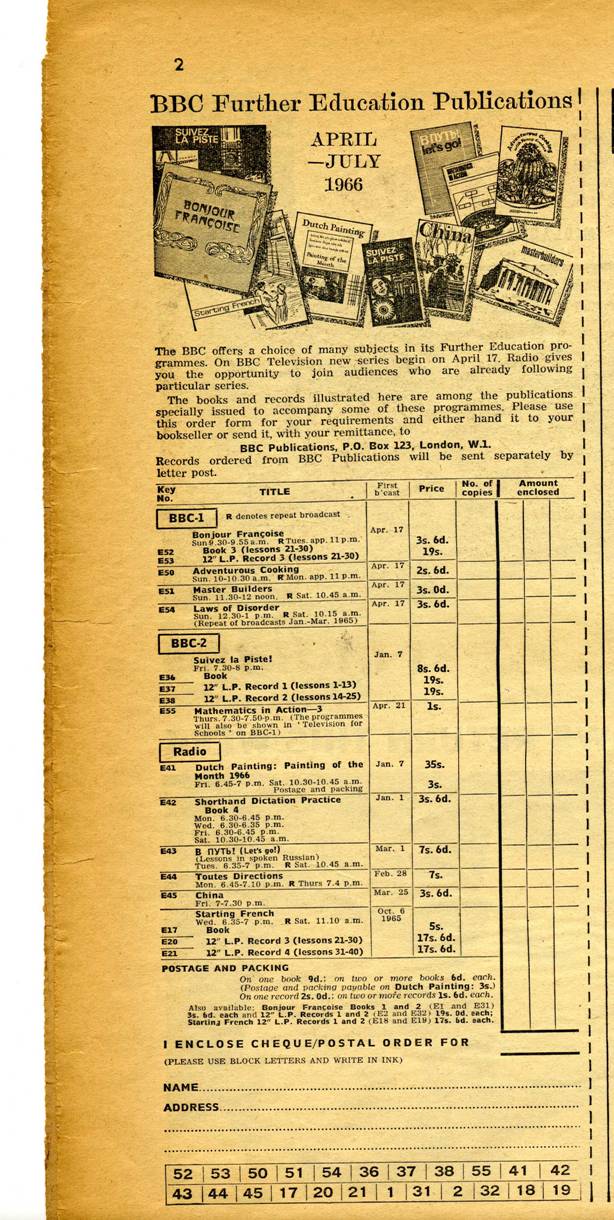
The Radio Times for the 16th-22nd April also contained a half page advert for BBC books and records to accompany its Further Education programmes (Adventurous Cooking, Laws of Disorder) – a peak into the pre-history of The Open University, when the BBC was already pioneering the use of multi-media platforms for adult education. 

Over at TV World in the same week, the letters were all about how best to make custard pies that flop – part of a discussion with the TV World cookery expert. This is from an age before Tiswas.