
Lots has been written about the involvement of the LSE with Gaddafi’s Libya, and especially about Saif Gaddafi’s connections with academics such as David Held. Held himself now has an essay at openDemocracy defending his own engagement, as neither naive nor complicitous.
Mothering and feminism
Everybody’s at it. Another colleague at the OU, Lucila Newell, has a blog called maternalselves: thinking feminist mothering, focussing as the name suggests on issues of motherhood and feminisim. The site includes informal reviews of papers/books on related topics, and links to other more-or-less academicy blogs on this theme.
citizen joe smith on nuclear power
Workshop on the Politics of Participation
Crisis of Participation; Participating in Crisis – 12 April 2011
The Open University, Walton Hall, Michael Young, Rooms 1-3, Milton Keynes, MK7 6AA
http://www3.open.ac.uk/contact/locations.aspx
One-day workshop organised by the Publics Research Programme (Centre for Citizenship, Identities and Governance, The Open University) in collaboration with Jenny Pearce (Professor of Latin American Politics and Director of the International Centre for Participation Studies, University of Bradford).
Workshop rationale
Just as publics are increasingly solicited to participate in solving the economic, social and political problems of various contemporary crises, so many existing forms of public participation seem to be straining under the tensions and antagonisms they are expected to contain. Crisis of Participation; Participating in Crisis is a one-day workshop intended to inaugurate conversations about the contemporary places, problematic roles and possible futures of public participation.
The idea is to come at the overarching theme from three perspectives: (i) contemporary art practice, critical social theory and popular culture/politics; (ii) critical social policy and governance; iii) development studies. These are three ways of cutting into debates about contemporary public participation in politics that have so far not sufficiently been brought into relation. The aim of this workshop is therefore to generate some new ways of viewing, engaging with and intervening in what’s going on.
Programme
10:15 -10:45 Welcome and coffee
10:45 -11:00 Introductions (Dr. Nick Mahony, Prof. Jenny Pearce and Prof. John Clarke)
11:00 -13:00 Panel 1: ‘Participating in crisis: public creativity’
Dr. Jeremy Gilbert (University of East London),
‘The desire for participation’;
Cecilia Wee & Sonya Dyer (Curators/organisers, ‘If Not, Then What?’ Chelsea Programme/Chelsea College of Art & Design)
‘Participatory creative practice in a climate of dissent’
Dr. Deena Dajani (The Open University)
‘Crisis of Representation: Gender and Participation in the 2007 Jordanian Parliamentary Elections’
13:00 -14.00 Lunch
14:00 -15:45 Panel 2: ‘Crisis of Participation: the contemporary politics of public action’
Prof. Jenny Pearce (University of Bradford)
‘The Twist in the Participatory Turn’
Prof. Marilyn Taylor (University of West of England)
‘Community Organising and the Big Society: is Alinsky turning in his grave?’
Prof. Helen Sullivan (University of Birmingham)
‘Does a ‘big society’ demand a limited localism?’
15:45 -16:00 Tea
16:00 -16.30 Reflections, identification of key themes and next steps
16:30 Depart
RSVP: If you would like to attend please e-mail: Socsci-ccig-events@open.ac.uk (Sarah Batt, Research Secretary, CCIG, a.s.c.batt@open.ac.uk, Tel: 01908 654704). For further information please contact Nick Mahony, (n.mahony@open.ac.uk) / CCIG website: http://www.open.ac.uk/ccig/
Sarah Batt
Research Secretary, ICCCR and CCIG
The Open University
Faculty of Social Sciences
Research Office
Walton Hall
Milton Keynes
MK7 6AA
Tel: +44(0)1908 654704
Fax: +44(0)1908 654488
The University as a Public Good
Nigel Thrift at The Chronicle of Higher Education, argues that we need to make a case for thinking of the University as a public good (without saying what the substance of this claim would consist of). A good place to start fleshing this argument out is a recent SSRC publication, Knowledge Matters: The Public Mission of the Research University (which includes a chapter by a couple of OU colleagues, John Brennan and Mala Singh). John and Mala belong to a research centre specialising in just these issues, CHERI, based at the OU, but not for much longer which is a great shame. Updates on the future of their research can be found here.
Sloterdijk, Honneth, and the politics of ‘provocation’
One of the theorists who is all the rage in spatial-theory-land at the moment, subject of a veritable ‘second coming’, is German philosopher Peter Sloterdijk. Society and Space had a special issue on his work a year or so ago, and Stuart Elden has edited a collection of essays on his work which is forthcoming. It’s interesting to watch this process, in particular the finessing of Sloterdijk’s political interventions. Sloterdijk is a professional provocateur, and amongst the various ‘controversies’ he has triggered in the world of German letters revolves around a Ayn Rand-like assault on the welfare state in 2009. I’m a bit slow, so am only now catching up on this, because I’m trying to write something about Honneth. You can read a summary of Sloterdijk’s position in English here in Forbes magazine or here in City Journal, both resolutely proud free-market publications. You can read Axel Honneth’s substantive response to Sloterdijk in translation here. Apart from the obvious politics to this (see the commendation of Sloterdijk by the National Review) there is also a dispute about how to interpret the role of various emotional dynamics in political life – a central theme of Honneth’s reconstruction of critical theory, and a feature of Sloterdijk’s work too since his ‘first coming’, in his analysis of cynicism. Rage makes the world go round for Sloterdijk, whereas disrespect and dignity are key dynamics for Honneth. Might sound similar, but quite different really. I’m not inclined to get too excited about Sloterdijk’s spatial metaphysics, which is what does excite geographers and others who like all things ontological; I actually think the reactionary inflection he gives to an analytics of resentment is helpful in reminding us that simply asserting the importance of ‘the emotional’ or ‘affect’ in life has no necessary political meaning per se – everything depends on how this affirmation is worked through. The Sloterdijk/Honneth to-do is interesting for drawing out the significance of this issue, and also helps to clarify an issue at stake in suggestions that Honneth’s ethics of recognition has some affinities with the work of Rancière – an affinity rooted in a particular sort of commitment to avoid a scholastic disdain for ordinary people (the case is made by Jean-Philippe Deranty).
Oecumene: Citizenship after Orientalism
 The website for the Oecumene research project based at The Open University, led by Engin Isin, is now up and running. The project has its own blog, and you can sign up as an ‘Oecumene Affiliate’ to keep up to date and become involved.
This is how the project is described:
“Oecumene: Citizenship after Orientalism focuses on the tension between two different institutions: citizenship, the process by which belonging is recognised and enacted, and orientalism, the process by which European political institutions are considered originary and primary. What connects citizenship to orientalism is that citizenship has been historically seen as a Judeo-Christian institution contrasted against Buddhism, Confucianism, Islam, and Hinduism. The project revisits questions of citizenship as political subjectivity in ‘orientalized worlds’ through genealogical investigations without orientalist assumptions. The aim is not only to uncover citizenship practices that remained either invisible or inaudible in other worlds but also to explore the possibilities of a renewed and expanded understanding of European citizenship.”
Living Geography
From Alan Parkinson of the Geographical Association at Living Geography, a draft of resources for school teachers to use to teach about and through the earthquake and tsunami in Japan. If I still taught students in real-time, this sort of material would be great even at undergraduate level – the sorts of pedagogy being done in school geography is often rather wonderful.
A non-event?
Fascinating interview with Mehdi Belhaj Kacem, one of the bright new things of French philosophy, on the Tunisian revolution. He’s very rude about Badiou and Zizek’s pronouncements on all this: ‘It’s obvious that Badiou and Zizek, who reacted very late to the first positive event of historical and global scope of the twenty-first century, know absolutely nothing about the situation’.
Whatever happened to social theory?
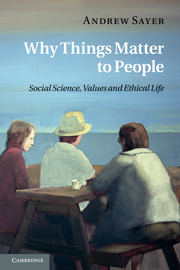 I’ve just been reading the new book by Andrew Sayer, Why Things Matter to People. It is a full-scale elaboration of the importance for critical social science of what Sayer calls ‘lay normativity’ – people’s evaluative orientation, or relation of concern to the world around them. Sayer thinks this aspect of life is systematically downplayed or misrepresented in lots of social theory. I think he is probably right about that. The notion of lay normativity was used in Sayer’s previous book, The Moral Significance of Class, and the project on ethical consumption that I have been working on, for it seems like ages, made use of what we at least understood this term to be getting at – the importance of giving credence to the evaluations of their own practices that people provide in social science encounters, not least as being able to tell us something interesting about how practices work. Here is the publisher’s blurb for Sayer’s new book:
“Andrew Sayer undertakes a fundamental critique of social science’s difficulties in acknowledging that people’s relation to the world is one of concern. As sentient beings, capable of flourishing and suffering, and particularly vulnerable to how others treat us, our view of the world is substantially evaluative. Yet modernist ways of thinking encourage the common but extraordinary belief that values are beyond reason, and merely subjective or matters of convention, with little or nothing to do with the kind of beings people are, the quality of their social relations, their material circumstances or well-being. The author shows how social theory and philosophy need to change to reflect the complexity of everyday ethical concerns and the importance people attach to dignity. He argues for a robustly critical social science that explains and evaluates social life from the standpoint of human flourishing.”
It will be interesting to see what sort of traction, if any, Sayer’s book gets in critical human geography. Once upon a time, when I was little, Sayer was one of the big names of Theory in geography, in the 1980s heyday of critical realism. Apart from forays every so often to call for more robust normative reflection in the discipline (most recently in Antipode), Sayer is much less of a presence now. He wrote an excellent book in the mid ’90s, Radical Political Economy: A Critique, which I remember Marxist colleagues being apoplectic about because it took seriously non-‘dialectical’ styles of social thought and made productive use of Adam Smith and Hayek.The style of theory that Sayer performs, with its close attention to argumentation, is rather uncommon in geography now. I’m not necessarily sold on all of Sayer’s arguments – I think, for example, that he might find more support for his broad thesis about human vulnerability and ethics in thinkers such as Levinas or Derrida, or for the importance of everyday attachments to things that matter in styles of cultural theory concerned with thinking about the ordinary, such as Lauren Berlant’s work; these are not traditions Sayer has much patience with. Genre blindness? But I think his diagnosis of the limits of current styles of critical thinking has a lot going for it – critical thinking does find it really difficult to give credence to ordinary dispositions as having value in and of themselves beyond their function in systems of discipline, as effects of subjectification, or as indices of unconscious dynamics, or at best residues of untapped resistance or invention.
I happen to think that Sayer over-eggs the normativity-is-important cake by insisting on making the argument with reference to ethical theories – there is a less explicitly ‘moral’ strand of philosophy concerned with rationality, reason, embodiment, and values that might inform the sort of reconstruction of social science Sayer recommends. I have been trying to write about these same issues in a rather more tentative fashion, for a series of ‘reports’ on ‘Geography and Ethics’ due to be published any time soon. The first deals with some recent accounts of justice; the second with some of the philosophy mentioned above, focussing on notions of practical reason [Sayer has lots of interesting things to say on this topic]; the third is still to be written, and will focus on the kind of social theories of value, normativity and justification that Sayer, amongst others, has been developing.
 Pop Theory