This sporting life

It’s the season for discovering new things about sports you know nothing about – or not, as in the case of dressage, the only Olympic sport dominated by Gloucestershire, and about which we all remain in the dark, unable to actually tell what makes for a 90% score rather than an 80%. In diving, we all know to look for the splash; in dressage, is it too much sand being kicked up by the hooves?

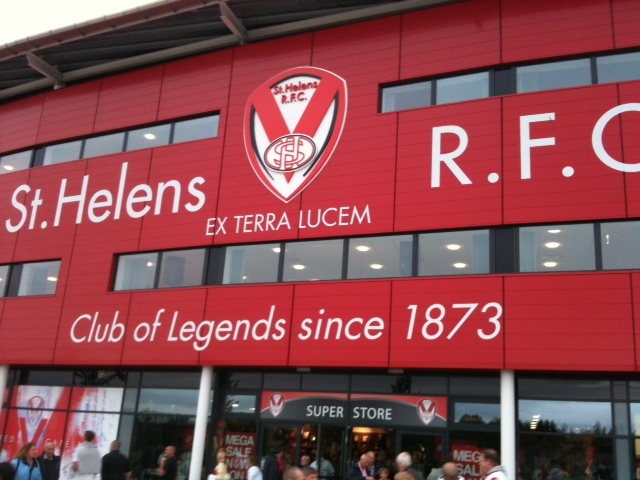
In this post-Olympics spirit of trying out new things, to watch obviously, on Friday I went to my first ever rugby league match. At St Helens, no less. A very balmy evening. In a hot August night sort of way.  Not barmy. I have no attachment whatsoever to rugby, one way or the other, and was struck not so much by the difference between the two codes, as much as the difference between this contemporary version and the remembered version from the 1970s that you used to see on Grandstand. An altogether leaner game, it seems. And not a flat cap in sight.

On the theme of the cultural differences that sport draws into view, there is a profile of Imran Khan in The New Yorker, one of those regular pieces that wonder whether he is likely to ever get to exercise significant political power in Pakistan. Amongst other things, the piece has to negotiate Imran’s status as ex-crickter for its presumed American audience, inevitably groping for an appropriate baseball reference point. That shouldn’t be that difficult, really. But Imran ends up being described as having once been a “hard thrower”, a description also used in relation to Sarfraz Nawaz. Oops. This couldn’t be more wrong, could it? Technically, throwing in cricket is cheating. What ever happened to The New Yorkers’ famous fact-checking?

Anyway, enough of this, back to work.

Media archaeology

I’ve spent quite a lot of time in the last month or so wading through a bunch of my parents’ ‘stuff”, following the death of my mother. There are different levels of ‘stuff’ involved here, of course, from a garage full of gardening tools to toothpaste. Different sorts of significance attach themselves to different types of ‘stuff’.

I’ve come to think of this process as akin to a form of personal, family archeology, as different objects provoke new questions, or new understandings of previously remembered events.

Once you have moved beyond the level of ‘stuff’ that is disposable (and this might vary, depending on how you feel), one way or another, the contents of one’s parents home seem to fall into two broad categories: material objects (including books), and ‘media’ stuff. Media stuff includes photos, but also in my case a large number of slides and negatives, and 2-3000 feet of 8mm cine film. Very little of this media stuff has been seen by me, or my sisters, I think, for three decades or so, at least. It has been living in lofts and cupboards, as is the way with these sorts of materials. I’m bringing it back to life, so to speak, having transferred 500 odd slides onto the PC, and have just had the cine film digitized (by a very nice man in Swindon who specialises in this – see SaveThoseMemories). 

Media stuff has a distinct emotional charge – it evokes different memories, but also evokes memories in different ways. I’ve now seen versions of my parents I had never seen before, as well as movies of me as a baby which are the only visual record of me actually ever having been a baby. And I have never quite realised before how much movement and how much sound there is lying within a still, mute image. 

Material objects, of course, can be very mundane – pin cushions, vinegar pots, tea caddies, African drums. They are, too, and unlike media stuff, fundamentally indivisible – and therefore potentially more contentious as objects of mourning. You can make copies of the cine film, and of the photos. There is only one vinegar pot, and I’ve got it. 

This is all just a preliminary ramble, really, because I have an inclination to write a little bit more about some of the things that the media stuff is disclosing. It turns out, by the way, that ‘media archaeology’ is a proper grown-up academic field: see here and here.

Environmental & Architectural Phenomenology

I’m sure some people out there will already know of this – EAP, or the Environmental and Architectural Phenomenology Newsletter, edited by David Seamon. This is what it’s about: 

“Published three times a year, EAP is a forum and clearing house for research and design that incorporate a qualitative approach to environmental and architectural experience.

One key concern of EAP is design, education, and policy supporting and enhancing natural and built environments that are beautiful, alive, and humane. Realizing that a clear conceptual stance is integral to informed research and design, the editors emphasize phenomenological approaches but also cover other styles of qualitative research.”

The Uses of Social Science

Here is a short film introducing a new Open University undergraduate module, The Uses of Social Science (DD206, in OU-speak), which has its first presentation this October, and which we have been making for a while now (I think I was thinner when we started). The story told by the module is that social science is used to describe, understand, and enact the worlds in which we live (for good or ill).

The film gives a little flavour of some of the topics and issues covered – the module makes extensive use of video, audio, and on-line resources, as well as old fashioned printed text too. Sign-up now.

Space, contestation and the political: themed issue of Geoforum

As previously advertised, my paper Situating injustice in democratic theory is now published ‘for real’ in Geoforum (not open access, of course, not yet – a pre-publication version is here). It’s part of a Themed Issue on Space, Contestation and the Political, edited by David Featherstone and Benedikt Korf. My piece is a preliminary attempt to outline what follows, geographically, from taking seriously recent work in political philosophy and political theory that develops normative principles from the premiss of the ‘priority of injustice’ – including work by Sen, Honneth, Fraser, Bohman, and Forst. Other contributors are Mustafa Dikeç; Robert Meyer, Conrad Schetter, Janosch Prinz; Uma Kothari; Urs Geiser; Klaus Schlichte; and Jonathan Spencer. Topics include political violence, Carl Schmitt, exile, Arendt and Ranciere, Norbert Eilas.

Nikolas Rose on ‘The human sciences in a biological age’

Interesting discussion here, including thoughts on ‘borrowing from the biological’ and ‘rushing to philosophers’, and some more sensible alternatives for thinking through what new understandings of the human actually mean for the future of the ‘human sciences’.

Theda Skocpol interview

Interview with Skocpol at Juncture, the IPPR’s journal, on the Tea Party, Occupy, health care, 2012 Presidential election, the importance of organisation, and other things. A taster:

“The lesson looking back over the modern history of democracies is that a crisis itself doesn’t create the response: a crisis simply create an opportunity for the well-prepared. History also shows that whatever forces and ideas were in play going into a crisis usually get either intensified or are often successfully adapted during that crisis. The crisis struck in 2008 after a long period of decline of the labour unions, particularly in the private sector, and a long period of intellectual hegemony for free market ideas and the idea that government stands in the way of economic recovery and progress. So it was very difficult to assemble a popular organised coalition that could suddenly present an alternative to the solutions that were being suggested by the financiers who created the crisis in the first place. Essentially, the failure of left forces in many countries to build broad coalitions with democratic roots over time really meant that they weren’t in a position to do that much.”