Media archaeology II

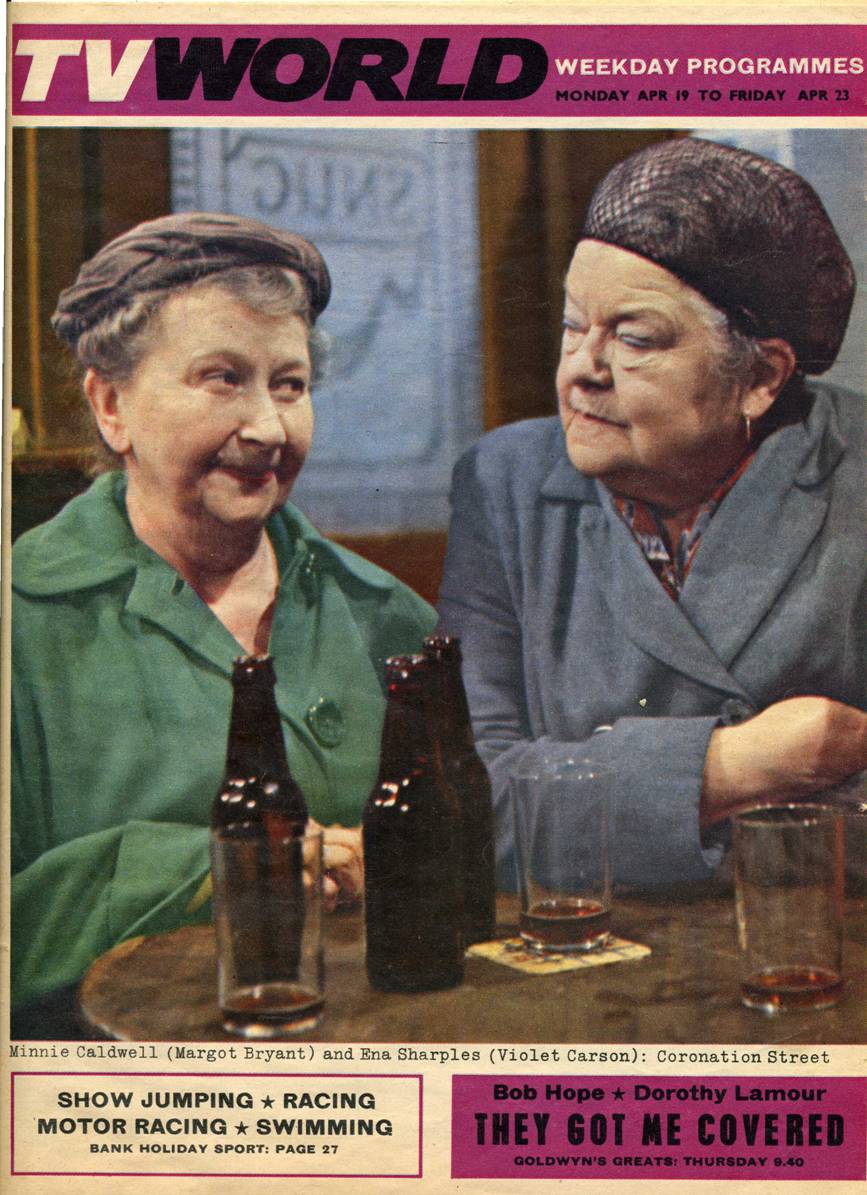
A while back now, I wrote a few posts about the family ‘stuff’ I was finding myself having to go through. Some of this stuff opens windows on quite personal and intimate histories, some of it more public ones. One of my favourite excavations has been the discovery of some more or less random pages from TV and radio guides from 1966. In a cupboard in my mother’s house was a bunch of framed pictures, including one of my two older sisters when they were toddlers. The frame of this picture was broken, and when I took it apart, behind the photograph, the paper used to pack the photo into the frame was old editions of the Radio Times and TV World (a predecessor of TV Times I guess). They are from Spring 1966, shortly after my parents and sisters returned to the UK after their African adventures – the TV World is actually for the old ATV region, and the Radio Times is the Midlands and East Anglia edition. 

These yellowing pages reveal a lost world of British public culture, when The Fugitive was the exciting new US import on ITV, Sheila Hancock starred in a show as “one of life’s most entertaining victims”, Captain Pugwash was a cartoon strip in The Radio Times, and you could order an Asbestos Garage from £43. 7s. from the back of the same publication.  Easter Monday’s schedule on ITV that year was all sport: international swimming, from Llanelly; motor racing, from Goodwood, obviously; racing from Newcastle; and show jumping from Hickstead (with commentary by Raymond Brooks-Ward, who I had never associated with ITV, in so far as I think about his career much at all). The BBC was about to broadcast the first of eight, yes eight, nightly programmes reconstructing the ‘Irish Rebellion’ of 1916.

The Letters pages of both publications are testaments to the critical capacities of engaged, active audiences – a brilliant debate about whether or not the plotlines of Softly, Softly were too vague and lacking in satisfactory clarity by the end of each episode, or for that very reason best compared to Kafka’s novels. Or a complaint about the contrast between the national news on BBC radio, presented apparently in “a serious, sensible, and factual manner”, and regional news stories which “are treated in a simpering, pseudo-cosy style”. Pseudo-cosy, what a great concept.
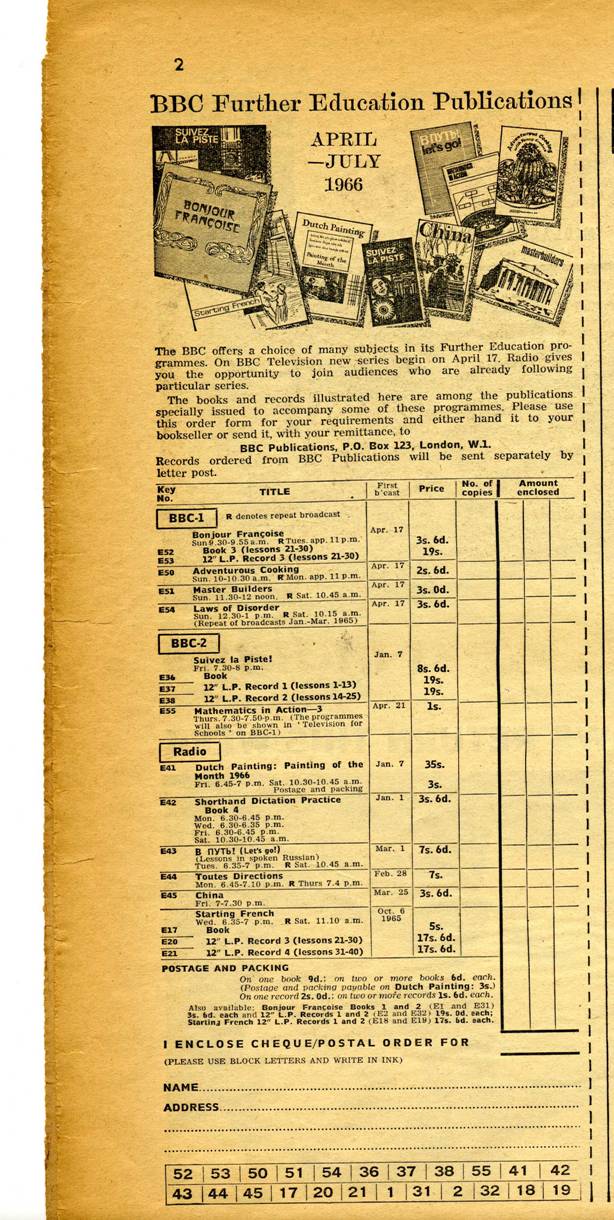
The Radio Times for the 16th-22nd April also contained a half page advert for BBC books and records to accompany its Further Education programmes (Adventurous Cooking, Laws of Disorder) – a peak into the pre-history of The Open University, when the BBC was already pioneering the use of multi-media platforms for adult education. 

Over at TV World in the same week, the letters were all about how best to make custard pies that flop – part of a discussion with the TV World cookery expert. This is from an age before Tiswas.

Coetzee reading from his new novel

Via @Stilllife0 on Twitter, here is JM Coetzee talking last month at Penn State, including a reading from his forthcoming new novel, as well as from a collection of letter between him and Paul Auster, being funny, sort of, about the arbitrariness of the sign and the degree to which names shapes our character and destiny.

Browsing as ethnography?

Does book-browsing in a foreign country count as a way of doing ethnography of the public intellectual culture of that place? I like to think so. Bloemfontein, where I have been spending this week at a workshop, and doing other bits and bobs, has a decent range of bookshops – at least two branches of Exclusive Books, the nation-wide bookstore, but also a good University-related Protea bookstore. There are a lot more Afrikaans-language books here than in Durban, where I have spent most of my time in South African before now, not surprisingly (including a Christian family bookstore called CUM books, believe it or not). The politics of Afrikaner identity is very much alive a live issue in the Free State, it seems.

Anyway, on my observation, there are a few publishing trends which seem interesting. One is the blossoming of SA-based and authored crime fiction – although more interesting, I think, is the work of Lauren Beukes, who writes sci-fi, of a sort, but really dystopic urban noir about South African cities the day after tomorrow – I am half way through Moxyland,  based in a near-future Cape Town, and have Zoo City, about Johannesburg, packed in the bag to take home.

There are also a lot of books about contemporary ANC politics, more than there were a decade ago or less even, some of them histories or biographies, and an interesting series of short books on current hot topics published by Jacana press, as well as lots of things about ANC politics right now, a month or so away from the big Indaba to be held here in Mangaung, where the conflicts about the Zuma leadership will be settled, one way or the other.

If I were here longer, I’d be reading all these – South African TV is designed to encourage reading. But I’m here just for a fleeting visit, enough only to start the newly published biography of JM Coetzee (600 pages, and he doesn’t write a novel ’til 200+ pages in – and nor had he led an exciting life before that), and the ever wonderful Ivan Vladislavic’s short collection The Loss Library, about writing-projects imagined and/or started but never completed – a topic close to my own heart.

RA post on ESRC project

Here are details of an opportunity as RA on an ESRC research project led by my colleague Melissa Butcher, on ‘Creating Hackney as Home: young people as participatory researchers and as publics’.


Escobar on alternatives to development

A fascinating discussion between Rob Hopkins and Arturo Escobar on the relevance of the transition movement in the global South.

More things to read

On the assumption that a blog is a means of thinking out loud, I have updated the Things to Read page, adding various unpublished bits and bobs, including texts of talks given over the last few years, as well as a first attempt to articulate some ideas about theorising emergent publics and some grumpy thoughts about why it might be best to think that politics is ordinary. One day I might get around to writing these ideas out in neat.

Open University initiatives on poverty

Here are a couple of OU-related initiatives and research projects on issues of poverty – a series of documentaries on Why Poverty? with other media resources too; and the re-launched website of the ESRC-funded collaborative project on Poverty and Social Exclusion (this will at some point soon have links to audio-visual materials associated with the new module The Uses of Social Science that has just started it’s first presentation – I’ll post again when this is live).

Is politics an enigma?

Via Derek Gregory at geographicalimaginations, I’ve just come across a short essay at Adbusters from Andrew Merrifield diagnosing the ‘spatial’ lessons of Occupy, which he presents in terms of the challenge of linking a clear and adequate Marxist theory of capitalism to the rather elusive practical challenge of doing politics in light of that sort of analysis. I guess the ‘engima’ that Andrew identifies might not be so puzzling if one did not imagine that the theory was quite so adequate, and if one did not suppose that ‘revolt’ was the only plausible model for thinking about politics. Oh well.

The essay does contain a nice description of what’s ‘public’ about occupied spaces, one that punctures the romance of ‘real’ spaces of assembly – publicness turns out to be about both situated encounters as well as catching the attention of more dispersed, disseminated audiences. A nice image, certainly, developed more fully in John Parkinson’s recent book which I mentioned a while back, for example, or in Kurt Ivesen’s work on spaces of public address , or various other places in which a stretched-out notion of public space is developed . It’s not really a terribly ‘revolting’ idea at all.

Two ‘media’ events

For anyone so inclined, two recently advertised events on media/communications issues:

A forthcoming lecture by Onora O’Neill at Goldsmiths in November; and an ICA ‘preconference’ next June, on the theme of Conditions of Mediation, organised by Scott Rodgers and Tim Markham.