
 Despite now being the home to one of the largest collections of scholarly books in the world, Swindon remains very much not-a-University town – there has been a long-standing civic ambition which goes back at least to the 1940s to get one. Recent years have seen initiatives to snag some bit of an expanding existing University, such as Bath, but these have come to naught. It does, though, now have a BPP University College, so that’s good. In a way. Maybe. Maybe not.
Swindon claims, not proudly, that it is the only major urban area in England and Wales without a University, or the biggest one, or some variation on this (though I think Milton Keynes might also qualify for this distinction, depending on what it is that this sort of claim is getting at – it’s about relatively low levels of participation in higher education in these places). Even Cirencester up the road is now set to be a proper University town.
Allan Cochrane and others at the OU have been researching the place of Universities in their localities and regions, looking at the changing rationales of economic growth and public engagement shaping this relationship. Swindon is interesting because here the story isn’t how established institutions now seek to engage with the places of which they are a part, but how and why local actors think it’s a good idea to have a local University in the first place. Via Twitter, I came across the latest round of discussions on this issue of the Borough Council earlier this month, including a consultancy report, A University for Swindon, which provides a profile of the current participation in HE of people living in Swindon. The report is shaped by the aim of establishing levels of potential demand for Higher Education in the town and round-abouts (ha!).
The report, and the wider strategizing over the last couple of years, indicates some of the assumptions about the potential benefits of having a higher education presence (of any sort, we’re not fussy), assumptions shared broadly across the political spectrum (as I think I have mentioned before, Swindon’s civic boosterism has a long history of attracting academic scrutiny of one sort of another, from Michael Harloe in the ’60s through to the 1980s localities debates. Phil Pinch even dubbed Swindon an archetypal ‘ordinary place’ twenty years or so ago. Trust me, it’s certainly a lot more ordinary than Johannesburg or Rio de Janeiro).
Anyway, the current strategy is an incremental one. A University Technical College (UCT) is set to open in 2014, with Oxford Brookes as its University sponsor and a locally-based ‘international high-tech’ company as its business sponsor. It will specialize in providing in engineering courses for 14-19 year olds. This is meant to be the first step towards realizing the dream of a University for the town, a dream which is seen as central to local economic development and growth, and which is strongly supported by Influence, the organization representing the business community in Swindon.
The report commissioned by the Council has some interesting stuff in it. For a start, Swindon has relatively low rates of participation in HE, and they are not improving. This, in fact, is central to the strategy for attracting or building an HE presence locally. There is an assumption that the skills base is central to future economic development, and that a University is one way of dealing with the supply side challenges facing the town. It turns out, and this is what first attracted my attention, that 15% of Swindonians in higher education study with the Open University, which is above the national average. The report takes this as proof of ‘latent demand’ for a local University, along with the fact that a third of all Swindonians enrolled in HE are at UWE in Bristol, Bath Spa, Oxford Brookes, or the University of Gloucester – all about an hours drive away, but none technically ‘local’ according to the way these things are officially defined. But the report is careful to point out that levels of participation in HE are not straightforwardly linked to the presence or absence of a local University: “The availability of local HE provision is just one factor influencing learning patterns, other factors include levels of attainment prior to 19; deprivation and aspirations.” Swindon does not score well at all in those other factors, which is the real story behind the report.
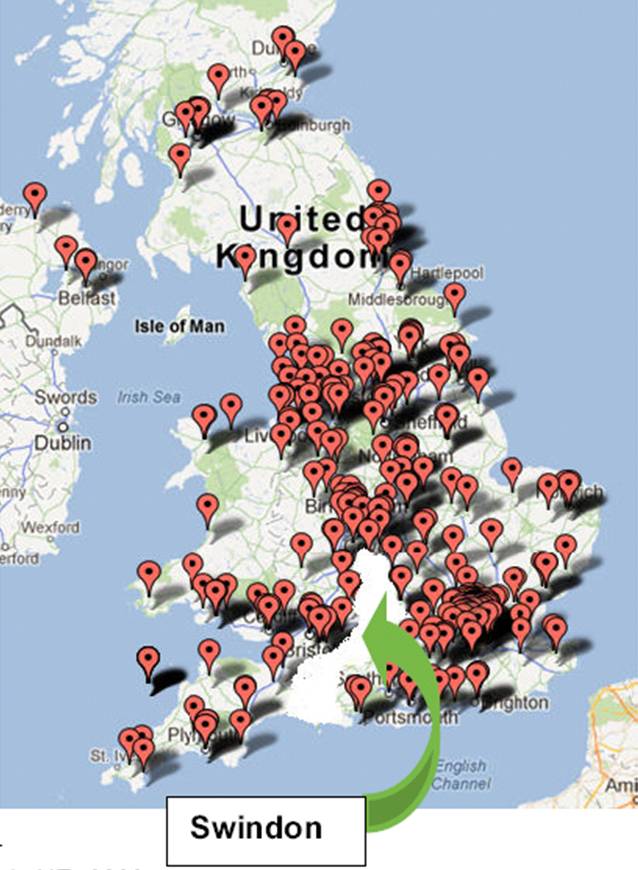
So there are interesting geographies revealed by this report – geographies of absence, and geographies of ambition, and imagined geographies too. In one section, for example, it is noted that “The impetus for a university stems in part from the knowledge that Swindon is one of the few major settlements in the country without an HE institution”. Then, with the help of a rather busy map, it is claimed that “Swindon lies in a swathe of country without a university which stretches from Stratford on Avon in the north to Weymouth in the south. Whilst this research has focused on demand from Swindon; this gap underlines the point that any new university would also be likely to attract students from nearby Wiltshire and Gloucestershire.” I’m not sure this ‘swathe’ actually adds up to a real region – it’s basically anywhere West of the M40 if you swing round Oxford on the A34, east of the M5 as long as you don’t stop at Bristol, Gloucester, or Cheltenham, and a large part of this empty swathe south of the M4 consists of Salisbury Plain. And I rather doubt whether rates of HE participation in Wiltshire towns like Marlborough or Salisbury will be significantly affected by any new University of Swindon (Swindon is in Wiltshire, but not necessarily of Wiltshire). And of course that statistic about the level of enrolment with the OU might not be best read as an index of the absence of alternatives either – but as further indication of the fact that local levels of HE participation are only tangentially related to local provision.
But keep your eye on Swindon – the future of non-elite higher education, shaped by assumptions about skills, the knowledge economy, and business partnerships might be slowly revealed here. Meanwhile, I have the sense of the town having all the component parts of a proper University without quite having composed them properly into one: loads of potential students, as well as already having all the books and even all the research money. What could be easier?


 There has been a flurry of interest in the theme of ‘planetary urbanization’ recently. Andy Merrifield has an essay on the theme of ‘
 In general, the story seems to be that we should think in terms of processes, maybe practices and strategies too, rather than fixed entities like ‘cities’ or discrete spatial objects like ‘the urban’. I suppose. This is a not unfamiliar argument of course, one made around issues of scale, for example, or indeed pretty much any other concern touched by Theory – personal identity, the state, Capital. I wonder whether this is really all that exciting any more as a claim about what theory can do for us. It is actually rather odd to assume that one needs theory to gain insight into the made-up, enacted, assembled, contingent, flow-like qualities of things that we often talk about and experience as if they were thing-like. And if theory is given this special privilege in the register of revelation, attached to a claim about its ‘political’ significance, then there is a risk of missing some important dimensions about the ordinary ways in which things (cities, states, people-with-identities) configure our lives in manageable, responsible ways (it also risks buying into some hoary modernist notions that somehow ordinary language isn’t quite adequate to capture the processual and relational qualities of live; it is, of course, perfectly adequate for that task, that’s why we have words like ‘process’ and ‘relation’ in the first place, and verbs, stuff like that).
 I have to come to like the idea that ‘the urban’ is really a name for a problem, or for a series or variable problems (not quite the same as thinking of variable ‘attributes’). This is an idea I am stealing for my own purposes from my colleague
 There seem to be two senses of publicness operating in lots of this work – an implicit ideal of transparency and openness, which operates as the benchmark against which any and all practices of security are always already rendered suspect; and a sense of public space as a communicative milieu of a certain sort, either for ideological interpellation or affective contagion, through which fear and anxiety is routinely circulated. If you combine these two, then you get to the point where security practices are always counter to public values, because they are meant to operate out of the open, they are hidden, surreptitious, secretive, invisible, and yet brilliantly effective for all of that.
 The two papers at the Ottawa workshop that seemed to stretch almost to breaking point the visual register in which security and its publics is theorised were, it turns out, both by geographers – Jennifer Hyndman talking about refugee camps in East Africa, and Alison Mountz talking about the use of islands as the location for off-shore detention centres by the US, UK and Australian governments. In both cases, there isn’t anything ‘invisible’ about the practices or places at issue – you can’t hide a refugee camp, they are in plain sight. Hyndman talked around the theme of ‘apprehending’, in terms of a kind of double, ambivalent political and epistemological sense of laying hold of and/or seizing, but also of learning about (I’m probably doing the argument an injustice). Likewise, Mountz framed her analysis in terms of drawing attention, distraction, things ignored, not just visibility and invisibility.
