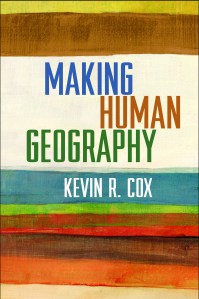
I have just read Kevin Cox’s new book, Making Human Geography. It tells the story, as he sees it, of how over the last 50 years or so, human geography has become a field of sophisticated theoretical and methodological inquiry. He starts by admitting this is a ‘personal understanding’, and it has a strong ‘interpretative’ line that reflects is own convictions, not least about the continuing saliency not just of Marxism, but of geography’s Marxism, of ‘historical-geographical materialism’ as an explanatory framework. I guess this won’t be to everyone’s tastes (there is plenty to disagree with about Kevin’s account of all sorts of things). But one of the things that I liked about the book was its tone. He worries about the ‘eclecticism’ associated with contemporary human geography, especially in its self-consciously ‘critical’ varieties; but does not complain about fragmentation nor indulge in nostalgia for lost coherence. Above all, the book makes an assertive case for human geographer’s achievements in laying the groundwork for the on-going challenge of spatializing the social sciences. This is a book about the ‘strong ideas’ developed by geographers, not the geographical ideas you can find elsewhere – no Lefebvre here, no ‘methodological nationalism’. These sorts of absences might be something that not everyone will be comfortable with – after all, geography now inhabits a broad field in which various spatial and environmental vocabularies are shared, including political theory, media studies, science and technology studies, as well as ‘Continental Philosophy’. All sorts of theorists get to be classified as ‘spatial thinkers’. Geographers increasingly thrive in this interstitial field, finding it easier to ‘pass’ as just another social scientist or theorist (in turn, in the UK at least, the institutional form of Geography in higher education has been transformed by the capacity of what are now very seldom mere ‘Departments of Geography’ to act as hospitable homes for various fields of inter-disciplinary social science ). Just how to ‘wear’ the distinctive disciplinary understandings of space, or scale, or networks developed since the 1950s outlined in this book has become more and more of a challenge. Not least, the challenge is to avoid a certain sort of ‘take-my-ball-home’ chauvinism that is associated, for example, with arguments about using space ‘metaphorically’ compared to proper ‘material’ understandings. The story in this book revolves around the different concepts of space (the trusty triad of absolute, relative and relational space) that have shaped human geography. This is a much more helpful way of approaching inter-disciplinary conversations (though not without it’s own implicit chauvinisms I suspect).
 This book covers a lot of ground – everything from geographical deconstruction to the expansion method (which is much less interesting than it might sound) – even as it cleaves to its own distinctive narrative line. It’s accessibly written, reflecting its origins no doubt in many years of seminar teaching. In parts, it presumes quite a lot of familiarity with the discipline and its main players. Apart from anything else, it does a really good job of elaborating on how important the ‘quantitative-spatial revolution’ both was and still should be for human geography’s intellectual progress: one of the most interesting themes is the idea of quantification and spatialization as two distinct intellectual movements that converged in the 1950s and 1960s; it also makes the point that the development of quantitative spatial science since then has been more often than not focussed on issues of contextualisation, against the caricature of ‘generalisation’ and ‘law-finding’ often directed against this style of work. Again, I guess the call for some sort of rapprochement across quantitative and qualitative styles might not resonate that much in some ears – not only, but not least, because to a considerable extent the cross-generational formation of human geographers (like me) naturally attuned to the worlds of social theory, Continental Philosophy, or qualitative methodologies is dependent on an institutionalised blindness around quantitative social science (the reverse is true too, of course).
I don’t necessarily agree with how Kevin interprets human geography’s trajectory. For example, I don’t really recognise the presentation of change since the 1980s, in terms of various ‘Posts’ that displace the centrality of Marxism. It’s a standard presentation, no doubt. It easily underestimates just how central Marxism still is in human geography, compared to any other social science field I can think of. I’d tell that story differently (perhaps in terms of a succession of errors compounding themselves… perhaps as the triumph of certain ‘philosophical’ temptations over the modern dilemmas of social theory…; or perhaps, on reflection, more charitably, in the same tone of genuine curiosity that Kevin strikes in his version of the story). But I do think that his account focuses in on the fundamental points of tension around which any disciplinary field develops: issues of method, key concepts, and the question of how best to understand ‘why things happen and why’. Above all, I like the fact that this is unashamed celebration of what human geographers do as geographers, and why this is important for the social sciences more generally.


 Pop Theory