Challenges of the New Urban Agenda

More recommended reading for the New Year, this time a critical reflection  on the potential implications of the translation of the ‘urban SDG‘ (Goal 11 of the Sustainable Development Goals) into UN-Habitat III’s New Urban Agenda, by my Exeter colleague Federico Caprotti and 8 co-authors (I think it is in the nature of this whole field of global-level urban policy innovation that making sense of things means collaborating with plenty of others).  It is published in Urban Research and Practice.

Here is the abstract:

“The UN-HABITAT III conference held in Quito in late 2016 enshrined the first Sustainable Development Goal (SDG) with an exclusively urban focus. SDG 11, as it became known, aims to make cities more inclusive, safe, resilient and sustainable through a range of metrics, indicators, and evaluation systems. It also became part of a post-Quito ‘New Urban Agenda’ that is still taking shape. This paper raises questions around the potential for reductionism in this new agenda, and argues for the reflexive need to be aware of the types of urban space that are potentially sidelined by the new trends in global urban policy.”

Cavell and Geography

Picking up on the background to my last post mentioning Linda Zerilli’s new book, Jon Pugh has a new paper, ‘A sceptical approach to ‘the everyday’: Relating Stanley Cavell and Human Geography‘ , available online at Geoforum exploring the significance of Stanley Cavell’s ideas for thinking in human geography. It serves as both an introduction to some key themes in Cavell’s thought, and also an engagement with other influential streams of theory-in-geography through an ‘ordinary’ lens, including non-representational theory, affect theory and pragmatism. I thoroughly recommend it if you are at all interested in thinking sensibly about the issues that those buzzwords bring to mind but don’t quite feel comfortable with the orthodoxies associated with them …

Here is the abstract:

“Over the past few decades there has been a turn toward ‘the everyday’ in the social sciences and humanities. For some authors, this turn is about making the everyday a new repository of authority of some sort, political, social, cultural or otherwise. For others, however, any turn toward the everyday interrupts any such evaluation. Focusing upon Stanley Cavell and the philosophical lineage that he continues from Emerson, Nietzsche, Thoreau and Wittgenstein, this paper examines Cavell’s interest in the menace and power of scepticism as key to understanding the everyday as a lived experience. As an introduction to this particular part of Cavell’s work for many Geographers, the paper puts Cavell in relation to more familiar approaches to the everyday, including de Certeau, critical Human Geography, non-representational theory, affect theory, psychoanalysis and pragmatism.”

A Democratic Theory of Judgment – Linda Zerilli’s new book

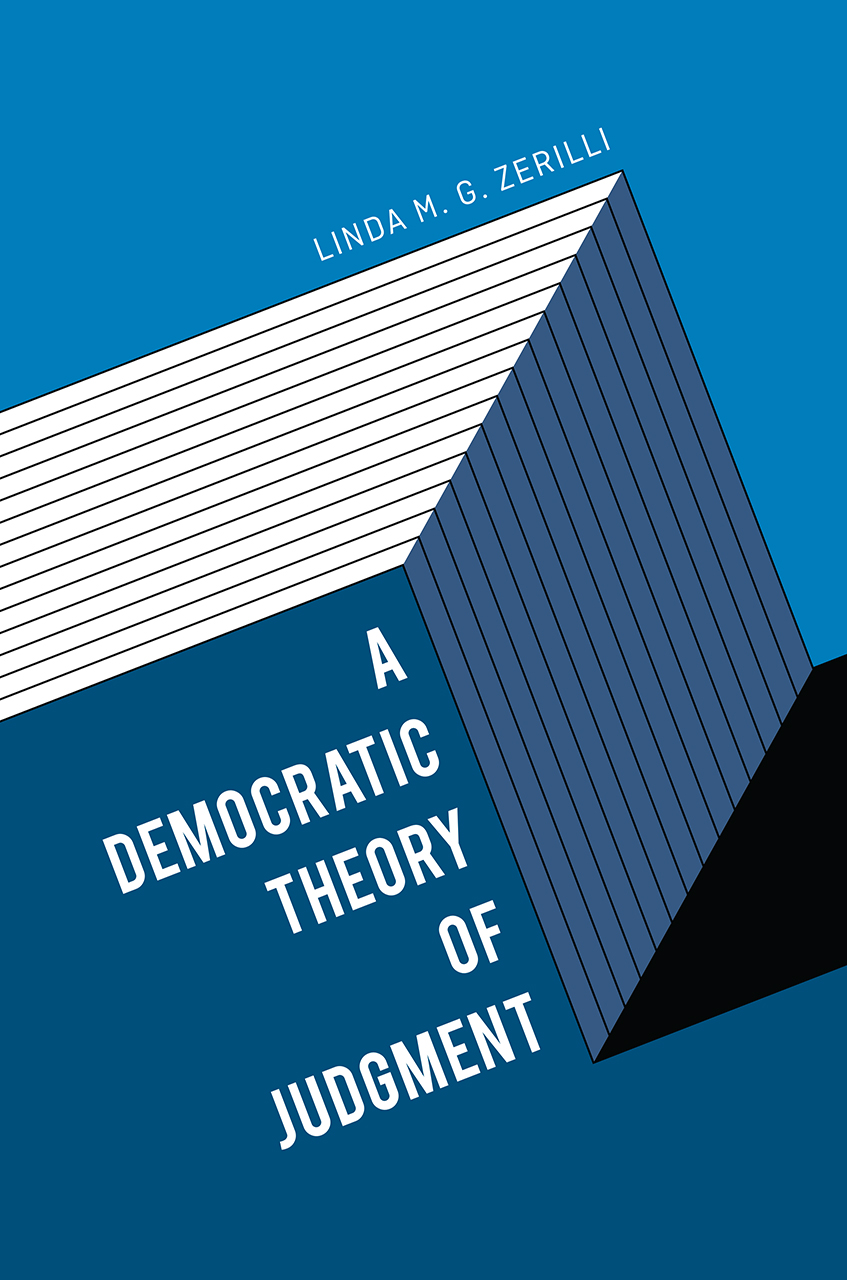
lzFollowing up on previous posts recommending the work of Linda Zerilli, I see that her new book is now out. A Democratic Theory of Judgment collects and synthesises and augments themes from her recent writings, including a sustained critical engagement in critical debates about affect in political theory (a critique that takes my own engagement with nonrepresentational ontologies seriously, in a critical way, alongside the arguments of Ruth Leys, which is flattering). But there is much more than that going on in the book it addresses what I would argue is a resolutely geographical problem of making critical judgments in new situations where inherited criteria don’t work (or, perhaps, where inherited understandings of how criteria work don’t work). My own attempt to elaborate on this problem, in my bookThe Priority of Injustice, out sometime this year,  owes a very great deal to what I have learned from reading Zerilli’s work, going back to her fantastic critique of skeptical residues in feminist cultural theory.

Elections as inference machines

bbElection results are wonderful things for generating piles of interpretation, since they are so informationally thin  (they only tell you how many people voted for each candidate in particular places, not why, or who they were, or anything else). Where would social science be without the secret ballot? But election results do provide just enough information to set-off all sorts of inferential flights of fancy, supported by waves of supplementary polling and survey evidence of different sorts. This might be one of the more important things that elections do for democratic politics – they generate deliberation after the fact, if not so much before! Getting your interpretation to stick is itself a political strategy, of course. The meaning of election results is nothing if not theoretically-overdetermined, one might say – give someone an election result, and they can use it to confirm their own favourite theory of what is going on in the world just now. It is even possible, for example, for some people to interpret Donald Trump’s election victory, secured quite legitimately by winning fewer votes than his opponent, but winning those votes in the right places, as “an unmistakeable rejection of a political establishment and an economic system that simply isn’t working for most people.” Never mind.

Anyway, on occasions like these, I tend to find myself thinking that I should either re-read, finish, or read for the first time certain things that I have kicking around the house, things like this:

Hannah Arendt, ‘Truth and Politics’, in Between Past and Future.

Ira Katznelson, Fear Itself: The New Deal and the Origins of Our Times.

Francis Fox Piven and Richard Cloward, Why Americans Don’t Vote.

Jan-Werner Muller, ‘Real Citizens‘, Boston Review.

Adam Phillips, Terrors and Experts.

Nick Clarke, Will Jennings, Jonathan Moss, Gerry Stoker, Anti-politics and the Left’, Renewal, 24, (2).

David Blight, Race and Reunion: The Civil War in American Memory.

David Slater

I was sad to hear that David Slater has passed away. In a parallel universe, we would have been colleagues, if only the University I worked for way back when had had the intelligence to hire David when they had the chance. I have always found him to be one of the most compelling critical thinkers in and around geography. He is among the few people to have written thoughtfully about the geographical resonances of democratic theory. His argument about ‘learning from other regions‘ was both a crucial moment in the reception of postcolonial thought in human geography, and remains highly relevant in the context of current debates about southern theory and decoloniality. The very first thing I ever read by him, when I was an undergraduate, on economism in development theory, remains in my memory as one of the smartest things I have ever read, a model of critical analysis, unashamed of its theoretical sophistication, to which we perhaps should all aspire.


Towards a Geography of Injustice

IMG_0166Just in time for anyone still wondering what they should pack to read by the beach this summer, here is a short paper by me entitled  Towards a Geography of Injustice, available open access at the Finnish journal Alue & Ympäristö (Region and Environment – my paper is not in Finnish, just to be clear), which I’m told is “unofficially” the “critical geography journal of Finland”.  This is pretty much the tidied up script of the Keynote Lecture I presented at the Annual Meeting of Finnish Geographers in Tampere back in October last year. I learnt lots and met nice people at the meeting, and thanks to Kirsi Pauliina Kallio for asking me to write the talk up properly.

This is a short and quite discursive version of only one part of a longer, and I hope deeper, argument about ‘the priority of injustice’ that I have been working out in my head while writing a book, which I think I have just completed this very week – it’s called, well,  The Priority of Injustice.  Somewhere between presenting a talk on ‘geography and the priority of injustice’ at Kentucky in April 2015, writing a first draft and then second draft in Vancouver last summer while on ‘research retreat’, and giving the Lecture in Tampere, I worked out what the book I have been writing was actually about – it’s about theories of democracy, substantively, I’ve always known that, but more specifically it’s about how to think about the vocation of thinking critically about democracy democratically, if you see what I mean. But it’s become a book about ‘the priority of injustice’- and this doesn’t mean favouring practice over theory, or even the empirical over the conceptual; it might mean not ever writing “(in)justice”, and not thinking of justice as an ideal; and not saying ‘post-political’; it might also mean thinking more about the meaning of domination, and freedom. Above all, it might mean thinking that politics is ordinary (but, obviously, in a not immediately obvious sense of ‘ordinary’….). 

This particular paper is an attempt to summarise all of that, and connect it to some thoughts about how these matters are and are not addressed in GeographyLand.

Seeing Like a Market and its Problems

UntitledFinally, a paper co-written by myself and Nick Mahony entitled ‘Marketing practices and the reconfiguration of public action‘ is published, in print, in Policy and Politics. It was made available online almost exactly a year ago. One of the odd things about the drawn-out rhythms of academic publishing is the tendency to be presented with previous versions of your own self. The paper arises out of a small research project on market segmentation methodologies that Nick and I worked on together when both at the OU. The Report from that project was published by the National Co-ordinating Centre for Public Engagement.

The new paper develops a more theoretically oriented argument about how to interpret the increasingly widespread use of a range of marketing technologies in non-commercial fields, including the public sector, by charities, by political consultants, and in the third sector. So, in that respect, its part of an ongoing argument I have been making (both in publications and on this blog) about the limits of standard ways of using concepts such as governmentality and neoliberalism in critical social science.

It is also, I can now see, now it is finally done and dusted, one of a series of ‘occasional papers’ in which I have tried to make use of the idea of  ‘problematization‘ to reframe the ways in which one might pursue the vocation of ‘critique’, including pieces on ideas of security and public life in Dialogues in Human Geography, a more  theoretical treatment of how this idea helps us read Foucault in nonsite.com, and an ongoing effort to use the ideas to make sense of the proliferation of urban concern across any number of fields.

So, anyway, one more time, here is the abstract of the Policy and Politics piece:

“Market segmentation methodologies are increasingly used in public policy, arts and culture management and third sector campaigning. Rather than presume that this is an index of creeping neoliberalisation, we track the shared and contested understandings of the public benefits of using segmentation methods. Segmentation methods are used to generate stable images of individual and group attitudes and motivations, and these images are used to inform strategies that seek to either change these dispositions or to mobilise them in new directions. Different segments of the population are identified as bearing particular responsibilities for public action on different issues.”

Bite Size Realism

“So in all human affairs one notices, if one examines them closely, that it is impossible to remove one inconvenience without another emerging.”

Niccolò Machiavelli, 1517, The Discourses.

Politics and the biases of media

There are various things about the phenomenon of Corbynism which reflect very badly on the quality of political thought on that part of the Left that likes to think of itself as new and shiny and alternative in a weirdly backward-looking, Bennite kind of way. From a personal but also professional point of view, the one thing that I find most amazing is the way in which this ‘movement’, from Jeremy Corbyn on down, thinks about “the media”. It is evident, and has been since last summer, that they really do believe in ‘media bias’, based on ideological grounds and intentionally reproduced, and that you can find evidence of it everywhere but especially in the BBC, personified in certain journalists.

There is no denying that Corbyn has had a bad press, but that of course is no evidence of media bias. To suppose that it is might just be a version of denial. And to think that there is such a thing as ‘media bias’ based on ideological grounds in the way in which the current Labour leadership and their supporters still, today, does is not only to display a basic misunderstanding of how journalism works, how news is made, how Party politics works (i.e. a misunderstanding of the world one is meant to have some grasp of as people working in Party politics), it is deeply troubling for two related reasons:

  • It indicates a failure to grasp the sorts of ‘bias’ that might well be at work in the conventions of news-making, biases towards things like narrative, good stories, arresting personalities, sincerity, and the like.
  • And following from this, what is really most troubling about the 1980s-style media studies view of ‘media bias’ circulating in strands of left commentary in the UK these last few months is not so much that it indicates a misunderstanding about dynamic world-making media practices, but what it reveals about how this sort of political perspective thinks about the interests of ordinary people.

If, as a politician, you keep publicly saying that your problems are due to the bias of ‘the media’, then you are demonstrating both a lack of self-awareness and a form of condescension towards people you think should really like you. And these are the sorts of dispositions that resonate quite powerfully in ‘the media’, irrespective of whether you are being reported on by Laura Kuenssberg or taking part in a fly-on-the-wall documentary on Vice, because they have little to do with ‘ideology’.