The Means and Ends of Higher Education

Things I Learnt With Colleagues Last Week

Week 4, and it looks like the combined stupidity of the UUK and lack of preparedness and care by individual University senior leaderships before the current UCU strike action started means that lots of University staff in the UK are still out on strike, not teaching students, not librarian-ing, not providing professional support to researchers, not, public-engaging, and not doing lots of other things they’d rather be doing. That does mean more “learnable moments” for those of us on strike, whether through talking to our colleagues on the picket line (or meeting new ones) or through tweets and re-tweets and blogs. I’ve decided to not have any shame about only now discovering things about my pension, or how the University I work at (NOT for) is run, and instead take my ongoing journey of discovery as an indictment of the very system we are all realising we are part of. After all, none of what we are learning about how the USS pension system has been undermined, or how this is related to the systematic financialization of University funding, or how University governance has been rendered obscure and unaccountable, is actually a secret. Some of it people have known about, and lots of this is actually a focus of robust research. But who has the time to keep up with all this? And who imagined that those representatives of the institutions that one might think were meant to act in the best interests of those who work for Universities would turn out to be, well, less than honest and trustworthy and competent, if not deliberately misleading?

A few things have caught my eye in the last few days, precisely because the focus of my attention has been directed by my colleagues at better understanding the economics of pensions systems and the business models of Universities and because I have had the time to pursue in more depth these issues (there’s a lesson here, surely, concerning what it says about the Efficient Market Hypothesis that it is only when employees are on strike that they have enough time to actually begin to even imagine being able to access all of the information they are supposed by adherents to that abstract principle to have at their disposal in order to function as rational fools).

The first was a great, succinct blog post by Ewan McGaughey explaining the relationship between the planned gutting of the USS pension scheme and shifts in the nature of University governance. As he puts it, the plan to shift risk away from Universities by rendering all ‘pension’ support into ‘Defined Contribution’ schemes in the name of flexibility and choice amounts to recommending a ‘Die Quickly’ Plan. Now, one thing we’ve all learned is that this whole programme of de-risking is related to a broader shift in the strategizing of UK Universities, whereby the urge to reduce pension support as liabilities is intrinsically linked to the imperative to diversify sources of funding in a context of reductions in direct government support. Now, the logics of financialization in higher education are perhaps longer established, and subject to research scrutiny, in a North American context than in the UK, but it is worth remembering that that’s a different context. Thomas Hale provides a short summary of ‘allure of the capital markets’ for Universities at the FT’s Alphaville site (you have to register, but it’s free after that, and totally worth it – he’s been writing about higher education for a while now). It’s good to keep in view the degree to which these transformations in the strategies of Universities are structured by a firm commitment by government since 2010 to restructure the economics of higher education in fundamental ways. The relationship between the pensions dispute and this trend towards financialization is captured in what now, two weeks later, reads like a very old statement from the Vice Chancellor of Exeter, according to which the costs of continuing to support the existing pension system would involve “a reduction to our resources, and would limit our ability to deliver our key missions around research and education as well as our ability to invest in, and improve, the facilities we provide.” This zero-sum representation of what is at stake in this dispute – between investing in uniformly high quality pay and conditions for staff versus a rather obscure sense of education and research ‘missions’ that centre on ‘facilities’ – is, in fact, simply a talking point proffered by the UUK for widespread use. That’s just one of the things we’ve all learnt because of the work of Gail Davies and Felicity Callard and others in reconstructing the explicit efforts of ‘The Voice of Universities’ to legitimise the shift from collective pension support to individualised “Die Quickly” savings plans. (And Exeter’s VC has more recently reiterated the same argument).  

The implicit view that supporting pensions is a liability that gets in the way of delivering key missions rests on a broadly shared imperative for Universities to be able to demonstrate that they are enhancing “student experience” – where this means access to high quality work spaces, to fantastic sports facilities, accommodation, high-tech teaching spaces, and the like. All of those things are crucial to making a University the space that it is meant to, no doubt. The interesting question is how it is that we have arrived at a situation in which all those material things are rendered affordable only by drastically restructuring academic labour markets in increasingly bifurcated ways while also streamlining ‘academic support’ professions.

The trelationship between the substantive issues behind the current pension dispute and the shift towards capital investment strategies amongst Universities is neatly captured by Philip Roscoe, discussing the origins of the strike in decisions made by UUK in 2017: “In the summer of last year USS asked employers – via Universities UK – whether they wanted more or less risk. It might seem a silly question, for out of context everyone wants less risk. But universities have a particular agenda. USS is what is known as a ‘last man standing’ scheme, meaning that should institutions start to fail, risk would pile up on those still operating. And university managers, now thoroughly versed in the language, practices and salaries of business, are obsessed with avoiding risk. Risk has practical implications, for under current accounting rules employers must carry full pension liabilities on their balance sheet. This affects administrators who, seeing themselves primarily as curators of rankings in a market-driven system, are diverting all the funds they can into an arms race of building and infrastructure investment. Universities can borrow very cheaply – often at less than the cost of inflation, and almost free money is too good a ticket to be passed up. But lenders are not going to offer such preferential terms to borrowers with huge pension liabilities; for a university, the covenant of USS begins to loom as an enormous blot on an otherwise shiny credit rating.”

The integral link between the pensions dispute and the financialization of University expansion plans involves a search for new sources of revenue, in a context of declining direct funding from government and uncertainty over the reliability of student fee income, the real value of which is declining year on year anyway. (Let’s not forget, in the midst of realising just how badly managed British Universities have been, that the changing political economy of higher education has its source in the determination of Tory-led governments since 2010 to try to make higher education conform to ridiculous models of markets and competition. Universities’ turn to capital investment programmes as a way of seeking enhance ‘student experience’ is an index of a motivated effort to enforce a competitive spirit on higher education institutions, and the move to ‘de-risk’ pensions liabilities is a central element of the resulting and still emergent business model in which getting better loan rates is the driving imperative.)

The transformation of the economics of higher education represents an opportunity for growth for certain fields of private investment, and that’s why there is so much consultancy by the likes of Barclays and KPMG flying around – it serves as a way of introducing potential investors to potential borrowers. Here is pwc summarising the new landscape of higher education funding:  “In an increasingly competitive market where all Universities are striving to offer their students, staff and visitors the most positive and rewarding experience possible, the quality of the built environment, the accommodation offering, and the delivery of estates services are playing a more critical role than ever before. In response to this, Universities are developing exciting and ambitious estates plans that propose significant investment in new facilities, and innovative ways of delivering services.” Now, the key thing about this emergent field is that buildings and facilities require long-term financing, and traditional lenders – banks – “are unable to write loans with the same duration and pricing levels of the past”. All of this is a source of some excitement:  “New sources of finance, as well as new commercial modes for securing this finance, are therefore needed and are being employed across a variety of projects in the sector”. As NatWest nicely put it, capital debt markets “have capitalised on the lack of bank liquidity for longer-duration financing”.

The most publicly visible example of Universities turning to debt capital markets takes the form of individual institutions – ones as very different as De Montfort and Cambridge – issuing their own bonds (an instrument of indebtedness sold by the issuer to the holder, e.g. what governments do). This trend serves as a way of securing long-term finance that bank lenders are not prepared to extend. But the logics of financialization are not only evident amongst institutions who have leveraged credit in this way. For example, the University of Exeter’s financial strategy is quite prudent – the University is “relatively highly geared”, that is, it’s focussed on paying down relatively high levels of debt accrued from past investments. This is one reason, of course, why pension commitments show up as a risk (not just a liability) for this type of institution.  For Exeter, “Pensions” are listed ahead of “Impact of the EU Referendum June 2016” when it comes to discussing financial risks: “The settlement of the USS 2017 actuarial valuation is a key risk, both financially and in terms of industrial relations, with the national trade unions agitating to protect current pension benefits. Current expectation is that the valuation will be settled within the current funding envelope, without increasing costs to the employer or employee but the likelihood that future pension benefits will have to be curtailed is high.” That was written a year or so ago I guess.

Of course the idea that pensions are ‘a material liability’ is just technical vocabulary, it’s not necessarily ripe for deconstruction. But when financial balance-sheets become ‘enveloped’, shall we say, in a wider process of actuarial de-riskification then the idea of pensions as liabilities gets translated into the idea of pensions as a risk, and helps to generate the search for securing the ‘resilience‘ in higher education financing.

Now, you might think that if you are already busy paying down lots of debt, you’d calm down about taking on a lot more. Well… the University of Exeter actually has an ambitious future capital investment strategy (‘Iconic Buildings on what used to be a Car Park’, for short). Exeter’s Capital Strategy proclaims “The next ten years will see us invest £428.5M in our campuses, estate and infrastructure. We are building the estate we need to deliver world-class research and an internationally excellent education, accommodating our students and our world leading academics in exceptional teaching, learning and research spaces.” As I said, there’ll be less car parking space as a result. And it’s not quite clear, from the outside (that is, for those working at this University) where this money is meant to come from. This investment strategy also sits alongside the University’s “People Strategy’, which has the sub-heading of ‘Attract, Perform, Retain’ – I’m not sure how any of those aims is meant to be enhanced by undermining University employees’ pension provision which, as UCU members have helpfully reconstructed over the last week or so, has been systematically pursued by British University senior management for a while now. 

Exeter is certainly a good an example of the recent spending spree on new buildings that characterises British higher education, a phenomenon that is rooted in a widely shared understanding that this is the secret to attracting students. And if building buildings is crucial to recruiting students, then in turn servicing the debt that finances that building depends on being able to guarantee future student income (an aside: one of the things that working through the logics of this dispute does underscore is just how important teaching students remains to the changing meaning of ‘the University’, including ‘research intensive’ ones). In his discussion, Hale helpfully identifies just how important rankings are to this process of financialization, playing two related roles in mediating demand of “student-consumers” and in “the overall marketing process of debt issuance” (i.e. in reassuring investors that Universities looking for credit are actually any good). Rankings are, of course, just one part of the ‘avalanche of numbers’ that has swamped HE – loads of ‘data’ is used to manage Universities internally so that universities can act in certain ways externally, as it were, for accountability and justification purposes for sure, but also to establish and maintain institutional credit worthiness (remember that next time you are congratulated for achieving a better position in a methodologically dodgy league table). But more precisely, rankings and league tables are now built into systems for finessing the calculation of the risks of different sorts of assets, liabilities, and both estate investments and human capital.

Needless to say, this sort of estate-led expansion of HE is not without its controversies.

It should be said that developing expansive capital investment strategies does not only involve individual Universities directly raising capital through bond issues. Again, pwc is helpful here: “We are, however, seeing significant interest from certain large investors to increase their exposure to the higher education sector through property-related income that is backed by a strong covenant”. What is being referred to here is the turn to using “lease based structures” that allow Universities to access capital with long maturities indirectly (and therefore not messing up the balance-sheet). That line about large investors ‘exposing’ themselves to the HE sector is, of course, meant to be ironic: it’s not really the investors that are exposed in these deals, which actually depend on the assumption that investing in University estate is a safe bet. This second form of ‘innovative’ higher education financing through the credit markets involves Universities partnering up with specialist financial companies, of which University Partnership Programme (UPP) is the most visible in the UK. UPP is a University accommodation developer, that provides to Universities  ‘special purpose vehicles’. Basically, they raise the capital for Universities and build and run student accommodation, and ownership of the buildings only passes on to Universities when the original debt is paid back (that might sound familiar). UPP describe what they do in the following way: “Our vision is to deliver the very best student experiences, in partnership with great universities. Our mission is to create exceptional academic infrastructure and support services in partnership. We design and develop high quality, affordable, student accommodation, academic infrastructure and support services. Our unique partnerships enable universities to make best use of their assets, freeing up university resources and improving services to students.” That last bit about ‘freeing-up’ resources is important, because this way of financing building projects allows Universities to keep the costs of investment off their balance sheets – thereby enhancing their on-going borrowing strategies. Nothing to worry about there then. 

It’s worth slowing down a moment, and recognizing that the emergence of this debt-fuelled model of higher education is rapidly evolving – until very recently Universities were able to raise capital on favourable terms because of an implicit assumption that they were in the last resort guaranteed against failure by government. That’s no longer such a wise assumption. Government now not only seeks to facilitate new entrants into HE but says out loud it will not automatically prop-up a financially failing University. This effort to enforce marketisation is one reason why it is important to differentiate between arguments that HE is currently an imperfectly functioning market that could be made more perfect, and an argument about why it might not be a good idea to imagine that it’s sensible to imagine it should or could be in the first place. Of course, Universities remain very heavily dependent on government funding in all sorts of ways, primarily in terms of credit-extended to fund student fees as well as direct grants and research funding. It’s not clear that the model of financialization of higher education upon which the trashing of my pension has been premised is actually even sustainable.

And it’s worth noting, in the middle of all this, just how variable the subject of ‘The Student’ has become. It’s easy to bemoan the idea that students are increasingly treated as consumers, but it in fact students are figured in various ways in contemporary higher education policy and strategy: as future recruits, they serve as security against which Universities can secure loans; they are quite publicly presented, amazingly, as superficial air-heads who are easily dazzled by ‘shiny buildings’ when making life-changing decisions; they are expected to be only ever motivated as utility-maximisers by the promise of future earnings in their choices and expectations and satisfactions (giving rise to a weird sense of what ‘vocational‘ means in education, which is reduced to quite instrumental ideas about value for money; which doesn’t leave much space for the idea of a calling, a passion, a life’s worth of mission); and, rather importantly given the debt-leveraged nature of all this building work, as reliable rent-payers. And this disaggregation of ‘The Student’ into a dispersed range of abstract singularities facilitates in turn the re-aggregation of “student voice” and “student experience”, always and only ever spoken-for by University managers.
It’s Not Neoliberalism!

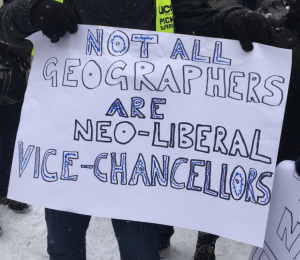
Now, at this point, I want to step sideways and make what might appear to be an arcane theoretical point: I want to say out loud that I think none of this can be helpfully analysed with reference to extant conceptualisations of neoliberalism. My reason for saying this here is because I have made this case on a couple of occasions as contributions to local UCU-related teach-outs in the last week or so, so I thought as a matter of good faith I should reiterate the argument here too. The framing of the wider context for this dispute routinely falls back on the terms of a popularised discourse of ‘the neoliberal University’ set against an idea of Universities as a public good that has come to define a whole space of critical imagination for the academic left and beyond. It’s worth slowing down a moment and considering what difference it makes to think about higher education as a public good or as a means of achieving the public good – and noticing that in neither case are market mechanisms necessarily inimical to desired collective outcomes. I happen to think that the analysis of processes of the marketisation, financialization, and consumerisation of higher education in the UK needs to be freed from the weight of the theoretical edifice of critical discourses of ‘neoliberalism’ (and I think this not just for academic reasons but also because I think it contributes to bad political strategy). I don’t want to rehearse a lengthy academic argument here, so I will try to be quick: leaving aside the complete incoherence of ‘neoliberal’ as either an explanatory or descriptive term, and the fact that all critical theories of neoliberalism tend to suffer from a somewhat unhealthy identification with their putative object of analysis (this is related to the methodological basis of most social science research on neoliberalism, which for all the talk of ‘political-economy’ tends to be based on fairly simplistic forms of discourse analysis (without even admitting it) and interviews with elite actors; or, for those late to the game, it is related to having no regard for the empirical at all, preferring to simply show the normative inadequacies of a set of theoretical propositions that are presented as having already been perfectly realised in the world). To cut a long story short, prevalent theories of ‘actually existing neoliberalism’ – whether the carpet theory of roll-back and roll-out variegated neoliberalization, or those of a more sophisticated poststructuralist variety, turn on stark contrasts between states and markets, or between the political and the economic – or, at a deeper level, between bad individualism and virtuous sociality (there are broader issues here about what kind of social theory is at work in critical analyses of ‘neoliberalism’, which tend to be reliant on functionalist theories of the state and of ‘subjectivity’, and devoid of effective understandings of the rationalities of action) .

There are at least three reasons why this whole framework of analysis doesn’t really help in analysing what we are all learning about the political economy of higher education through our involvement in this dispute. They all deserve more attention than I can muster here, but I’ll mention each in turn:

  • First, it disallows the possibility of any positive knowledge of the economic (at best delegating that knowledge to a tradition of Marxist analysis that is certainly worth taking very seriously). And if there is one thing we’ve all learnt these last couple of weeks, it’s that it’s really useful to be able to know about the economics of finance.
  • Second, as already intimated, risk the central theme linking the use of rankings, pensions as liabilities, and the financing of capital investment (again, that’s what Gail Davies and Felicity Callard  have been excavating). And risk is quite central to modern concepts and practices of public life, in a way often underestimated by critical theories. There really is something called the ‘The new risk agenda‘ that is being embedded in bought-in, consultant-led higher education strategising, management and administration. It’s a world in which future pension liabilities show up as a financial risk while leveraged on- and off- balance indebtedness doesn’t, no-one takes seriously the risk of undermining the professional confidence of University staff in senior leadership, and all those flakey metrics are used to make it appear that future student recruitment is a lock-in. There is certainly a debate to be had about ‘the privatization of risk‘, although that’s not quite what is involved here – it’s more like a process in which privatised models of risk, via actuarial practices and the operations of debt markets, have become integral to the delivery of new understandings of the ‘public benefits’ of HEIs.
  • Third, and picking up on this suggestion, entrenched critical discourses of neoliberalism find it very difficult to acknowledge that the marketisation and financialization of higher education involves the reconfiguration of the relationship between the means and ends of the public dimensions of higher education, rather than the diminution of the public qualities of University life in the face of unrelenting privatisation (the values of efficiency, accountability, freedom and choice that legitimise that reconfiguration are, after all, no less public values than, say, equality or justice). It is presumed that market mechanisms – in this case financialized practices – can only ever undermine properly public values (and it’s never explained why this infectious relation cannot work in the other direction as well).

The example of pension provision, which is what our dispute centres on, should remind us that there is no necessary reason why private means cannot be used to secure public goods (in that respect, Adam Smith remains a rather insightful theorist of modern public life). The history of pension provision in the UK from the early 20th century until the introduction of George Osborne’s “Freedom and Choice’ reforms in 2015 illustrates that it’s perfectly possible to combine private markets for investments with specific tax regimes to deliver welfare outcomes.


Should Universities Calm Down?

I guess my point is simply that higher education isn’t a public good – there are multiple public goods associated with higher education (and they might actually be proliferating even as the means of achieving them is being narrowed). At its most straightforward, as subject to the Charity Commission, Universities in the UK are obliged to demonstrate that their activities deliver Public Benefit to all sorts of constituencies (have a google, you’ll quickly be able to find the annual reporting of how your University’s delivers Public Benefit). It is possible to imagine various configurations of the objects, subjects and mediums of public life rather than holding to a stark contrast between two separate, and opposed realms. The marketisation and financialization of higher education, expressed not least through heavily leveraged capital investment programmes, represents a re-configuration of the means and ends of the public qualities of HE. And it’s not just done in the name of public values (to think that this will do as an analysis requires you to still believe in the concept of ideology, which you just shouldn’t). To illustrate my point, consider the evaluation of the capital investment by the research-intensive Russell Group Universities between 2012 and 2017 produced by the economics consultancy BiGGAR Economics in 2014 (great name). It should be said that most of the increase in capital investment by Universities is driven by a relatively small set of research-intensive institutions. The evaluation found that almost 100,000 jobs would be supported by more than £9 billion of projected investment – spending on “a wide variety of different types of project from new libraries and student accommodation to major urban regeneration projects and world-leading medical facilities” – and that every £1 invested will generate £4.89 ‘gross added value’  – these claims being arrived  at by using a “specially developed economic model”, the details of which are not made publicly accessible. These impacts will be felt over different time-scales – the total added value is divided between short-term impacts (the impacts of building the buildings), longer-term operational impacts (which derive from what goes on in the new buildings once they are built) and long-term ‘catalytic’ impacts: there at least 6 dimensions to this latter category, which anchors the really strong claim involved, namely that capital investment by Universities does not just amount to a redistribution of central government moneys but contributes to the active generation of new wealth. The six dimensions are ‘graduate productivity’, ‘medical research’, ‘commercialisation and innovation’, ‘enhanced research competitiveness’, ‘tourism’ (basically, parents coming to stay in University towns when their kids graduate) and ‘improved learning environment’ (which loops back to securing future student recruitment).

The report has a lovely conclusion, in which it is asserted that “Investing in a high quality learning and research environment” allows Universities “to attract and maintain the best students and researchers”. In this vision, capital investment projects are integral to the building of the ‘human capital’ that is central to both teaching and education. What a lovely idea. Unfortunately, no-one told the authors of this report that the specific business model upon which these programmes of capital investment depend actually requires that academic labour markets are increasingly bifurcated and students increasingly treated as assets – so that the ‘human capital’ part of that equation is actually sacrificed to the ‘capital-capital’ part.

The BiGGAR report illustrates that even when the impacts of higher education are, as they increasingly are, presented as accruing to individuals (the future salaries of students) or private entities (‘industry’) then this is understood as being a means through which wider public benefits can be generated. It’s just one example of how far the reconfiguration of higher education has involved a trend by Universities to claim to ‘doing everything‘ for everyone (social mobility, productivity increases, technological innovation, instilling civic spirit, solving climate change, etc., etc.); and the associated adoption of management models that are shaped by the imperative to provide evidence of that capacity to deliver for both instrumental reasons and accountability reasons.

So, again by way of example, the University of Exeter makes regular use of economic consultants to help it publicly demonstrate the benefit of increasing number of international students that it has bought to the city and region, part of a broader imperative to demonstrate the economic impacts of the University locally and regionally. And in case that sounds a little too economistic, then the University also makes strong claims about acting as an anchor institution the generates all sorts of social and cultural benefits alongside economic ones. The “anchor institution” idea has taken off in government and other public agencies around HE, and it’s an interesting example of travelling theory, whereby the original sense of the potential of certain public institutions driving regeneration in deprived and ‘vulnerable‘ localities and regions has been turned into a generalised narrative about Universities driving innovation and growth anywhere and everywhere. The specific combination of justificatory logics behind these sorts of claims about local impact is not peculiar to Russell Group institutions, it’s common across the whole HE sector. And one of the key roles of the not-so-loved UUK is to scale up these sorts of claims to the national level.

Now, to return to my theoretical hobby-horse, I don’t think neoliberalism or ‘privatisation’ or counterposing ‘people versus profit’ actually captures what is going on here (And I realise that “It’s complicated and contradictory and complex” doesn’t make a great slogan. It’s much worse even than Rectify the Anomaly, although I am personally increasingly drawn to the idea that University staff should campaign around the slogan “We Have a Right to be Well Managed”). Those slogans (and that’s what ‘neoliberalism’ really is remember) ask us to buy into a moralistic contrast between bad privatised, competitive, marketised, individualised practices versus good, virtuous, sharing ones. As I said, I think the ‘neoliberal’ frame leads us to misrecognize the degree to which what is at stake is a dispute between different understandings of the public responsibilities of higher education, and especially between different understandings of the best means by which to achieve the public purposes of higher education. I happen to think a better place to start is to take seriously  Rowan Williams’ characterisation of the current trends in higher education restructuring as being shaped by a “half-baked utilitarianism“. It’s a suggestion that has more purchase in analysing the dynamics of the changing world of higher education, and it is neatly illustrated by the line parroted by VCs that I mentioned at the start, in which the costs of sustaining decent pensions systems is set against the sacrosanct requirement to continue to invest in expansion: that zero-sum line exposes how the calculation of the value of the public benefits of higher education – in terms of social mobility and productivity improvements and that innovation and economic growth that is meant to follow from a credit-led expansion strategy – is totted up and then the ‘sufferings’ resulting from gutting staff pensions are simply subtracted from the total: what you get is a projected  overall increase in an aggregated utility function.

In the UK, a shared sense of hubris continues to drive higher education policy (by government) and strategy (by Universities), around which the contradictions and conflicts between these actors revolve. It also lies behind the increasingly toxic mess of top-down, vicious, paternalist, patronising management systems that has come to characterise University life. A significant proportion of University staff have decided to call BS on the whole complex of funding, financing, and management over the last few weeks. As this dispute moves towards its fourth week, what is becoming increasingly clear is that it is not just that the governance of collective University decision-making is in crisis – that much is clear enough when the constituent members of UUK are themselves complaining that this organisation can’t be trusted – but that the whole model of individual University governance is itself in need of urgent reassessment. It’s easy to fixate on the responsibilities of VCs in all of this, but McGaughey is surely right to suggest that it is the whole edifice of upper-level University governance that needs to be democratised: “in every university, staff, the University and College Union, and students should demand every governing body has a majority elected by staff and students.” The reason why ‘democracy’ is the answer to the crisis of British higher education exposed by this dispute is not so much because ‘neoliberalism’ is opposed to democracy (the two are rather closely entangled), but because what everyone keeps calling ‘neoliberalism’ is really a specific assemblage, shall we say, of practices and meanings of accountability, freedom, and public value. At least that’s my argument, and I’m sticking to it.



The Performance of Pensions

The current dispute in UK universities over the future of the pension system for University staff has been the occasion for much solidarity and comradeship – publicly on picket lines, through teach-outs and on social media, and I suspect also more private, care-full channels of support and encouragement. The phrase a ‘teachable moment’ has been heard often enough over the last couple of weeks, although I’m coming to think of all this as a ‘learnable moment – for example, an awful lot of us know a lot more about pension financing and asset pricing and investment and projected life-expectancy, and the mendacity of our employers, than we did a week or so ago. Because that what academics tend to do when they are on strike – they read and research into the things animating their grievances; they think for themselves. Who knew?

All this learning has been facilitated by shared Facebook posts and tweeted links and blogposts, as well as real conversations and events (presumably). And, you know, it’s amazing what you can learn on Google. Part of me is embarrassed to admit to not knowing more about all of this before (but I used to be young and carefree about old age). Then again, the reason it has been so engrossing to learn more about the background to this dispute is precisely because what one is learning is that one’s trust in the good faith of Universities to protect the best interests of their staff that underwrote that ignorance turns out to have been rather ill-placed.

To say the least. My colleague Gail Davies has been tweeting her analysis of the role of the investment consultant Aon Hewitt in shaping the strategy of UUK – ‘The Voice of Universities’ – to redesign University pension system not just in the last year but for some time longer than that. You should have a look at Gail’s thread on all this. And then look at the thread by Felicity Callard that picks up the story, and then Shaun French, and follow where it all leads (it’s not pretty). 

There are all sorts of issues raised by the digging that Gail and Felicity and Shaun and others have been doing. Apart from anything else, the capacity of Twitter to serve as a genuine space of intellectual enlightenment, but also perhaps the limits of that (it can be difficult to keep track of the narrative arc emerging almost in real time as we all discover what a deep hole we have been dug into by our employers). But also some proper ‘theoretical’ ones of very immediate relevance: what Gail and Felicity have found, as a matter of public record, is that UUK and Universities have been complicit in a motivated effort not just to adjust to a ‘shifting landscape’ of pension economics but to help instigate a shift away from collective pooling of risk by Universities to benefit their staff through supporting a pension system to relocate all the risk onto staff by instigating individual savings plans (remember, we now all know that “a DC is not a pension at all“). It turns out the Universities we work for stand as very good examples of the efforts to deliberately enact market practices in new ways that academics themselves have analysed. These and other issues no doubt deserve much more attention – much broader attention is perhaps the better way of putting it – beyond the confines of this particular dispute.

One thing I have learnt, for example, is that reform of the USS pension system actually serves as a live empirical experiment for economists researching the unequal redistributory effects of pension scheme redesign. Financial economists have used the 2011 rule change, when USS closed its final salary scheme to new members, to assess the redistributory effects of rule changes to pensions systems (2011 is also when the national government withdrew from underwriting the USS system, thereby transforming the level of risk to which this system is technically exposed, a central issue in the current dispute). To cut a long story short, they find that this rule change involved a redistribution of wealth from ‘members’ to ‘sponsors’ (that is, from University staff to Universities); and that the costs of this redistribution fall unequally on younger/newer members. Here’s part of the summary of their findings: “The rule change in October 2011 resulted in the transfer of about £32.5 billion of wealth from the members to the sponsor during the 2011-2015 period. This is the equivalent of about £600 million per year, or over 60% of the sponsor’s contribution in 2011 of £938.4 million.” Let that sink in for a moment – and think about it next time you wander past a shiny new building on the campus where you work.

In a rather understated conclusion, the authors helpfully remind us “Since pensions are deferred pay, this represents a substantial pay cut”. And that was back in 2011!

Now, this all comes from a published academic research paper, using robust methods of data analysis (you know, that middle bit of papers that we all mostly skip over, where people show their workings), which addresses a more general issue of scientific significance in its own field, and, oh, remember, would have been through a thorough process of peer-review. You know, the sort of social science knowledge that Universities are rather reluctant to allow entry into their own forms of strategising. I wonder why?

The Crisis of Legitimation in Higher Education

You can tell that University administration has become dysfunctional when it becomes normal for everyone to refer to senior managers from the VC downwards by their first names. After all, properly functional, responsible bureaucracies are supposed to be anonymous and depersonalised – yet Universities in the UK increasingly organise themselves internally as if the effective operations and achievements of the whole institution can be accounted for by the forms of authority projected through the charisma of their ‘leaders’ (This is a just warped expression of a more basic and much cherished principle of University governance, whereby Vice-Chancellors are selected from ‘the ranks’ as it were, moving from practicing academics to senior management positions). Of course, the relationships that really matter in Universities are those structured by conventions of pastoral care between students and teachers, and by respect between professionals, not those structured by weirdly personified hierarchies of cascading “strategy”. In the UK, the consequences of the topsy-turvy distribution of personal relations of trust and suspicion in cultures of higher education management (see also my previous comments on the systematic distrust towards academic professionalism embedded in the TEF) have been fully realised in the current dispute about the future of the pension system in pre-1992 Universities. And whatever the outcome of the dispute, it seems to me that there at least two certainties upon which one can count about what life is going to be like in the future for people working in this part of the UK higher education sector.

1). Large numbers of academic and non-academic staff working in British Universities now know that senior management have, to varying degrees and with some notable and honourable exceptions, been actively seeking to systematically diminish the pay and conditions of those working in the sector – we know this because we have all been reading about this for at least a couple of weeks now, a bit late perhaps but better late than never (you can read the position of your own institution here, and more generally follow up on this issue by following the commentary by Michael Otsuka). If the UUK position on the future of the USS pension system prevails, then there will be an awful lot of University staff who will find themselves significantly less materially well off and secure in the future. I’m not aware of any plan by any University to think about compensating their staff for the financial losses which will follow from proposed changes to the USS system. Basically, we’re all expected to do the same amount of work (that is, “more and more” of it all) for less money. This is worth saying out loud to underscore the brazen quality of the collective position publicly endorsed by Universities which provoked the current strike action by University staff. Even if the UUK position does not prevail, even if in some unlikely outcome the UCU’s position wins the day (I’m not that optimistic), then what now exists is an open awareness across the sector, amongst everyone working in a University (with a few notable exceptions), that the particular institution they work for was more or less happy to try to force through this sort of restructuring as quietly as possible, without admitting it, and by attempting to ‘naturalise‘ the economics of pensions by way of justification when called out. The sheer mendacity of Universities in allowing the dispute over pensions to get to the current point (leaving aside deeper questions about longer term mismanagement of the pensions system) is not something that will just be erased from memories – it’s now a known fact about institutions that are often enough happy to circulate platitudinous congratulations to their staff when League Table results go well or REF outcomes are positive or NSS scores go up, that they were and are keen to steal money from those same staff members in order to sustain what seem like increasingly thoughtless and unsustainable strategies of institutional growth and ‘global’ competitiveness (the visible, measurable success of which we all suspect directly benefits senior management through ill-considered performance related pay schemes).

2). The irreparable damage to morale and trust that follows from the betrayal revealed by the UUK position and the way it has been meekly supported by individual institutions is only further worsened by the ways in which the more routine forms of higher education administration have been almost automatically applied to the micro-management of the current dispute. This extends from explicitly punitive and provocative efforts to bully staff into giving up on strike action through to more ordinary, often rather clumsy, but I have no doubt widespread efforts such as those at my own institution to require individual academics to provide detailed information about the impact of their strike action on teaching (somehow they never ask that question about impacts on research), as well as explicit efforts to force colleagues to make-up classes not held because of strike action (i.e. to provide teaching after the strike for which salary has been withheld because of being on strike). These sorts of heedless attempts to manage the effects of the strike action extend to the making of blanket promises to students, strongly implying to them that any missed classes will indeed be caught-up by striking academics, a promise which amounts to central University managers seeking to leverage the expectations of students in order to expose often relatively junior staff members to further stress, harassment and pressure. In one respect, this is business as usual, in so far as all of these forms of response reflect what is now an almost taken-for-granted model of top-down micro-control in which University management seeks to monopolise the right to speak in the interests of students in order to impose from above changes to teaching practices that are wholly insensitive to either sound pedagogy or well-established good practice at ‘the chalkface’. In short, if one certainty going forward is that senior University managers will not be able to put their own Humptiness back together again, the other seems to be that they will nonetheless continue for a while yet to operate with the same centralised models of internal micro-management as before, thereby only compounding the effects of demotivation, demoralization and lack of trust that follow from 1). above.

The predictable outcome of the current dispute, then, is that University senior managements are likely to be widely held in contempt by significant proportions of the staff working for their own institutions, and with complete justification. Again, with some exceptions of differing degrees (and those exceptions just underscore the degree to which the standard line taken by many Universities is an intentional decision to act in a particular manner), a large number of individual Universities and the umbrella organisation UUK have been revealed to be dishonest, out of touch, ill-informed, and manipulative (did I forget to mention incompetent?); and the embedded systems of institutional micro-management that have been rolled-out over the last decade or so have been revealed to be entirely unsuited to the cultivation and maintenance of a spirit of collegiality upon which any University community crucially depends.

Properly speaking, that all amounts to a real live crisis of legitimation – Universities no longer have the means to secure the identification of those over whom they presume to exert authority.

It should be said that this is far from an unambiguous state of affairs. University management in the UK is already suffering from a very serious PR problem thanks to scandals about vice-chancellor pay and expenses. The cultural politics of that issue are far from obviously aligned with the interests being defended by the UCU in its campaign for secure pensions (remember, the same person who thinks that levels of VC pay is a scandal also thinks that academics’ spend half their time on holiday, which is another way of saying we are underworked and overpaid). This dispute, however enlivening and affirming for all of those involved in it, is taking place in a context in which a decadent and decaying Tory government is intent on forcing through a series of ill-considered structural changes to higher education, including revisions to student fee systems, intrusive regulatory regimes (TEF, again), heightened competition by allowing ‘new entrants’, and further compromising the autonomy and integrity of research at the altar of ‘innovation’ and ‘regional growth’ and ‘impact’ and ‘global challenges’. For an entire culture of higher education senior management and leadership to have been so thoroughly delegitimized in the eyes of those who, remember, do all the teaching and deliver all that research excellence, is in this wider context a far from unambiguous process. There is, after all, nothing about ‘crisis’ situations that tends naturally to encourage progressive outcomes. This is a moment for heightened vigilance not only towards the unfolding of this particular dispute but also of the ways in which this dispute might be spun and appropriated by various interested on-lookers.

The ‘crisis’ that the current dispute over pensions represents is, one might suggest, in no small part an effect of a systematic form of hubris shared across a whole stratum of University managers, a stratum which has for more than two decades happily embraced and promoted the idea that Universities can do everything – deliver social mobility, help drive national economic growth and technological innovation and revive productivity, generate cultural diversity and creativity, anchor local and regional dynamism, and various other functions too. Taking on these undeniably public responsibilities has, however, been associated not only with the adoption of particular models of University financing but also with the consolidation of ill-starred systems of centralised and hierarchical management that are, in practice, at odds with the fundamentally pluralistic qualities of the modern University. There is behind all of these issues a series of questions about the opacity and unaccountability of University governance, beyond and above questions about the management of Universities, that too often remain hidden from view – time for the co-operative University, anyone?


The Politics of Knowing in the Modern University

One of the peculiar things about working in Higher Education in the UK these days, as Universities become increasingly assertive about declaring their own public significance – in terms of their contributions to students’ employability and thereby national productivity, to regional and national economic regeneration, and to local diversity and creativity – is the sense of dissonance that arises from the use made by those institutions of various sorts of ‘data’ and ‘evidence’ and even ‘concepts’ to support those justificatory claims, on the one hand, and on the other what seems increasingly to be the systematic elision of social science expertise in the public performance of the importance of any single University, or of Universities in general (as a colleague of mine has helpfully pointed out, this process is one symptom of the institutionalised stupidity of audit-led higher education governance in the UK).

The current dispute between the University staff union, the UCU, and Universities UK (UUK) over the sustainability of USS pension system (or, if your prefer, over the attempt by the latter to basically allow Universities to steal money from their employees) is one example of this disconnect, and an illustration of the politics of knowing internal to the operations of contemporary HE institutions. The position of the UUK, parroted by many (though not all) VCs of Universities, rests on the claim to have access to  a singularly authoritative interpretation of complex financial information (including the putting beyond question of certain ‘facts’, as if actuarial knowledge is, and even presumes to be, an exact predictive science). But lo and behold, it turns out that Universities are full of people who not only read the papers and know about how institutions work and what really motivates people, but also a whole bunch of experts who turn out to be perfectly adept at questioning the authority of those singular interpretations of the facts.

The know-it-all style of communication displayed by some Universities in the current dispute is one part of a more general, increasingly taken-for-granted model adopted by Universities in which they loudly project their achievements and ambitions, in the interests of securing student recruitment, public and private funding, and not least, hoped-for alumni support. I sometimes wonder, only half seriously, whether Universities shouldn’t be obliged to append a message to their external communications stating that the viewpoints of ‘the University of X’ do not necessarily represent those of individuals working for that University. The same model of communications has become a feature of internal management cultures too – so that internal management is increasingly shaped by the self-congratulatory register that assumes that everyone is meant to buy into the corporatised mission of ‘the University’ – as if academics work for the the Universities that employ them, rather than simply working at those institutions: we derive our sense of vocation from and owe our loyalty to wider “invisible colleges”. (Whisper it, but really, nobody cares where the University they happen to work at stands in international league tables; that’s not something worth taking any pride in at all, and if you think it is, you don’t understand the complex ecology of modern scientific knowledge). And that’s simply a way of saying that ‘a’ University is more than one thing. Of course, people who manage Universities obviously know that; but increasingly this type of knowing has to be systematically effaced in practices of internal management – another version of stupidity, no doubt.

This style of univocal management is not unrelated to the habit of central HE administrations to assertively seek to represent “student voice” in internal management systems. Student voice is captured by various internal and external metric-based, not-very-robust survey methods (that’s you, NSS), one part of a broader audit culture in HE of course, and then wielded against academic staff to impose centrally determined, pedagogically dodgy programme changes. The purest expression of this form of management is the TEF, an insidious expression of out-of-date Principal-Agent theories of public management, in which students are understood to stand exposed to having their interests as recipients of services usurped by the temptations to self-interest of those supposed to provide those services. (There is a larger story to be told here about quite why British Universities remain beholden to models of top-down, hierarchical management that are, indeed, so dated). As a more or less eagerly embraced  system of mismanagement, the TEF involves a doubling of this set of understandings: externally, Government appointed agencies are meant to provide the monitoring function that will keep the Agents (Universities) from mistreating the Principals (students); internally, the logic is just cascaded downwards, so that the central management of the University takes on the role of guaranteeing that untrustworthy Agents (academics) don’t short-change the Principals (those same students). You’ll notice how, in this logic, ‘students’ are doubly displaced into chains of representation in which their ‘voice’ is only ever ventriloquised by those claiming to have their best interests in mind. In this model, students are always and only seen as Pawns; University senior management are treated by their external Government overlords as defensive elitists, but are tempted to think of themselves internally within their own institutions as altruistic Knights; and so, one way or the other, academic staff are only ever treated as Knaves.

One perhaps unexpected effect of the current dispute in UK higher education is the disclosure, revealed by quite robust survey methods, that lots of students’ seem quite sympathetic to the sorts of grievances behind the UCU-led dispute. At the very least, the presumption that students speak with one “voice”, one that aligns perfectly with the perspective represented by central University management strategies, evidently lies in ruins. Herein perhaps lies the longer term significance of this dispute, whatever its outcome (there’s certainly no need to be that optimistic that the employees’ position will win the day). What has been rather shamelessly revealed by the UUK position in general, and in varying degrees by different Universities in their somewhat insensitive repetitions of that position, is a fairly brazen lack of respect not only for their staff in terms of the material issues at stake (pay, pensions and conditions), but also for the basic professional competencies upon which Universities’ day-to-day roles of education, research, scholarly and pastoral care depend. That’s something very difficult to row back (I’m sure that from a management perspective it might well be a difficult task to motivate academics; but once they have been systematically de-motivated, it becomes impossible – all you are left with is systems to “incentivise” them, which are really just a way of systematising the de-motivation). I suspect that part of the reason why some VCs have recently distanced themselves, in different ways, from the UUK party line was an appreciation of the need to publicly maintain some modicum of professional respect towards their staff through the course of this dispute. Other Universities have simply doubled down on the “we know better than you do” model of management and communication, at the same time as thoughtlessly seeking to talk to students as if only they had their best interests at heart in contrast to short sightedness   academic staff.

Did someone say ‘stupid‘?

Social Justice and the City

The latest issue of the Annals of the Association of American Geographers is dedicated to the theme of Social Justice and the City – a long standing theme, of course, in GeographyLand. As the editors of this issue state in their introductory essay, “geographers maintain fidelity to the idea that the discipline should keep working to understand unjust processes within urban life and simultaneously seek solutions to make cities more just.” The wide range of issues through which this commitment is now expressed is well illustrated by the 26 papers contained in the issue (including one co-authored by my colleague Jen Bagelman).

My own contribution to this collection is entitled ‘Geography and the Priority of Injustice‘, and extends the argument about styles of reasoning about normative issues developed in The Priority of Injustice to debates in geography and related fields. While stocks last, you can access a free download of the paper by clicking on this link – or email me and I’ll send you a copy. Here is the abstract of the piece:

“This article considers the challenges that follow from giving conceptual priority to injustice in the analysis of political life. Human geography, urban studies, and related fields of spatial theory meet this challenge halfway, insofar as expressions of injustice through social movement mobilizations are given primacy over philosophical elaborations of justice. The privileging of practice over theory, however, reproduces a structure of thought in which justice continues to be understood as an egalitarian ideal against which injustice shows up as an absence or deviation. The practical primacy accorded to expressed claims of injustice inadvertently displaces a model of authoritative, monological reasoning about the meaning of justice from ideal theory onto explanatory accounts and ontologies of space. Basic assumptions about how spatial theory matters to questions of justice are disclosed by tracing the recurrent disavowal of “liberalism” in debates on social justice and the city, the just city, and spatial justice. Thinking about claims of injustice in a double sense—as involving demands on others that require vindication—calls into question the value of inherited ideals of the political significance of the “the city,” by drawing attention to the enactment of distributed public spaces of claims-making, reasoning, and accountable action.”


Affect theory and its disaffections

It turns out that the single most visited post on this blog is, still, from 2011, discussing Ruth Leys’ rather wonderful take-down of affect theory in Critical Inquiry (apart from anything else, this is an important lesson about always giving the things you write a decent title – a lesson I learnt a long time ago). Leys’ CI critique of theories of affect in the humanities and social sciences is one part of her broader genealogy of the human sciences. Her new book, The Ascent of Affect, is, she says, the third in a trilogy alongside Trauma and From Guilt to Shame. The new book is a sustained critical engagement with debates within and over the sciences of emotion that provide the more or less acknowledged background of social theories of affect and non-representationalism (in so far as there is any claim at all in these theories that the grand metaphysical generalisations one can derive from reading Deleuze and others aren’t just made up – to a considerable extent, these theoretical fields inadvertently offer themselves up as exemplars of the ‘autonomy of affect’, to the degree that ontological claims are simply asserted as beyond dispute and thereby effectively immunised from any critical scrutiny). The emphasis in Leys’ account is on disputes and disagreements within this scientific field – the dimension which makes any authoritative appropriation of such fields to settle arguments within the social sciences and humanities so problematic.

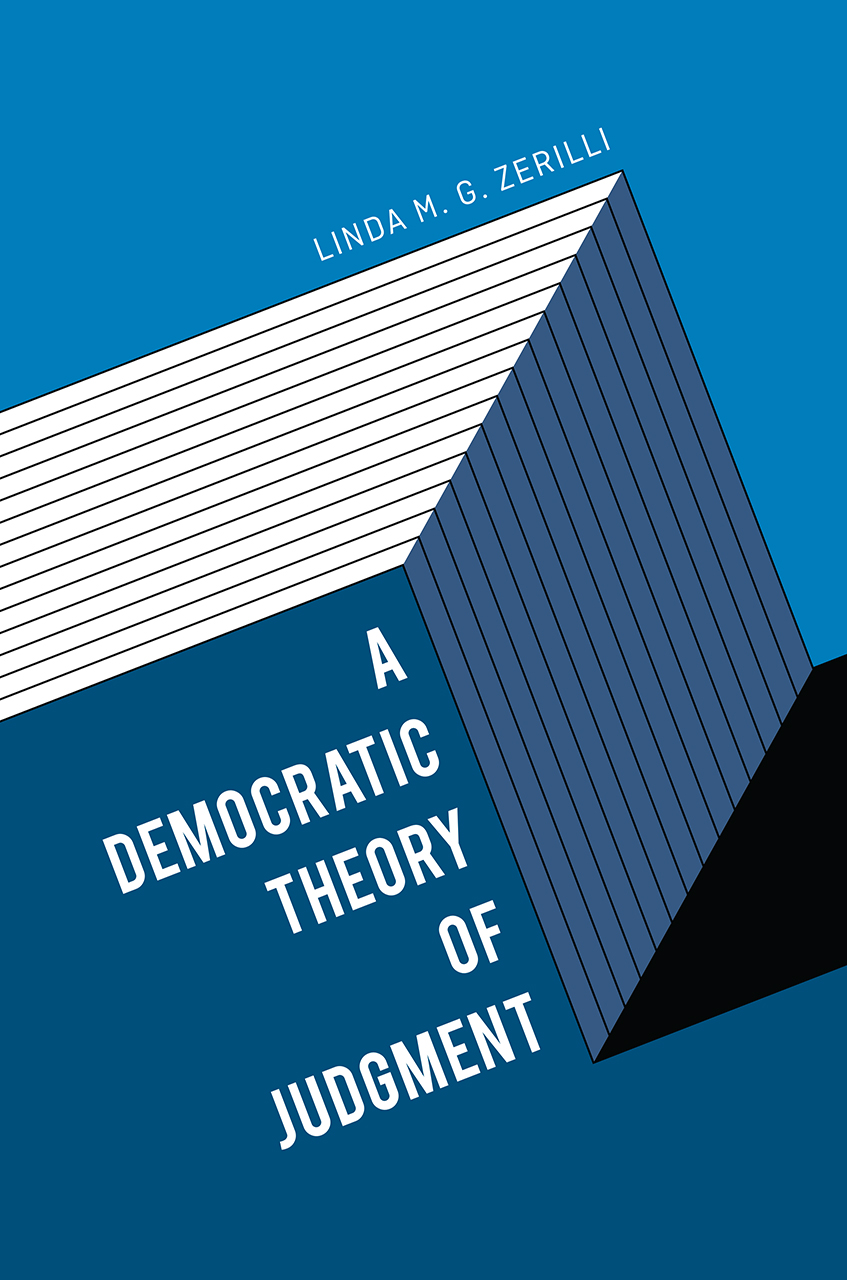
The Ascent of Affect came at the end of a year that I had begun by reading Linda Zerilli’s equally wonderful A Democratic Theory of Judgment, a work of political theorising not of genealogy, but one which also engages critically with the turn to affect in recent cultural and especially political theory. In her book, Zerilli takes my characterisation of the layer cake ontology of non-representational theory as pretty much capturing the essence of affect theory more generally, which is very flattering. The combination of an architectural vocabulary of levels with a vocabulary of temporal priority (all those feelings and inclinations kicking in before anyone is even conscious of it…) is the recurrent rhetorical feature of a whole genre of affect theory, and it connects it with a much broader cultural world of psychologised neuro-commentary (Jessica Pykett has recently elaborated on some of the implicit spatial assumptions one finds in popularised versions of neuroscience). It’s a feature that discloses what I would be inclined to call, ripping the phrase off from Gilbert Ryle, the logical geography of action that distinguishes this field – this theme is just now beginning to come clear for me as the focus of next book, now that the flurry of excitement associated with publication of the last one has died down.

Zerilli presents Ruth Leys and myself as providing two distinctive critical perspectives – as ‘affect theory critics’ – which again is flattering (I only ever wrote one paper and a couple of blogposts, whereas you can find the emerging outlines of Leys’ more recent sustained critique not only in her Critical Inquiry piece but also in those earlier books as well). Both Zerilli and Leys present me as accusing affect theorists of ‘cryptnoromativism’ – of not being able to able to defend their normative preferences with reasons because, as Zerilli puts it, for them reasons “always trail after affect-driven preferences”. Leys, on the other hand, sees the problem as an inability or unwillingness on behalf of advocates of the autonomy of affect to take any normative position at all – as she puts it in her new book, for affect theorists “preferring democracy to despotism is life preferring tea to coffee”. The stronger point she is making is that affect theory closes down any sense of disagreement as a dimension of life – it’s a theme developed much more explicitly in Todd Cronan’s critical account of the affective turn in aesthetics in Against Affective Formalism– where the recurring argument is that appeals to the causal power of affect have the effect of closing down any space not just of intentionality but also therefore of interpretation, and that herein lies the political unconscious of those appeals, registered in the erasure of any scope for legitimate disagreement or dispute. Leys uses my argument to specify her own point, suggesting that there is no a contradiction at all between avowing progressive causes and affirming the power of affective priming but a considerable degree of consistency precisely because the former are indeed taken to be mere personal preferences (strictly speaking, I don’t think I did rely on a sense of performative contradiction in my discussion of non-representational ontologies, which is not after all the same thing as cryptonormativism – I happen to think, more generally, that the real problem across these debates is the authoritative appeal to ‘ontology’ (or, ‘the made-up’, let’s call it) in a way that forecloses on the significance of normativity to life, which I think is a rather similar worry to Leys’ worry about the elision of intentionality).

The issue that Leys’ genealogy of disputes over the science of emotions – and especially over the validity of the affect program theory of basic emotions proposed by Sylvan Tomkins, the thinker championed by Eve Kofosky Segwick in the pivotal text in the turn to affect in the humanities – clarified for me is a key contrast, one that cascades through social theory and humanities debates about affect, between two quite distinct images of the social. Noncognitivst and anti-intentional interpretations of the emotions tend to hold to images of isolated monads, housing a brain, buffeted by external stimuli. The social here stands as an external, totalising environment (call it an ‘atmosophere’, perhaps?). It’s a very traditional image. Leys reconstructs  a counter-tradition that holds to a view of mindedness as contextual and ecological, and thereby has lots more to say about issues of intentionality. The difference might be captured by the shift in the meaning of ideas about unconscious mental activity which Leys mentions in  her book. The unconscious, in psychoanalysis, is a “dynamic-conflictual” concept, and it only makes any sense against a background assumption that subjectivity is intentional, just not wholly so. This idea is contrasted to a view of unconscious activities “as forms of automatic, nonconscious information processing occurring in computer-style subsystems capable of acting independently of the mind’s conscious control”. It is this second sense of ‘unconscious’, with or without the scientific references, that is the operative usage in arguments in GeographyLand and related fields which champion and/or bemoan the extent to which apparently wilful action is in fact influenced, primed and manipulated in all sorts of ways that are beyond the mind’s control.

The noncognitivist strand of scientific research on emotion, with an emphasis on the on the stark separation and hierarchical ordering of systems of knowing and feeling, clear divisions between insides and outsides, the emphasis on information processing and stimulus response, and its attachment to identifying sub-personal mechanisms, informs an imagination of the social reduced to monadic pre-individuals immersed in totalising atmospheres and subjected to triggers and impulses that wholly shape them. With or without the direct reference, the analogy between this reductive, if not necessarily eliminationist, scientific imagination of the social and the imagination found in humanities and social science fields absorbed by affect theory is, well, uncanny. (There is, I think an interesting line of questioning left unexplored by Leys about the degree to which the divisions within the sciences of emotions might be related to a discernible difference amongst advocates of the importance of affect between strongly anti-intentional advocates of the autonomy of affects, which tend to invest heavily in science as the source of insights into the ontology of affect, and versions of affect theory that redistribute the relations between knowing and feeling, reflecting and doing in more creative ways – the concern, for example, with issues of attachment in Lauren Berlant’s version of affect theory suggests a refashioned understanding of the aboutness of affective dynamics, rather than a wholesale rejection of intentionality).

Zerilli’s discussion of affect theory in political thought is actually rather wary of what she quite rightly identifies as the central emphasis of Leys’ critique – the problem of intentionality (recognition of this issue does not even arise in geographical discussions of these matters, beyond simplistic dismissals of ideas of intentionality and rationality as all a bit old-hat – a sign of the philosophical unseriousness of those discussions, one might suppose). I am tempted to locate Leys’ genealogy of research on emotions as part of a wider “nonsite school” of cultural criticism, since her work clearly shares a number of commitments with the broader project associated with that journal of which she is one of the founding editors – whose mission statement asserts a shared interest in “a set of theoretical topics – the ontology of the work of art, the question of intentionality, the ongoing appeal of different and sometimes competing materialisms – and in part out of opposition to the dominant accounts of those topics.” It should be said that the emphasis in much of the work associated with nonsite.org, in Cronan’s book already mentioned for example or in the work of Walter Benn Michaels, is primarily upon redeeming a certain sort of concept of artistic intentionality. I am personally not convinced that artistic practice provides the best paradigm for thinking about intentionality, and one of the important features of Leys’ book is that she locates issues of cognitivism, noncognitivism, and intentionality more squarely in a philosophical debates, centring in no small part on issues rehearsed in the ‘McDowell/Dreyfus debate’ a while ago now. This is rather more interesting, and more ordinary, ground upon which to locate discussions about the relations between embodiment and mindedness, the human and the nonhuman, rationality and intentionality.

Leys’ book raises important questions about the ways in which interdisciplinary work depends on the selective invocation of examples and on claims to speak authoritatively in one field on the basis of privileged grasp of settled knowledge in other fields. One of the central concerns of the nonsite.org ‘school’, if there is such a thing, is a focus on the implications for understandings of intentionality and interpretation of the automatism built into various artistic mediums – painting, photography, film, and so on. In one of those odd coincidences that make reading more than one thing at the same time fun, I was reading Leys’ book at the same time as I came across the cricket writer Christian Ryan’s Feeling is the Thing that Happens in 1000th of a Second, a book all about the photography of Patrick Eagar, and specifically the photos he took in the summer of 1975 (amongst other things, it’s a book that thematises the way in which photography might constitute the conditions for nostalgia – a subtext of Ryan’s story is that much of the cricket in that summer was actually a bit crap, and he presents 1975 as a cricketing year that mattered primarily because of Eagar’s photography, in all sorts of ways – a summer when “the photography of the ballet mattered more than the ballet”). Ryan’s book is all about the relationship between chance, luck, accidents and the skills and habits of the photographer, mediated by the automatisms of cameras and remote controls. Ryan’s book should be read alongside Gideon Haigh‘s Stroke of Genius, a book about Victor Trumper, but more precisely about the making and after-life of the single most famous cricket photo of them all – both tell stories about what we can learn about habitual, embodied skilled action (of the photographer as well as cricketers) from attending the process of its representation (OK, so that’s how I read them, not least ‘coz I was reading Leys’ book at the same time as reading Ryan’s, which reminded me of this dimension of Haigh’s book which was my Christmas book last year – and not least because Ley’s narrative of disagreements over the science of emotions revolves in part around a critique of the rather peculiar way in which photographs of facial expressions secure the authority of Paul Ekman’s influential research on basic emotions). And remembering the centrality of baseball to the McDowell/Dreyfus debate, it struck me that this particular coincidence is slightly less than wholly contingent on my own odd interests – one could do a lot worse than these two recent cricket books if one wants to be provoked to think more about the relationships between embodied skills, rule following, automatism, expertise, luck and the felt sense of what is doable and sayable that are at the centre of the scientific and philosophical debates that Leys dissects – there is, after all, no reason to take cricket any less seriously than the disputed fields of science that remain so attractive to certain strands of cultural and political theory. And these two books aren’t really about cricket anyway (books which are tend to be really boring) – they are about mediation, which might just be the concept that holds the key to moving beyond the dead-ends down which non-representational anti-intentionalism has led critical thought.


On The Priority of Injustice IV: Prolegomena to Democratic Inquiry

Last time I was reflecting on the central themes in The Priority of Injustice, I was discussing the contrast between action-oriented social theories and subject-centric interpretations of cultural and political theory and ‘Continental philosophy’. The final part of the book seeks to demonstrate the difference that cleaving more closely to the former strand of thought makes to a geographical programme of political inquiry. The subject-centric view of political life underwrites a form of spatial analysis focussed on closures and exclusions and the positioning of subjects in fields of meaning and affective force. The alternative perspective that I develop in Part 3 of the book revolves around the reconstruction of the principle of all affected interests in recent critical theories of democracy. And, related to this, it also involves a reorientation of a concern with democratic justice around the value of non-domination as distinct from fairness (i.e. it’s not straightforwardly liberal, although it does presume that one should take liberalism more seriously than has become the norm in radical theories of democracy).

In Part 3, this argument unfolds rather slowly, step-by-step, Chapter-by-Chapter, first with a discussion of the all affected interests idea (Chapter 6), then running this theme into a discussion of the centrality of the harm of domination in critical theory (Chapter 7), and then elaborating on how this in turn leads to a shared focus on ‘the priority of injustice’ across strands of critical theory and post-analytical political philosophy (Chapter 8).

The principle of all-affected interests – that anyone affected by a decision should have some say in its formulation – is a fairly intuitive aspect of the idea of democracy. Initially, it combines two aspects – one of being affected, but also of being able to exert agency, of being able to affect outcomes in some way. It is often discussed as a prescriptive norm of one sort or another; more interestingly, in the work of Ian Shapiro for example, it is used to develop an account of democratic inclusion that privileges relations of power over those of membership (Nancy Fraser also has a moment in which she uses it in this sense, although it is subsequently revised). The only problem with that view is that it lends itself to a view of affectedness as something that can be objectively determined by some form of causal analysis (which is why it might be very attractive to geographers, and is also why Fraser ends up moving away from it, on the grounds that it is an idea that supports ‘monological’ forms of reasoning). I suggest in Chapter 6, Claims of the Affected, that one can actually divide the first sense – of being affected – into two, a sense of having an interest in an issue in a kind of objective way, and a sense of taking an interest in an issue, in a sort of subjective way. It’s a distinction that is sometimes made in a prescriptive way (in Shapiro, I think, and also in Robert Goodin’s work on this theme), but sometimes embraced as opening up the idea of affectedness in more fun directions (by Bruno Latour, for example, but Robert Dahl got there first). So, I end up with a threefold heuristic distinguishing between being affected, being moved, and having agency – and then, I suggest that one can use this threefold account of affectedness to better appreciate the importance of Habermas’s translation of the principle of all affectedness into the terms of a theory of communicative action, and how various critics of Habermas further extend this translation in more explicitly contestatory and less rationalistically rationalist visions of democratic politics.

Oh, and all of this is framed by an argument against the presumptive “methodological globalism” of critical theories of democracy (i.e. their suspicion of local, emplaced, bounded, nationalised forms of political life). I close this chapter by suggesting that the threefold version of affectedness maps roughly onto three questions one can ask about the spatial registers of political action – questions about how spatial relations generate issues, serve as mediums for their apprehension as issues, and as potential vectors for effective agency, or not as the case may be (that’s an argument that I have made elsewhere at greater length than I do in this book – here and here, for example).

With what I am sure is a seamless segue, the argument then moves onto Chapter 7, Subjects of Domination, which works back over the theme of all affectedness to tease out the centrality of the harm of domination to recent critical theories of democracy – the discussion centres in particular on Iris Marion Young, my favourite thinker ever, as well as Nancy Fraser, and with a nod to Philip Pettit (not quite perhaps of this same tradition, but an important reference point for it). One thing to underscore about the concern with centring discussions of democratic justice on the issue of domination – of the arbitrary subjection to the will of others – is that it marks a decisive difference separating critical theories of democracy from liberal theories of democracy. Now, I’m quite fond of liberalism, of certain sorts, but of course in TheoryLand it’s a knock-down target – too individualistic, too rationalistic, too universalizing, not radical enough, and so on and so on. In terms of the discussion in this chapter of my book, since it is moving towards an elaboration of the theme of injustice, the pertinent point about egalitarian liberal theories of justice is that they prioritize the value of fairness, in terms of what one is due, of just deserts, fair shares. That’s not a principle to be lightly dismissed, of course. But from the critical theory perspective, the emphasis is not on fairness but upon matters of arbitrary rule – of how one is treated (the distinction is important, for example, for appreciating why Habermas isn’t properly characterised when labelled as a liberal; not that there’s any shame in being one of those, of course). And this matters because it recasts how geography enters into the critical theory imagination of democracy – here, James Bohman’s work is exemplary, because he elaborates on a sense of distanciated and distributed spatial relations as mediums through which people are exposed to to subjection to arbitrary rule by others, or, they are made vulnerable to domination.

Somewhere in all of that, I think I am trying to gesture at a difference between two ways of thinking about “why relationality matters politically”. Thinking of the strung-out relational constitution of social life is not interesting, politically, because it’s a way of telling moral stories about the constitution of identities through disavowal or by revealing the fact of being bound into other people’s actions without knowing it. It is interesting for a much more serious reason, but also perhaps a less all-encompassing one, related to questions of agency and consent and domination (again, Young is the best guide here).

Having got this far – having re-cast the idea of all affectedness and then related it to the value of non-domination, the story moves on to Chapter 8, The Sense of Injustice, in which the theme of the priority of injustice is explicitly elaborated. This theme kind of crept up on me as I was writing the book in 2015. And I’m still trying to work out quite what it involves. The idea as I present it in this Chapter has various sources, perhaps most importantly Judith Shklar’s book The Faces of Injustice, but also Elizabeth Wolgast, and some similar looking ideas in Hannah Pitkin and Cora Diamond, as well as a more systematic consideration by Thomas Simon in Democracy and Social Injustice. There is something vaguely ordinary linking this strand of reflection on the theme. I link this strand of thought to another strand, coming out of critical theory, especially Axel Honneth – and through back him to Barrington Moore, Jr. – and also Rainer Forst. And then, thirdly, a strand of thought which is basically Amartya Sen, most explicitly in his The Idea of Justice. Finally, Miranda Fricker’s Epistemic Injustice, another book that starts off from Shklar’s provocation, and which is a really interesting combination of analytical political philosophy and strands of poststructuralist feminist theory.

That may or may not seem like a random collection of thinkers, but I think it is actually quite tightly drawn together around a shared prioritization of the sense of injustice as the dynamic of democratization. The argument for the priority of injustice, or at least my grasp of it, goes something like this:

  • First, determinations of injustice can and are made independently of a prior theory of justice (or, to put it another way, you don’t need a universal theory of justice to make judgments about the injustice of a situation).
  • Second, this follows from the fact that injustice has its own texture, a phenomenology of its own (though not a singular one, for sure) – it is not simply a function of the absence of justice or the failure of some party to act justly. Injustice is better understood on the analogy of health and disease (a thought that first came to me at the suggestion of Jouni Häkli on one of the early occasions when I tried to talk about all of this) – illness is not an absence of health, it is a positive condition – diseases have causes and conditions all of their own. One has a cold, or catches the flu.
  • Thirdly, injustice is felt (rather than rationally apprehended by reference to principles) – there are different versions of this argument, in Shklar, Moore, Honneth and others. One implication is that negative feelings – anger, revenge – might be important animating passions of struggles against injustice. But this also has implications for how one imagines the possibility of developing a democratic methodology of the sort implied by Shklar’s argument that the expressions by victims of injustice should be accorded a privilege of some sort (I try to outline some of those implications in the ‘supplementary’ paper on Geography and the priority of injustice).

There’s a lot more to say about this whole theme – it’s a long chapter! One thing that follows from it is that we would do well to not think that justice is an ideal, without thinking the smart thing that follows from that observation is that it is a mere illusion. Justice is done as a response or remedy to some harm or other – it is not a pure phenomenon poorly realised, it is a mark both of an imperfect world and of the possibility of betterment. Which is a thought that might route us back to the theme of the ‘ethnographic emergence’ of the meaning of normative values that was discussed earlier in the book – in given contexts, the meanings of justice, for example, will bear the historical traces of specific harms and compromises, and it might be worth exploring the consequences of that fact.

Another issue that arises from all this is the proposition that injustice is a public phenomenon, related to an argument about the double sense in which claims-making is made central to the recognition and redress of injustices: claims as assertions made against a certain state of affairs and addressed to others, and assertions as acts which need to be processed in some sense or other. That’s a theme I need to develop further and the full implications of which require deeper analysis – not least, I think because it might be key to avoiding what I can see might well be a potential trap for any injustice-centred account of political life, an issue identified in Samuel Moyn’s genealogy of the rise of the politics of human rights since the 1970s. One of the Moyn’s suggestions is that the rise of human rights as an alternative global activist imagination and associated ascendancy ideals of human dignity embedded in human rights campaigning, in law, and in political philosophy involves a redefinition of the relations between morality and politics “around the worst than can transpire in history, rather than some better order that could be achieved through political contest and struggle” (see Moyn, S. 2014. Human Rights and the Uses of History. London, Verso, p. 33). One challenge of developing an injustice framework is, then, to work through how to avoid this problem of settling, as it were, for trying to avoid the worst rather than striving towards doing things better. But that might be for another book.

Anyway, so that is the narrative sequence of Part 3 of The Priority of Injustice, and it makes perfect sense in my head – reconstructing the theoretical significance of the theme of affectedness in democratic theory (Chapter 6), opening this out to a consideration of the specific form of harm, domination, made central in critical theories of democracy (Chapter 7), and then drawing these two strands together by teasing out the shared emphasis on the priority of injustice in what might appear to be disparate traditions of political thought (Chapter 8).

Now the book is finished, I have to decide what to do next with this whole argument.


On The Priority of Injustice III: Changing the Subject:

The third theme that I have noticed running through The Priority of Injustice in my own re-read through of the whole thing follows on from the themes of ‘spatial grammar’ and the imperative of not seeking to correct other people’s flawed ontologies that I have already mentioned. I have come to view with deep distrust views of the task of Theory as a means of laying bare the aesthetic or affective or cognitive devices that reproduce people’s subjection. The idea that ‘people have been got at’, as Alan Sinfield once put it, is a recurring theme of a great deal of contemporary critical thought, especially when influenced by traditions of ideology critique – an influence that can be traced from theories of ideological state apparatuses through ideas about discourse and representation through to current fascinations with affect and atmospheres and algorithms. Across this range, the idea that politics – both of the sort one doesn’t approve and of the sort one hopes to support – works through changing the subject is a constant.

My interest in the theme of the ordinary is in no small part shaped by an effort to find a way of thinking that escapes the scholastic frame of reference that underwrites the ‘changing the subject’ paradigm. The ordinary is a theme that one can find in various thinkers – in Raymond Williams or Charles Taylor, for example, it is used as a counterpart to ideas of the privileged or the elect qualities of culture. This sense does have some presence in the more specific, but also somewhat elusive, sense of the ordinary that is indebted to Stanley Cavell’s work, elaborated, for example, in the writings of Veena Das. Ordinariness, in a Cavellian spirit, is a matter of affirming that the experience of the distance between the given and the possible is not an extraordinary one – it does not require a crisis, or a rupture, or some disruption of routine for this distance to be felt or apprehended. One reason that this affirmation is important, in relation to theories of subjectivity and subjectification, is that it throws into new relief the interpretation of contingency, whether of meaning or identity. The trick of being able to see all settled or inherited patterns of meaning as arbitrary (and interpreting arbitrariness as basically the same as ‘changeable’) easily leads to a scholastic temptation, as defined by Pierre Bourdieu, of projecting back onto practices under investigation the distance (social and analytical) that enables them to be objectified in the first place, and then transposing the revealed distance between the theoretical possibility of change and practical acceptance into a theory of power (i.e. power works by fixing and naturalising what are in fact fluid and contingent relations). Invoking Cavell, I would argue that this whole way of thinking misplaces “the vulnerability to doubt” that is one of his phrases for the ordinary, by failing to see that skepticism is a constant standing possibility of life, or, as I put it in the book, by not accepting the fact “that the world as we know it is not all that it may seem is an ever-present condition of action”.

Reflecting on all this as I have re-read my own book has made me think that there is actually a really interesting shift evident in the way in which change is figured in social theory over the last couple of decades (a shift that is really a line of important division, not a succession from one way of thinking to another). Explaining social change is, of course, a fairly basic concern of all sorts of social science, and usually involves some genre or another in which action is placed within a broader frame of context, or conditions, or constraint. Various traditions of thought, from the historicism of Weberian sociology to dialectically informed Marxism to theories of resilience, all tend to take it for granted that change is an intrinsic feature of social life – what’s a stake is how it is manifested. But with the ascendancy of subject-centred theories, under the sway of poststructuralist theories and the turn to ontology in particular, one can see the emergence of a different interpretation of change. In these strands of thought – whether it in theories of hegemony or of the distribution of the sensible or ontological politics or assemblage – it is presumed that the task of theory is to account for the stabilisation, ordering, or fixing of life into patterns of serial reproducibility. Change, in these accounts, is extraordinary – the objective is to establish theoretically the very possibility of change itself.

The difference here – between thinking of change as an ordinary feature of life that is manifested in various ways, or thinking of change as a rare event that interrupts orderly routines and stable patterns – seems to me now to be quite central to the contrast that I work through in The Priority of Injustice between action-oriented styles of social theory and subject-centric theories (which would include theories that remain fixated on demonstrating the illusory qualities of ‘the subject’). The latter traditions of thought are strongly attached to images of change as a punctual event – the echoes of classical ideas of revolution remain clear – that disrupts otherwise settled, more or less fixed habits. In the book, I suggest that this range of theory shares in an “unexamined idea of time: political time consists of a kind of punctuated equilibrium, where moments of dramatic and wholesale transformation of entire fields of action interrupt periods of durable and predictable routine.”

The set of relations between concepts of subjectivity-as-subjectification, ontologies of order, and images of change is in turn related to a remarkably resilient, shall we say, notion of the tasks of critique, understood primarily as a practice of denaturalization of apparently naturalized phenomenon – of demonstrating the theoretical possibility of the change-abilty of practices that are, apparently, lived and experienced as eternal and inevitable (the assumption that this is how life is ordinarily lived and experienced is, to reiterate, best thought of as a necessary projection of the methodological protocols derived from ontologized theories of subjectification).

The difference between action-oriented theories and subject-centric ones is partly related, in my discussion, to different attitudes to what Maeve Cooke calls “the justificatory dilemma” facing any avowedly critical theory, referring to the responsibility to justify that existing relationships both can and should be changed. To cut a long story short, subject-centric theories tend either to elide the problem of validity (justifying the vision of alternative futures that underwrites critique) into demonstrations of the plausibility of change, or, if more honest, they elevate openness to change and defamiliarization as the highest normative aspiration available to us (as the very essence of democracy, for example). The difference between these two styles of theory is the central narrative device in The Priority of Injustice – in particular, I use a simple contrast made by Axel Honneth to organize my discussion and evaluation of various strands of democratic theory. Honneth suggests that there are two broad paths out of what he calls the ‘productionist paradigm’ of critical theory (i.e. classical Marxism), in which substitutes for the lost faith in the universalizing agency of the industrial proletariat are found either in more pluralised accounts of rationalities of action (i.e. there’s more to life than labour), or in the search for deep ontological sources of the principle of negativity once invested in the working class (i.e. in antagonism, in abundance, lack, or even more perfectly, in the very gaps and fissures of ontological difference itself).

As you can probably tell, I am drawn towards the action-oriented strands of thought that Honneth points towards, and this informs my attempt to redeem something of value from the increasingly predictable literature on ‘the political’. If there is something distinctive that defines ‘the political’, then it’s not found in some irreducible force of antagonism, or in us/them relations, or in the ever present fact of violence. I commend Mary Dietz’s argument that what defines politics is an irreducible dimension of strategic action – this Machiavellian perspective helps us see that Foucault is the exemplary theorist of politics for our times, because Foucault is fascinated by strategic forms of action (that’s what Habermas and other similar thinkers haven’t liked about his work, and this dislike is what helps us see Foucault as first and foremost a theorist of action rather than ‘power’ -or, that what’s interesting about what he has to say about ‘power’ is the parts which are couched in the vocabulary of action). And all of this just means that rather than thinking of the distinction between politics and the political on the layer-cake analogy derived from political readings of Heidegger, it’s best thought of as directing our attention to the analysis of the different ratios between action and its conditions (that’s a reference to Kenneth Burke that I don’t make in The Priority of Injustice, but which I am thinking of developing properly in my next book).

Another thing to say about all of this is that the contrast between overly ontological readings of ‘the political’ and more ‘phenomenological’ versions that I prefer almost, but not quite exactly, maps directly onto the related contrast between realist/disassociative interpretations of the political and idealist/associative interpretations – my claim is that the significant choice is not between a grim and realist view of politics versus a rosier, more collective view; it’s between more social-theoretical traditions of action theory versus more culturalist-philosophical styles of subject-centric thought.

This argument about concepts of action and the subject is important because it goes to the central issue of how to understand democracy as a mode of the sharing of rule. There are different images of ‘sharing’ available to us, after all – it can be understood in terms of the singular will of all, or on the model of naturalistic consensus found in anarchism, or of being duped into acceding to rule by identifying with available distributions of the seeable and sayable, or, if you prefer, in terms of being bound to respect decisions to which one was at least in some respect a party. Subject-centric views of political life tend to rely on rather wooly ideas about consensus – consensus tends to be used to refer to any and all occasions in which action can be shown to accord to or attune with various background conditions, so that it isn’t even the name for a process of agreement. The relevant value in democratic theory isn’t really consensus anyway (not even in old uncle Habermas), it’s consent, which isn’t the same thing – consent has to be sought or won, and is almost certainly always grudging anyway, but the importance of holding this contrast open – between straw-figures of consensus and ideas of consent – is that it roots us back towards the importance of analysing the relations between ‘the politics of power’ and ‘the politics of support’ (I discuss all of that in Chapter 4 of the book, The Scandal of Consent, in which the dividing line between action-oriented theories and subject-centric theories is located within broadly poststructuralist strands of thought, so that Stuart Hall and Partha Chatterjee are shown to be much better guides to the dynamics of democratic politics than Laclau and Mouffe or Ranciere).

There is a geographical dimension to this strand of my argument too, in case you were wondering. A chain of associations derived from the subject-centric strand of thought has come to define a veritable paradigm of spatial politics in human geography, urban studies, and related fields:

  • the image of political time that contrasts images of settlement and order with moments of interruption and rupture lends itself to a view of proper politics as best exemplified by dramatic disruptions in and of public space;
  • it underwrites the view that proper politics inhabits margins and fissures, offset against mainstreams and the status quo;
  • it is closely associated, as we have seen, with a view of critique as a process of defamiliarization;
  • and it supports and is supported by understandings of how people’s subjectivities are functional effects of mediated systems of malevolent power.

Here then, the long shadow of Althusser’s notion of interpellation is still evident – it is the master-metaphor that one so often still finds governing the political interpretation of all sorts of other theory or theorists, all the way from Foucault to psychoanalysis and various points between. This combination of associations finds expression in an explicitly spatial model of politics as changing-the-subject:

  • subjects are formed, in this paradigm, by being ‘enframed’, by being set-in-place (before a painting, a chain of signifiers, a field of perception, a structure of address, or just immersed in an atmosphere);
  • throw in an orthodox interpretation of the relational formation of subjectivity, in which any collective identity as ‘We’ is constitutively posited against an abjected ‘Them’ (an interpretation of favoured sources that is just wrong), so that subject-formation appears as form of exclusionary territorialization;
  • and you arrive at a framework for analysing any and all practices as scenes for the reproduction of various exclusions and/or always potential sites for the creative reconfiguration of the imaginary identifications before which people remain, in the last instance (as they say), necessarily enthralled.

That, then, is what I am trying to work through, particularly in Part 2 of The Priority of Injustice, although these themes run across the whole thing. As I say, the contrast between action-oriented and subject-centric theories, which you may or may not find too stylized for your own tastes, captures for me something important that allows me to differentiate between strands of thought often bundled together in discussions of poststructuralism, or Continental philosophy, or political ontology – basically, I use this distinction to peel off various thinkers from that broad grouping, and draw them closer to strands of thought working a Habermasian vein with which they are normally not be associated. But I’ll say a little more about that re-arrangement next time.

On The Priority of Injustice II: Two Cheers for Structural Analysis:

I have already admitted that I love the cover of The Priority of Injustice, but I should also say that I am delighted to have a book about democracy that is actually published in Athens, and not Athens in Greece, but Athens in Georgia – a place that resonates in different ways for me, as the home of the B52s and REM of course, but also where my sister’s dog Betty Boop was bionically reconstructed and where I spent the oddest Valentine’s Day of my life and where I once bought an original copy of the Warren Commission Report for $1.

The associations with particular places that this admittedly rather abstract book has for me brings us to another theme running through The Priority of Injustice which I need to remember and affirm, namely the degree to which the value of universality depends upon rather than being ruined by the acknowledgement of the situated qualities of life. Now, universality is one of the most denigrated terms of contemporary TheoryLand. One of the presumptions of my book is that academic fields which spatial theorists are often rather sniffy about – thought of as suffering from ‘anaemic’ spatial imaginations – might be sources of smarter styles of geographical analysis than is acknowledged. They might, for example, be much better at thinking carefully about the difference between universality and generality, or between particularity and specificity, than traditions of critical spatial theory, which tend too often to think that critiques of universalism in philosophy, for example, pertain primarily to the problem of whether certain concepts, ideas or principles can be applied everywhere.

I suggest in the book that discussions of universalism need to more carefully distinguish between a sense of universality as referring to an ambition to impartiality and a sense of universality as animating spirit of claims for inclusion (an argument drawn from, amongst others, Seyla Benhabib and Carol Gould). Part of the point of making the distinction is because it draws into view the variety of ‘genres of reasoning’ through which universality is articulated in passionate, partial registers. This argument is linked to an elaboration of the revised idea of ‘criteria’ to be found in Stanley Cavell’s work – where they are understood not as principles under which phenomena are placed and evaluated, but as means of ‘going on’ in new situations. The broader significance of this view of criteria is that it underscores how the proposition that ‘meaning is use’ is best understood as taking on its full force by reference to the idea that meanings change as they are applied to new situations. I discuss all of this in Chapter 2 of the book, Criteria for Democratic Inquiry, which covers, amongst other things, Hannah Arendt and Derrida on exemplary thinking and judgment as well as Cavell on criteria and Gallie on essentially contested concepts, all in order to outline what I take to be the notably geographical problem of how to understand democracy’s translability across different contexts (a problem that is actually neatly resolved by Charles Tilly in the best ever extended analogy between lakes and political life you will ever come across). Thinking of the meaning/use relation in terms of application – thinking that using concepts is precisely about using them in new situations – is also a way of underscoring the sense of the ordinariness of political concepts that I try to elaborate in the book, in so far as the theme of the ordinary in Cavell especially directs us to a sense in which newness is not a dramatic rupture from settled patterns, nor an extraordinary departure from established norms, but just a matter of ‘moves in new directions from what we have done before’ (to paraphrase Cora Diamond) in the course of ‘going on’ with action (to refer back to Cavell).

In the second half of the same chapter, via that analogy from Tilly, I link the philosophical account of the ordinariness of democracy as a concept to some more social scientific work that treats democracy in the same spirit – as ‘enacted’ in various forms and as ‘ethnographically emergent’, again stealing ideas from others (Mike Saward and Julia Paley respectively) – my book is as much a paean to my own favourite thinkers as anything else; it’s the work of a fan.

I use this line of argument to recommend a remarkably simple idea, culled from Albert Hirschman’s work on the lessons to learn from post-war modernization programmes (a precursor to his more famous account of the importance of analysing different combinations of exit/voice/loyalty to understand the dynamics of organizational fields). Hirschman suggested that one look into the “structural characteristics” of different projects, by which he meant the forms of leverage and the limits and path dependencies that determine the degree of what he calls “latitude” and “discipline” imposed by situations on the scope of discretion available to participants (this is all part of a more famous story about the “hiding hand” and why ‘development’ does not require preconditions already to be in place). The point of all this, in my book, is to suggest that political analysis should avoid presuming in advance that the causes behind observed conflicts are self-evident, by falling into the trap of  theoreticism, again, in which one always already knows in advance that expressions of discontent are indices of some ‘underlying’ structural cause (‘neoliberalism’, etc., etc., etc.). That sense of ‘structural’, the one that comes so easily to forms of critical analysis, might well underplay what Bernard Williams called “the significance of conflict”, which directs attention not only to an appreciation of causes and conditions but also to what conflicts mean to those involved, from the inside.

The concern with ‘structural characteristics’ in Hirschman is, then, a matter of demonstrating a certain sort of contextual sensitivity to the qualities, one might say (in order not to say ‘materialities’), of situations without lapsing into particularism.

And all of this, in Chapter 2, is then a precursor to the argument presented in a later chapter, Chapter 5 (The Significance of Conflict), when Hirschman returns, alongside Jon Elster and Helmut Dubiel, to help me outline a much more ordinary way of thinking about the much vaunted ‘irreducibility’ of contestation and antagonism in political life (who, after all, doesn’t recognize that?). My argument there is that rather than wallow in the odd worlds of ontological layerings and becomings, it might be more productive to follow a path of analysis focussed on making sense of ‘rationalities of action’, suggesting here that a series of conceptual distinctions found in various strands of thought – between distribution and recognition (Honneth, Fraser, Tully, etc.), or communicative and strategic action (Habermas), class and status (Fraser, again), arguing and bargaining (Elster, and Hirschmann, and Dubiel), perhaps convincing and persuading too (Habermas, and Rorty, and Diamond, etc.) – are best understood as aspects of any and all forms of action which can be combined in different ways (again, this is meant as a kind of heuristic redemption of ideas often taken in too categorical a way even when they are not explicitly ontologized). And all of this – this whole way of working out a sense of why looking at the ‘structural characteristics’ of situations might be important – is meant to culminate in the recommendation that one dimension (one of three) of a geographical analysis of political life would involve the diagnostic investigation of “the types of influence to which particular patterns of the exercise of power are susceptible”.

The distinction between thinking of ‘structural’ in terms of a contrast between the contingently observed and real causality, or, by contrast, in terms of a sensitivity to the latitudes and disciplines characteristic of situations, is crucial to differentiating between two models of ‘critique’ (another running theme of this book). In one, being critical is all about revealing that ‘power’ always lies behind observable phenomena, in a kind of debunking manoeuvre (this is far and away the most taken-for-granted understanding of the critical vocation in self-consciously ‘critical’ social and cultural analysis). In the other, being critical is simply a matter of clarifying the pressures and limits that orient possibilities of action in particular situations (which means that people who write drama might be better guides to the art of criticism than theorists trained in the skills of deducing the effects of cultural works).

From this second perspective, an operative concept of structure is a basic requirement of any form of social science analysis, however reluctant people might be to use the idea of structure itself (here is Roberto Unger explaining why). This relates back to an issue I touched upon last time, concerning the degree to which debates about the meaning of the distinction between politics and the political turn on the interpretation of the relationship between observed actions and their conditions.

Iris Marion Young, one of the stars of The Priority of Injustice, once made the point straightforwardly enough, pointing out that a ‘structural’ form of analysis is concerned with identifying the factors that position people in relationships that in turn help to shape their understandings, their capacities, their desires (on this reading, structure is a concept of possibility, not of necessity – that’s Unger’s point too). Young’s point is that ‘structural’ analysis is a characteristic of a certain sort of genre, a particular type of story. And this view of structure goes back to E.P. Thompson’s polemical revision of the notion of determination as ‘the setting of limits’ and ‘the exerting of pressures’ on action, an idea that is now finding a new life, mediated via the recovery of Raymond Williams’ allusive notion of “structures of feeling”, in non-representational theories of affect and atmosphere. Which just goes to show how that basic intuition about the structuring of action is not abandoned in avowedly post-structuralist theories – it’s just sublimated into ontological narratives of being and becoming, or suturing, or undecidability, or magmas of signification, and so on (that is, sublimated into the search for THE source of negativity or excess that allows one to posit the certainty of the possibility of change), as well as into the general fascination with functionalist accounts of how ‘subjects’ are made and re-made in all sorts of ways by forces that lie beyond them. More on that topic next time.

On The Priority of Injustice I: Arguing with Theory

It’s a funny experience, publishing a book – something that one has lived and worked with for perhaps years and invested all sorts of energies into finally comes out, and there is an odd sense of anti-climax (it’s a lot like finishing a PhD). But it’s also odd to actually read one’s own book in proper book form, bound and beautiful, even though The Priority of Injustice is pretty much the only thing I have been reading since at least the summer of 2015. There is a kind of terror involved (what does it read like?), but also a nice experience of affirmation, as you notice that there is maybe something coherent running through the whole thing (although maybe you have to have been reading, writing and editing it for more than two years to actually notice this). So, I have now read my own book, again, cover to cover, and annotated it in detail (but only in pencil…).  At some point in the future, certainly next Spring, I will have to talk about the arguments in the book, so I am going to take the liberty of writing a few short posts over the next little while in which I am going to say out loud, to myself at least, what some of the main themes of the book are, as a kind of mnenonic practice.

The first of the themes which are central to the overall arc of the book which I want to remind myself of is that of ‘arguing with theory’.

The Priority of Injustice is a book about theory, in the sense that, as I have previously mentioned, was once used by Talcott Parsons – it treats ideas as an archive of documents that “present problems of understanding and interpretation”. But I also try to move away from an idea of Theory as a kind of standing body of ideas that one is meant to display mastery over (some hope), and instead actually try out my hand at theorizing. I realise that that immediately sounds perhaps even more pompous than the idea of mastering other people’s ideas (if it is taken as developing a whole raft of new concepts all of one’s own), but it seems to me a more appropriate, and modest ambition. (There are a couple of things I have read since writing The Priority of Injustice that express very clearly the idea of theorizing I am working towards in the book, Richard Swedberg’s The Art of Social Theory and John Levi Martin’s Thinking Through Theory – I mention them here not least to underscore another aspect of the argument I am making in the book, which is that a social theory imagination involves a different, less theoreticist style of reasoning than the sorts shared by convergent traditions of political theory and cultural theory).

There are two related senses in which I think of what I am doing in this book as theorizing.

First, I outline an approach to reading for the “spatial grammar” of different traditions of political thought, which is meant to contrast to a taken-for-granted approach in critical spatial disciplines such as human geography or urban theory of correcting the bad ontological assumptions of traditions of thought found to be inadequately attuned to 40 years worth of thinking about relational spatiality (a habit that extends to a standard style of critique of the spatial ontologies of policy-makers or journalists or corporations or one’s fellow citizens). Reading for the spatial grammar of theories is directed by a principle of charity, to borrow an idea from Donald Davidson, that is, of trying to maximise understanding across what might appear to be incommensurable vocabularies. The notion of grammar, then, in this formulation is meant to direct analytical attention “to the actions being performed in the use of words and concepts”, so that when one comes across thinkers making use of spatial and temporal concepts then the primary concern should be to take seriously “what is really at stake in their expression”. This first sense of theorizing at work in the book is related to a broader argument, developed in the first two chapters, about thinking of the meaning of normative concepts like democracy not by reference to etymological derivation but with reference to their use in new situations.

This ordinary way of thinking about concepts is linked to the second sense of theorizing in the book. It’s an approach that I seek to apply more fully in the three chapters of Part 3 of the book, in which I argue that the geographical turn in deliberative theories of democracy associated with discussions of topics like cosmopolitanism, global justice, or transnationalism is best interpreted as an occasion for a repeated disaggregation of the component parts of key principles, such as freedom, or equality, or participation. The point of developing this argument is to cash-out the suggestion I make at the start of the book, that we should think of ‘theory’ as something that “helps to direct our curiosity to issues that deserve further attention”. It leads me to recommend a heuristic notion of critical theory, borrowing this time from Andrew Abbott, where the aim of theorizing is to develop concepts “that help to orient new pathways to findings things out” – again, the contrast is meant to be with approaches to theorizing that develop models of what counts as proper politics or ideal democracy against which emergent forms always come up short. In Part 2 of the book, I elaborate this heuristic approach to the interpretation of concepts in order to to distinguish between different accounts of the distinction between ‘politics’ and ‘the political’. In what has become the standard interpretation of this distinction, the simple observation that action has conditions is transformed into strong claims about the apparent paradox that necessarily contingent foundations will always be prone to immanent forces of disruption. I suggest that the real value of the politics/the political distinction lies in the rather more prosaic task of helping “to open up new ways of investigating the conditions of political action”. It’s this version of the distinction that I then develop further in the reconstruction of the all-affected interests idea in Part 3 of the book, which I present not as a prescriptive rule for determining the scope of democratic inclusion or the form of rule, but as a guide to the analysis of the geographies of claims-making.

It’s these two related ways of theorizing – I call them ordinary in places, heuristic in others, depending on the philosophical inflection in play at that moment – that I have in mind when I claim, towards the end of the book, that The Priority of Injustice is meant as “kind of prolegomena to democratic inquiry in a geographical sprit” – as I’ve said before, I think of this book as a kind of space-clearing exercise, as an attempt to clarify problems and issues which requite further investigation.