
Here is a really interesting analysis of the participants and supporters in the Occupy movement, by Ruth Milkman, Stephanie Luce and Penny Lewis, providing both sociological and historical context: Changing the Subject: A Bottom-Up Account of Occupy Wall Street in New York City.
Category Archives: Politics
Neoliberalism as radical political economy
 In the intellectual world I grew up in and to a large extent still inhabit, the phrase ‘political economy’ is often just another way of saying ‘Marxism’. I’m not sure if it’s ‘ironic’ that this tradition of work has come to be so focussed on the conceptual object ‘dubbed’ neoliberalism, which is theorised as the real world realization of ideas emanating from the post-WW2 revival of ‘political economy’ of a different sort. The status of neoliberal ideas as variants of political economy is often overlooked, primarily because of the investments in simple state/market dualisms that shape critical conceptualizations of neoliberalization.
One of the founding figures of contemporary political economy is James Buchanan, who died last week. Buchanan is one of the unsung heroes/villains of neoliberalism, if there is such a thing – above all through helping to invent public choice theory, a framework for applying certain sorts of economic ideas to the analysis of state actors, bureaucracies, and other organisations. More broadly, Buchanan illustrates the degree to which ideas about the rule of law, constitutionalism, rule-following, and the like provide a positive theory of the state and the public realm rather than simply a straightforward preference for the market over the state (like other thinkers associated with the canon of neoliberal ideas, perhaps with the exception of Richard Posner, Buchanan took the financial crisis of the last five years as largely confirming his own views). Buchanan is as good a place as any to start the task of understanding how states and markets have been reconfigured around new models of public value, rather than by a straightforward shift simply from good public values to bad private ones. Stephen Collier has elaborated on Buchanan’s importance as a ‘minor’ figure in the genealogy of neoliberal practice, in ways which suggest a need to rethink the conventional framework for the critical analysis of neoliberalism more generally.
Buchanan is famous for the line about thinking about ‘politics without romance‘, which rapidly devolved into a deeply cynical view of public actors as rent-seeking parasites. It’s interesting to read the appreciations of Buchanan in places like the FT, The Economist, Wall Street Journal, Forbes, Bloomberg News, The Daily Telegraph over the last week – you can glean a sense of how public choice theory supports a certain sort of right-wing insurgent self-image, speaking in the name of democratic choice (as revealed preference) against the usurping inclinations of elites. It reminded me of the argument made by John Dryzek some time ago now, in which he argued that public choice theory did indeed share some important affinities with Frankfurt School-style critical theory.
Appreciating Buchanan’s work is important not least because, whisper it, belonging as it does to a tradition of thought that is embedded in particular understandings of democracy, it does address difficult issues of collective action, institutional design, and accountability that conventional left social theory struggles with, oscillating as it does between proto-anarchistic suspicion of ‘the state’ and nostalgia for stale social democratic settlements of the public good. Disentangling and differentiating accounts of ‘rationality’ might be an imperative to rethinking the democratic potentials of emergent forms of contemporary public action – and being able to tell the different in the political valence between Buchanan, say, and Mancur Olson, or Kenneth Arrow, or Amartya Sen, or Jon Elster, or Elinor Ostrom, seems an important task along this road (the differences turn on the degree to which theories are able to account for the rationalities of co-operation as something more than merely aggregation or secondary). Not all styles of rational choice theory are equally pathological, perhaps.
Is cultural activity really epistemological struggle?
 I spent a few days in Liverpool over the Christmas break, and while there I tried to take advantage of being in a Capital of Culture, as was. The main attraction was an exhibition at the Bluecoat of prints by William Kentridge, The Universal Archive. This solo exhibition provided an interesting contrast to my last proper High Culture experience, back in Oct/Nov, during my trip to Bloemfontein. Bloem’ has great art gallery, it turns out, the Oliewenhuis. They had an exhibition People, Prints and Process, of various print-based art works produced by artists associated with the Caversham Centre with which Kentridge is closely involved. This exhibition contained one or two pieces by Kentridge, but alongside the work of lots of the artists using print as their medium. The prints in the show currently in Liverpool (it’s moving on soon I think) are actually slightly out of context, in a sense – they are of course rather static, but bring to mind the more animated works by Kentridge for which they often seem to serve as templates or testing grounds, or perhaps, traces (this exhibition didn’t have any of his films on show – not necessarily a bad thing – I always find it really difficult to watch arty film in a gallery space).
It was interesting to see these two exhibitions in close succession – in the exhibition at the Oliewenhuis, Kentridge is one almost a bunch of other South African artists, and the sense of print as a distinctively African medium was to the forefront – as well as how print is a vernacular, mass medium rooted in the textures of local life, as exemplified by the widespread use of linocut techniques. Whereas in the Universal Archive exhibition, Kentridge is presented as the internationally famous artist from South Africa.
I am not making a political point (and this is not my field of expertise), just reflecting on the experience of seeing the same bits of art in two different contexts – not just two different places (sunny and warm, cold and rainy), but seeing one or two of the same pieces sitting alongside works by other artists compared to making up part of a whole collection by the same artist. The difference, in fact, between the two sites, the two fields, enhances one’s appreciation, all around.
Local Politics: A University for Swindon?
 Despite now being the home to one of the largest collections of scholarly books in the world, Swindon remains very much not-a-University town – there has been a long-standing civic ambition which goes back at least to the 1940s to get one. Recent years have seen initiatives to snag some bit of an expanding existing University, such as Bath, but these have come to naught. It does, though, now have a BPP University College, so that’s good. In a way. Maybe. Maybe not.
Swindon claims, not proudly, that it is the only major urban area in England and Wales without a University, or the biggest one, or some variation on this (though I think Milton Keynes might also qualify for this distinction, depending on what it is that this sort of claim is getting at – it’s about relatively low levels of participation in higher education in these places). Even Cirencester up the road is now set to be a proper University town.
Allan Cochrane and others at the OU have been researching the place of Universities in their localities and regions, looking at the changing rationales of economic growth and public engagement shaping this relationship. Swindon is interesting because here the story isn’t how established institutions now seek to engage with the places of which they are a part, but how and why local actors think it’s a good idea to have a local University in the first place. Via Twitter, I came across the latest round of discussions on this issue of the Borough Council earlier this month, including a consultancy report, A University for Swindon, which provides a profile of the current participation in HE of people living in Swindon. The report is shaped by the aim of establishing levels of potential demand for Higher Education in the town and round-abouts (ha!).
The report, and the wider strategizing over the last couple of years, indicates some of the assumptions about the potential benefits of having a higher education presence (of any sort, we’re not fussy), assumptions shared broadly across the political spectrum (as I think I have mentioned before, Swindon’s civic boosterism has a long history of attracting academic scrutiny of one sort of another, from Michael Harloe in the ’60s through to the 1980s localities debates. Phil Pinch even dubbed Swindon an archetypal ‘ordinary place’ twenty years or so ago. Trust me, it’s certainly a lot more ordinary than Johannesburg or Rio de Janeiro).
Anyway, the current strategy is an incremental one. A University Technical College (UCT) is set to open in 2014, with Oxford Brookes as its University sponsor and a locally-based ‘international high-tech’ company as its business sponsor. It will specialize in providing in engineering courses for 14-19 year olds. This is meant to be the first step towards realizing the dream of a University for the town, a dream which is seen as central to local economic development and growth, and which is strongly supported by Influence, the organization representing the business community in Swindon.
The report commissioned by the Council has some interesting stuff in it. For a start, Swindon has relatively low rates of participation in HE, and they are not improving. This, in fact, is central to the strategy for attracting or building an HE presence locally. There is an assumption that the skills base is central to future economic development, and that a University is one way of dealing with the supply side challenges facing the town. It turns out, and this is what first attracted my attention, that 15% of Swindonians in higher education study with the Open University, which is above the national average. The report takes this as proof of ‘latent demand’ for a local University, along with the fact that a third of all Swindonians enrolled in HE are at UWE in Bristol, Bath Spa, Oxford Brookes, or the University of Gloucester – all about an hours drive away, but none technically ‘local’ according to the way these things are officially defined. But the report is careful to point out that levels of participation in HE are not straightforwardly linked to the presence or absence of a local University: “The availability of local HE provision is just one factor influencing learning patterns, other factors include levels of attainment prior to 19; deprivation and aspirations.” Swindon does not score well at all in those other factors, which is the real story behind the report.
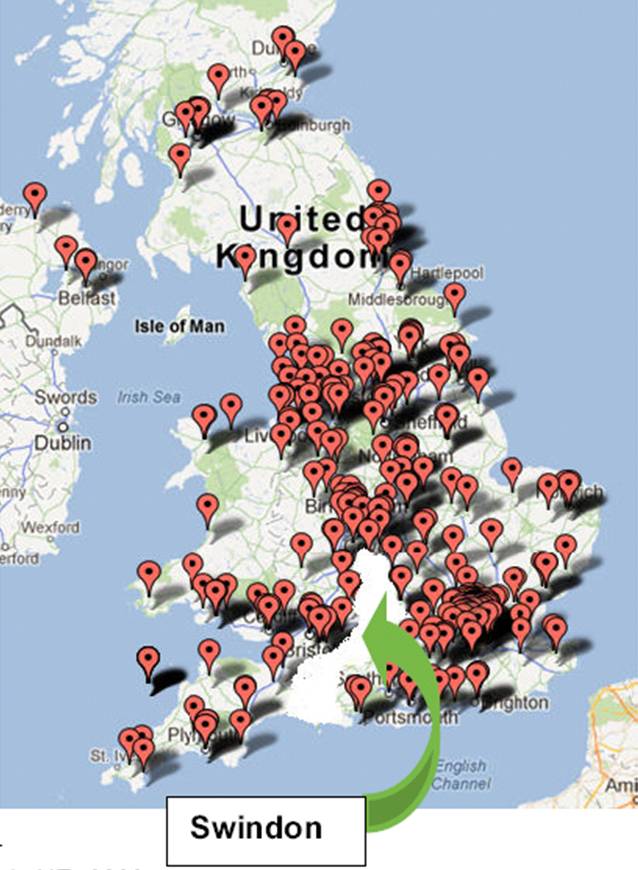
So there are interesting geographies revealed by this report – geographies of absence, and geographies of ambition, and imagined geographies too. In one section, for example, it is noted that “The impetus for a university stems in part from the knowledge that Swindon is one of the few major settlements in the country without an HE institution”. Then, with the help of a rather busy map, it is claimed that “Swindon lies in a swathe of country without a university which stretches from Stratford on Avon in the north to Weymouth in the south. Whilst this research has focused on demand from Swindon; this gap underlines the point that any new university would also be likely to attract students from nearby Wiltshire and Gloucestershire.” I’m not sure this ‘swathe’ actually adds up to a real region – it’s basically anywhere West of the M40 if you swing round Oxford on the A34, east of the M5 as long as you don’t stop at Bristol, Gloucester, or Cheltenham, and a large part of this empty swathe south of the M4 consists of Salisbury Plain. And I rather doubt whether rates of HE participation in Wiltshire towns like Marlborough or Salisbury will be significantly affected by any new University of Swindon (Swindon is in Wiltshire, but not necessarily of Wiltshire). And of course that statistic about the level of enrolment with the OU might not be best read as an index of the absence of alternatives either – but as further indication of the fact that local levels of HE participation are only tangentially related to local provision.
But keep your eye on Swindon – the future of non-elite higher education, shaped by assumptions about skills, the knowledge economy, and business partnerships might be slowly revealed here. Meanwhile, I have the sense of the town having all the component parts of a proper University without quite having composed them properly into one: loads of potential students, as well as already having all the books and even all the research money. What could be easier?
Political Concepts
Via geographical imaginations, here is a link to an online journal, Political Concepts, “a multidisciplinary, web-based journal that seeks to be a forum for engaged scholarship. Each lexical entry will focus on a single concept with the express intention of resituating it in the field of political discourse by addressing what has remained unquestioned or unthought in that concept”. Some interesting family resemblances, in fact, between this project and the Keywords Project , although also perhaps some distinguishing features too – that emphasis on “addressing what has remained unquestioned or unthought” about concepts implies a more obvious ‘critical’ methodology perhaps than the kind of almost philological attention to ordinary usages that might underwrite the concept of ‘keywords’. It seems to me that this sort of methodological difference is worthwhile acknowledging, and thinking through further.
Urban discontents
 There has been a flurry of interest in the theme of ‘planetary urbanization’ recently. Andy Merrifield has an essay on the theme of ‘Whither urban studies’, and there is a longer published version of his argument about the contemporary fate of the old-fashioned sounding ‘urban question’ (and Andrew has a new book coming out on all this too, The Politics of the Encounter). There is a video of the workshop discussion of the same theme at theurbanfix. This post also includes a link to a lecture by Neil Brenner on similar themes, re-posing ‘the urban question’ as ‘the urbanization question’ – and outlining some themes from a paper on planetary urbanisation by Brenner and Christian Schmid in a recent collection, Urban Constellations, edited by Matthew Gandy.
My interest in these interventions arises both from some things I have been trying to work on (teach, mainly), and also because I am meant to give a paper in a session at the 2013 Association of American Geographers meeting in a set of sessions on the future of critical urban theory. Reading and watching these and other things are helping me to clarify what it is I might try to say then.
There are some interesting overlaps in the arguments being made across this range of ‘post-Lefebvrian’ urban theory (I just made that up). There is the gesture of noting and then taking one’s distance from the oft-repeated line about ‘more than half the world’s population’ now living in cities, or at least in some type of urban settlement. It’s no doubt sensible to pause awhile about such stylized facts (although the stats about urban population growth might be better thought of along the lines suggested recently by David Runciman in LRB, as representations that enable certain sorts of political work to get done, not just as data to be dismissed as empiricist distractions). The distance-taking involves a move towards a claim about what urban theory can and should do, negatively and positively. It should definitely not, it turns out, presume the adequacy of taken-for-granted, ‘positivist’ understandings of what a city is, or of what counts as an urban settlement more generally – that risks buying into not only out of date notions, but ‘ideological’ ones too. What urban theory should do is burrow down into the ontological – to define clearly what the object of analysis of what-used-to-be-called- ‘urban studies’ actually is, in all its multiplicity-yet-dialectical-unity. It’s not at all clear why any intellectual field needs this sort of philosophically underwritten definitional clarity – other than as a prop to cope with a lack of confidence.
Don’t get me wrong – I think the arguments going on here are, in terms of their content as it were, really interesting: Brenner and Schmid’s theme of concentrated and extended urbanization processes is a really neat way of capturing the dynamics of contemporary spatial processes; Andy Merrifield has a really interesting riff about thinking of so many urban attributes (but I’m not sure we need to think of these as all an expression of a singular substance).
 In general, the story seems to be that we should think in terms of processes, maybe practices and strategies too, rather than fixed entities like ‘cities’ or discrete spatial objects like ‘the urban’. I suppose. This is a not unfamiliar argument of course, one made around issues of scale, for example, or indeed pretty much any other concern touched by Theory – personal identity, the state, Capital. I wonder whether this is really all that exciting any more as a claim about what theory can do for us. It is actually rather odd to assume that one needs theory to gain insight into the made-up, enacted, assembled, contingent, flow-like qualities of things that we often talk about and experience as if they were thing-like. And if theory is given this special privilege in the register of revelation, attached to a claim about its ‘political’ significance, then there is a risk of missing some important dimensions about the ordinary ways in which things (cities, states, people-with-identities) configure our lives in manageable, responsible ways (it also risks buying into some hoary modernist notions that somehow ordinary language isn’t quite adequate to capture the processual and relational qualities of live; it is, of course, perfectly adequate for that task, that’s why we have words like ‘process’ and ‘relation’ in the first place, and verbs, stuff like that).
It’s easy to pick holes in definitions of ‘the urban’. If you spend enough time looking at these definitions, you can come away thinking that you are in the middle of a Borgesian fiction, social-science style. Urban can mean:
‘Localities of 200 more inhabitants’ (Greenland); ‘Agglomerations of 2500 or more inhabitants, generally having population densities of 1000 persons per square mile or more’ (USA); ‘Towns, that is, localities legally established as urban’ (Bulgaria); or just ‘Town of Stanley’ (Falkand Islands(Malvinas)).
Borges’ lesson about the arbitrariness of classification was, of course, that the seemingly arbitrary qualities of classifications which lack definitive clarity are best read as an index of specific practical purposes and plans. I suppose, then, that doubts about the adequacy of some concepts of the urban are really an indication of doubts about the value of the projects of which those concepts are central. Radical urban theory, after all, has been consistently suspicious of ‘applied’ styles of urban thinking, those too closely connected to fields of planning, for example, or development, or even environmental management, where all those clunky concepts of bounded settlements and territorialised objects do their useful work – preferring to identify with social movements, and with more or less concrete imaginations of protest and resistance.
 I have to come to like the idea that ‘the urban’ is really a name for a problem, or for a series or variable problems (not quite the same as thinking of variable ‘attributes’). This is an idea I am stealing for my own purposes from my colleague Allan Cochrane, who develops it in his book on Urban Policy (if one is looking for an authoritative Theory reference, Foucault’s observations in his lectures on Security, Territory and Population about ‘the problem of the town’ might be a fun place to start – ‘the town’ emerges there as a figure for an extended network of dependence and vulnerability to which various agencies seek to respond). Allan, Scott Rodgers and I have been trying to articulate some of the implications of thinking about the urban in this way, partly through an edited collection on the theme of ‘Where is urban politics?’ that might hopefully see the light of day next year. Meanwhile, I have also tried to articulate the same set of ideas while thinking about making an OU Masters course on the theme of Changing Cities intended primarily to translate critical urban theory into a useful resource for those professions who act as key ‘intermediaries’ of contemporary spatial politics (planners, environmental managers, those sorts of people, maybe the occasional ‘activist’). To cut a long story short, I think the point would be that all those various attributes of ‘the urban’ are generative of their own points of political contention – but also that there is more to the variety of urban politics than protest; and indeed, that there is often more to protest than protest (protest is a form of claim-making, after all, of one sort of another). And, finally, that there is no reason whatsoever to assume (or want) this variety of urban-generated-but-not-contained politics to coalesce into anything so coherent as ‘revolutionary politics’ (one of the unacknowledged achievements of Marxist spatial theory is to demonstrate that the universalised agency required of a revolutionary political imaginary is always already, as they say, displaced and deferred).
So I have decided that arguments about the need to update and refine, specifically, to refine, our understandings of urban and urbanization, by posing this issue in terms of a debate about ‘the urban question’ from almost 40 years ago, tell us more about the operative concept of ‘theory’ at work in certain strains of critical urban and spatial theory than they do about how best to think about the meaning of ‘urban’, urbanism, the city, or urbanization. I wonder whether theory is really the sort of practice that has the task of isolating the ontological outlines of phenomena – of ‘the urban’, or perhaps, ‘the political’, from the appearances of town and cities and mere politics (there is of course much the same concept of theory at work in accounts of ‘the political’ as in contemporary discussions of ‘the urban question’, sharing much the same intellectual lineage – not for nothing does the notion of ‘post-political’ attach so easily to discussions of ‘the city’). I wonder too whether theory is really the proper medium for identifying the immanent potential for radical change in current events. Theories are, by definition, always theories of something – which means that any theory is caught in a subordinate relation of accountability to something that it isn’t. Unfortunately, too often this ‘other’ of theory is just assumed to be ‘Politics’ – which means that an overly theoreticist account of theory ends up holding itself accountable to an overly theoreticist account of what counts a proper politics.
So I’m left thinking that what the current state of radical urban theory confirms is not so much that ‘the urban’ is conceptually incoherent, but rather that the model of theory at work in this field needs to be challenged.
Public action: making things visible or catching the attention?
 I’ve been meaning to write down some thoughts provoked in particular by the workshop on Security and its Publics that I attended in Ottawa back in September, but other things have been in the way – including another workshop on Rethinking the Public, this time in Bloemfontein, which partly confirmed some of these thoughts even though it wasn’t limited to the security theme.
Both events confirmed for me that there seems to be an almost automatic tendency for discussions of publicness to devolve into discussions of ‘the Public’, as if the main thing at stake was the status of a sociological entity, equivalent to a group, or a people, or a nation. Thought of like this, of course, ‘the Public’ is always either found wanting (not interested enough in the things they should be), or is being misled. This tendency to think of publicness in terms of a substantive subject is, perhaps, only compounded by the current interest in insisting that publics need to be theorised as ‘material’ or ‘materialised’. This just threatens to compound the problem of thinking of publicness in overly substantive terms, rather than as a weird, queer, perhaps magical quality that requires an account of action not substances.
The Ottawa workshop included academics, activists, and artists (here is a reflection from Kate Milberry, one of the other participants) – the emphasis intellectually was shaped very much by critical security studies and IR: papers about drone strikes, the militarisation of the policing of protest, creeping surveillance of everyday life, that sort of thing. I presented a paper around the hunch that much of the critical analysis of security and ‘securitization’ has conceptual trouble imagining practices of policing, surveillance, war even, as ever possibly being pursued for legitimately public ends. The problem is conceptual in so far as it follows from an investment in certain sorts of theory which aren’t very good at thinking about the public mediums of action, not least of violent action – dark readings of Foucault, credulous readings of Agamben, that sort of thing.
 There seem to be two senses of publicness operating in lots of this work – an implicit ideal of transparency and openness, which operates as the benchmark against which any and all practices of security are always already rendered suspect; and a sense of public space as a communicative milieu of a certain sort, either for ideological interpellation or affective contagion, through which fear and anxiety is routinely circulated. If you combine these two, then you get to the point where security practices are always counter to public values, because they are meant to operate out of the open, they are hidden, surreptitious, secretive, invisible, and yet brilliantly effective for all of that.
One of the things that crystallised for me at this workshop is the degree to which critical invocations of ‘public’ values often presume that publicness is all about visibility – hence the sense that securitization is problematic for public values because it is presumed that it is a process all about secreting things, hiding them away (I think there might be fundamental differences in how ‘security’ is thought in IR/critical security studies when compared, say, to fields working on ‘biosecurity’ and related topics – this is partly disciplinary, no doubt, but also something to do with different ways of reading Foucault and Foucault-sourced notions such as governmentality, biopolitics, and, well, security). I’m not sure I’m convinced that security practices and discourses should be thought of as presumptively illegitimate, undemocratic, or suspect just because they may involve some element of secrecy (which they may or may not anyway). Is secrecy necessarily opposed to the public values of democracy? Always?
The sense that securitization is at odds with democratic values begs some questions. What public values, for example, are at stake in processes of securitization? (Protection, order, etc – these are public values after all). Again, there is an interesting difference here with work on biosecurities, which does seem able to articulate security practices with thinking about publicness in a non-reductive way. More broadly, I came away thinking that the visibility/invisibility frame really isn’t a very helpful way of thinking about processes of public formation at all. It might even be an index of not thinking very hard about what the politics of public formation.
There seems to be an assumption in critical analysis of security that if only it were possible to make more widely visible various types of terrible thing – drone strikes, human rights abuses, unauthorised interrogation techniques, militarized policing – then ‘the public’ would naturally object. The analysis of security and its publics in this register of visibility sustains some standard critical gestures – critique is all about making things visible, uncovering hidden away things, perhaps bearing witness. The visual register tends to take for granted that ‘the public’ would and should, under the right circumstances, be horrified by the same things that upset the critic – it is assumed that the harms and wrongs of some practices should be self-evident, and this means this sort of critical analysis ends up coming close to always blaming ‘the Public’ for their indifference.
 The two papers at the Ottawa workshop that seemed to stretch almost to breaking point the visual register in which security and its publics is theorised were, it turns out, both by geographers – Jennifer Hyndman talking about refugee camps in East Africa, and Alison Mountz talking about the use of islands as the location for off-shore detention centres by the US, UK and Australian governments. In both cases, there isn’t anything ‘invisible’ about the practices or places at issue – you can’t hide a refugee camp, they are in plain sight. Hyndman talked around the theme of ‘apprehending’, in terms of a kind of double, ambivalent political and epistemological sense of laying hold of and/or seizing, but also of learning about (I’m probably doing the argument an injustice). Likewise, Mountz framed her analysis in terms of drawing attention, distraction, things ignored, not just visibility and invisibility.
Apprehension and attention seem much more useful, conceptually, as more than mere figures of speech, than the metaphorics of visibility and invisibly for understandings processes of public formation. In particular, attention is a much better theme through which to hold in tension the sense of the public as a kind of sociological entity and the sense of publicness as involving some abstraction from more immediate social relations. It helps to pinpoint how ‘making things public’ might be less about making things visible, or seeing things, and more about noticing, paying attention, or being distracted, or indeed, attending to and caring.
The reason I like the idea of thinking of public formation in relation to notions of attention and attending is because, of course, there is an economy of attention that is a little more subtle than that suggested by visibility versus invisibly. Attention is a key concept in the economics of information and in some strands of media theory too. The general point is that attention is a scarce resource – you can’t pay attention to everything all at once; attention is, further, selective, and partial. And it’s often really hard work to get people to pay attention. Attention might be a much better theme around which to pursue a concern with the ‘materiality’ of public formation – for example, going back to the theme of security, it might be the case that some issues, some scenes and sights, resist attention almost by their very nature – including the horrors of violence and torture. It might be much more difficult to build sustained attention around some issues than others, because of the ‘aesthetic’ qualities of those issues.
I also think attention might be a fun way to get at what seems to me to a fundamental division within contemporary academic work on ‘public’ things. Lots of this work tends to think of publicness primarily as a communicative practice, in either deliberative-legitimatory ways or agonistic-oppositional ways. This work finds it really difficult to acknowledge that ‘public’ is also a name given to certain sorts of institutionalised, bureaucratic configurations – the public sector, public transport, that sort of thing. But public agencies, charged with delivering material goods and services, might also be thought of in terms of the analytics and economics of attention – in a sense, they are organised practices for sharing, distributing and providing attention, even of aggregating attention – for paying attention to some in the name of others, of delegating the responsibilities of attending. Giving attention, attending to the needs of ‘the public’, is what these agencies do. In principle.
Anyway, somewhere here, around the notion of attention, I think there might be a way of thinking about the family resemblances that connect different paradigms of public life – more communicative ones with more organisational ones.
And I think attention also challenges the terms of criticism through which public formation is discussed. The critique of securitization in terms of visibility and invisibility either overestimates the obvious normative pay-off of making things visible, or it ends up having to invest too much hope in the same rationalities of affective contagion that it takes as its object of critique in the first place. Issues may or may not rise to public attention, on the other hand, because of something about the issue that resists or repels attention; or lack of attention might be sociologically structured – people have other things to do, other things to pay attention to, other concerns to attend to. And above all, this all suggests paying more attention to the hard work involved in attracting and maintaining attention, as well as in distracting attention – harder than exposing things, or just hiding them away.
I wonder if it would be possible to imagine an account of public formation which does entirely without a visual vocabulary? This vocabulary gets in the way of thinking about the sorts of action involved in public practices, the sorts of action involved in noticing, caring, attending.
Politics and numbers
I’m a bit slow, but here is an excellent deflationary analysis of the rhetoric of numbers, representation and misrepresentation in and around Occupy by, David Runciman.
Escobar on alternatives to development
A fascinating discussion between Rob Hopkins and Arturo Escobar on the relevance of the transition movement in the global South.
Is politics an enigma?
 Via Derek Gregory at geographicalimaginations, I’ve just come across a short essay at Adbusters from Andrew Merrifield diagnosing the ‘spatial’ lessons of Occupy, which he presents in terms of the challenge of linking a clear and adequate Marxist theory of capitalism to the rather elusive practical challenge of doing politics in light of that sort of analysis. I guess the ‘engima’ that Andrew identifies might not be so puzzling if one did not imagine that the theory was quite so adequate, and if one did not suppose that ‘revolt’ was the only plausible model for thinking about politics. Oh well.
The essay does contain a nice description of what’s ‘public’ about occupied spaces, one that punctures the romance of ‘real’ spaces of assembly – publicness turns out to be about both situated encounters as well as catching the attention of more dispersed, disseminated audiences. A nice image, certainly, developed more fully in John Parkinson’s recent book which I mentioned a while back, for example, or in Kurt Ivesen’s work on spaces of public address , or various other places in which a stretched-out notion of public space is developed . It’s not really a terribly ‘revolting’ idea at all.
 Pop Theory