Where angels fear to tread: Badiou, Zizek, and les événements

The concept of ‘event’ has become a hot topic in certain strains of cultural and political theory, inflected by the thought of Derrida, Deleuze, Badiou, and others. It’s meant to be a figure for the surprising, unforeseen, ruptural, and, perhaps, the relation of the ‘exciting’ to the more routine, entrained, predictable. It’s also become, in some usages, a smart way of keeping alive a messianic fantasy of political revolution.

It’s been fun, given all the talk of ‘the event’ in theory-land, to see so many of the leading figures of ‘Continental Philosophy’ expound on the political events sweeping North Africa and the Middle East these last two months. Because what is notable is how many of these commentaries manage to find exactly what they want to find in Tunisia, or Egypt, or Libya – even if it’s confirmation of the pure contingency of ‘the event’.

So Alain Badiou has found confirmation of his own version of communism, replete with Orientalist flourishes about ‘Eastern winds’; Hardt and Negri had a nice piece in The Guardian, in which these events were all about the multitude, leaderless movements, and horizonality; Peter Hallward is one amongst a number who are inscribing these events into broader narratives of a revolt against neoliberalism. From a somewhat different position within contemporary Franco-philosophical scene, Andre Glucksmann is less sanguine.

Zizek’s interpretation of the uprising in Egypt is my favourite: “The uprising was universal: it was immediately possible for all of us around the world to identify with it, to recognise what it was about, without any need for cultural analysis of the features of Egyptian society. In contrast to Iran’s Khomeni revolution (where leftists had to smuggle their message into the predominantly Islamist frame), here the frame is clearly that of a universal secular call for freedom and justice, so that the Muslim Brotherhood had to adopt the language of secular demands.” This is a brilliantly self-aggrandizing assertion, one that underwrites the arrogation of interpretative authority to a cadre of bombastic universalists who don’t have to worry about what they do and don’t know about other places!

The projection on these worldly events of current theoretical perspectives has been a feature of lots of the commentary over the last month or so. It’s perhaps most obvious in the ongoing debate about the role of new media like Twitter in triggering and spreading political rebellion – where debate has oscillated between those who over-state the importance of new media, and those who dismiss this aspect. Jay Rosen has already analysed the rhetorical positions in these debates, which might be read as one moment in broader contemporary cultural debates about social technologies, wonderfully dissected by Adam Gopnik in The New Yorker last week.

Amongst all this reflection, the best commentary I have found has been on the SSRC website, which contra Zizek, has provided lots of well-informed discussion by people who know about the region, including voices actively involved in these struggles (Noel McAfee at Gone Public has also provided useful links to regional voices). A couple of things stand out from these discussions – one is a more careful understanding of the secular qualities of these movements, discussed by Seyla Benhabib and John Boy for example; and the other is the importance of nationalist registers to these movements against authoritarian regimes. In both respects, the know-nothing universalism of Badiou or Zizek is revealed as somewhat limited in its analytical purchase. The best way to learn from these events, the welcome challenge presented in the commentaries by Badiou and Hardt & Negri, is to listen to people who know what they are talking about. That’s always a good way learning something you didn’t already think you knew.

Favourite Thinkers V: Gideon Haigh

Highlights of the cricket World Cup make pretty good late night TV if you are sitting up late tending a new born. It’s about as much of this tournament that one really needs. I’ve come to the conclusion that the only reason that cricket is worth taking notice of anymore is because it provides the background for reading Mike Selvey in The Guardian, and especially for reading Gideon Haigh. Haigh’s Ashes 2011 is just published, barely a month after the end of the series – since he wasn’t writing for The Guardian, this is doubly worth it. It even contains the phrase ‘epistemological case study’ with reference to Ricky Ponting. I’ve also been reading Haigh’s latest collection of essays, Spheres of Influence, actually published by Melbourne University Press. It is mainly concerned with the institutional context of contemporary international cricket, and starts with a wonderful 60 page analysis of how India has come to dominate world cricket economically, written in a whirlwind style. Haigh is great at skewering the self-importance of cricket’s personality led culture; but he is really excellent at exposing the political economy of the game – that’s what this book does, reminding you that he was/is a business journalist, a vocation evident in his analyses of the Packer revolution or of the economics of early international cricket tours through the figure of Warwick Armstrong. The silliness that cricket has become is redeemed by this sort of writing and analysis.

‘From the blogosphere to the street’

Continuing the theme of how to understand the role of new media in helping to explain events in Egypt, the SSRC’s Immanent Frame blog site has two new excellent pieces by anthropologists, which place these practices in broader contexts, written by Charles Hirschkind and Farha Ghannam. Read together, they do a nice job of emphasizing two things: how new media practices like blogging are embedded in wider media ecologies, relating to and reconfiguring other media forms and practices, particularly of news making; and the important relationship between these reconfigurations of media publics and the politics of occupying and contesting urban public spaces.

What do ‘media’ do?

Following my post on the reporting of events in Egypt, Alex Marsh sent me a link to this think-piece by BBC correspondent Paul Mason, Twenty reasons why it’s kicking off everywhere, which seeks to draw some general lessons from recent protest events in places as diverse as Greece, Ireland, North Africa and the UK. The piece has since been published in The Guardian, and has attracted some attention, not least as indicative of a BBC policy of encouraging journalists to engage in more detailed discussions via blogging.

Mason’s piece treads between a focus on ‘technology’ and a more interesting discussion of some of the sociological aspects of this range of events – the emphasis on the role of young, relatively highly educated people is surely correct. There is an inevitable journalistic emphasis on the newness of all of this, and the default assumption remains that this is really a story about how ‘technology’ transforms the conditions of political action. The geographer Tim Unwin has a list of various reports that address what he himself calls “the agency of mobile ‘phones and the use of social networking environments over the Internet” in shaping political upheaval in Tunisia, Egypt,  and beyond. His last comment is important: “Much research needs to be undertaken on the real role of ICTs in these ongoing political processes.  What seems apparent, though, is that many participants do indeed believe that these technologies are helping them achieve their objectives.” A certain view of the potential of digital communications is no doubt an important part of the ‘spontaneous philosophy’ of contemporary activism. Likewise, Mason’s think-piece refers in passing to how “activists have read their Chomsky and their Hardt-Negri”. I’m not so sure this necessarily means “they have a better understanding of power”, but in so far as it is true, it does certainly mean they are likely to have a particular, well-formed view of how power operates, for better or ill. But it seems to me that both of these aspects of activist self-understanding – of ‘communications’ and of ‘power’ – are more interesting if they are understood as internal dimensions to this form of organisation, without requiring anyone to affirm the ‘objective’ validity of either of these views of how political action unfolds. The focus on the importance of new media in much of this reporting and commentary allows a narrative framing in which politics is rooted in a generalised but unformed sense of ‘grievance’ rooted in ‘poverty’ and ‘oppression’ which is then given expression by new communications opportunities – Manuel Castells neatly summarises this narrative in his comments on all this.

In short, there is a particular concept of the mediating work that ‘media’, old and new, perform in much of the commentary on the role of social media and digital technology in contemporary politics – they can be ascribed so much importance by virtue of being attributed a merely mediating function. Amongst other things, what disappears from view from this perspective is the different practices that different communications technologies help to configure – twitter and facebook are playing different roles in contemporary events in the Arab world to that played by Al-Jazeera. While much of the commentary out there is about how new media changes how politics is done, my sense is that the real imperative behind much of this kind of commentary is the attempt to understand the changed conditions under which news is made, and indeed, the changed conditions under which academic expertise about complex situations can be articulated in real-time (and there might be interesting elective affinities between certain self-understandings of activism and the focus of media reporting on individualising effects of new media).

For an antidote to some of the more detached commentary on events in Egypt and Tunisia, there are some interesting debates going on amongst anthropologists, which provide much more depth of understanding than is found in much of the technology-focussed discussion. There are a couple of more circumspect reflections on the role of media in these political eventsOne of these pieces makes the point that the focus on the new mediums of political change is a recurrent feature of reporting and commentary on these types of dramatic political events: “This is an evergreen story…The interest that’s focused on social media now, ten years ago was focused on web portals, before that it was focused on email and list-serves, before that it was television.” And in this respect, there is an interesting archive of reportage and commentary on the protests around the contested Iranian election in 2009, described by some as a ‘twitter revolution’, which two years on is an interesting case-study of how the global news narrative of politics as technological expression unfolds and then unravels over time.

Democracy Live

I came across an interesting theory blog the other day, called GonePublic, which belongs to Noelle McAfee, and focuses on links between philosophy, political theory and contemporary public life. She has a new book out, which I had not come across before, called Democracy and the Political Unconscious, which I haven’t yet read, but which sounds interesting in its emphasis on the relationships between collectively felt trauma and the challenges of building and sustaining democratic cultures. Her site also has a link to a recently published collection, Democracy in What State?, which includes contributions by some of the grandees of ‘continental-style’ political philosophy – Ranciere, Zizek, Badiou, Agamben, Nancy. Should make interesting reading, given the decided ambivalence about ‘democratic’ values one might impute to at least one or two of these thinkers. And while I am on the subject of things I haven’t read properly yet, there is also an interesting looking essay in Political Studies by Andy Dobson on Democracy and Nature, that thinks through the relevance of Latour’s provocations about nature and democracy by emphasising the importance of practices of listening as well as the well-trodden emphasis on speaking in recent democratic theory.

I stumbled across these references a week or so ago, and remembered them this week while finding myself watching a lot of day-time television, in that zonked-out, sleep-deprived way that one does in the first few days after the birth of a new child. We have sat glued to images of protest and violence in Cairo and other Egyptian cities. I wonder which, if any, of them would be most helpful for understanding what is going on there. Between them, these theoretical works look like they cover the shared terrain of cutting-edge democratic theory these days, which revolves around a couple of intertwined issues: how best to think of the mediums of inclusive democratic politics – in terms of deliberating, representing, and/or other modes of more or less embodied action; and how to square these images of how democratic politics should be best practiced with a more worldly acknowledgement that democracy is rarely founded democratically, but is shaped at its origins often by violence, trauma, and suffering. Of course, there is a style of theorising about ‘the political’ that presents these two sides as standing in a starkly contradictory, or aporetic relationship, so that democracies are always tainted at source by foundational violence. This serves as a way of reconfiguring some quite old-fashioned images of messianic revolution with ideals of democratic politics. Alternatively, there is an Arendtian vision in which the sorts of street protests going on in Egypt this last week or so are examples of a mode of collective, public action that is constitutively opposed to violence and yet is the very source of democratic energies.

Now I don’t know very much about Egypt, and am not inclined to over-interpret events there just for the sake of theoretical point-scoring. But watching these events, distracted by more real personal events and from a distance, I have been struck by how at times like this what you really want is contextual, social-scientific forms of analysis rather than interpretative political theory.  And, it’s also useful to have some sense of how things might be theorised by those more familiar with these contexts than the usual theory-suspects.

One of the riffs this past couple of week about Egypt, and before that about Tunisia, has been about the importance of social media like twitter and facebook in coordinating the protests and collective mobilizations that have shaken authoritarian regimes. To a large extent I think, this sort of emphasis is really an index of a culture of journalism that doesn’t know very much about the places where dramatic news events often take place, and is therefore forced to fall back on a familiar narrative line. Malcolm Gladwell has a neat little blog post on this theme here, in which he points out that the fact that the fact that events in Egypt have been partly shaped by the use of new media might be far down the list of relevant factors worthy of attention. His point is that the fascination with the mediums through which contemporary collective action is made possible, with the ‘how’, tends to distract attention from the content, from the ‘why’ of such action. There is a kind of flattening effect of this sort of news narrative, in so far as it makes political revolutions in Tunisia just another version of half-hearted online petition exercises led by government in the UK or the latest smart viral marketing campaigns of this or that underground pop song. The focus on the medium is not only exaggerated, as Gladwell suggests, but tends to obviate the need for any deeper analysis of why political events like this take place at all – I have actually learnt very little about Egyptian politics after a week of watching blanket news coverage from there.

Of the things I have had time to read on this issue, I enjoyed this piece on why the narrative that paints Egypt in 2011 as potentially a re-run of Iran in 1979 doesn’t hold up really helpful, precisely because it provided a basic outline of the social and organisational context in which these events are unfolding. It reminded me too of an old media studies analysis of the importance of tape cassettes to the Iranian revolution. Maybe each political revolution has its own  iconic ‘new media’ technology?

And the cassettes example isn’t as old sounding as it may appear. The anthropologist Charles Hirschkind has a detailed ethnographic account of the importance of taped sermons in shaping contemporary Islamic public spheres, in The Ethical Soundscape. One reason why this account resonates is that it reminds us that there is more to ‘media’ than just communicating – the ongoing importance of this media technology, in Hirschkind’s account, lies in the practices of self-sustained by a culture of listening, of being devout, of cultivating a particular spiritual and public ethics of life.

Hirschkind’s account of the practices of contemporary public life in Islamic societies like Egypt and Iran suggests a much more nuanced understanding of ‘public space’  than one often finds in spatial disciplines like geography or urban studies, which have a tendency to fetishize ‘real’ public spaces. I suppose the centrality of Tahrir Square to the events in Egypt in the last week might seem to confirm this emphasis. But I wonder. This seems to be an example of a struggle of over a specific site, as a symbolically important location rather than a site of real power, the control of which projects or reaches beyond its coordinates in space. A year or so ago I listened to a talk, at a workshop in Rome on political agency, by the Egyptian academic and activist Heba Raouf Ezzat, who talked about the vibrant but furtive quality of the political public sphere in Egypt. She recommended the work of Asef Bayat, who has written about new ‘post-Islamic’ social movement politics and the ordinariness of political action in the Middle East. Bayat has also written about the figure and reality of ‘the Arab street’, which he reconstructs as a complex of ideas and practices about the force of popular opinion, the fragility of state power, and the calibration of formal political processes to material conditions of life (what Africanist political theorists might call ‘the politics of the belly’). Bayat has updated this analysis of the new Arab street in the last week in relation to events in Tunisia and Egypt.

Between them, these sorts of analyses of the spaces of  political action are helpful in indicating the extent to which democratic energies might be understood as urbanized in certain respects without forcing one to fetishize a particular romantic image of the city as the scene of political life. There is an urbanity to the movements for change in Egypt, Tunisia, Iran and elsewhere, it seems – in so far as they are peopled by labour activists, and professional classes, by women’s organisations, as well as by varieties of religious activism which are resolutely modern in their concerns and maybe often even ‘secular’ in their form. And it seems too there might be something resolutely urbanized about the ‘conjunctural’ factors at work in these recent events – the central importance of economic grievances over unemployment and food prices is indicative of the interplay between spatially extensive infrastructures of provisioning upon which contemporary urban living on the scale of a city like Cairo depends; and more contained, lived and shared experiences of stunted citizenship.

Film theory

I have been to the cinema three times this week, the first time I have done that since I was an undergraduate, and used to go almost every night at 11 to the now defunct Arts Cinema in Cambridge. Movie-going has been something to do this week while waiting for a baby to arrive. We both went to see The Little Fokkers, on a Monday afternoon, and were the only people in the cinema. It was like having a private screening. Terrible film though. Then it was Eat, Pray, Love, which was better, best of the three, but still not very good. Full of cliches about other countries. Best thing about this film was going to the 11am show, the Seniors Club performance. £3 for the film plus a cup of tea and a biscuit. It was more than half full. It reminded me of the PhD research of Berry Cochrane at the OU, who did go-alongs with OAPs to the cinema to investigate what sort of practice movie-going is, and how the practice shapes what ‘film’ is. Finally, I went with my four year-old daughter to see the new Disney animation, Tangled, a version of the Rapunzel story. This was not that great either – too many weak songs. Not As good as The Princess and the Frog by a long shot. We had to go to see the 3D version, but my daughter took the glasses off after a couple of minutes, saying that ‘they bring everyting too close’, and that this made her jump. Which pretty much sums up what 3D film technology seems to be for.

Choreographed pop

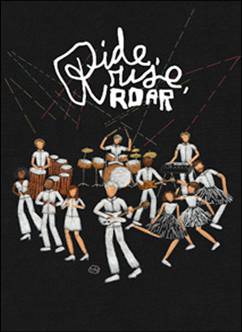
I had a night out last night, on my own though – my thirty-nine week pregnant partner stayed at home for some reason. I went to see the UK premiere of the new David Byrne concert film, Ride Rise and Roar [I should keep this blog from becoming excessively focussed on him shouldn’t I]. When I say I went to the premiere, this is sort of true – last night was the premiere of the film, somewhere in London, but the film was simulcast in other cinemas round the country. This exciting event attracted a total of 8 people to the Swindon screening – me, and seven other people; I was the youngest. Oh well, that tells you something about Swindon I suppose. There was supposed to be a live simulcast Q&A session with Byrne afterwards, but rather inevitably the cinema in Swindon couldn’t connect up properly. Oh well, I left happy. The film is great – it is about the choreographing of the performance, as well as a film of the show itself. It made me realise how unusual it is to see any movement on stage for standard ‘rock’ music or ‘indie’ music – for guitar based pop, that is. Take That, or Girls Aloud, that sort of pop music is always animated, which is part of what differentiates it as a distinctive genre.  Concert movies are also rather static – any movement comes from lighting, camera positions, editing, and so on. Nobody dances in The Last Waltz. So it was fascinating, and toe-tap inducing, to see  old Talking Heads songs and new Byrne/Eno songs literally put into motion.

Favourite Thinkers III: David Byrne

I accidently bought David Byrne’s concept album about Imelda Marcus just before Christmas, while out trying to buy gifts for other people. It’s called Here Lies Love, and is co-produced with Fatboy Slim. It’s full of suprisingly good dance songs, with guest lyrics by all sorts of mostly female singers, including favourites such as Kate Pierson and Róisín Murphy. I also read Byrne’s book about cycling and cities in the summer, while on holiday, which is kind of a blog-book, and was actually one of the things that sparked the idea of trying to write a blog myself.  Between them, these two ‘works’ have reminded me of just how much I like David Byrne as a ‘thinker’, and just how important his style of ‘thinking’ might have been in shaping, or confirming, some of my own intellectual inclinations. Talking Heads was the first pop music that I discovered as ‘my own’, in the sense that up to that point (about 1983) I was entirely dependent on listening to things already in the house (my mother’s Neil Diamond record, who I still harbour a soft spot for; my dad’s Johnny Cash album, ditto: David Bowie’s Changes, which both of my sisters’ had copies of, as surely did all sisters who were teenagers in the 1970s; I was less inclined to the Billy Joel, Rush, or Black Sabbath). One of my sisters did in fact send me Talking Heads’ 1983 album, Speaking in Tongues, but alongside albums by Oingo Boingo and X, and without quite knowing what she was doing I think. Talking Heads were my route away from mid-1980s rockism defined by Dire Straits, Pink Floyd, and Marillion, towards a ‘I wear black on the outside because black is how I feel on the inside’ world of the Jesus and Mary Chain, That Petrol Emotion, the Cocteau Twins, Pixies, and Throwing Muses.

Anyway, where was I? Talking Heads songs always had this great geographical sensibility, I think – they are about ordinary experiences of places, of living in cities, of travelling, of meeting new people, of being out of place. They are also about the absurdism of these ordinary experiences, of course. I haven’t really followed Byrne avidly since the end of Talking Heads, although the Bicycle Diaries is just one example of how this geographical imagination has continued to flourish in his work since then – it is part of a serious engagement with issues of contemporary urbanism he is involved in. I do sometimes tune in to his radio station – he posts a monthly play list on his  website, of more or less coherently themed songs – sometimes this contains things I am already familiar with, sometimes it opens up new musical avenues to explore, or not.

I’m not sure if pop songs are meant to count as intellectual influences – and I suppose Byrne is one of those people of whom it could be claimed that they are not really ‘pop’, since his work from Talking Heads and on has always been more or less ‘arty’. On the other hand, I remember once having a conversation with a cultural geographer interested in geography and music, who was quite disdainful of my response of ‘Talking Heads’ to his question about whether there was any popular music that was ‘geographical’ (this was a drunken conversation late at night at a party). On his understanding, ‘popular music’ really meant some sort of quasi-organic, placed-based more-or-less-folk music that evaded commercialization. Oh well. I still think that Byrne is ‘pop’, not least in having a sense of wonder for the potentials of commercialised public culture. But I’m not sure I either can or should seek to intellectualise about the sort of pop culture he produces, or why it matters to me.

Favourite Thinkers II: Pauline Kael

Now that I live in a town almost devoid of bookshops, it’s a big occasion when I get out at the weekend and end up buying a book of any sort. Last week in Stroud, the slightly odd leftie-hippy enclave in the heart of the staunchly Tory Cotswolds, I picked up two second-hand volumes of collected reviews by Pauline Kael, the long-time film critic for The New Yorker from the late 60s through to the early 90s. I haven’t read anything by her since I was a student in the late 80s, in the days when I tended to go to the cinema on average once a day, mainly at 11pm at night. I remember liking her not least because she had a soft-spot for John Hughes-style teen movies, on the grounds that they were the only American films left which centred on questions of class.

I was primed to re-acquaint myself with Kael because earlier this year I read a great little book by Craig Seligman, Sontag and Kael: Opposites Attract Me, which compares and contrasts the styles of criticism of these two quintessential ‘New York intellectuals’, both very serious writers, both interested in ‘the popular’, but one, Kael, more than the other, managing to avoid the traps of avant-garde disdain for popular taste. Reading the essays in the two volumes I bought in Stroud, Reeling (which covers the early 70s) and When the Lights Go Down, covering the ‘golden age’ of mid and late 70s Hollywood films (although one surprise is just how many films Kael didn’t seem to review, no Chinatown, or plenty of other ‘classics’ of that time, but lots of reviews of late-period John Wayne), is proving a joy, partly because lots of these films are the films I grew up watching on TV, so there is a familiarity to them, but also because reading Kael writing about them contemporaneously, placed in their 1970s milieu of the weekly or monthly review, throws films like Westworld or Taxi Driver or Saturday Night Fever into wholly new perspective, as part of their time, sitting alongside Rooster Cogburn or The Gauntlet, as part of a contested public culture of representations of violence, sexuality, liberation, aspiration, and resentment.

What I have most enjoyed about reading Kael again is the principled populism of her criticism, expressed most clearly I think in the sense that the object of her criticism is not ‘Film’ so much as ‘the movies’, ‘movies’, or a ‘movie’. This is the privileged term of her writing, and I think it captures something quite distinctive and valuable that offsets her writing from more solidly ‘academic’ styles of film analysis. ‘Movies’ indicates an appreciation of the unavoidably populist dimension of this form of, well, popular culture – Kael’s negative judgements are always shaped by a sense of disappointment that a particular movie fails to be as good a version of the kind of movie it claims to be (in one of these pieces, she describes the latest release by a reknowned French director as probably ‘a perfect film’ but for her an ‘entirely forgettable movie’). This attitude is summed up in a great definition she gives at the start of Reeling, of the ‘maze of borderlines’ in which criticism operates: “criticism is a balancing act, trying to suggest perspectives on the emotions viewers feel, trying to increase their enjoyment of movies without insulting their susceptibilities to simple, crude pop”. This is wonderful statement of Kael’s appreciation of the visceral, sensual qualities of ‘movies’ – that they can leave us ‘reeling’ – but also of her self-understanding of her own relationship to viewers/readers. This definition of criticism strikes me now, on reading it for first time some three and a half decades after Kael penned it, as standing in very stark contrast to a style of cultural theory in which discovering the emotional or ‘affective’ dynamics of enjoyment involved in unashamedly ‘mass’ forms like the movies is still, astonishingly, presented as a politically charged act of revelation and de-mystification. Reading Kael again has reminded me of the rarity of finding academic writing about popular culture that doesn’t fall into the trap of condescending towards popular taste, and of how much of the writing and thinking about ‘culture’ I have learnt most from has not been written by academics at all, but by ‘critics’ who actually like  the cultural forms, if not every example, about which they write.