Bite Size Theory: The Visual World of French Theory

Photo Yann Revol“I argue both directly and implicitly that it was the confrontation with the explosion of the art world and its discourses – as well as events on the street and the barricades – that released a generation of philosophers from the ivory tower of the École Normale Supérieure and that their engagement with contemporary art played a crucial role in formulating the new postmodern mindset”.

Sarah Wilson, 2010, The Visual World of French Theory: Figurations, Yale University Press.

Bite Size Theory: The Big Screen

“In the early 1960s, there was confusion over what to call this transaction – was it film, the movies, or cinema? You could tell a person’s taste and agenda by the word he used most often. “Cinema” meant the history, and the suggestion that it has been superior then; “film” was the essential function and might be covering an urge to make the stuff: while “movie” usually meant America and fun”.

David Thomson, 2012, The Big Screen: The Story of the Movies and What They Did to Us, Allen Lane.

French Disko

JDOne of the thoughts I had when I started this blog was a semi-serious idea of trying to write about an asymmetry: I had been reading lots of Simon Reynolds, and was struck by a sense that while lots of late ’70s early ’80s new wave music was influenced by French Theory of a certain sort (all those art school boys and girls), French Theory itself is largely devoid of any pop sensibility at all (Roland Barthes is perhaps the exception who proves the general rule, and for that very reason, might just be the most interesting thinker of the whole lot).

Anyway, as I said, this is only a semi-serious, half-formed idea, which is what blog posts are for after all. Buy me a drink, or two, and I might be prepared to develop and defend some hypothesis of some sort around it. The canon of French Theory has impeccably modernist cultural reference points – Kafka, Boulez, Mallarmé, Artaud, that sort of thing. And a heavy investment in Kant’s Third Critique too. Not very ‘pop’ at all, really (maybe work on ‘Film’ is an exception, but actually, ‘Film’ is a terribly arty way of thinking about movies). Whatever hypothesis it is that I might want to defend should this thought ever become more than a half-formed one would be around the distinctiveness of ‘pop’ in relation to more serious sounding topics such as the popular, populism, the everyday, or the ordinary. None of which, however much you like them as concepts, have very much to do with fun. The semi-serious thought has to do with the idea that theories of culture, meaning, subjectivity and the like tend to be based on very select canons of favoured texts, which are thought to exemplify or allegorise or serve as best-case analogies for cultural processes in general. Or, just that it matters which cultural texts underwrite general theories of culture (should I admit that the only reason I know or appreciate anything about that canon of avant-garde modernism is because I once read too much Theory?).

Scan 130200001-1The reason I have been thinking about this recently is entirely frivolous. We are about to embark on our first overseas holiday with our children, to France, and part of my fatherly role in this is obviously to make sure we have things to listen to in the car – I’m the playlist monitor. So I have been trying to construct a ‘French Pop’ playlist, obviously. There are certain rules – it has to have about 14-15 songs on it, so it can be burnt to a disk for playing in the car; it has to be able to sustain the interest of a toddler and a 6 year old on a long journey (so it’s an ‘experiment’); it consists of songs we already have (with a couple of exceptions – I learnt some things doing this); and it is flexibly francophile rather than narrowly French (in the spirit of the Frenchness of French Theory).

Avoiding things like Michelle, Psycho Killer, Roxy Music’s Song for Europe, difficult songs by Throwing Muses, various Blondie/Debbie Harry possibilities, as well as anything by the Violent Femmes or St. Etienne, and fully aware that I am exposing something about my own tastes which is perhaps left private, here is the list:

  1. Get Lucky, Daft Punk
  2. Désenchantée, Mylène Farmer
  3. Ping Pong, Stereolab
  4. Le Freak, The Ukulele Orchestra Of Great Britain
  5. Spacer, Sheila B Devotion
  6. Lady Marmalade, LaBelle
  7. Tu veux ou tu veux pas, Brigitte Bardot
  8. Complainte Pour Ste Catherine, Kate & Anna McGarrigle
  9. La Danse De Mardi Gras, Steve Riley & The Mamou Playboys
  10. Un Gaou a Oran, 113 Clan, Magic System & Mohamed Lamine
  11. Marieke, Jacques Brel
  12. Non La Vie N’est Pas Triste, Martha Wainwright
  13. Bonnie and Clyde, Brigitte Bardot & Serge Gainsbourg
  14. Don’t Go, Nouvelle Vague (rather than this, which was vetoed as not age-appropriate).
  15. Ça plane pour moi, Plastic Bertrand

I’m not sure if the list is clarifying for me what exactly it is that my semi-formed hypothesis should be, other than to confirm that the lack of pop sensibility amongst a generation of French thinkers can’t be blamed on an absence of good pop. There is actually some Marx in there somewhere, as well as Cioran too, apparently, so something for the Theory-boys. As well as trying to be catchy, I’m assuming that listening to this as we drive across Normandy will help to refresh all those useful phrases one needs when holidaying in France: “Voulez-vous couchez avec moi, c’est soi?’

Why Theory? indeed.

Interview with Toby Miller

An open access interview at Communication and Critical/Cultural Studies with Toby Miller on cultural studies and communication studies, and the class politics of different versions of ‘the humanities’.

My Loss Library

RPostI mentioned way back now, before Christmas, a book that I picked up when I was in Bloemfontein, The Loss Library and other unfinished stories, a collection by Ivan Vladislavic about “stories I imagined but could not write or started to write but not finish” – stories from which characters wandered off into other stories, or from which episodes escaped to turn up in other novels. Of course, by writing a book about these ‘failures’ and false starts, Vladislavic has managed at least in part to cash-out the original intuitions behind these characters, episodes, and plot-lines, if only at a tangent to his original intentions.

I have been confronted with my own loss library, of sorts, in the last couple of weeks, as I have been going through piles of paper in boxes and draws as I prepare for an office move. I have been doing quite a good job of throwing lots of paper out – unread photocopied journal articles on topics I once imagined I might need to know about for imagined projects which now, at this juncture in life, I am confidently able to say that I will never get around to even starting. And then there are the remnants of projects started but never finished, of half-written papers, of book proposals not picked-up by publishers, of unsuccessful research grant bids.

– There are my first, unsuccessful bids for ESRC funding (on publishing and global culture, on food and media), and failed bids for research in South Africa (on media and understandings of crime and violence, for example).

– There are uncompleted grant proposals (on notions of European identity in city of culture programmes, the trace of a year-long conversation with Denise Meredyth about governmentality and cultural policy.

Scan 130690012-15– There are unwritten papers, on the ‘sexing’ of communications technologies in First Amendment jurisprudence, an idea developed during a summer spent in the Law School library at Ohio State in 1998; notes and drafts of a paper on the ‘normalization’ of apartheid in academic debates about South African democratization in the mid-1990s, fragments of lunch-time conversations with Kevin Cox that same summer; drafts of a jointly authored paper with Peris Jones on the strange career of BopTV, the television station of the ‘independent’ homeland of Bophuthatswana, which survived until the late 1990s, and which we thought could serve as an interesting entry-point to think about the politics of regionalism after the end of apartheid.

– There are notes of some initial research at the BBC archives at Caversham, in Reading (I didn’t like the idea of travelling too far to an archive), on the role of Lord Reith in the early history of South African broadcasting (Reith travelled to South Africa in 1934, to advise on the setting-up of a broadcasting service which would enhance the development of ‘the Union’ (Reith’s diaries from this trip consist mainly of griping about the quality of the service he experienced on his travels).

None of these projects are completely off the wall, in retrospect: they seem to be examples of me working out ideas about media, South Africa, democracy, cultural policy, Foucault, textual publics, that sort of thing, the sorts of things I did (and sometimes still do) worry about and have worked on through other projects. There does seem to be a strain of my former self trying to find ways of writing in a more sustained way about popular culture, which perhaps I have never quite found the courage to do. Maybe that’s what one should do on a blog?

If piles of paper and files of unfulfilled projects are part of my ‘extended mind’, or the ‘prosthesis’ of my own ‘individuation’ (depending on what theory you favour), then what will happen to me if I throw out these traces of ambition and failure?

Living with Poverty

Later this week, a news series of documentaries about poverty in the UK starts, a BBC/OU collaboration called Living with Poverty. Links to OU-related resources can be found here, including an interactive tool for exploring (mis-)representations of poverty.

New book by Nick Couldry on media practices

I picked this up from the Conditions of Mediation page on Facebook – a new book by Nick  Couldry, Media, Society, World: Social Theory and Digital Media Practice, further developing a practice-based approach to all things media-related.

Woman’s Hour: talking about early fatherhood

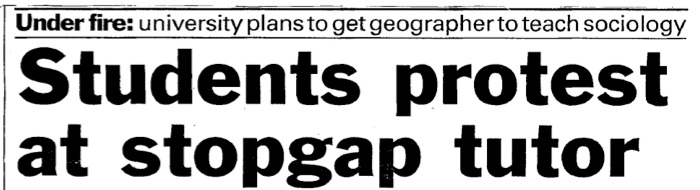
NHMy media experience has not quite added up to 15 minutes of fame so far – I was once on the front cover of the University of Reading student paper, and that rolled into the Reading Evening Post the next day (a scandal about geographers teaching sociology); and I was once quoted in a South African daily, and refuted by a government minister in the same story.

So given the chance, I jumped at the opportunity to be on Woman’s Hour on Radio 4 this morning – in my capacity as ‘ordinary bloke with kids’, obviously, the accidental by-product of being a research subject in Tina Miller’s study of men becoming fathers.

If this was even half decent radio, it wasn’t because of me, but because Dean Beaumont from DaddyNatal and Tina were arguing; I have lots of other things to say on the topic, but generally, I think that there is a fine line between supporting fathers to be involved around childbirth, on the one hand, and assuming this must be an active role in order for it to have any value – the reason many men might find it so weird, including me, is because they might be unfamiliar with how to just ‘be there’ for another person, doing what they are told, all the while trying to remember it’s not primarily about them.

I’m wondering what to make of the fact that there is an inverse relationship between the size of the audience for this programme and the degree of professional expertise I can claim to have to talk authoritatively about this topic. I only did it for Cultural Studies’ purposes.

Touch Me I’m Sick

JDEntirely coincidentally, this week, the week that HMV went into administration, I have finally decided to get rid of my LPs and cassettes – the former unplayed since 2000, the latter briefly revived in a house move in 2009, but long forgotten before that. I already have duplicate CD versions of some of these, or CDs of greatest hits which do much the same thing; and I have ordered a dozen or so replacements on CD from one of those online sites that has hastened HMVs decline, on the principle that every household with two female children growing up in it needs to contain a copy of Liz Phair’s Exile in Guyville, as well as London Calling (and I  don’t feel that guilty about HMV, I feel I did my bit to help them over the Xmas period). Nevertheless, this has meant deciding that there is a whole bunch of music I don’t want to listen to anymore.

I’m not a great believer in the idea that music sounds better on vinyl, or even in the ritual of taking records out of sleeves and that sort of thing; I do think having a physical object as the repository for music is crucial to how I at least listen – browsing a list of titles isn’t the same as browsing a shelf of poorly organised things. But there is something to be said for the LP as an art object, over CDs – I’m keeping Fear of Music ‘cos it has a weird corrugation pattern on it. What I have been going through, deciding what to chuck, what to replace, and what few to keep, is a distinctive aesthetic, not necessarily as constrained as even I remember: mid-to-late-80s-white-boy-Indie, sandwiched between the fading of New Wave and the horrors of post-Nirvana grunge. When the whole world seemed very jangly.

CodIn most cases, letting go has been fairly easy. I don’t have any great desire to return to Big Black’s Songs about Fucking, one of the least sexy records ever; or Dinosaur Jr; or Polvo. And I’ve decided that I no longer need to keep either of my sisters’ copies of David Bowie’s Changes One, or the family copy of The Beatles’ 1962-66 ‘red’ greatest hits.

But I’ve also rediscovered things I had forgotten about – at the risk of embarrassment, or not, things like Pavement’s Slanted and Enchanted, Talk Talk’s The Colour of Spring, Eartha Kitt, The Colorblind James Experience, Dionne Farris, The Aquanettas, Scrawl, who I saw almost get electrocuted in Columbus, Ohio in 1998, even The Triffids, whose career was ruined by Jason and Kylie’s wedding. I’ve also discovered to my surprise that I seem to have acquired every record ever made by the Throwing Muses up to the mid-90s.

I have been left wondering what principle I used to apply when buying some things on LP rather than cassette – some sense that certain things might be listened to on the move, perhaps, or maybe a sense that some albums you were meant to buy as LPs because they were proper and serious. I can’t remember when I bought my last record on vinyl, although I have a feeling it might have been a second-hand copy of Fleetwood Mac’s Rumours in Reading in about 2000. The first was Remember You’re a Womble. They’re both going out.

Is cultural activity really epistemological struggle?

Picture 044I spent a few days in Liverpool over the Christmas break, and while there I tried to take advantage of being in a Capital of Culture, as was. The main attraction was an exhibition at the Bluecoat of prints by William Kentridge, The Universal Archive. This solo exhibition provided an interesting contrast to my last proper High Culture experience, back in Oct/Nov, during my trip to Bloemfontein. Bloem’ has great art gallery, it turns out, the Oliewenhuis. They had an exhibition People, Prints and Process, of various print-based art works produced by artists associated with the Caversham Centre with which Kentridge is closely involved. This exhibition contained one or two pieces by Kentridge, but alongside the work of lots of the artists using print as their medium. The prints in the show currently in Liverpool (it’s moving on soon I think) are actually slightly out of context, in a sense – they are of course rather static, but bring to mind the more animated works by Kentridge for which they often seem to serve as templates or testing grounds, or perhaps, traces (this exhibition didn’t have any of his films on show – not necessarily a bad thing – I always find it really difficult to watch arty film in a gallery space).

It was interesting to see these two exhibitions in close succession – in the exhibition at the Oliewenhuis, Kentridge is one almost a bunch of other South African artists, and the sense of print as a distinctively African medium was to the forefront – as well as how print is a vernacular, mass medium rooted in the textures of local life, as exemplified by the widespread use of linocut techniques. Whereas in the Universal Archive exhibition, Kentridge is presented as the internationally famous artist from South Africa.

I am not making a political point (and this is not my field of expertise), just reflecting on the experience of seeing the same bits of art in two different contexts – not just two different places (sunny and warm, cold and rainy), but seeing one or two of the same pieces sitting alongside works by other artists compared to making up part of a whole collection by the same artist. The difference, in fact, between the two sites, the two fields, enhances one’s appreciation, all around.