Urban Refugees: New book in Routledge Research in Place, Space and Politics Series

urI’m delighted that the first book in the Routledge Research in Place, Space and Politics Series has just been published – Urban Refugees: Challenges in Protection, Services and Policy, edited by Koichi Koizumi and Gerhard Hoffstaedter. Congratulations to the editors and all the contributors.

As Series Editor, I’ll also take this opportunity to remind anyone out there with a book idea, a half-finished book manuscript, or an edited collection in mind, to consider the series as a possible outlet – further details here. Do let me know if you have any questions about the series. Forthcoming titles in the Series include books that address a range of issues including ‘the commons’, migration and radical autonomy, and popular geopolitics; and beyond that, books addressing the politics of theatre, psychological governance, political street art, and the politics of architecture.

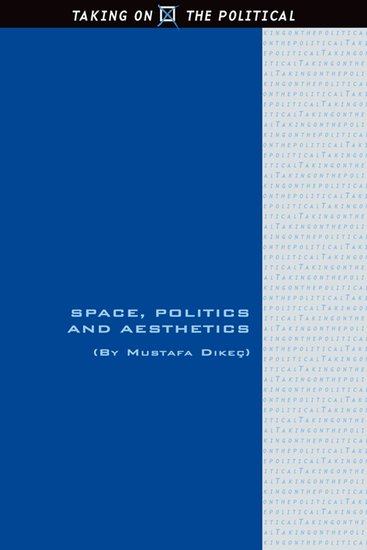
Space, Politics and Aesthetics: New book by Mustafa Dikeç

9780748685974I took part in a ‘conversation’ on the theme of Spaces of Democracy yesterday at UCL, organised by Liza Griffin and others, one of a series of events co-organised by the Bartlett School and the OU’s OpenSpace research centre. The other participants were Erik Swyngedouw and Mustafa Dikeç. I gave a potted version of the argument of the book I’m meant to be writing, in response to the question ‘Does democracy need the city?‘.

Mustafa has a new book hot off the presses, Space, Politics and Aesthetics, about thinking spatially about politics alongside Arendt, Nancy, and Ranciere. There is already one review available here.

Approaches to Human Geography: new edition published

91rdYH74XwLOh the excitement – a new year, and a new book in the pigeon hole at work. The new, second edition of Approaches to Human Geography, edited by Stuart Aitken and Gill Valentine, has been published. I have found this text, and various others in the ‘family’ of associated texts published by Sage on ‘Key Concepts’, ‘Key Texts’, ‘Key Thinkers’ really useful in my own transition back into not-so-distanced higher education teaching in the last year or so.

I happen to have a chapter in the Approaches volume, titled Postcolonialism: Powers of Representation. I don’t know about other chapters, but I think mine is a significant revision from the previous one, in tone if nothing else.

2014 Top Ten: Fun Books

IMG_2978Sometimes, in addition to the books I read for work, I also read things for less instrumental reasons, almost for pleasure, although the boundary is a bit fuzzy (in both directions). This is a list not so much of ‘best books’ of the year, more a list of the books associated with my favourite book-buying/book-reading experiences of the year.

1). Sarah Vowell’s Assassination Vacationbecause this is the kind of holiday I would like to take.

2). Let’s Talk About Love, by Carl Wilson, which is the best, and probably only, book about Celine Dion I am ever going to read.

3). Double Negative by Ivan Vladislavicmy favourite writer-whose-books-you-can-only-seem-to-buy-in-South-Africa.

4). The 10 Rules of Rock and Roll: Collected Music Writings 2005-09, by Robert Forster. I bought this for a couple of quid in Bristol, not knowing that he wrote music criticism, and discovered some new things to listen to as a result; I almost cried when reading his appreciation of co-Go Between, Grant McLennan.

5). James Salter’s Last Nightshort stories, no sentence of which can be read quickly, really good for reading in the bath.

6). Michael Tomasky’s Yeah! Yeah! Yeah!, my first e-book, I read this in one sitting on a flight to New York city. There were not screaming crowds awaiting my arrival.

7). Gideon Haigh’s Ashes to Ashes. I have come to dislike most things about cricket, leaving one or two pleasures at the edges, like Mike Selvey in The Guardian, and Vic Marks on the radio, and Gideon Haigh; this is really only a collection of his daily newspaper columns of the 10 Ashes Tests of 2013-2014.

8). The Years of Lyndon Johnson, Volumes 1, 2, and 3, by Robert Caro. This is a cheat, since I haven’t actually read all three of these this year, but I have been dipping in and out of each one, having read the fourth volume a couple of Christmas’s ago, and then seeing Bryan Cranston play LBJ in All the Way in March. The Bluecoat second-hand bookshop in Liverpool has had these three volumes sitting around for years, so I finally succumbed and got the lot for £20, a bargain).

9). The Portlandia Cook Book. I’ll give this a try, but nothing with pickles.

10). Simon Critchley’s Memory Theatre. I read this in two sittings, to and from Disneyland Paris on Eurostar, which seems appropriate in all sorts of ways.

2014 Top Ten: Theory Books

shoes’tis the season to make best-of-the-year lists, it seems. I read books for a living (which means not necessarily from start to finish, and generally by writing in them as I go along). These are my favourites from this year, ones which made me think the most, or confirmed my prejudices, or surprised me a little bit, and all of which also bought at least a little bit of pleasure.

1). Wrong-Doing, Truth-Telling: The Function of Avowal in Justice – Michel Foucault (like discovering a lost record by Talking Heads from somewhere between 1978 and 1982).

2). Dictionary of Untranslatables: A Philosophical Lexicon – edited by Barbara Cassin.

3). Sophistical Practice: Toward a Consistent Relativism – Barbara Cassin.

4). Genealogy as Critique: Foucault and the Problem of Modernity – Colin Koopman.

5). Keys to the City: How Economics, Institutions, Social Interaction, and Politics Shape Development – Michael Storper.

6). Democracy and Illusion: An Examination of Certain Aspects of Modern Democratic Theory – John Plamenatz (and oldie, bought by accident).

7). Making Human Geography – Kevin Cox (my favourite book by someone I know).

8). Africa’s Urban Revolution – edited by Sue Parnell and Edgar Pieterse (makes you think about cities and urbanization in new ways).

9). Justification and Critique: Towards a Critical Theory of Politics – Rainer Forst.

10). Sources of the Self: The Making of the Modern Identity – Charles Taylor (another oldie, and I’m not sure why I found myself reading this, but I did, and then I wondered why I hadn’t done so before).

Bite Size Theory: Democracy Past and Future

“The differentiation of the political today, then, follows from the fact that more and more modes of representation, types of supervision, procedures of monitoring, and manners of expression of preferences are becoming available and distinguishing themselves from one another. Paradoxically, democracy thus seems to be diluted precisely because the possibilities of relating to institutions and one another are multiplying.”

Pierre Rosanvallon, 2006. Democracy Past and Future, New York, Columbia University Press.

Bite Size Theory: The Politics of Suffering and Smiling

“The study of politics is concerned with power. It normally starts from things as they are supposed to be: individuals competing for resources within a given socio-economic framework. But perhaps this is the problem: what we set out to discover is what we know already because we have a sense of how the political system works. What we need to do is to come to the question of politics from a different angle – one that enables us to cast a different light on what is happening, for it is the light we cast, the questions we ask, which ultimately determines what we see.”

Patrick Chabal, 2009, Africa: The Politics of Suffering and Smiling, London, Zed Books.

Bite Size Theory: On the Postcolony

“By defining itself both as an accurate portrayal of Western modernity – that is, by starting from conventions that are purely local – and as universal grammar, social theory has condemned itself always to make generalizations from idioms of a provincialism that no longer requires demonstration since it proves extremely difficult to understand non-Western objects within its dominant paradigms.”

Achille Mbembe, 2001, On the Postcolony, University of California Press.

Bite Size Theory: The Representative Claim

“Representation is about claim-making, and it is purposeful: makers of claims are trying to achieve acceptance and other effects through the conceptions of subject and object that they construct.”

Michael Saward, The Representative Claim, Oxford University Press, 2010.

Bite Size Theory: The Sources of Social Power (Volume 4)

“Neoliberals, like socialists, must compromise with power realities to achieve any of their goals. So within what is often called the neoliberal movement I distinguish four tendencies: principled neoliberalism elevating markets and individualism, the interests of capitalists, the interests of political elites, and a conservatism that uses the state to enforce morality, law and order, nationalism, and militarism. Though there is overlap among all of these, it is useful analytically to separate them.”

Michael Mann, 2013, The Sources of Social Power: Volume 4, Globalizations, 1945-2011, Cambridge University Press.