I think I just finished my book.
Oscilliate Wildly
I think I just finished my book.

I think I just finished my book.
 I am, finally, ever so close to finishing my book, and sending the final manuscript away to the publisher. A couple more weeks of ‘research retreat’ would enable me to complete it, but I am well and truly back in the real world now, so it’s a matter of squeezing book-work in between all sorts of other things. This coming week I have a nice distraction from worrying about not working on the book, as I am attending the Annual Meeting of Finnish Geographers, in Tampere. I am giving a couple of talks, one on ‘Geography and the Priority of Injustice’. Last time I talked to this title, back in April, I only had a very long note-like draft of a book. This time, I have a written-out-in-prose final draft, going through final edits. It’s a real thing, not a pretend thing.
My working title for the book has become The Priority of Injustice, although the ‘geography’ bit is not actually central to the book. The talk is developing into the occasion where I try to say out loud why the grand theme of the priority of injustice might capture some of the difficulties covered over in much of the work in the burgeoning field of geographies of justice. So I’m thinking of the coming week as a final impetus to finishing the monster in the box, so that I might move on to other things.
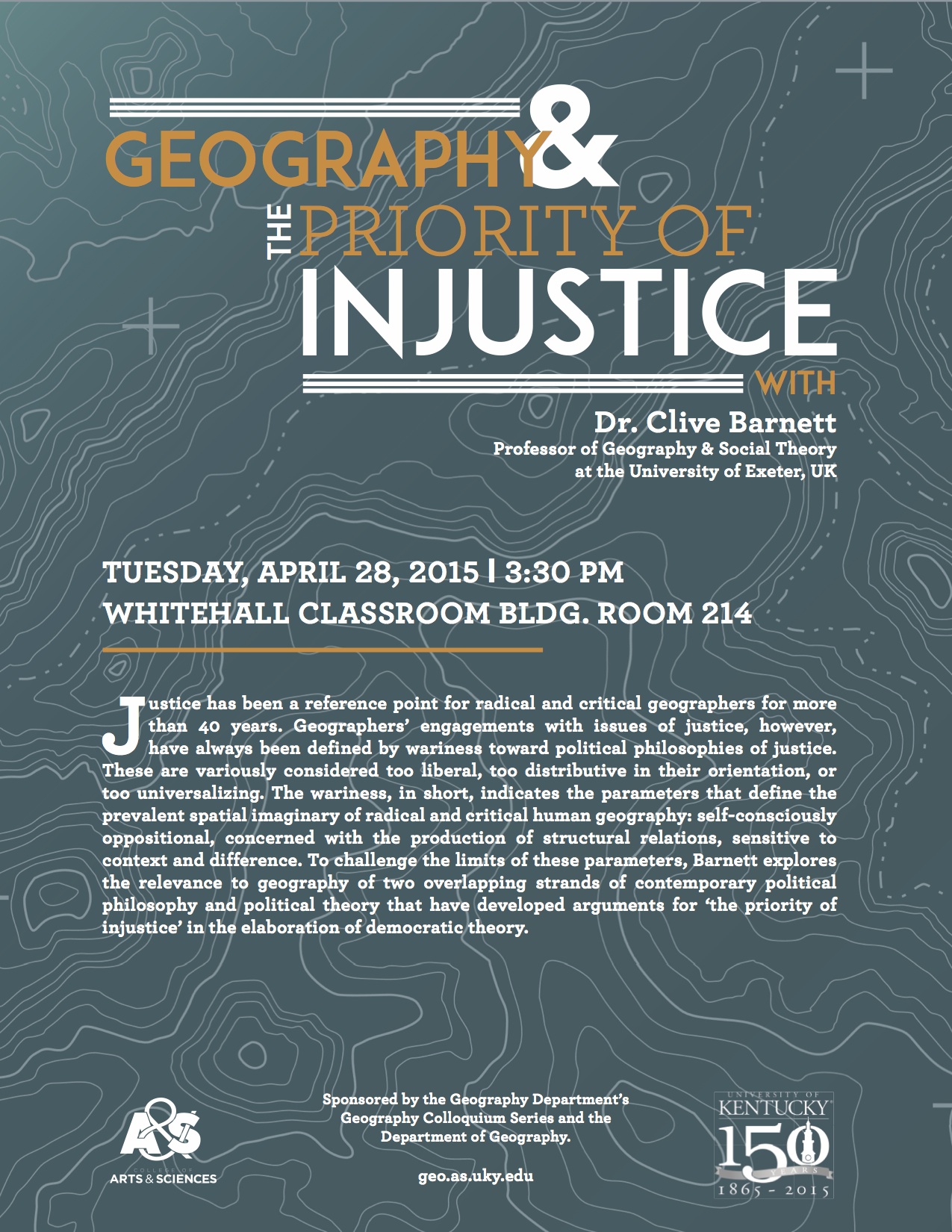 Next week I’m attending the Annual Meeting of the Association of American Geographers, in Chicago – organising a couple of sessions on Cases, Spaces and Situations, as well as giving a paper on problematization and urban theory. I’m then going on to visit the Geography Department at the University of Kentucky, in Lexington. I’m giving a talk there on the theme of ‘the priority of injustice‘, and the relevance of recent work on this theme to how the central normative concept of radical and critical human geography is approached. This is the first time I will have talked to the central argument of my book, still in progress, and tentatively entitled Democracy and the Geographies of Justice. I’m looking forward to the challenge of having to say out loud and in public what it’s meant to be about.
 Following up on the earlier post about the IJURR symposium on the theme Where is Urban Politics? I thought I should plug my own paper in this collection. My piece is titled ‘What do cities have to do with democracy?’ (the answer is that ‘it depends’; you’ll have to read the paper to find out what exactly it depends on). I have been giving a version of this paper as my default seminar presentation for about 4 years now, so I’m not quite sure what I will talk about if and when I’m next invited anywhere, but I do hope that this extensive pre-release touring of the paper will boost sales.
This paper is actually the last in a cluster that I have written on themes such as political agency, urban problems, ideas of contestation, and the idea of ‘all affected interests’. When I finished this one (a while ago now), I realised that I really needed to write a book linking these together, since an 8000 word (or so) article is not enough space to elaborate the full sweep of the argument that I have in my head which connects these all together. So that’s what I am doing now, this summer, writing a book about democratic theory, notions of injustice, and the geographical imagination needed to develop open-minded inquiry into these themes – it’s preliminary title is Locating Democracy, contracted with the University of Georgia Press, in their Geographies of Justice and Social Transformation series. I’m saying this out loud and in public as a way of imposing some external discipline on myself, to help me along in the task of actually writing the book.
Anyway, anyway, in the meantime, here is the abstract from the IJURR paper:
“The relationship between urbanization and democratization remains under-theorized and under-researched. Radical urban theory has undergone a veritable normative turn, registered in debates about the right to the city, spatial justice and the just city, while critical conceptualizations of neoliberalism present ‘democracy’ as the preferred remedy for injustice. However, these lines of thought remain reluctant to venture too far down the path of political philosophy. The relationship between urban politics and the dynamics of democratization remains under-theorized as a result. It is argued that this relationship can be usefully understood by drawing on lessons from avowedly normative styles of political theorizing, specifically post-Habermasian strands of critical theory. Taking this tradition seriously helps one to notice that discussions of urbanization, democracy, injustice and rights in geography, urban studies and related fields invoke an implicit but unthematized democratic norm, that of all-affected interests. In contemporary critical theory, this norm is conceptualized as a worldly register of political demands. It is argued that the conceptual disaggregation of component values of democracy undertaken through the ‘spatial turn’ in recent critical theory reorients the analysis of the democratic potentials of urban politics around the investigation of the multiple forms of agency which urbanized processes perform in generating, recognizing and acting upon issues of shared concern.”
 Pop Theory