“It was not Marxism that made Lenin a revolutionary but Lenin who made Marxism revolutionary.”
Orlando Figes, 2014, Revolutionary Russia, 1891-1991.

“It was not Marxism that made Lenin a revolutionary but Lenin who made Marxism revolutionary.”
Orlando Figes, 2014, Revolutionary Russia, 1891-1991.
“Strong as was Lyndon Johnson’s compassion for the poor, particularly poor people of color, his deep, genuine desire to help them had always been subordinate to his ambition; whenever they had been in conflict, it had been compassion that went to the wall. When they had both been pointing in the same direction, however – when the compassion had been unleashed from ambition’s checkrein – then not only Lyndon Johnson but the cause of social justice in America had moved forward under the direction of this master of transmuting sympathy into governmental action.”
Robert Caro, 2012, The Years of London Johnson, Volume 4: The Passage of Power.
“Throughout LBJ’s life, in every institution of which he had been a part, a similar pattern had emerged: as he rose to power within the institution, and then, as he consolidated that power, he was humble – deferential, obsequious, in fact. And then, as the power was consolidated, solid, when he was in power and confident of staying there, he became, with dramatic speed and contrast, overbearing, domineering.”
Robert Caro, 2002, The Years of London Johnson, Volume 3: Master of the Senate.
“Understanding political power in a democracy requires understanding elections.’
Robert Caro, 1990, The Years of London Johnson, Volume 2: Means of Ascent.
“The grass had grown not over a season but over centuries. It wouldn’t have grown at all had it not been for fire – prairie fires set by lightning and driven by wind across tens of thousands of acres, and fires set by Indians to stampede game into their ambushes or over cliffs – for fire clears the land of underbrush, relentless enemy of grass. […] Even with the aid of fire, the grass had grown slowly – agonizingly slowly. […] It had grown slowly because the soil beneath it was so thin.”
Robert Caro, 1982, The Years of London Johnson, Volume 1: The Path to Power.
 The latest book in the Routledge Research in Place, Space and Politics series has been published – Externalizing Migration Management: Europe, North America and the spread of ‘remote control’ practices, edited by Ruben Zaiotti. Further details are available here.
Further details on the series, including guidelines for submitting proposals, can be found here and here.
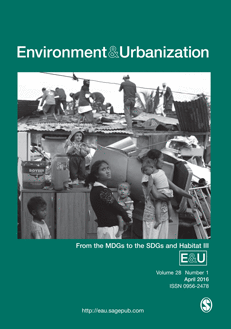 The latest issue of Environment and Urbanization contains a collection of papers examining different aspects of the emergence of the so-called ‘new urban agenda’ in global development policy, titled From the MDGs to the SDGs and Habitat III. It includes the paper by myself and Sue Parnell, ‘Ideas, implementation and indicators: epistemologies of the post-2015 urban agenda‘ which tracks some of the intellectual influences circulating around these worlds of policy-making and agenda-setting (Sue also has another piece tracing the longer history of global urban development agendas in World Development).
To repeat a previous invitation, if you would like a copy of our paper, do let me know and I will forward it along. Once more, here is the abstract for the paper:
“The success of the campaign for a dedicated urban Sustainable Development Goal (SDG) reflected a consensus on the importance of “cities” in sustainable development. The relevance accorded to cities in the SDGs is twofold, reflected both in the specific place-based content of the Urban Goal and the more general concern with the multiple scales at which the SDGs will be monitored will be institutionalized. Divergent views of the city and urban processes, suppressed within the Urban Goal, are, however, likely to become more explicit as attention shifts to implementation. Acknowledging the different theoretical traditions used to legitimize the new urban agenda is an overdue task. As this agenda develops post-2015, the adequacy of these forms of urban theory will become more contested around, among other concerns, the possibilities and limits of place-based policy, advocacy and activism; and ways of monitoring and evaluating processes of urban transformation along multiple axes of development.”
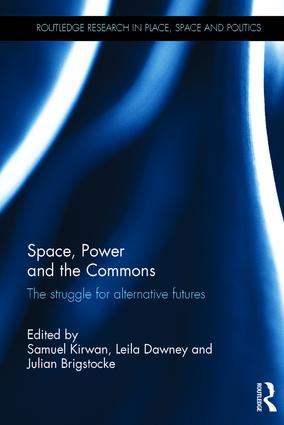 The latest book in the Routledge Research in Place, Space and Politics series is now published (technically it is a 2016 book) – Space, Power and the Commons: The struggle for alternative futures is edited by Sam Kirwan, Leila Dawney and Julian Brigstocke, and is associated with the Authority Research Network. It’s an important addition to the literature on the theme of ‘the commons’, not least because it draws together discussions of high theory on this topic (Hardt, Nancy, Ranciere, etc) with empirical analyses of practices of ‘commoning’.
This is the second title to appear in the Place, Space and Politics series, after the collection on Urban Refugees. There are more titles in the pipeline. More details on the series, including guidelines for submitting proposals, can be found here and here.
Here is Andy Merrifield on ‘Europe’s New Urban Question’, speaking at Kentucky a month or so ago.
 I have a piece newly published in Dialogues in Human Geography, grandly titled ‘On the milieu of security: Situating the emergence of new spaces of public action‘. As that may or may not indicate, it is a discussion of different ways in which issues of security are discussed in various fields of critical social science. It is one attempt to think through how ideas of problematization might re-cast the self-image of ‘critique’ in left theory, or at least, to elaborate further on two very different ways of doing things with Foucault (I’m sure there are more than tw0).
The formula for this new-ish journal is that lead articles are published alongside a series of commentaries. My interlocutors were Ben Anderson, It’s an interesting process, and I would have loved to write more in response to the commentaries, partly for clarification inevitably, but also because different people raised all sorts of issues I have lots to say about as well (like concepts of attention).
As with lots of my publications recently, this one was not so much planned as arising out of an invitation to think about a topic I didn’t know I was meant to know about. It dates back to a conference in Ottawa more than three years ago on the theme of Security and its Publics (organised by two of the commentators mentioned above, William and Anne-Marie). Efforts to publish a collection of the papers from the event fell foul of some rather shoddy practices from journal editors (not in geography, I should hasten to add). The turnaround for the piece in Dialogues, from submission to full publication, has been less than a year, which is remarkable considering that it involved not just getting referees for the original submission but also a whole bunch of coherent commentaries too. William and Anne-Marie have also published a piece which addresses some of the issue raised at the event, on the theme of ‘Bringing publics in critical security studies‘.
Here’s the abstract for my lead piece:
“Critical analysis of security presents processes of securitization as sinister threats to public values such as accountability, inclusion and transparency. By questioning some of the theoretical premises of this view of the milieu of security, it is argued that practices of securitization might be understood less as an assertive medium for the constitution of the social field and more as a responsive mode of problematization of the temporalities of concerted public action. The argument proceeds in stages. First, two ways in which publicness is figured in the critique of security are identified and the spatiality of securitization associated with them elaborated. Second, this view of the spatiality of securitization is then linked to two modes of temporality that apparently define the historical novelty of contemporary security practices. It is argued that uncovering the pernicious politics of security depends on identifying putative subject effects sought and achieved by programmes of rule. In contrast to this approach, an alternative inflection of the genealogical perspective on security is identified. This inflection seeks to diagnose problematizations to which security initiatives are a response, suggesting a reorientation of critical attention to investigating the reconfiguration of public life around various temporal registers of uncertainty, adjustment and repair. The article closes by arguing that the specific public values at stake in securitization should be given more credence.”
 Pop Theory