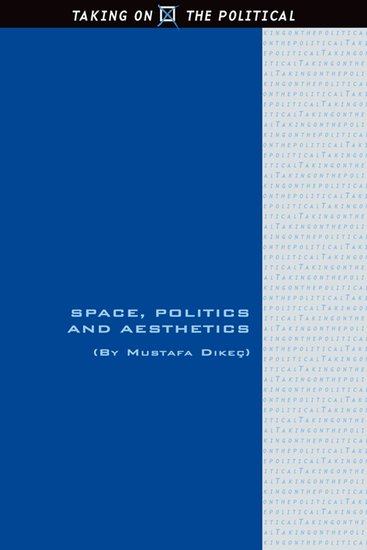
Space, Politics and Aesthetics: New book by Mustafa Dikeç

9780748685974I took part in a ‘conversation’ on the theme of Spaces of Democracy yesterday at UCL, organised by Liza Griffin and others, one of a series of events co-organised by the Bartlett School and the OU’s OpenSpace research centre. The other participants were Erik Swyngedouw and Mustafa Dikeç. I gave a potted version of the argument of the book I’m meant to be writing, in response to the question ‘Does democracy need the city?‘.

Mustafa has a new book hot off the presses, Space, Politics and Aesthetics, about thinking spatially about politics alongside Arendt, Nancy, and Ranciere. There is already one review available here.

(How) Should we Read Heidegger?

Scan 130690059-3Just noticed this in Geografica Helvetica (via a tweet from Juliet Fall about this journal being open access now) – a ‘debate’ emerging, perhaps, about the implications for geographical thought of the latest revelations in Heidegger’s ‘black notebooks‘, published last year (not very flattering revelations, which is of course saying something). Benedikt Korf raises the question of whether there isn’t something irredeemably tainted, poisonous, about Heidegger’s thought. Ulf Strohmayer takes up the challenge thus laid down, arguing that the best way to respond is to delve even deeper into Heidegger’s thought – a not uncommon response to the sorts of questions Benedikt raises. Somewhere between the two pieces, the question of the degree to which the fascination with/of Heidegger depends upon all the biographical stuff (Nazi, adulterer, prude, anti-semite, etc) is passed over.

Of course, it might always be possible to go along in geography without worrying about Heidegger’s thought at all, one way or the other.

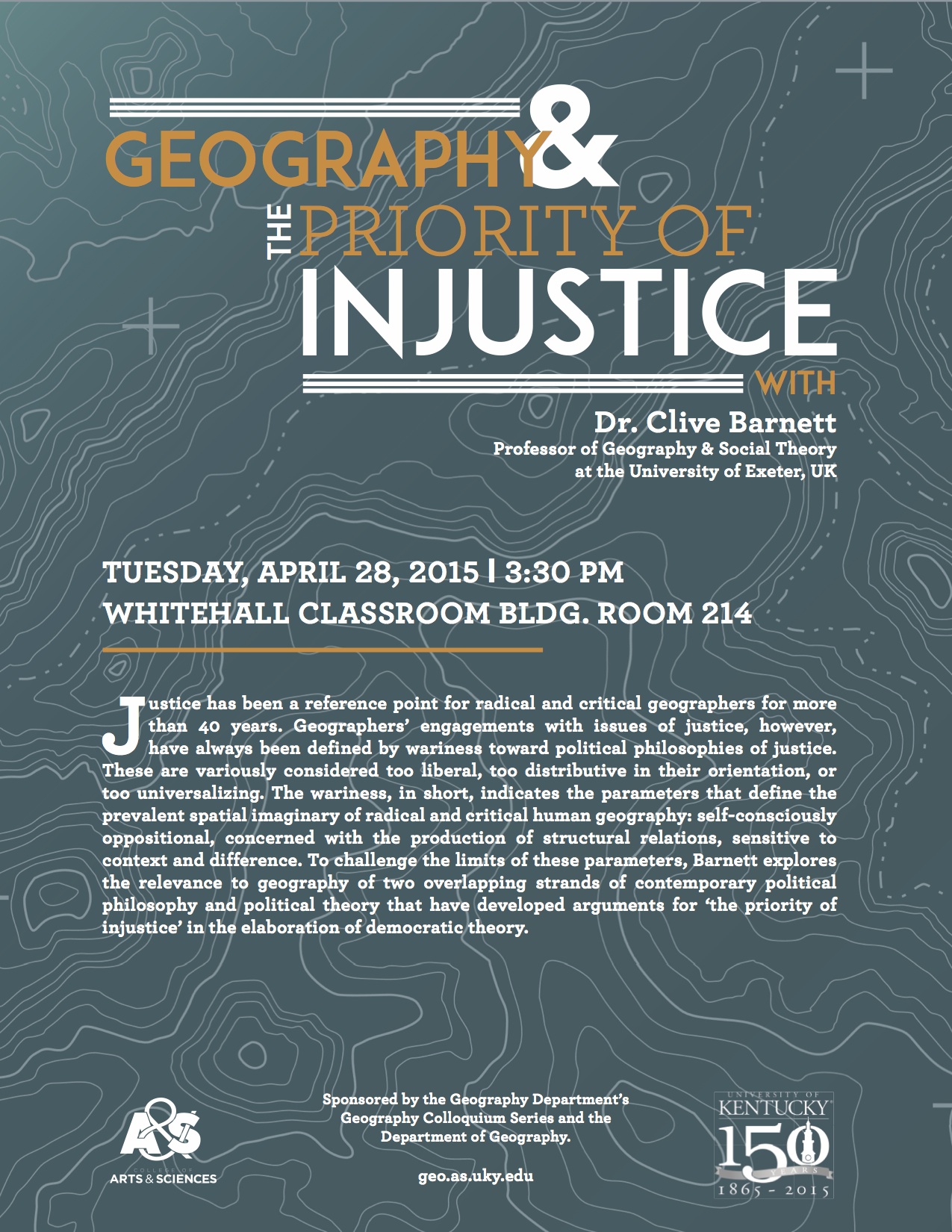
Geography and the Priority of Injustice

Geo & Injustice_REVNext week I’m attending the Annual Meeting of the Association of American Geographers, in Chicago – organising a couple of sessions on Cases, Spaces and Situations, as well as giving a paper on problematization and urban theory. I’m then going on to visit the Geography Department at the University of Kentucky, in Lexington. I’m giving a talk there on the theme of ‘the priority of injustice‘, and the relevance of recent work on this theme to how the central normative concept of radical and critical human geography is approached. This is the first time I will have talked to the central argument of my book, still in progress, and tentatively entitled Democracy and the Geographies of Justice. I’m looking forward to the challenge of having to say out loud and in public what it’s meant to be about.

2014 Top Ten: Theory Books

shoes’tis the season to make best-of-the-year lists, it seems. I read books for a living (which means not necessarily from start to finish, and generally by writing in them as I go along). These are my favourites from this year, ones which made me think the most, or confirmed my prejudices, or surprised me a little bit, and all of which also bought at least a little bit of pleasure.

1). Wrong-Doing, Truth-Telling: The Function of Avowal in Justice – Michel Foucault (like discovering a lost record by Talking Heads from somewhere between 1978 and 1982).

2). Dictionary of Untranslatables: A Philosophical Lexicon – edited by Barbara Cassin.

3). Sophistical Practice: Toward a Consistent Relativism – Barbara Cassin.

4). Genealogy as Critique: Foucault and the Problem of Modernity – Colin Koopman.

5). Keys to the City: How Economics, Institutions, Social Interaction, and Politics Shape Development – Michael Storper.

6). Democracy and Illusion: An Examination of Certain Aspects of Modern Democratic Theory – John Plamenatz (and oldie, bought by accident).

7). Making Human Geography – Kevin Cox (my favourite book by someone I know).

8). Africa’s Urban Revolution – edited by Sue Parnell and Edgar Pieterse (makes you think about cities and urbanization in new ways).

9). Justification and Critique: Towards a Critical Theory of Politics – Rainer Forst.

10). Sources of the Self: The Making of the Modern Identity – Charles Taylor (another oldie, and I’m not sure why I found myself reading this, but I did, and then I wondered why I hadn’t done so before).

Bite Size Theory: Thinking in an Emergency

“Insofar as I am making an argument about finding and following good habits, I am also making an argument about finding and following, binding ourselves to, good constitutional procedures. Conversely, I am suggesting that our contempt for our laws, the suspension of constitutional requirements overseeing our entry into war, is in part based on our contempt for the habitual that is undeserved.

Elaine Scarry, 2011, Thinking in an Emergency, W.W. Norton.

Bite Size Theory: On the Postcolony

“By defining itself both as an accurate portrayal of Western modernity – that is, by starting from conventions that are purely local – and as universal grammar, social theory has condemned itself always to make generalizations from idioms of a provincialism that no longer requires demonstration since it proves extremely difficult to understand non-Western objects within its dominant paradigms.”

Achille Mbembe, 2001, On the Postcolony, University of California Press.

Bite Size Theory: Public Goods, Private Goods

“The possibilities of real or hypothetical agreement or consensus in the world are extremely limited. This does not, of course, imply that it might not be an extremely good idea to conduct as extensive discussions as possible, develop discursive institutions, and so on. We might have all kinds of good reasons for this apart from the excessively cheerful idea that free discussion would give us automatic access to a common good.”

Raymond Geuss, 2001, Public Goods, Private Goods, Princeton University Press.

Bite Size Theory: On Violence

“Violence can be justifiable, but it never will be legitimate. Its justification loses its plausibility the farther its intended end recedes into the future.”

Hannah Arendt, 1969, On Violence, Harcourt and Brace.

Bite Size Theory: Being Singular Plural

“What comes to us today is the demand to give the meaning of being-in-common according to what it is – in– common or with- – and not according to a Being or an essence of the common.”

Jean-Luc Nancy, 2000, Being Singular Plural, University of Minnesota Press.

Bite Size Theory: The Ethics of Deconstruction

“Democracy is a fragile, agnostic, doxic form of political life, where fragility is the price to be paid for the refusal of all forms of immanentism. Democracy is the politics of difficulty, opacity, and dirty hands, of the fact that the social is not a complete, transparent oeuvre, that political action is always taken on an open, undecidable terrain.”

Simon Critchley, 1992, The Ethics of Deconstruction: Derrida and Levinas, Blackwell.