Public action: making things visible or catching the attention?

I’ve been meaning to write down some thoughts provoked in particular by the workshop on Security and its Publics that I attended in Ottawa back in September, but other things have been in the way – including another workshop on Rethinking the Public, this time in Bloemfontein, which partly confirmed some of these thoughts even though it wasn’t limited to the security theme.  

Both events confirmed for me that there seems to be an almost automatic tendency for discussions of publicness to devolve into discussions of ‘the Public’, as if the main thing at stake was the status of a sociological entity, equivalent to a group, or a people, or a nation. Thought of like this, of course, ‘the Public’ is always either found wanting (not interested enough in the things they should be), or is being misled. This tendency to think of publicness in terms of a substantive subject is, perhaps, only compounded by the current interest in insisting that publics need to be theorised as ‘material’ or ‘materialised’. This just threatens to compound the problem of thinking of publicness in overly substantive terms, rather than as a weird, queer, perhaps magical quality that requires an account of action not substances.  

The Ottawa workshop included academics, activists, and artists (here is a reflection from Kate Milberry, one of the other participants) – the emphasis intellectually was shaped very much by critical security studies and IR: papers about drone strikes, the militarisation of the policing of protest, creeping surveillance of everyday life, that sort of thing. I presented a paper around the hunch that much of the critical analysis of security and ‘securitization’ has conceptual trouble imagining practices of policing, surveillance, war even, as ever possibly being pursued for legitimately public ends. The problem is conceptual in so far as it follows from an investment in certain sorts of theory which aren’t very good at thinking about the public mediums of action, not least of violent action – dark readings of Foucault, credulous readings of Agamben, that sort of thing.

There seem to be two senses of publicness operating in lots of this work – an implicit ideal of transparency and openness, which operates as the benchmark against which any and all practices of security are always already rendered suspect; and a sense of public space as a communicative milieu of a certain sort, either for ideological interpellation or affective contagion, through which fear and anxiety is routinely circulated. If you combine these two, then you get to the point where security practices are always counter to public values, because they are meant to operate out of the open, they are hidden, surreptitious, secretive, invisible, and yet brilliantly effective for all of that.

One of the things that crystallised for me at this workshop is the degree to which critical invocations of ‘public’ values often presume that publicness is all about visibility – hence the sense that securitization is problematic for public values because it is presumed that it is a process all about secreting things, hiding them away (I think there might be fundamental differences in how ‘security’ is thought in IR/critical security studies when compared, say, to fields working on ‘biosecurity’ and related topics – this is partly disciplinary, no doubt, but also something to do with different ways of reading Foucault and Foucault-sourced notions such as governmentality, biopolitics, and, well, security). I’m not sure I’m convinced that security practices and discourses should be thought of as presumptively illegitimate, undemocratic, or suspect just because they may involve some element of secrecy (which they may or may not anyway). Is secrecy necessarily opposed to the public values of democracy? Always?

The sense that securitization is at odds with democratic values begs some questions. What public values, for example, are at stake in processes of securitization? (Protection, order, etc – these are public values after all). Again, there is an interesting difference here with work on biosecurities, which does seem able to articulate security practices with thinking about publicness in a non-reductive way. More broadly, I came away thinking that the visibility/invisibility frame really isn’t a very helpful way of thinking about processes of public formation at all. It might even be an index of not thinking very hard about what the politics of public formation.

There seems to be an assumption in critical analysis of security that if only it were possible to make more widely visible various types of terrible thing – drone strikes, human rights abuses, unauthorised interrogation techniques, militarized policing – then ‘the public’ would naturally object. The analysis of security and its publics in this register of visibility sustains some standard critical gestures – critique is all about making things visible, uncovering hidden away things, perhaps bearing witness. The visual register tends to take for granted that ‘the public’ would and should, under the right circumstances, be horrified by the same things that upset the critic – it is assumed that the harms and wrongs of some practices should be self-evident, and this means this sort of critical analysis ends up coming close to always blaming ‘the Public’ for their indifference.

The two papers at the Ottawa workshop that seemed to stretch almost to breaking point the visual register in which security and its publics is theorised were, it turns out, both by geographers – Jennifer Hyndman talking about refugee camps in East Africa, and Alison Mountz talking about the use of islands as the location for off-shore detention centres by the US, UK and Australian governments. In both cases, there isn’t anything ‘invisible’ about the practices or places at issue – you can’t hide a refugee camp, they are in plain sight. Hyndman talked around the theme of ‘apprehending’, in terms of a kind of double, ambivalent political and epistemological sense of laying hold of and/or seizing, but also of learning about (I’m probably doing the argument an injustice). Likewise, Mountz framed her analysis in terms of drawing attention, distraction, things ignored, not just visibility and invisibility.

Apprehension and attention seem much more useful, conceptually, as more than mere figures of speech, than the metaphorics of visibility and invisibly for understandings processes of public formation. In particular, attention is a much better theme through which to hold in tension the sense of the public as a kind of sociological entity and the sense of publicness as involving some abstraction from more immediate social relations. It helps to pinpoint how ‘making things public’ might be less about making things visible, or seeing things, and more about noticing, paying attention, or being distracted, or indeed, attending to and caring.

The reason I like the idea of thinking of public formation in relation to notions of attention and attending is because, of course, there is an economy of attention that is a little more subtle than that suggested by visibility versus invisibly. Attention is a key concept in the economics of information and in some strands of media theory too. The general point is that attention is a scarce resource – you can’t pay attention to everything all at once; attention is, further, selective, and partial. And it’s often really hard work to get people to pay attention. Attention might be a much better theme around which to pursue a concern with the ‘materiality’ of public formation – for example, going back to the theme of security, it might be the case that some issues, some scenes and sights, resist attention almost by their very nature – including the horrors of violence and torture. It might be much more difficult to build sustained attention around some issues than others, because of the ‘aesthetic’ qualities of those issues.

I also think attention might be a fun way to get at what seems to me to a fundamental division within contemporary academic work on ‘public’ things. Lots of this work tends to think of publicness primarily as a communicative practice, in either deliberative-legitimatory ways or agonistic-oppositional ways. This work finds it really difficult to acknowledge that ‘public’ is also a name given to certain sorts of institutionalised, bureaucratic configurations – the public sector, public transport, that sort of thing. But public agencies, charged with delivering material goods and services, might also be thought of in terms of the analytics and economics of attention – in a sense, they are organised practices for sharing, distributing and providing attention, even of aggregating attention – for paying attention to some in the name of others, of delegating the responsibilities of attending. Giving attention, attending to the needs of ‘the public’, is what these agencies do. In principle.

Anyway, somewhere here, around the notion of attention, I think there might be a way of thinking about the family resemblances that connect different paradigms of public life – more communicative ones with more organisational ones.

And I think attention also challenges the terms of criticism through which public formation is discussed. The critique of securitization in terms of visibility and invisibility either overestimates the obvious normative pay-off of making things visible, or it ends up having to invest too much hope in the same rationalities of affective contagion that it takes as its object of critique in the first place. Issues may or may not rise to public attention, on the other hand, because of something about the issue that resists or repels attention; or lack of attention might be sociologically structured – people have other things to do, other things to pay attention to, other concerns to attend to. And above all, this all suggests paying more attention to the hard work involved in attracting and maintaining attention, as well as in distracting attention – harder than exposing things, or just hiding them away.

I wonder if it would be possible to imagine an account of public formation which does entirely without a visual vocabulary? This vocabulary gets in the way of thinking about the sorts of action involved in public practices, the sorts of action involved in noticing, caring, attending.

Media archaeology II

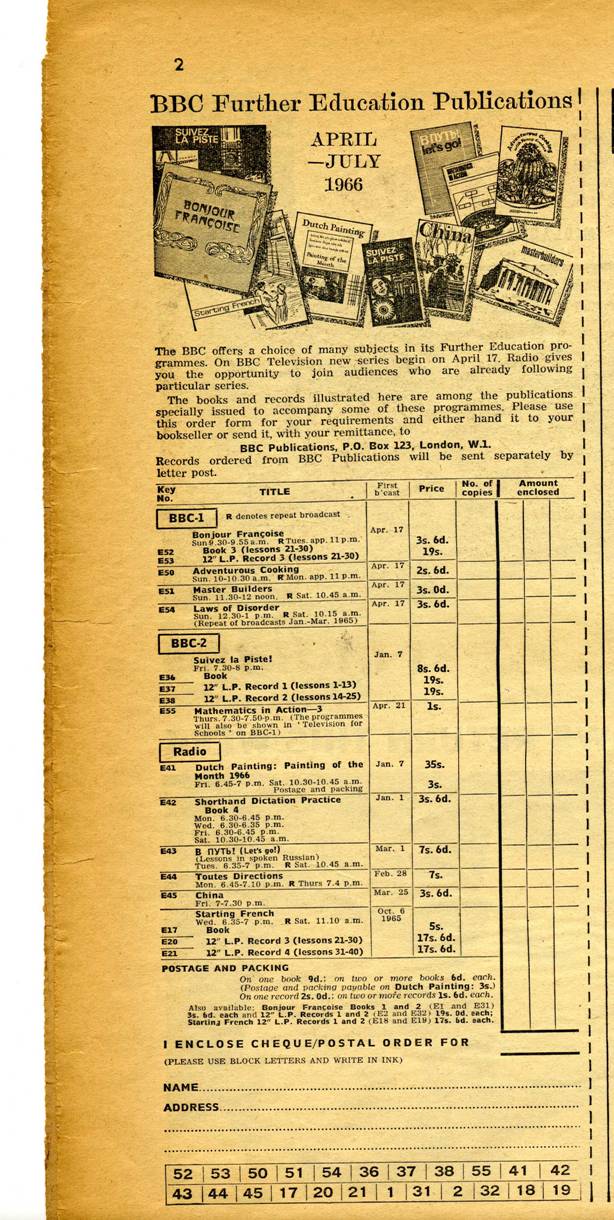
A while back now, I wrote a few posts about the family ‘stuff’ I was finding myself having to go through. Some of this stuff opens windows on quite personal and intimate histories, some of it more public ones. One of my favourite excavations has been the discovery of some more or less random pages from TV and radio guides from 1966. In a cupboard in my mother’s house was a bunch of framed pictures, including one of my two older sisters when they were toddlers. The frame of this picture was broken, and when I took it apart, behind the photograph, the paper used to pack the photo into the frame was old editions of the Radio Times and TV World (a predecessor of TV Times I guess). They are from Spring 1966, shortly after my parents and sisters returned to the UK after their African adventures – the TV World is actually for the old ATV region, and the Radio Times is the Midlands and East Anglia edition. 

These yellowing pages reveal a lost world of British public culture, when The Fugitive was the exciting new US import on ITV, Sheila Hancock starred in a show as “one of life’s most entertaining victims”, Captain Pugwash was a cartoon strip in The Radio Times, and you could order an Asbestos Garage from £43. 7s. from the back of the same publication.  Easter Monday’s schedule on ITV that year was all sport: international swimming, from Llanelly; motor racing, from Goodwood, obviously; racing from Newcastle; and show jumping from Hickstead (with commentary by Raymond Brooks-Ward, who I had never associated with ITV, in so far as I think about his career much at all). The BBC was about to broadcast the first of eight, yes eight, nightly programmes reconstructing the ‘Irish Rebellion’ of 1916.

The Letters pages of both publications are testaments to the critical capacities of engaged, active audiences – a brilliant debate about whether or not the plotlines of Softly, Softly were too vague and lacking in satisfactory clarity by the end of each episode, or for that very reason best compared to Kafka’s novels. Or a complaint about the contrast between the national news on BBC radio, presented apparently in “a serious, sensible, and factual manner”, and regional news stories which “are treated in a simpering, pseudo-cosy style”. Pseudo-cosy, what a great concept.

The Radio Times for the 16th-22nd April also contained a half page advert for BBC books and records to accompany its Further Education programmes (Adventurous Cooking, Laws of Disorder) – a peak into the pre-history of The Open University, when the BBC was already pioneering the use of multi-media platforms for adult education. 

Over at TV World in the same week, the letters were all about how best to make custard pies that flop – part of a discussion with the TV World cookery expert. This is from an age before Tiswas.

Open University initiatives on poverty

Here are a couple of OU-related initiatives and research projects on issues of poverty – a series of documentaries on Why Poverty? with other media resources too; and the re-launched website of the ESRC-funded collaborative project on Poverty and Social Exclusion (this will at some point soon have links to audio-visual materials associated with the new module The Uses of Social Science that has just started it’s first presentation – I’ll post again when this is live).

Two ‘media’ events

For anyone so inclined, two recently advertised events on media/communications issues:

A forthcoming lecture by Onora O’Neill at Goldsmiths in November; and an ICA ‘preconference’ next June, on the theme of Conditions of Mediation, organised by Scott Rodgers and Tim Markham.

Subjects of emergency

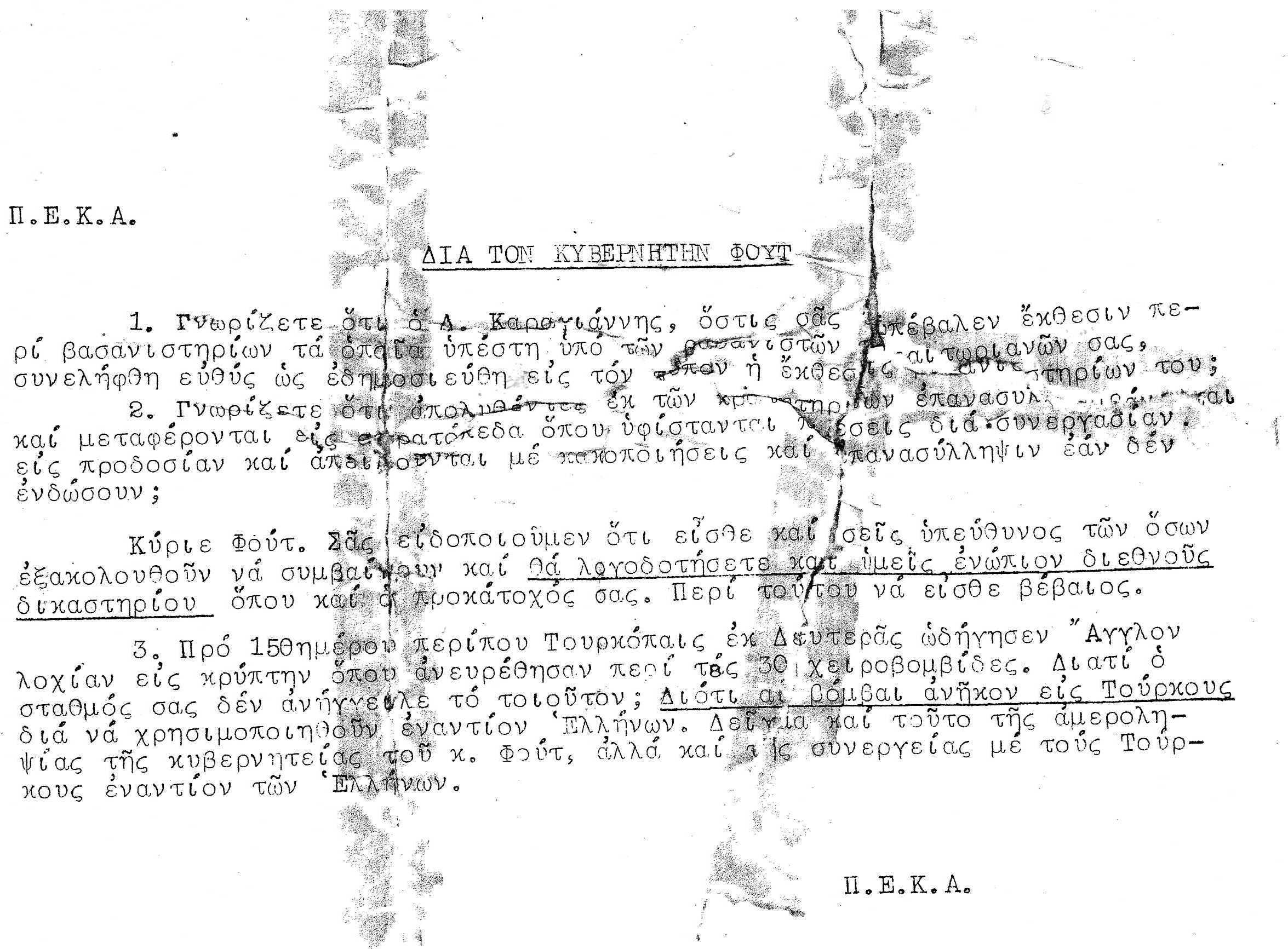
More from the family archives: my mother and father were married in August 1957, and he was then posted to Cyprus. My mother arrived to join him at the beginning of 1958. She arrived slap bang in the middle of ‘the Emergency’. By 1958, Britain’s ‘small war’ in Cyprus was reaching its end game. The emergency was a response to the paramilitary campaign of the EOKA (the National Organization of Cypriot Fighters), who sustained a campaign of bombings, shootings, assassinations and demonstrations for 4 years from 1955 . EOKA’s campaign was halted in 1959, when the British negotiated a settlement for independence with Archbishop Makarios, rather than ‘Enosis’ or unification with Greece which had been the explicit aim of the campaign. Cyprus was another of those places where the British developed counter-insurgency and anti-terrorism strategies in the 1950s.

The cinefilm from this period consists of long stretches of film taken while driving around the island; and from the air, of flying around it too. My mother always referred to this period by repeating the same anecdote – one about being escorted around town by soldiers carrying Sten Guns. It clearly left an impression.

Amongst many other things, my mother pasted into her scrapbook orders from British military officials to servicemen on how to conduct themselves (see: Viking Patrols), but also EOKA leaflets addressed to both British soldiers and to local Turkish and Greek Cypriots (see: EOKA to British Soldiers and Rumours). Leafleting was in fact a key aspect of the EOKA’s campaign, it turns out – a kind of legitimizing and/or intimidatory and/or mobilising public supplement to the use of violence. These come from June 1958, during an intensification of inter-communal violence and British clampdown.

There are also a couple of gems from October 1958, issued in the days immediately following the shooting dead of the wife of a British serviceman on the island. They provide specific instructions to households for going shopping to the NAAFI (see: Lady customers) and even more precise instructions for wives (see: Restrictions on wives) as to when and where and whom to visit.

This handful of pieces of paper are like a personal archive of my mother’s experience of colonial and anti-colonial violence, order and terror. They give a little insight into the ordinary ways in which the subjects of the emergency were constructed by various sides: as ‘youths’ and ‘mobs’; as ‘civilised persons’ or ‘agressors’; as ‘helpless Greeks’ and ‘soldiers’ obeying orders, or just doing a ‘bobby’s job’; as ‘husbands’ and ‘wives’ and ‘children’.

Apart from anything else, all this makes it a little more obvious why a move to Rhodesia may have appeared a nice idea.

Media archaeology

I’ve spent quite a lot of time in the last month or so wading through a bunch of my parents’ ‘stuff”, following the death of my mother. There are different levels of ‘stuff’ involved here, of course, from a garage full of gardening tools to toothpaste. Different sorts of significance attach themselves to different types of ‘stuff’.

I’ve come to think of this process as akin to a form of personal, family archeology, as different objects provoke new questions, or new understandings of previously remembered events.

Once you have moved beyond the level of ‘stuff’ that is disposable (and this might vary, depending on how you feel), one way or another, the contents of one’s parents home seem to fall into two broad categories: material objects (including books), and ‘media’ stuff. Media stuff includes photos, but also in my case a large number of slides and negatives, and 2-3000 feet of 8mm cine film. Very little of this media stuff has been seen by me, or my sisters, I think, for three decades or so, at least. It has been living in lofts and cupboards, as is the way with these sorts of materials. I’m bringing it back to life, so to speak, having transferred 500 odd slides onto the PC, and have just had the cine film digitized (by a very nice man in Swindon who specialises in this – see SaveThoseMemories). 

Media stuff has a distinct emotional charge – it evokes different memories, but also evokes memories in different ways. I’ve now seen versions of my parents I had never seen before, as well as movies of me as a baby which are the only visual record of me actually ever having been a baby. And I have never quite realised before how much movement and how much sound there is lying within a still, mute image. 

Material objects, of course, can be very mundane – pin cushions, vinegar pots, tea caddies, African drums. They are, too, and unlike media stuff, fundamentally indivisible – and therefore potentially more contentious as objects of mourning. You can make copies of the cine film, and of the photos. There is only one vinegar pot, and I’ve got it. 

This is all just a preliminary ramble, really, because I have an inclination to write a little bit more about some of the things that the media stuff is disclosing. It turns out, by the way, that ‘media archaeology’ is a proper grown-up academic field: see here and here.

Regulating nothing?

For anyone interested in such things (and you should be), here is the full 193 page U.S. Supreme Court ruling, including dissents, in National Federation of Independent Business v. Sebelius – upholding the constitutionality of Obamacare, mostly. When is a tax not a tax, when is a penalty a tax, can you regulate people because they are not acting?

Already an interesting subtext to the story is developing, about the twitter-sphere, and CNN, calling the result too early, evidently having only listened to John Roberts for a couple of minutes. High drama, it seems.

Mobile Learning I: Sent from someone else’s iPad

I have a new iPad – well, it is not mine, it’s from my department, part of a deal whereby three of us get to play with them in return for trying to find ways of sharing with colleagues what we have learnt about how these devices transform the conditions of student learning. ‘Mobile learning’ is a strong emphasis in distance education at the moment, certainly at the OU.

I already have an iPhone – an important stimulus to starting this blog was getting it, back in August 2010, and wondering what new worlds it opened up – I signed up for twitter, friended people on Facebook, and then decided to start a blog, after conversations with bright young techie things like Scott Rodgers and Kellie Payne. A way of getting inside the medium, that’s my excuse.

And we also have an iPad already in the house – shortly before the birth of Baby 2 in early 2011, the expectant mum decided to buy one, brooking no argument against the idea (I bought a car; like the iPad, justified on the grounds that this was all for the good of the family). So now we have two in the house (iPads).

I have a worry that these new arrivals are leading us to neglect the paper based media that still litters the house – the daily paper, weekly or monthly magazines, the fiction and non-fiction books. But it is not a controlled environment, I keep reminding myself – the reason these might all be unread these days might have something to do with the disruption caused by the other mobile device that did finally arrive at the end of January last year, the one which turns out to be much more interactive and increasingly mobile than an iPad.

Anyway, I’ve had this one, ‘mine’, about 10 days, and I’m trying to take seriously the task of using it to learn about mobile learning (I have also been reminded of just how wonderful the B52s’ Private Idaho is, accidentally, on YouTube). Using it seriously, mainly, immediately makes clear how far this sort of device is primarily a reading medium – you can of course write on them, emails, even blog entries, but there is something for me at least rather constraining about them in that respect (and I know you can get widgets to annotate online documents, but it’s still not the same as writing in your own books, or as naughty).

We lucky three are meant to report to the department on our i-Experiences, sometime, so I thought I might try to record first impression ideas about just what I am learning, on the move, sitting down, with a device you have to plug into the wall every night, and sync occasionally with your PC, and that’s so expensive you can’t leave it on its own ever, about the wonders of not-so-mobile learning. So, this stream might be become a regular feature.

Like much of the hype about blogging being a terribly important new medium of academic communication (hasn’t anyone noticed that blogging is a bit old, a bit 2000s?), I actually find the concept of mobile learning terribly muddled, not least in terms of the amount of thinking that might still be required about what the implications are (and aren’t) of new technologies for designing quality distance education curricula that enhance student learning and don’t just assume that good teaching is now all about sending students off to, well, YouTube to surf for 35-year-old footage of the B52s.

My hunch is that we are living through a moment when what ‘new technologies’ are doing is making much more clearly visible, and making practically possible, the distinction between quite abstract or ‘dispersed’ practices of literacy – reading, writing, watching, listening, chatting, presenting, taking notes, reflecting – and the specific material mediums with which, until very recently these practices have been most closely associated with. Thinking of this iPad as a learning device immediately brings into view the questions of how we learn from reading text (and from reading different genres), how and what we learn from watching TV, film, video in general, or what we learn from listening to other people talking, or, singing. Which are not, of course, new questions, or shouldn’t be, they just might now have been made much more explicit as pedagogical problems rather than assumptions.

And my second first thought about all of this: the ‘mobile’ bit in mobile learning might be misleading to the point of distracting from the more relevant aspect of ‘mobile learning’, which is so obvious but seems to get covered over by the mobility theme: the really dramatic thing about mobile communication is all about the temporalities of communication they open up, and close down,, in terms obviously of allowing real-time collaborative learning, storage and retrieval on the go, that sort of thing, but also more generally, and mundanely, it is to do with how ‘mobile’ devices actually function as mediums for allowing us to fill in all sorts of previously quiet times, off-line times, with very active communicative engagement with our favourite authors, journalists, or friends. Another obvious thought, bought into focus by the new arrival in our home.

Newish blog: Ecotechnics

I’m a bit behind here, but James Ash has a newish blog, called Ecotechnics, on ‘the relationship between technology, theory and space’ – regular posts on phenomenology, Stiegler, habits, practices, Malabou, Nancy, brains, that sort of thing, those sort of people. Well worth a follow.