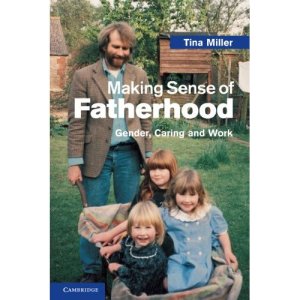
Being on the receiving end: Making sense of Fatherhood

Just in time for Christmas, a new book out on becoming a father, Making Sense of Fatherhood, by sociologist Tina Miller at Oxford Brookes, who has previously written about experiences of becoming a mother. My reason for mentioning this is personal, because I am in it. I was one of Tina’s research subjects, back in 2006 and 2007, which involved being interviewed before and after the birth of our first child. The publication of the book is timely, since we are now expecting our second just after Christmas, so it gives me an opportunity to remember what life felt like last time.

I haven’t read the book yet, so I don’t  know whether I ended up being a useful [anonymised] informant, nor what Tina has made of all the dad-talk in general. But I enjoyed the experience of being in her project, both for personal and ‘professional’ reasons. Personally, it was fun to have the opportunity to talk about what was going on way back then, and ‘Tina’ became a kind of imaginary friend in my head, who I would silently talk to as I wondered the streets of Bishopston pushing a pram for what seemed like hours on end. Professionally, it was interesting to be on the other side, as it were, to have a glimpse of the ordinariness of how lots of empirical social science gets done. I didn’t really think of it this way at the time, but it was pointed out to me the other day that my participation in Tina’s project sort of counted as ‘volunteering’. So now I am intrigued to discover if there is any work out there on how dependent social science research is on the willingness of people to be interviewed, counted, surveyed, and so on.

So, I might have more thoughts on being a research subject once I have read the book; and I’m going to look into the ‘research volunteering’ thing a little bit more too. In between all the busy, engaged parenting, obviously.

Favourite Thinkers II: Pauline Kael

Now that I live in a town almost devoid of bookshops, it’s a big occasion when I get out at the weekend and end up buying a book of any sort. Last week in Stroud, the slightly odd leftie-hippy enclave in the heart of the staunchly Tory Cotswolds, I picked up two second-hand volumes of collected reviews by Pauline Kael, the long-time film critic for The New Yorker from the late 60s through to the early 90s. I haven’t read anything by her since I was a student in the late 80s, in the days when I tended to go to the cinema on average once a day, mainly at 11pm at night. I remember liking her not least because she had a soft-spot for John Hughes-style teen movies, on the grounds that they were the only American films left which centred on questions of class.

I was primed to re-acquaint myself with Kael because earlier this year I read a great little book by Craig Seligman, Sontag and Kael: Opposites Attract Me, which compares and contrasts the styles of criticism of these two quintessential ‘New York intellectuals’, both very serious writers, both interested in ‘the popular’, but one, Kael, more than the other, managing to avoid the traps of avant-garde disdain for popular taste. Reading the essays in the two volumes I bought in Stroud, Reeling (which covers the early 70s) and When the Lights Go Down, covering the ‘golden age’ of mid and late 70s Hollywood films (although one surprise is just how many films Kael didn’t seem to review, no Chinatown, or plenty of other ‘classics’ of that time, but lots of reviews of late-period John Wayne), is proving a joy, partly because lots of these films are the films I grew up watching on TV, so there is a familiarity to them, but also because reading Kael writing about them contemporaneously, placed in their 1970s milieu of the weekly or monthly review, throws films like Westworld or Taxi Driver or Saturday Night Fever into wholly new perspective, as part of their time, sitting alongside Rooster Cogburn or The Gauntlet, as part of a contested public culture of representations of violence, sexuality, liberation, aspiration, and resentment.

What I have most enjoyed about reading Kael again is the principled populism of her criticism, expressed most clearly I think in the sense that the object of her criticism is not ‘Film’ so much as ‘the movies’, ‘movies’, or a ‘movie’. This is the privileged term of her writing, and I think it captures something quite distinctive and valuable that offsets her writing from more solidly ‘academic’ styles of film analysis. ‘Movies’ indicates an appreciation of the unavoidably populist dimension of this form of, well, popular culture – Kael’s negative judgements are always shaped by a sense of disappointment that a particular movie fails to be as good a version of the kind of movie it claims to be (in one of these pieces, she describes the latest release by a reknowned French director as probably ‘a perfect film’ but for her an ‘entirely forgettable movie’). This attitude is summed up in a great definition she gives at the start of Reeling, of the ‘maze of borderlines’ in which criticism operates: “criticism is a balancing act, trying to suggest perspectives on the emotions viewers feel, trying to increase their enjoyment of movies without insulting their susceptibilities to simple, crude pop”. This is wonderful statement of Kael’s appreciation of the visceral, sensual qualities of ‘movies’ – that they can leave us ‘reeling’ – but also of her self-understanding of her own relationship to viewers/readers. This definition of criticism strikes me now, on reading it for first time some three and a half decades after Kael penned it, as standing in very stark contrast to a style of cultural theory in which discovering the emotional or ‘affective’ dynamics of enjoyment involved in unashamedly ‘mass’ forms like the movies is still, astonishingly, presented as a politically charged act of revelation and de-mystification. Reading Kael again has reminded me of the rarity of finding academic writing about popular culture that doesn’t fall into the trap of condescending towards popular taste, and of how much of the writing and thinking about ‘culture’ I have learnt most from has not been written by academics at all, but by ‘critics’ who actually like  the cultural forms, if not every example, about which they write.

Vote early and vote often

The response to the election of Ed Miliband as new leader of the Labour Party was interesting not least because it was the occassion for various commentators to articulate their views on what counts as properly ‘democratic’. Julian Glover is The Guardian‘s resident apologist for the coalition, in the sense that he keeps writing these pieces which try to articulate the idea that the coalition reflects some sort of ‘intellectual powerhouse’ rather than, say, a political deal (what would be wrong with admitting this?). Today Glover came up with a very weak argument against equality, on the grounds that any argument which prioritises this value “overlooks the possibility that the actions needed to compel equality may be seen as unfair by those who do not benefit from them”. Er, yes, I suppose they might. This might be true of people earning lots of money who don’t want to pay higher, progressive taxes, just as it might be true of white South Africans benefitting from apartheid who might not have welcomed the onset of a new democratic dispensation. Glover goes on to claim that “An equally valid idea of a fair society may be one in which people are given the space and the right to strive for inequality: advantage achieved by their own efforts”, and then admits that this might all sound “horribly right wing“. It actually just sounds a bit dim (not much intellectual power-housing going on in this sort of argument), although it is certainly provocative to read Glover at the moment because he seems to be trying to articluate a kind of Nozickian-style hyper-individualistic take on coalition spending plans as not just unfortunate necessities but as positively welcome. Each to their own, I suppose, and Glover’s perspective does at least have the advantage of suggesting that ‘the Big Society’ idea at least has some intellectual substance to it compared to what passes as ‘orangist’ Liberal Democract thinking – it reminds one of how far the Big Society narrative departs from a fully-loaded ‘liberal’ individualism of the sort ascribed to ‘Thatcherism’, how far Cameron’s rhetoric for a long-time has been geared to transcending the burden of ‘there is no such thing as society’, and how far the Big Society is properly part of a ‘conservative’ tradition of thought with some intellectual weight.

Anyway, where was I? A few weeks ago, Glover described Ed Miliband’s victory as ‘peculiar and undemocratic’, without quite explaining why. It might have been peculiar, certainly, in so far as electoral college arrangements always generate some oddities; but the ‘undemocratic’ charge seems peculiar itself. Firstly, Ed Miliband won within the rules, of course, which no one contested. Secondly, though, the results indicate that Ed Miliband would actually have ‘won’ the election on just about any electoral system one can think of, if the ‘bias’  built into the unequal loading of the three-way division of the electoral college system between Labour MPs and MEPSs, party members, and members of affiliated organisations is lifted and one only looks at total number of individual votes casts for the Labour leader: he would have won under a first-past-the-post system counting first preferences (the system the Tory party uses); and he would have won under an alternative vote system which counted each indivual vote cast equally too (the system the Liberal Democrats use). It was only close because the votes of those individuals most likely to vote for Ed Miliband were systematically discounted in the electoral college system – quite legitimately, of course (the real issue in all this is whether one thinks trade union members should be enfranchised in this particular electoral system; and more broadly, this episode exposed the deeply undemocratic attitudes of many commentators to the position of trade unions in functioning liberal democracies).

Anyway, somehow Glover’s hyper-individualism seems connected for me with a certain sort of self-righteousness that is associated with current arguments about electoral reform, in which it is widely presumed that proportional representation is the preferred ideal against which any other alternative voting system is an unfortunate, temporary compromise. But what if PR harbours a horribly thin, de-racinated conception of political life, in which all that matters about politics is being counted as an individual bearer of opinions? There are other values worth considering, and across the spectrum from Tory (and not so Tory) worries about representing geographical communities to genuine concerns about accountability and efficiency, these seem worth acknowledging. I have always had a soft-spot for electoral geography, a much maligned field which actually has really interesting things to say about the politics of Politics, and one thing this field reminds us of is that ‘choosing an electoral system‘ is always a thoroughly interested, grubby, political act. We are about to experience, in the UK, at least 9 months of public debate about the fairness of different models of voting, and it will be interesting to see which democratic values are given most prominence as we publicy learn more about the pros and cons of different voting systems – the deafult assumption of ‘proportionality’ bundles up just some of the relevant values, certainly, but while it appears to be intuitively the most ‘fair’, it also tends to cover a series of mathematical problems which means that no purely proportional system is really possible, and might even mean that any imaginable democratic system must always contain an element of electoral dysfunction. The point of all this, I think, apart from any interest one might have in social choice theory or rationality, is that the mathematics of democracy reminds us that there is always a politcal, normative excess in any discussion of ‘fair’ procedures of the sort to which we are about to be subjected. Let’s see how much of this excess is allowed to be clearly articluated these next few months (this excess is precisely why elections are the place where the ‘the political’, in the sense this idea is conceptualised by post-structuralists like Mouffe or Ranciere, is routinely exposed and made public).

And, on a sort of related issue, there is a new podcast interview with Michael Dummett, on Frege, on philosophy bites. Dummett is one of the grand old men of English-language, Analytical philosophy, but kind of interesting despite that (!) – an anti-racist campaigner (who has reflected on the relevance or not of Frege’s anti-semitism for interpreting his philosophy), and author of an important theory of voting in precisely that same tradition mentioned above. A different model of engaged intellectual from the one we have inherited from the ‘Coninental’ tradition.

Slow Work in Progress

I have been on leave the last couple of weeks, though not quite on holiday. I’ve been decorating various rooms of our house, sanding walls, filling holes, painting. So I have been in the house for two weeks, apart from forays to Swindon’s enormous B&Q for supplies. I have ended up listening to an awful lot of radio as a result, which has become a project in itself. There is BBC Radio 6 of course, thankfully saved, but actually quite difficult to listen to all day – too much ‘mortgage indie’. Oddly, I did end up listening to 4 days of county championship cricket, an unexpectedly exciting end of season round of games – I can’t ever remember first class county cricket being broadcast on the radio, but digital radio makes is possible. I suppose, when I think of it, this wasn’t really broadcasting, not even narrowcasting, rather something like sliver-casting.

Between these delights, I have been catching up with some favourite podcasts, or experimenting with some new ones. I usually only listen to these in the car on the way to work, and over the summer haven’t really kept up the habit. I first started listening to podcasts regularly in 2008, during the US Presidential election, and it’s election time again in the US, so I have been listening to various things to keep up – Slate’s weekly Political Gabfest is fun in an anguished liberal sort of way, and there are now a couple of podcasts which provide regular highlights from progressive/liberal radio and TV in the US – the Best of the Left podcast, and Democracy Now! I have also discovered Stephanie Miller, who is a bit like John Stewart on speed, without the pretence of exasperated moderation. More soberly, The New Yorker has a great weekly podcast The Political Scene, and The Nation’s Chris Hayes has a regular podcast The Breakdown. These provide my sources for up to date analysis of the currently ever more bizarre world of US politics. There isn’t anything I know of which does the same sort of thing in the UK – The Guardian’s Politics Weekly is very good, but in general this medium of public debate doesn’t seem well developed in the UK. Maybe because we don’t have a madly partisan media scene. Yet.

These sorts of podcasts work well because they have a regular rhythm to them, updated daily or weekly, and none of them is too long – an hour or so at most, for the ‘magazine’ style podcasts. The other podcasts I have been listening to these last couple of weeks, and which I sometimes listen to in the car, are more resolutely academic. I feel I should listen to these ones more often than I do, but actually after two weeks of trying, I have decided that many of them do not really suit the ‘medium’ of the podcast as well as they might. There are some exceptions, but these prove the rule – Philosophy Bites, which consists of short, 15 minutes or so of interviews with philosophers talking big philosophy – Pat Churchland on ‘eliminative materialism’ , Galen Strawson on conceptions of the self. Nigel Warburton and David Edmonds, who host Philosophy Bites,  have an interesting podcast about podcasting here. The OU also has a great list of podcasts, some of which are bespoke course materials, some of which are ready-made for iTunesU. These shows work because they are relatively short, and often take the form of the interview or round-table discussion. There are some longer ones – Canadian educational broadcaster TVO has Big Ideas, which seems to be mainly lectures by academics – I listened this week to a great talk by the late Gerry Cohen, using Olivia Newton-John to elaborate on his distinctively radical understanding of conserving existing values, and Toby Miller laying out a great agenda for studying the environmental impacts of cultural practices. Australian public radio has The Philosopher’s Zone, which is more interview based. And Julian Baggini, editor of The Philosopher’s Magazine, has a magazine style monthly podcast as well.

These podcasts all work well. I’m not so sure about all of the stuff you can access on iTunes mind. Lots of the content available on iTunesU seems to be there for promotional or recruitment purposes, without a lot of thought being put in to making material interesting. The OU has a big presence on iTunesU [I’m even on it], but this material is well produced with an eye to the nature of the medium being used. On the other hand, while you can download lots of famous people talking and lecturing from UC Berkeley or Oxford, much of this material is just recordings of seminars or lectures, which means that you don’t get the benefit of any visual aids people might be using, and the overall lesson I learnt from two weeks of trying to listen to these sorts of podcasts was that the academic lecture, as a communication form, really is pretty dysfunctional.

One of the first things I listened to over the course of my two weeks of decorating was David Byrne on TEDTalks, reflecting on how far different styles of music are generated in symbiotic relationship with the architectural spaces of performance, recording, and listening. I think you might extend the same sort of idea to thinking about how well different styles of talk-heavy analysis – of news, cinema, or philosophical concepts – translate to platforms that are beyond-radio, as it were. Lectures work in so far as they literally have a captive and immobile audience. But the academic podcasts which work are shorter, less analytical, and tend to work more as ‘tasters’ than substitutes for reading – they are better attuned to the spaces and rhythms in which one might find oneself listening to them, in the car, or standing on a ladder with a paint brush in your hand.

Back to work now – writing/reading/thinking work, that is, not painting/listening work.